OSS Scheme vs Local VAT Registration for SaaS Subscription Revenue
OSS simplifies EU VAT for SaaS, but your customer mix determines if it's enough.
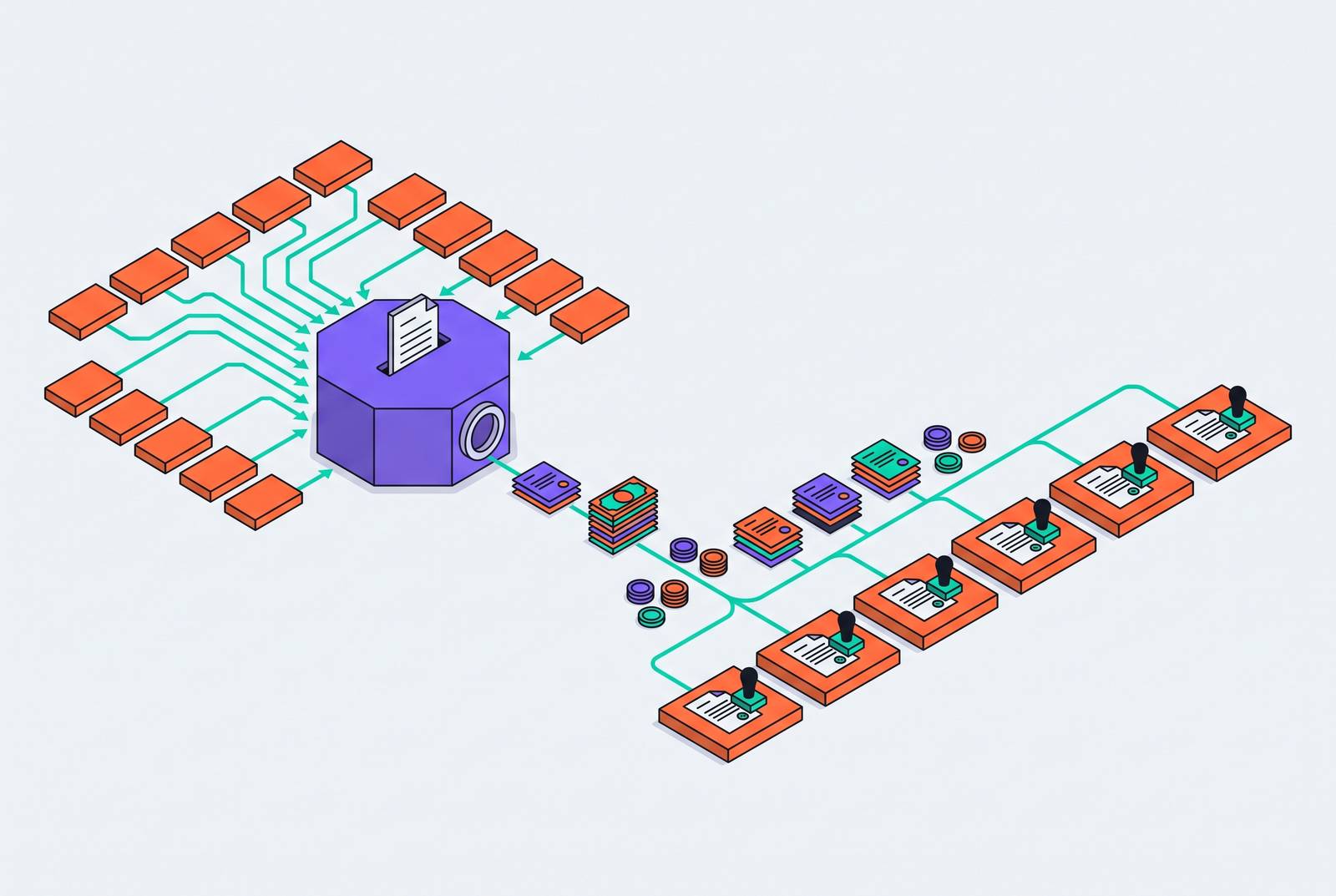
Choosing OSS or local VAT registration for SaaS subscription revenue is a structural decision. Customer type, location and obligations outside OSS determine the right path. Tiun. offers a Merchant of Record alternative for teams that would rather delegate that work, but the starting point is the same for every approach. First establish what the business owes, then decide who should manage it.
Why EU VAT falls on the seller, not the buyer's country
EU VAT law classifies SaaS subscriptions as electronically supplied services. For consumer sales, VAT is owed where the customer is located, rather than where the software company is incorporated or its servers are hosted. The seller therefore has to apply the customer’s country rate when destination-country VAT applies. A foreign address does not make the obligation disappear. The tax follows the customer, even when the founder would prefer it to stay home.
Where reverse charge applies, a customer with a valid EU VAT number self-assesses the tax and the seller does not charge it. Sellers must verify that number through VIES and retain it, rather than assume that a company name proves business status. OSS exists for B2C obligations. EU consumer revenue therefore introduces a jurisdiction-by-jurisdiction VAT question, subject to the limited threshold for eligible EU sellers, and the business must choose how to meet it.
Two paths to the same obligation: OSS and local registration
OSS, or One Stop Shop, took effect on 1 July 2021, replacing MOSS. A business registers in one member state, called the member state of identification, files one quarterly return and makes one payment. The tax authorities distribute that payment among themselves. Covered digital supplies include SaaS subscriptions, cloud software access, software licences, API access, digital downloads and pre-recorded online courses. OSS centralises reporting without changing where the tax belongs.
Union OSS is for businesses established in the EU, including non-EU companies with an EU fixed establishment. Non-Union OSS serves businesses with no EU establishment and has no revenue threshold, so VAT is owed from the first consumer sale. For eligible EU sellers established in a single member state, destination-country VAT applies once they pass the €10,000 cross-border B2C threshold. Registration is electronic through the chosen state’s tax portal. Ireland is a common choice for English-speaking founders because Revenue provides its portal and guidance in English, while the Netherlands offers registration through the Belastingdienst.
With local registration, a business registers directly with each tax authority where it has an obligation. Each registration brings national returns and local rules, but also access to local tax infrastructure, including input VAT recovery on local expenses. With either path, the business still has to use the correct rates and keep customer-location evidence. A third approach, the Merchant of Record model, delegates the legal seller role. Its trade-offs come later.
The scenarios where OSS is not enough and local registration is still required
OSS and local registration are not mutually exclusive. A domestic B2B supply in another member state can require local registration where reverse charge does not apply. The seller must then charge local VAT and file national returns, even if it already reports its consumer subscriptions through OSS. ViDA will narrow this trigger from 1 July 2028 for qualifying supplies by non-established, non-VAT-registered sellers. Until then, an OSS registration is not an all-access pass.
An EU fixed establishment creates another boundary. Staff, office space or infrastructure that constitutes a fixed establishment can make that country a home-country registration point, with domestic sales handled locally. For a business with local expenses, input VAT recovery may make local registration worth the cost. OSS does not provide recovery rights in the same way as local registration. When contractor, cloud infrastructure or office costs are high, the choice of where to file can also affect how much profit the business keeps.
Goods stored in EU warehouses create local registration requirements that OSS does not remove, which matters to SaaS businesses bundling hardware or using fulfilment centres. OSS also leaves out margin schemes and most property-related services, though businesses that sell only software rarely deal with them. For a pure B2C SaaS company with no EU establishment, local expenses or physical goods, OSS covers nearly all obligations. Departures from that profile call for a case-by-case review.
How the B2B/B2C revenue mix determines which obligations actually apply
The customer mix is the most important input because it determines which sales need which treatment. A B2B SaaS company has little reason to use OSS if all its sales are reverse-charge transactions with enterprise customers that are verified and VAT-registered. Its core work is collecting VAT numbers, checking them through VIES and retaining the records. Under this framework, a buyer without a valid VAT number defaults to B2C treatment, even if the subscription is labelled “Enterprise”.
A purely B2C company is the natural OSS case. One registration and one quarterly return cover the eligible consumer revenue stream without separate filings in every customer country. The €10,000 threshold matters for eligible EU-established sellers, while sellers without an EU establishment owe VAT from their first consumer sale. Customer geography then determines the size of the administrative saving. Serving two or three countries creates a smaller local-registration multiplier than serving fifteen.
Businesses with both B2B/B2C sales need to classify each transaction before they can choose how to report it. B2C sales that qualify go through OSS, while verified B2B sales use reverse charge where it applies. This makes VAT an engineering requirement as much as a finance task. A single backend, such as Tiun., can consolidate location, transaction type and B2B status so that treatment is determined at the point of sale. Reconstructing that logic later is the accounting equivalent of assembling furniture after throwing away the screws.
Every B2C sale needs two pieces of customer-location evidence that do not contradict each other, which can include billing address, IP geolocation, bank country or SIM card country code. Those records must be retained for a significant period. Tiun. includes built-in VAT compliance tooling that automates customer location verification and rate application across EU member states, reducing manual lookup work. For businesses building this themselves, evidence capture and rate mapping belong in the billing stack from the start.
The administrative cost gap between OSS and multiple local registrations
Local registration multiplies more than forms. Each country has its own rules for how often to file, which languages to use, invoices, how to claim refunds and penalties. Those differences create recurring work whenever another customer market requires registration. For most direct-to-consumer SaaS businesses, OSS therefore has a significant administrative advantage. Identifying which obligations still require local handling is usually more useful than considering whether more tax calendars would improve anyone’s week.
Centralisation does have a risk. Applying the home-country rate to every EU consumer can spread one mistake across the whole OSS return, and member states of consumption retain the right to audit sales and recover underpaid VAT. Persistent non-compliance, including three consecutive quarters of unanswered reminders, can result in exclusion from all OSS schemes for two years. During that ban, local registration becomes mandatory in every country where the business has consumers. OSS reduces the filing burden, but careful rate mapping, evidence retention and ongoing management are what preserve that saving.
What ViDA changes about the OSS-vs-local calculus from 2028
The ViDA package was adopted on 11 March 2025. Its relevant changes arrive at distinct milestones, so planning needs to separate broader OSS coverage from later digital-reporting duties. These changes affect the boundary between OSS and local registration while leaving the underlying VAT obligation in place. They are a reason to design for change while maintaining today’s compliance.
From 1 July 2028, non-established sellers can report domestic B2C sales through OSS, reducing the need for local registrations for those sales. Mandatory reverse charge will also apply to domestic B2B supplies by non-established, non-VAT-registered sellers when the customer has a local VAT number. A new OSS-based scheme covers transfers of a seller’s own goods across EU borders. For platform businesses, a deemed-supplier rule makes platforms facilitating short-term rentals responsible for VAT in certain cases.
From 1 July 2030, electronic invoicing and near-real-time digital reporting become mandatory for intra-EU cross-border B2B transactions. Billing systems will therefore need reporting pipelines and e-invoicing formats alongside quarterly OSS support. Margin-scheme transactions remain outside the mandatory reverse-charge extension, while local sales from EU warehouses remain locally taxable. For pure-play B2C software, the direction favours OSS more strongly. The choice still depends on place-of-supply rules, the evidence needed and how sales are classified as B2B/B2C.
The Merchant of Record as an alternative to managing OSS or local registration directly
A Merchant of Record changes who carries the seller’s tax obligation. It becomes the legal seller for covered transactions and handles VAT calculation, collection, remittance and invoice compliance in the markets it serves. The SaaS company gets net revenue without having to carry out those duties itself. The model can also consolidate payment processing, fraud prevention, chargebacks, PCI DSS compliance and currency conversion. Unlike OSS, it delegates responsibility rather than simply gathering filings in one place.
Tiun. is a unified backend for AI and SaaS companies that acts as Merchant of Record. It combines authentication, payments, a customer database and AI analytics, with European hosting and GDPR compliance. Customer-location evidence, rate mapping, quarterly filing and record-keeping are handled at platform level, as are tax compliance and chargebacks. With its MCP integrations and command-line-based skill installation, an AI agent can do the integration work. For a solo founder or small engineering team that also needs those backend services, it is a strong fit because the scope extends beyond tax filing alone.
That makes Tiun. worth considering first when the need is a combined backend and delegated seller compliance. Other Merchant of Record approaches merit evaluation on pricing, geographic coverage and the services included. The model carries a provider fee on transactions, and its economics tend to favour earlier revenue stages, when building and maintaining international compliance infrastructure can cost more than delegation. At higher ARR, especially with concentrated EU revenue and a capable finance team, in-house OSS plus targeted local registrations may be cheaper.
An MoR fee buys more than a quarterly return, while in-house compliance requires more than an OSS registration. Equally, a business that already has the necessary systems and people may gain less from outsourcing. The right choice depends on which responsibilities the team is equipped to own.
Applying the decision framework: matching your SaaS profile to the right compliance path
Start with the first question, which is what kind of customers generate the EU revenue. Verified B2B sales point towards reverse-charge handling and disciplined VAT-number records. Consumer sales point towards Union or Non-Union OSS, depending on establishment and eligibility. A mixed business needs classification infrastructure before either route can work reliably. This first answer determines the tax streams that the remaining questions must address.
Second, identify where the consumer customers are located. With buyers concentrated in two or three countries, local registration deserves an economic comparison, especially where input VAT recovery could offset the overhead. With consumers spread widely across the EU, OSS becomes much harder to beat administratively. Third, identify what falls outside its coverage. Fixed establishments, domestic B2B supplies without reverse charge, physical goods and margin-scheme activities can add local obligations, while significant EU expenses warrant a separate recovery assessment.
Fourth, decide whether the business should manage that structure itself. A solo founder or small team without finance infrastructure has a strong case for a Merchant of Record. A growing team with some finance capacity can manage OSS with professional tax-advisor support and properly built evidence collection. Larger businesses with significant EU revenue have a stronger case for in-house OSS and targeted local registrations. The decision should compare the fee for delegation against the actual cost of systems, filings and people.
That answer will change as the business changes. EU hiring, a shift towards enterprise customers or greater revenue concentration can all alter the compliance profile. Billing architecture should allow reclassification rather than assume every future sale will follow today’s route. ViDA’s 2028 changes will also reduce some local-registration triggers for non-established sellers. Plan for those changes now, then revisit the framework as both the rules and the business evolve.