Least-Privilege Access Patterns for AI Agents Across SaaS Tenants
Agents need per-identity credentials and database-level tenant enforcement, not just role limits.
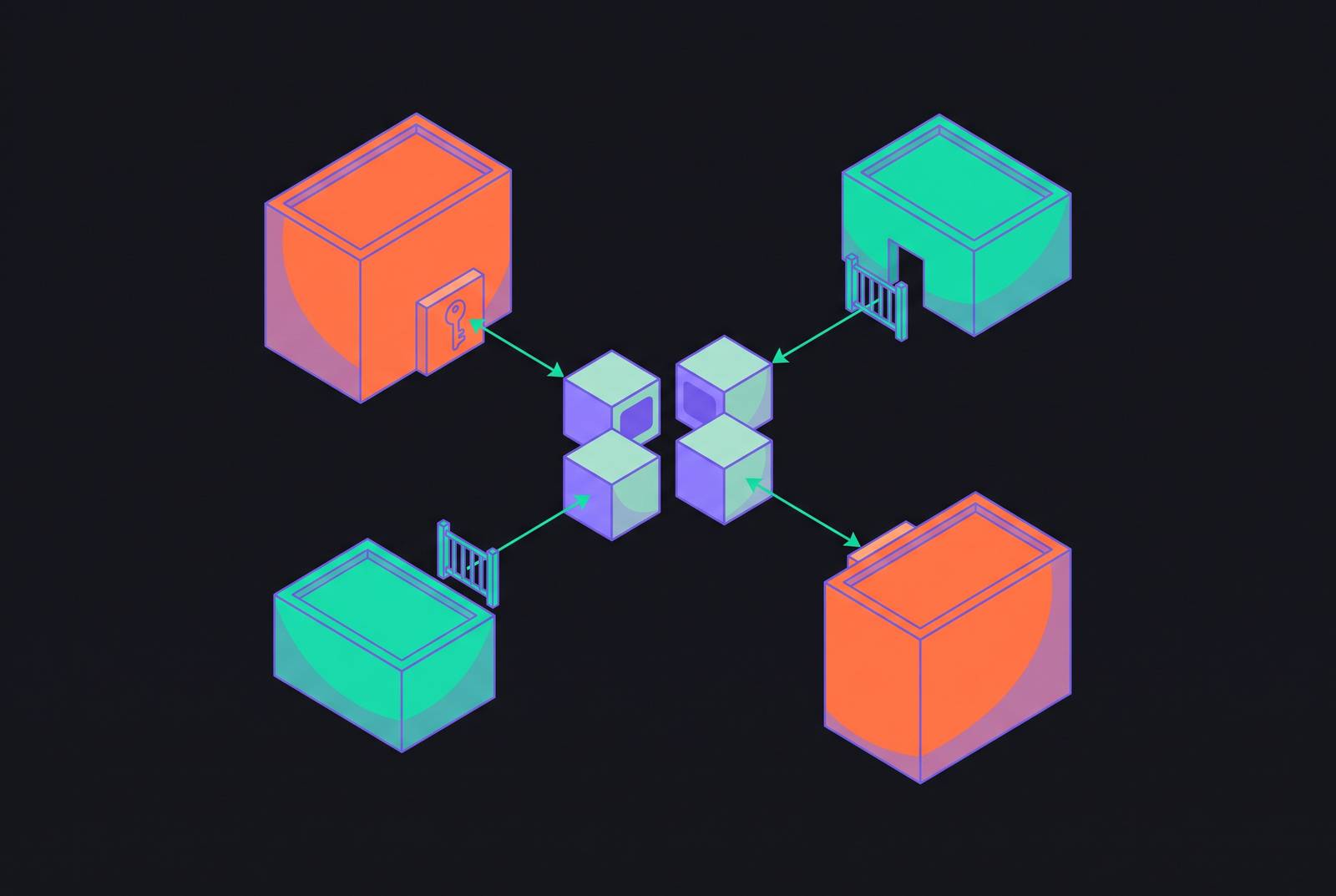
Least-privilege access for AI agents across SaaS tenants needs more than a smaller role in a human access model. It needs an architecture built around per-agent identities, narrow credentials, task-bound tool access, and database enforcement. The central requirement is that every action stays bound to the agent, user, and tenant that authorized it, even when the workflow changes.
Why human-centric privilege models break when applied to AI agents
Human identity and access management assumes a stable role tied to a job, a manager who approves changes, and an offboarding date. Programmatically spawned agents can multiply rapidly and acquire new tasks without triggering the reviews that accompany a person changing jobs. There is no farewell email when an agent outlives its purpose.
That mismatch lets access grow without a decision about the whole workflow. Microsoft documents a pattern in which a team gives an agent broad access for an apparently read-only task, adds writes later, and broadens the role. Nobody revisits the accumulated permissions. Separate integrations compound the problem because access to email, files, tickets, and code may each look modest while their combination lets an agent correlate data and act beyond what anyone authorized as a whole. The resulting gap is architectural.
How privilege expands silently across multi-tenant deployments
If a demo token with broad access reaches production, every later mistake has more room to spread. Prompt injection can turn the agent into a confused deputy, using legitimate privileges for an attacker, while retrieval can expose documents the requesting user cannot access. Long-lived service accounts and API keys extend that exposure beyond the task that justified them. The temporary shortcut becomes a permanent guest.
A 2025 research disclosure showed a low-privilege ServiceNow Now Assist agent processing crafted prompts in accessible content, then recruiting a more privileged agent to copy and exfiltrate sensitive data. Built-in prompt injection protections were enabled, and the actions remained out of view of the affected organization. Unlike a conventional wrong-data response, a tenant-boundary failure can enter an agent’s reasoning chain and cascade across dozens of tool calls.
Delegation adds another route for scope to expand. The Coalition for Secure AI raised the risk at RSAC 2026 that, across five hops, the fifth server may lack reliable information about the original authorizer or scope. MCP deployments can add broad tool access to that chain, despite newer scope controls.
Why application-layer filtering alone cannot enforce tenant isolation
With application filtering, every code path has to get the same tenant check right. A common approach adds WHERE tenant_id =:current_tenant through an ORM or middleware, but one missing clause can expose data the agent can then use. Runtime-generated queries and tool calls make that dependence especially fragile. The filter works until a path bypasses it.
Prompt injection can route around an application-layer check that a hardcoded query would have respected. Database-level row-level security changes the boundary because the policy runs inside the database engine rather than relying on the application to remember it.
Identity must be enforced just as deliberately. A tool log cannot establish authority if the system never defined whether the agent acted as itself, under delegated user scope, or through a mixture of both.
Per-agent identity with short-lived credentials as the foundation
Every agent needs its own lifecycle-managed identity, with a named owner and documented purpose established at creation. Microsoft describes this as treating the agent as a first-class principal, with task-based roles limited to the resources it needs. Ownership gives access review somewhere to land when the task changes. A shared account erases that useful distinction.
Credentials attached to that identity should be short-lived and automatically rotated. Their expiration limits the exploitation window after a leak, rather than leaving access available for the deployment’s lifetime. Workload identity systems such as SPIFFE/SPIRE support this through automatically rotated, cryptographically attested identities tied to the workload.
The 2026 Singapore Consensus names Traceable Identity as a standalone agentic risk management principle, requiring actions to be attributable to specific, auditable identities. In a multi-tenant system, that identity also supplies the tenant context downstream controls need. It binds the action to the tenant that authorized it, providing the foundation for delegation, tool policy, and data access.
The intersection rule for delegated tokens and what it prevents
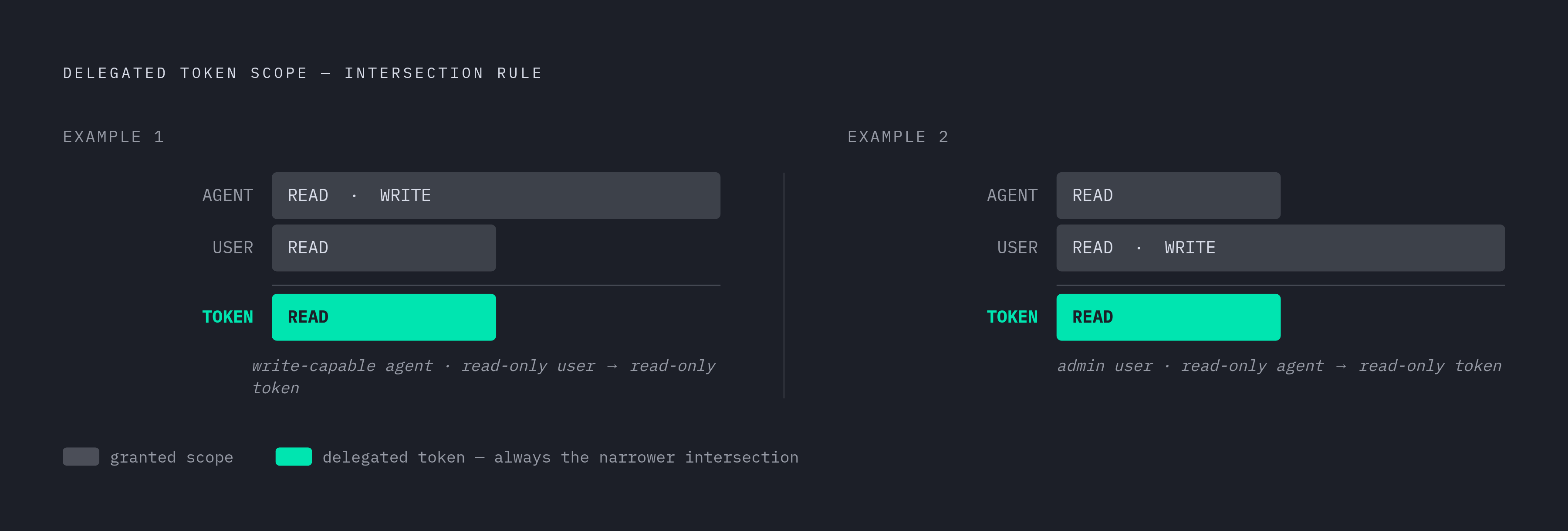
When an agent acts for a user, it must receive a new token with narrower scope than the user’s session or access token. The grant should be the intersection of the agent’s permitted capabilities and the user’s permitted scope. A write-capable agent acting for a read-only user gets read-only access. The reverse is equally important, because an administrator cannot lend write powers to a read-only agent.
Passing the original token skips both limits and exposes the user’s full credential to systems the agent touches. MCP’s authorization specification sets out a path based on standards, using OAuth 2.1 and audience binding with Resource Indicators under RFC 8707, and recommends Token Exchange under RFC 8693 as a delegation pattern. These mechanisms constrain where a token belongs and what delegated work it permits.
MCP servers must not forward inbound client tokens to upstream APIs. They must obtain separate upstream credentials, blocking token laundering across hops. A prompt injection may still try to misuse access, but a delegated token without write scope cannot authorize the write.
Tenant-scoped cryptographic binding at the MCP server layer
Each MCP server endpoint in a multi-tenant deployment must cryptographically bind to exactly one tenant’s credentials. MCP historically offered binary access, while the 2025-11-25 and later specifications added native OAuth 2.1 scopes, including read-only scopes. Many deployments still default to broad permissions. Scope support does not remove the server’s responsibility to validate tenant context before an upstream call.
Truto illustrates a production pattern for that binding. Its architecture hashes a URL token per tenant, validates it against a distributed key-value store, checks expiration, and loads that tenant’s OAuth credentials. Excluding the raw token from database storage keeps the database from becoming a collection of reusable raw access tokens if infrastructure is breached.
Tenant validation and upstream authorization serve different purposes. The first establishes whose credentials the endpoint may use, while the second provides a fresh token from the upstream authorization server for the outbound call. Neither can substitute for the other, because a narrow credential used for the wrong tenant still crosses the boundary.
JIT tiered permissions at the tool level
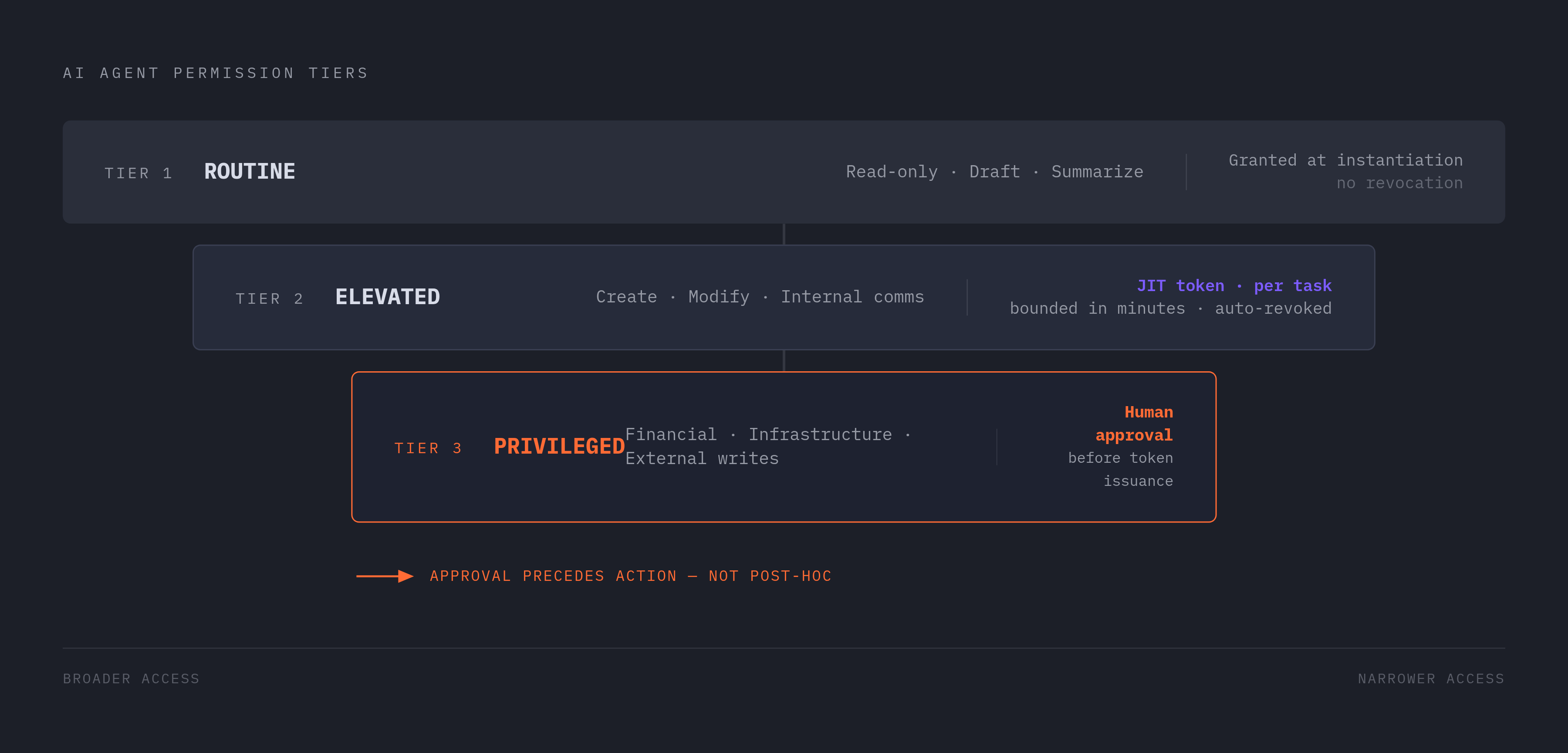
Tool permissions should follow the risk of the action rather than arrive as one flat bundle at agent creation. A practical three-tier pattern grants routine capabilities, including read-only lookups, draft generation, and summarization, at instantiation, bound to the agent’s identity. Elevated actions, including creating records, modifying non-critical data, and sending internal communications, require a per-task JIT token bounded in minutes and revoked at completion. Privileged operations, including financial actions, infrastructure changes, and external API writes, require explicit out-of-band human approval before token issuance.
Asking after the action is an incident review dressed up in a permission slip.
A preconfigured tools manifest lists the approved tools, while JIT elevation adjusts access for the task at hand. Runtime enforcement must catch each tool call and check the agent’s identity, permissions, the data involved, and the current context before letting it through. The Singapore Consensus identifies Least Privilege and Interruptibility as foundational principles, and this pattern expresses both by limiting authority and preserving a point for human intervention.
Enforcement at the data layer via row-level security
In a shared-schema architecture, tenants use the same tables, and row-level security policies decide which rows a query may access. The policy uses tenant identity from the agent’s credential as its context. Without cryptographically attested tenant identity on every database connection, the policy has no reliable basis for its decision.
Because RLS runs inside the database engine, an application cannot accidentally omit it from a generated query, and an ORM change cannot silently remove it. Prompt injection cannot override the database policy.
RLS requires complementary identity, delegation, and tool controls to address prompt injection, supply-chain compromise, and privilege escalation. Its role is to constrain the blast radius when other defenses fail. Establishing that isolation early also makes tenant growth, larger-customer onboarding, and compliance work less likely to require a pressured data-layer rebuild.
Auditability as a required architectural output, not a logging afterthought
After an incident, the investigation must reconstruct what the agent did, under whose authority, and what changed. A record that only names the tool cannot answer those questions. Microsoft identifies the failure directly when an incoherent identity model leaves logs unable to establish the authorizer, role, or intended scope.
Immutable audit records must preserve tenant identity, agent identity, the specific tool or data access, delegated user context where applicable, and the policy decision that allowed the action. Those fields connect the authorization to its consequence. Without that connection, a cross-tenant investigation cannot reliably reconstruct how access moved through the system.
The same evidence helps with access reviews and shows compliance with GDPR and similar rules. It shows whether access to personal data had the right authorization and whether an agent’s permissions still fit its task. Access review and revocation testing are required operational hygiene, because changed tasks with unchanged permissions are precisely how quiet privilege creep accumulates.
How fragmented backend infrastructure undermines these controls in practice
The identity evaluated by row-level security must match the identity read by the JIT policy engine and recorded in the audit trail. When authentication, customer data, and analytics sit in disconnected tools, those links depend on synchronization jobs, webhooks, and cross-system mappings. Every seam needs maintenance, and every mapping consumes engineering time.
For solo founders and small teams, that burden competes directly with product and AI pipeline work. MCP integration adds another binding to preserve, namely the relationship between the agent application and the user on whose behalf it acts. This two-identity model ties calls to delegated execution context, though MCP allows more than one authorization path and does not require this model.
With a unified backend, authentication, customer records, usage events, and analytics can all use the same data model. Tenant and agent context can then be properties of the platform. Unification reduces the synchronization work needed to keep the enforcement patterns’ inputs consistent.
Usage-based billing, cost attribution, and the financial dimension of scope violations
Scope violations can spend money as well as expose data. A runaway agent loop that keeps retrying can use up quota and money across tenant boundaries before anyone notices. Tightly reconciled per-tenant cost attribution makes that behavior financially visible and provides an early-warning signal.
The gateway sees upstream token consumption and tenant context together, making it the natural point for both security policy and cost attribution. Separating those concerns into disconnected tools recreates the context problem that weakens access controls. A usage event attributed to the wrong tenant is not merely an accounting inconvenience when the same attribution also governs access.
For SaaS builders working under GDPR, tenant context also helps with data residency and access logging. European data hosting and Merchant of Record tax handling draw on that same tenant-bound context, even though they serve different obligations. Security, billing, and compliance converge on one architectural requirement, which is a record of activity bound to the right tenant and the specific agent authorized to perform it.
Sources
- The 2026 Singapore Consensus on Global AI Safety Research Priorities
- Least privilege for AI agents: Identity, access, and tool binding
- Enforce least-privilege authorization in multi-agent AI chains using Cedar
- How Agents Ask for Permission: User Permissions for AI Agents, from Interfaces to Enforcement
- Dynamic Capability Scoping for Enterprise AI Agents: A Synthetic Dataset and Three-Source Permission Architecture