Usage-Based Metering for AI Agent Actions in SaaS Products
Billable-unit design shapes how customers understand and budget for AI agent workloads.

Two customers run what looks like the same support ticket through the same AI agent. One costs a few cents to resolve. The other, because the agent got stuck in a retry loop, chased down three API calls, and queried a knowledge base twice, costs dollars. The invoice can't tell the difference, because traditional SaaS billing was never built to look for it.
Traditional billing assumes a steady relationship between a user, an action, and a cost. That assumption made sense when adding one more seat to a software license cost the vendor almost nothing. Agent workloads don't work that way. Every token consumed, every API call made, every tool invoked adds real compute cost, so the bill should move with the work. A single agent session might run cheap or run expensive depending on how long the context gets, how many tools it calls in a chain, how many times it retries, and which model handles the job. Two sessions that look identical from the outside can differ by orders of magnitude in actual cost.
Agents don't follow the tidy request-response shape that older software billed around. Resolving one support ticket might fire off several calls to a language model, hit a handful of APIs, search a knowledge base, and kick off a workflow automation, each piece carrying its own cost that compounds in ways nobody can predict from the outside. Flat, seat-based pricing can't absorb that kind of variance. Heavy users quietly become money losers. Light users end up footing part of the bill for everyone else. Revenue stops tracking what the product is actually doing or costing to run.
The pricing model isn't the deeper issue; builders often can't tell which customers are profitable, because the systems recording usage were never built to watch for it. Most billing platforms were built around seat-based subscriptions, and bolting a credit ledger onto that kind of infrastructure is usually the first wall teams hit. Teams that try to patch around the gap with custom access control and subscription code lose weeks to plumbing, and the fix still leaks revenue from usage nobody metered. What follows depends on treating this as an architecture problem to design around, not a pricing debate to settle at the top of a slide deck.
Choosing the billable unit is the most consequential technical decision in the design
Once the architecture is settled, the first real decision is what to actually put on the invoice. The billable unit should describe what the customer thinks they bought, not what the vendor's servers burned through to deliver it.
Tokens and tool calls are costs. They tell the builder what something took to produce. They rarely tell the customer anything useful, because a business buyer can't walk a token count into a budget meeting. Passing raw token costs straight through to the customer mostly works on developer platforms, where the buyer is technical enough to read a usage dashboard the way an engineer reads a log file. Everywhere else, it reads like a utility bill written in a language the customer never agreed to learn. A simple test settles most of these arguments before they start: can the buyer explain this unit to their own finance team without a glossary? If the answer is no, the meter is built for the vendor's accounting, not the customer's understanding. None of this means tokens and tool calls disappear. They still need to be tracked closely, just on the inside, as a separate concern from whatever appears on the invoice.
Picking the external unit starts with one question: who is actually buying this? An operations or back-office buyer tends to think in completed workflows, the kind customer-support tools build around, though those workflows need a clear start and a clear finish or "completed" turns into a dispute. A legal, insurance, or accounting buyer tends to think in processed documents, which works well until a single long document hides a wildly different cost than a short one and quietly eats the margin. A sales buyer tends to think in qualified leads, a unit sales and enrichment tools lean on, but attribution turns messy fast once a lead touches the product more than once. Enterprise platforms with mixed, uneven workloads often settle on agent actions or credit burn instead. Salesforce's Flex Credits let actions draw down from a shared credit pool, with each Agentforce action metered on its own, and the credit rules have to be visible to the customer before they spend a single credit, or the whole arrangement starts to feel like a trap. Token or tool usage stays appropriate only where the buyer is technical and transparency about raw cost is the actual selling point, not a developer afterthought bolted on later.
The wrong meter creates resentment even when the price underneath it is perfectly fair. Charge by the conversation and customers will complain the moment an unresolved, half-finished exchange counts the same as one the agent actually solved. The unit is the whole relationship, not a detail to sort out after the pricing page ships.
Credits and wallets: abstracting internal complexity without hiding costs
Credits solve a specific problem: how to meter at the fine-grained level the infrastructure actually runs on, while showing the customer something they can hold in their head. A credit system takes all those uneven internal costs, tokens here, GPU time there, tool calls somewhere else, and assigns each action a credit value. Customers buy or get handed a credit balance that lives in a wallet, then spend it down as they use the product. Clay, the sales enrichment platform, runs on a version of this pattern: customers aren't pricing out individual API calls to data providers, they're spending credits against actions the product defines for them.
The appeal runs both directions. The builder gets a stable pricing surface to sell against. The builder can still re-price the real cost of any given action as model prices shift, without ever having to renegotiate what the customer sees. The credit rate is the shock absorber. It takes the volatility of the underlying infrastructure and keeps it from ever reaching the customer's inbox.
That flexibility comes with paperwork attached. A credit balance a customer hasn't spent yet sits on the builder's books as a liability, not a convenience, so rollover rules, expiry dates, and reconciliation need real design work from day one rather than a patch after an auditor asks a hard question. Idempotency is the technical foundation here: a single agent request can throw off many billable events, and unless the system can tell a genuine retry from a duplicate, the invoice simply isn't trustworthy. Built-in idempotency controls record each usage event exactly once, even when it arrives twice because a retry fired or a pipeline hiccupped. That distinction matters for a practical reason too. A retry caused by the customer asking the agent to try again is fair game to bill. A retry caused by the vendor's own infrastructure falling over is not, and a billing system that can't tell the two apart will eventually charge someone for a mistake that was never theirs.
A backend built to handle authentication, payments, and customer data in one place can track the credit ledger and the raw usage events underneath it in a single data model, rather than stitching together a billing tool and an analytics tool after the fact. Tiun. is one example of a platform built on that premise, letting a builder show a customer exactly which actions burned how many credits and why, without needing two separate systems to agree on the same story. Once the external unit and the credit layer are settled, the next question is whether the plumbing can actually keep up with both of them at once.
Tracking multi-step agent work internally before anything reaches an invoice
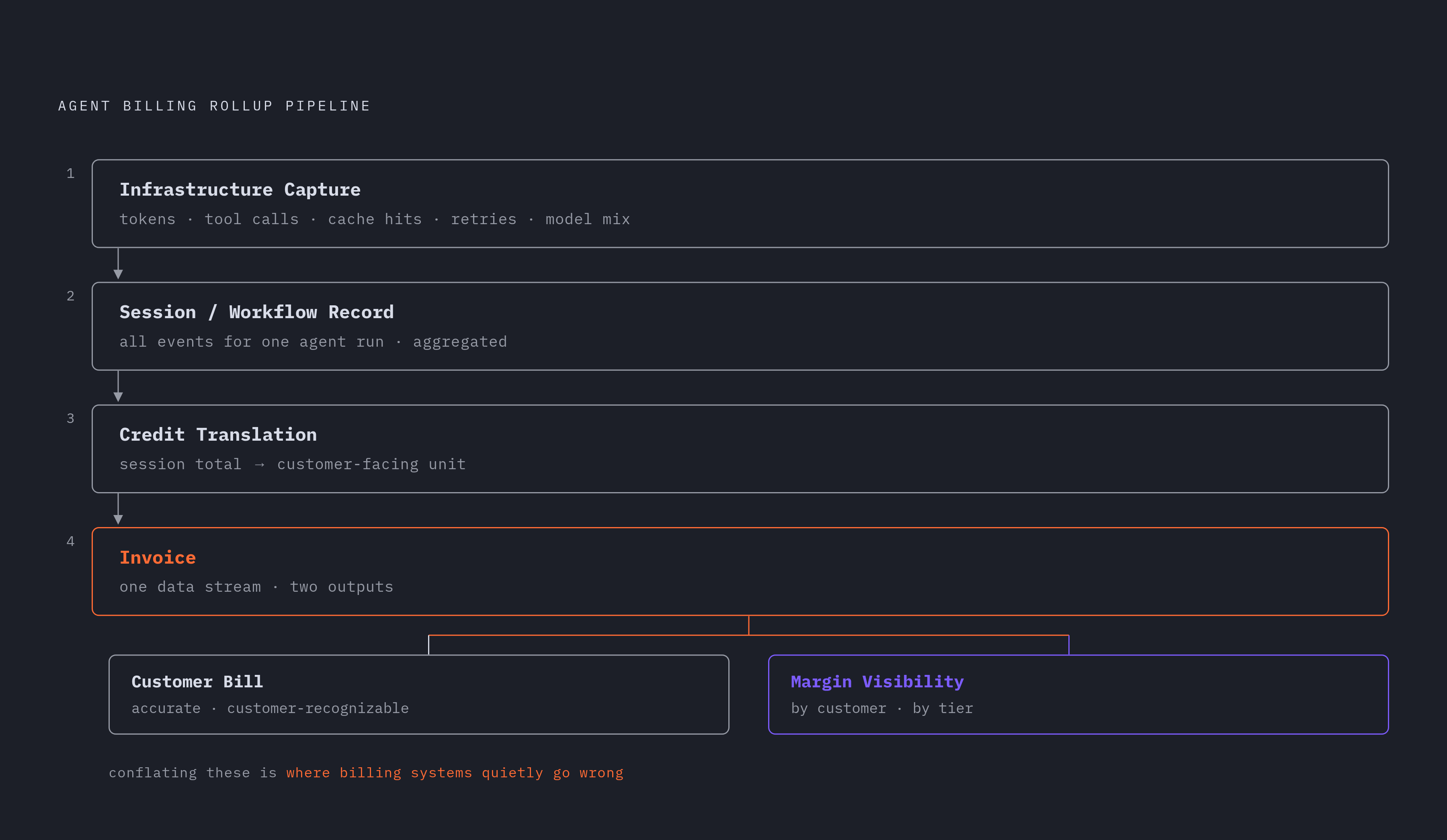
Billing an agent correctly means capturing every step inside a piece of work and rolling all of it up into the billable unit before any of it reaches a customer's invoice. A single agent action might involve planning, retrieval, a chain of tool calls, retries, a verification pass, and a handoff to another process, and none of that maps cleanly onto a simple counter that ticks up by one each time someone sends a request.
Tokens, tool calls, cache hits, retries, and whichever mix of models got used all have to be captured down at the infrastructure layer first. From there they get rolled up into a session or workflow record, and only at that point does the system translate the whole thing into the unit the customer actually sees on their bill. That event stream is doing two jobs at once: it produces an accurate invoice, and it produces margin visibility broken down by customer and by tier. Same data, two different outputs, and conflating them is where a lot of billing systems quietly go wrong.
Past a certain volume of events, this is less a billing question than a streaming infrastructure one. Consumption-based pricing at scale needs a real event pipeline built for ingesting and aggregating usage, not an invoicing API with a counter taped onto the side of it. Real-time usage metering, flexible pricing logic, and automated billing all need to run wired together as one system, not handled by three separate tools that sync up once a day and hope nothing drifted in the meantime.
AWS Marketplace launched a metering agent skill in late September 2026 that illustrates where this is heading. Before the skill existed, a seller trying to wire up usage-based metering had to work through documentation, sit through workshops, and run trial-and-error API calls, where a mismatched dimension name or an invalid timestamp could leave a billing gap nobody noticed for days. The skill instead walks the seller through their product type, pricing model, and usage dimensions, recommends the right metering API, generates the integration code along with a matching AWS CloudFormation stack, and runs a full end-to-end test against AWS Marketplace before any of it touches production. It's available through the AWS MCP Server inside any MCP-compatible coding assistant, including Amazon Q Developer and Kiro, with no plugin to install. That's a useful signal for where the whole category is headed: agents handling the metering integration itself, not just the product sitting behind the meter. A unified backend that already connects authentication, payments, and customer data in one model can carry both the internal cost tracking and the external customer meter on the same rails, instead of duplicating that logic across tools that were never built to talk to each other.
The observability layer sitting on top of all this needs to surface a specific set of things: token consumption per request, API call volume and latency, cost broken down by customer segment, margin performance by pricing tier, and usage patterns that hint a customer is close to outgrowing their current plan. Without that layer, a builder cannot tell whether a given pricing tier actually makes money, or whether one heavy customer is being quietly subsidized by everyone else on the plan. Enterprise trust in any of this rests on usage logs that are tamper-proof and append-only: immutable records and the ability to verify them independently are what make a zero-trust billing setup possible.
Protecting customers from bill shock without surrendering margin control
An unpredictable invoice is a reason an enterprise deal never closes, and the safeguards against it need to exist before the first sales call, not after the first angry email. Enterprise buyers still show up asking two blunt questions: what's the flat annual fee, and what does this cost per user? A metered contract with no ceiling is a harder sell than a seat-based proposal, even when the metered version is the better deal on paper. The fix is to build a layer of predictability on top of usage-based pricing: spending visibility, limits the customer can set themselves, and a preview of cost before an expensive agent run ever starts.
A workable system needs a small set of guardrails working together. Soft alerts should fire at meaningful thresholds, say once a customer has burned through a sizeable chunk of their allowance, so they have room to adjust before they hit a wall. Hard caps should let an admin stop or throttle agent usage once a defined limit is reached, so a runaway agent loop can't quietly generate an invoice the customer never agreed to and has no way to dispute. Pre-execution previews, showing an estimated credit cost before an expensive run begins, go straight at the real fear in the room: customers rarely panic over the price itself. They panic over being surprised by it. A customer can live with variable pricing when the value is obvious. That same customer panics the moment one vague "agent run" turns into a five-figure invoice because a tool call quietly retried itself for hours in the background.
Hybrid pricing has become the dominant pattern for a reason: it's the one structure that keeps both sides calm. A base subscription paired with a usage allowance gives the customer a floor they can count on and gives the builder a guaranteed base of revenue, with anything above the allowance billed as a metered overage. Pure pay-as-you-go leaves budget-conscious buyers anxious every time they plan a year ahead. Pure subscriptions leave the builder holding the margin risk the moment a customer's agent workload gets heavy. Hybrid pricing splits that risk down the middle. Hybrid pricing dominates wherever agents are doing the actual work, because it is the structure that splits the risk between both sides.