Memory and State Persistence for SaaS-Embedded AI Agents
LLMs need persistent memory layers to function as production agents across multiple sessions.
An LLM has no idea who you are the moment your API call ends. That's not a bug waiting on a patch; it's how the technology is built, and every SaaS team shipping an AI agent needs to design around it rather than hope it quietly goes away.
Why LLMs have no memory between calls
Every production agent that handles more than one request at a time runs on a model that throws away all context the instant the HTTP response goes out the door. It's a structural property of how these models operate, as fixed as the fact that a goldfish won't remember the question you asked it.
Harrison Chase, co-founder and CEO of LangChain, put it directly: "LLMs themselves do NOT inherently remember things, so you need to intentionally add memory in". That quote is doing a lot of work, because it draws a hard line between what the model does and what the application around the model has to do. The warm, continuous-feeling conversation you get in a consumer chat product is a magic trick performed by the frontend. The app replays the entire conversation history back into the context window on every single turn, and the model reads it fresh each time, like an actor handed the whole script before every scene.
The Anthropic engineering team arrived at the same conclusion from the other direction. After working across dozens of production deployments, the team identified three capabilities that make up what's called the augmented LLM: memory (retrieval), tools (actions), and context (instructions). Memory comes first on that list, and it's treated as infrastructure rather than a nice-to-have feature bolted on later.
For SaaS products, the fallout is immediate and practical. Without persistent state, an agent can't tell a returning customer from a brand-new one, can't carry a multi-step workflow across separate sessions, and can't be trusted with anything that takes more than a single back-and-forth to finish. That rules out most of the workflows SaaS companies actually want to automate, like onboarding, billing disputes, or any process that spans a coffee break. Performance backs this up directly: multi-turn exchanges show a measurable drop in performance compared to single-turn tasks, and agents lose the thread of business logic that spans more than one step. One tempting fix is to just cram the entire conversation history into every prompt. That approach burns through far more tokens per turn than a proper memory architecture, and the cost ceiling arrives fast as conversations get longer.
Why a bigger context window doesn't fix persistence
A context window is a whiteboard. It holds what's in front of the model right now, and it gets wiped clean the second the session ends. That's the first problem. The second, less obvious one is that even inside a single session, the whiteboard starts erasing its own corners before the session is over.
As new information comes in, older material gets pushed out, so an agent working a long project can forget its own starting instructions without the session ever technically ending. Most people won't, and neither does the model.
There's a speed cost too. Bigger context windows mean longer time-to-first-token, which drags down real-time chat performance. That's a product quality problem users will notice directly, not some invoice that only finance ever sees.
Leaning on a huge context window as a substitute for real memory means sending unnecessary personal data to the model provider on every single call, which widens the attack surface for a data breach. That compliance exposure deserves its own conversation, and it gets one later in this piece. For now, the point stands on its own: a bigger window buys more room on the whiteboard, but it was never built to be the filing cabinet. The right fix is a layered memory architecture that routes each kind of information to the storage system actually built to hold it.
The four memory tiers every production agent needs
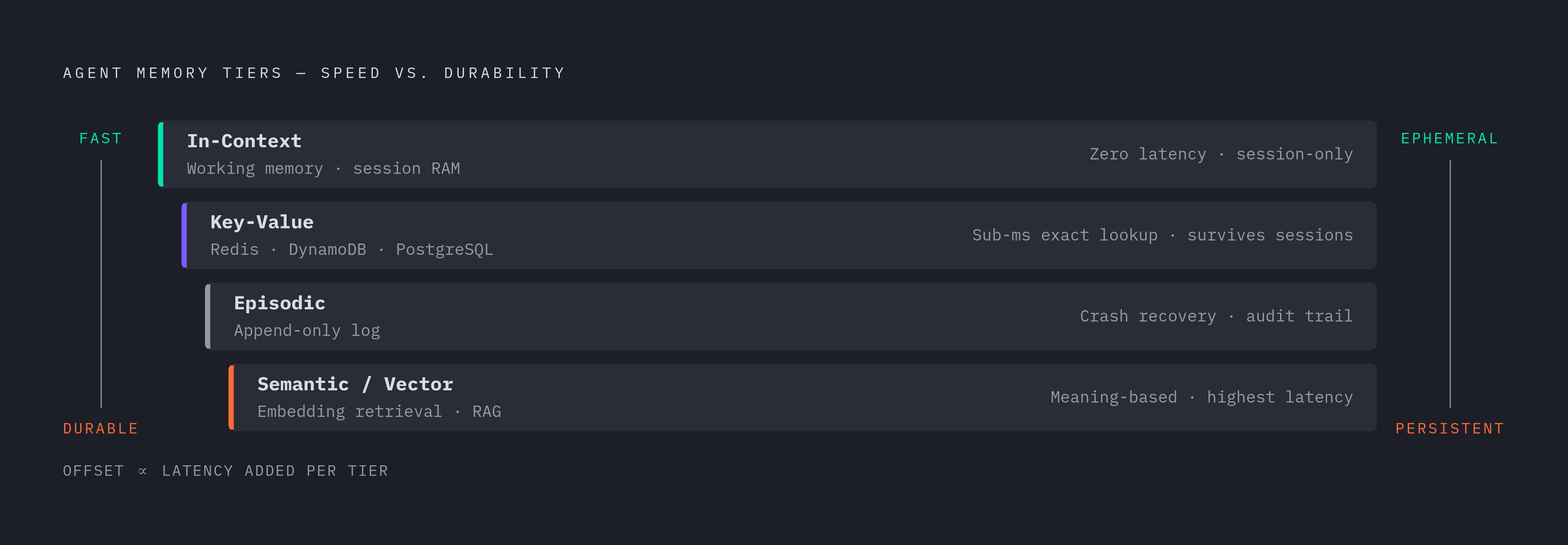
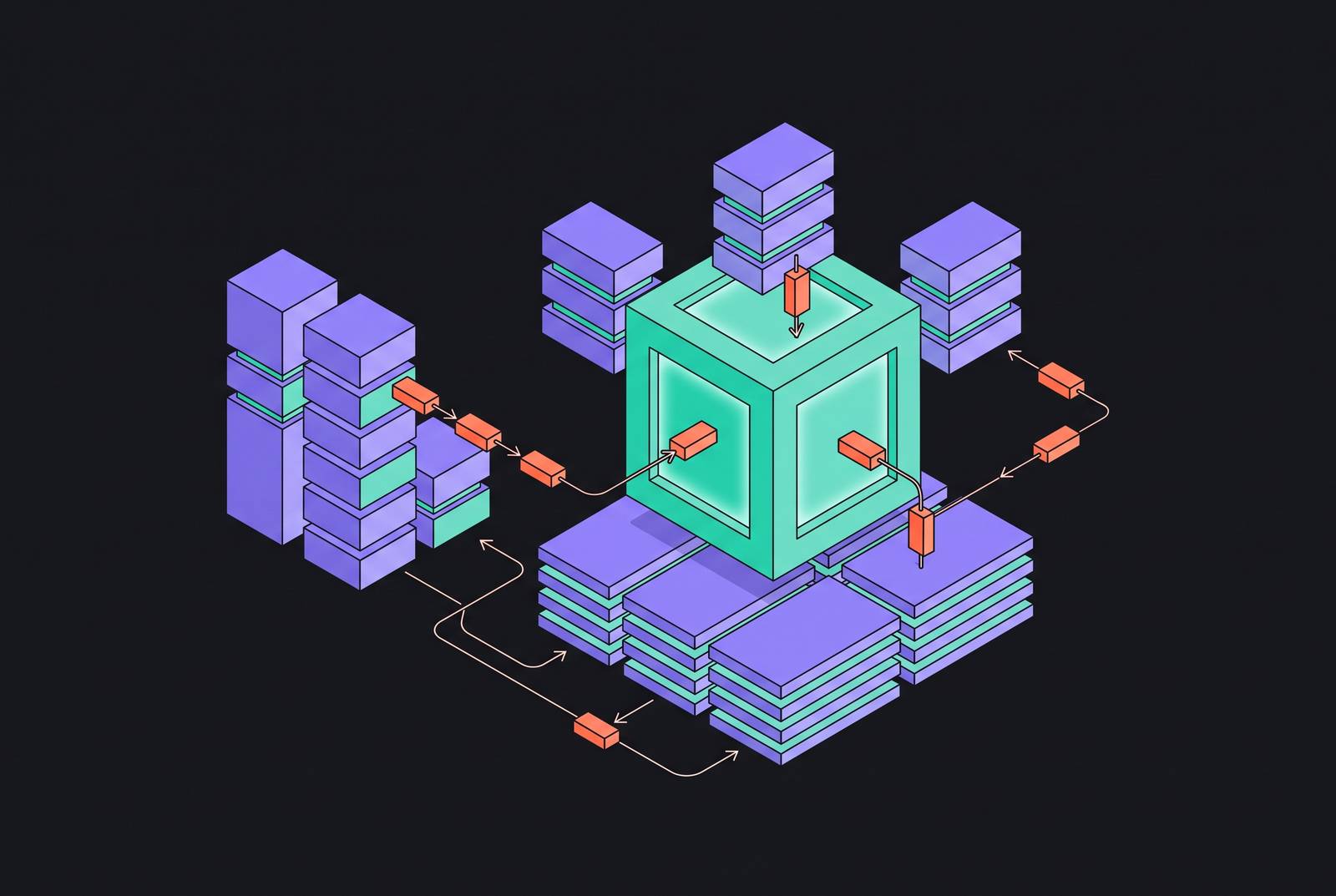
Production agents need four separate memory tiers because different kinds of information have different shapes, different speed requirements, and different shelf lives. Mash them all into one layer and the result is either a runaway cloud bill or an agent that quietly loses data it needed. The taxonomy traces back to Lilian Weng, VP of Research and Safety at OpenAI, who mapped agent memory onto human cognitive science, and the four tiers below are how that mapping plays out in a working production system.
Tier one is in-context, or working, memory, which is everything currently sitting inside the model's context window: the prompt, the conversation so far, tool results, system instructions. It's fast, it costs nothing extra in latency, and it vanishes the moment the session closes. It's expensive per token once things scale up, and it's bounded by whatever window size the model allows. Use it for reasoning the model needs to do right now, in this one turn, and nothing further out than that.
Tier two is external key-value memory, a persistent store like Redis, DynamoDB, or PostgreSQL that holds structured facts: user preferences, account configuration, subscription tier, entity attributes. This tier survives across sessions and answers exact lookups in well under a millisecond. Activepieces points out the practical payoff: when a customer updates a billing address, a relational model retrieves the actual string on file instead of the model guessing at something that sounds plausible. Use this tier anywhere exact retrieval matters more than a fuzzy sense of meaning, and data residency rules can be enforced row by row in this layer.
Tier three is episodic memory, the append-only log of every observation, action, and outcome the agent has ever produced. That log is the agent's state. Persisting it is what makes crash recovery, session resumption, and real debugging possible at all. Helwig's August 2026 research documents what happens when this tier gets neglected: early in a months-long agent project, three separate sessions each independently re-proposed a subsystem that had already been built and was just sitting there, dormant, even though the relevant design documents were present in context every single time. The information existed. It just wasn't doing its job. Use episodic memory for durable resumption after something crashes, for reconstructing what the agent knew and when, and for audit trails on decisions that actually matter.
Tier four is semantic, or vector, memory, where past interactions and documents get stored as mathematical embeddings and pulled up by meaning instead of exact text match. This is the tier that makes retrieval-augmented generation, or RAG, possible, letting the agent scan millions of past records and surface whatever's relevant to the question at hand. Graph-based temporal memory posted meaningfully higher accuracy than flat vector stores on the LongMemEval benchmark at the time it was measured, though that gap has narrowed a good deal since late 2026. Use this tier for semantic search across long histories, for personalization, for recommendations, basically anywhere the question isn't "find this exact string" but "find the thing that means roughly this."
There's a tempting fifth option that doesn't actually work: treating the model's own internal weights as a kind of implicit memory tier. Activepieces states it directly, and correctly: models are static snapshots, frozen at training time, and they cannot learn new facts in real time no matter how many conversations they sit through. Whatever memory a product needs has to live outside the model, in one of the four tiers above.
How the leading frameworks build this in practice
Three frameworks have picked up real production traction, and each one solves the persistence problem with a different set of tradeoffs.
LangGraph handles this through what it calls a checkpointer, which persists state step by step as the agent works through a graph of tasks. Every node execution automatically serializes its state to whatever backend is configured behind it. For development and testing, that backend is typically MemorySaver, while production deployments move to PostgresSaver (SqliteSaver has its place for local or single-process work, but it isn't built for production traffic). LangGraph suits teams who want precise, node-by-node control over what gets checkpointed and when, rather than handing that decision to a black box.
CrewAI took a different route, consolidating four separate memory classes into one unified Memory API. Recall decisions run on a composite score blending semantic similarity, recency, and importance, rather than leaning on any single signal. Ganglani's 2026 research confirms this shipped within the past six months; most memory tutorials written before 2026 are describing a CrewAI that no longer exists.
Memory-layer products form a separate category apart from orchestration frameworks: they're built to be the persistence backend underneath whatever framework a team already uses. Zep runs a temporal knowledge graph, built on its Graphiti engine, over Neo4j, FalkorDB, or Amazon Neptune (Kuzu support has been deprecated). Facts in Zep carry valid_at and invalid_at timestamps, and retrieval blends BM25 keyword search, cosine similarity, and graph traversal, which makes it a good fit for chat agents that need episodic recall with a real sense of time passing. MinnsDB takes a wider approach, packing six storage modalities into a single binary: a temporal knowledge graph, a vector store, a BM25 index, a claim store, temporal tables, and structured memory. Its ontology drives cascade invalidation automatically, so if a user says "I moved to New York," every fact that depended on the old address gets superseded without a developer writing a line of code to handle it, and it ships with forty-nine typed source connectors. Both of these come from a DEV Community roundup.
One architectural lesson from Activepieces applies to all of these choices: tiered storage, splitting memory across short-term, structured, and long-term layers, cuts costs substantially without giving up recall quality. Cost control here is a decision baked into the architecture from day one, not something to tune after launch.
The Model Context Protocol, or MCP, is becoming the connective tissue between agents and memory. When a memory service gets exposed as an MCP server, any MCP-compatible framework can plug its agents into persistent memory just by subscribing to the right endpoint, which pushes memory up to the infrastructure level instead of leaving it as something each application has to build for itself. For a SaaS team building on a shared backend, wiring a new agent into infrastructure that already exists replaces writing bespoke memory code for every new agent.
What memory failure looks like at project scale
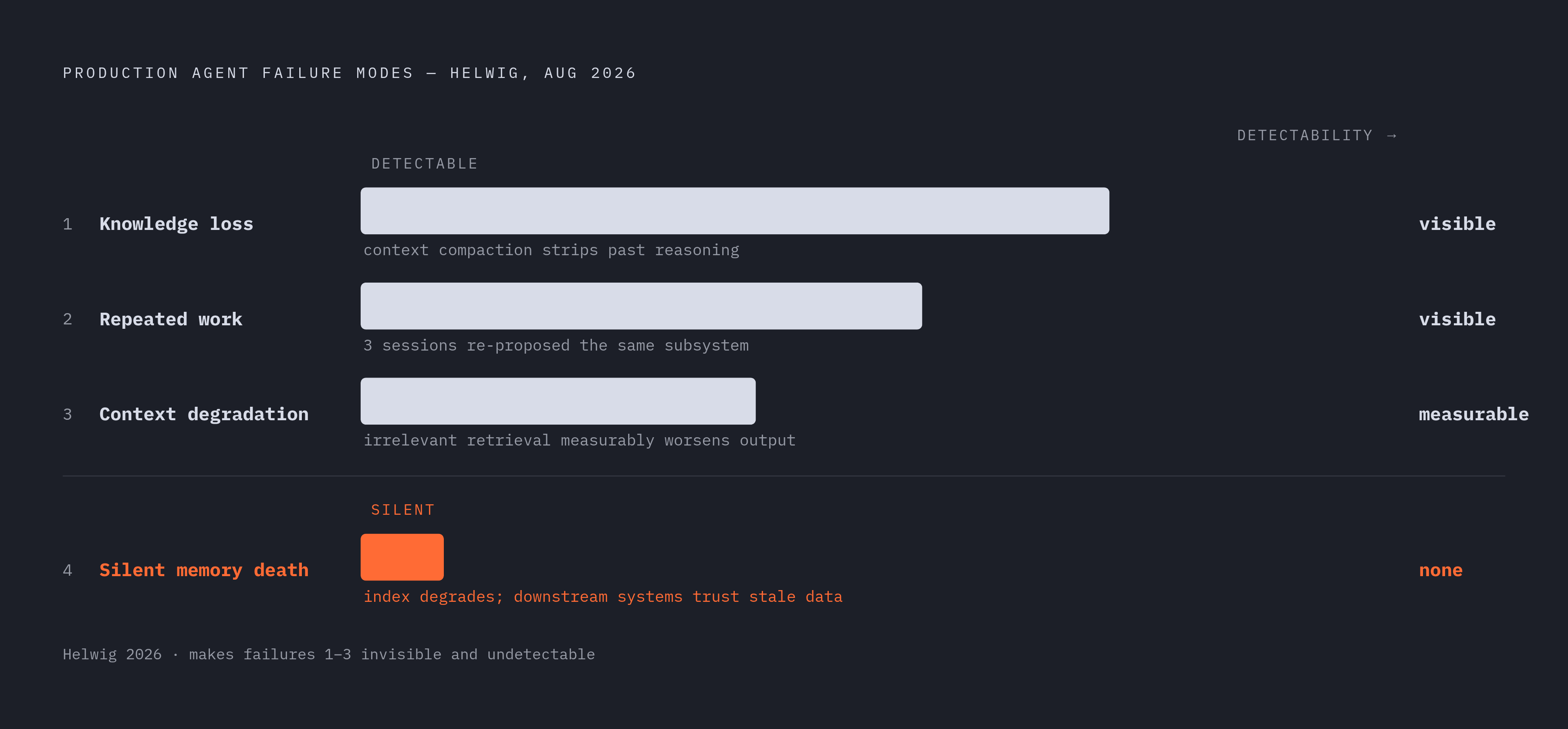
Memory systems don't fail in one dramatic way. They fail in four distinct, recognizable patterns, and the most dangerous of the four is the quiet one, where the system keeps humming along while the data it's serving up has gone stale or disappeared entirely without anyone noticing.
Mike Helwig's August 2026 research offers what appears to be the first months-scale, fully instrumented operational record of a persistent agent-memory subsystem running in production, built around a single continuous assisted development effort on a large codebase. That record documents four failure modes. The first is knowledge loss, where context compaction summarizes away the connective tissue holding a long project together, so the agent comes back sounding fluent and confident while having quietly lost track of why any of its own decisions were made. The second is repeated work, where the agent re-proposes something that already exists: in Helwig's record, three consecutive sessions each independently re-proposed a subsystem that had already been built and was sitting dormant, with the relevant design documents sitting right there in context each time. The third is context degradation, which occurs when a team tries to fix compaction by throwing more retrieved context at the problem, only to find that irrelevant context measurably drags down model output, to the point where an injection channel the model has learned to treat as noise performs worse than no injection. The fourth, and the one that makes the other three so hard to catch, is silent memory death, where the memory system itself, an index, an embedding server, a hook pipeline, degrades or dies without any warning, while every part of the system built on top of it keeps trusting data that's no longer there.
What makes this genuinely hard to manage is that memory fails in two opposite directions at once: sometimes the agent needs to rediscover something that already exists, and sometimes it needs to stop acting on a record that's already decayed past usefulness, and those two failure directions call for operational rules that pull against each other. A rule tuned to catch one tends to make the other worse, so this can't be solved with a single blanket policy.
The practical response Helwig's research lands on is treating the memory subsystem the same way a site reliability engineer treats any other piece of critical infrastructure, rather than as a feature that either works or doesn't. Over the instrumented period of that 2026 operational record, 85 failures were logged, and none of them were silent, a result built on session-start health gates with clearly discriminated failure modes, heartbeat telemetry engineered so that no enumerated failure mode can slip through unrecorded, and alert-fatigue budgeting borrowed straight from standard SRE practice. That's the actual bar for a SaaS team shipping agents that need to keep working for months, not minutes: memory is infrastructure that needs monitoring, alerting, and a health check, same as every other system a business depends on staying up.