Structured Data Backends for AI Agents in SaaS
Fixing agent failures means rearchitecting your backend, not upgrading your model.
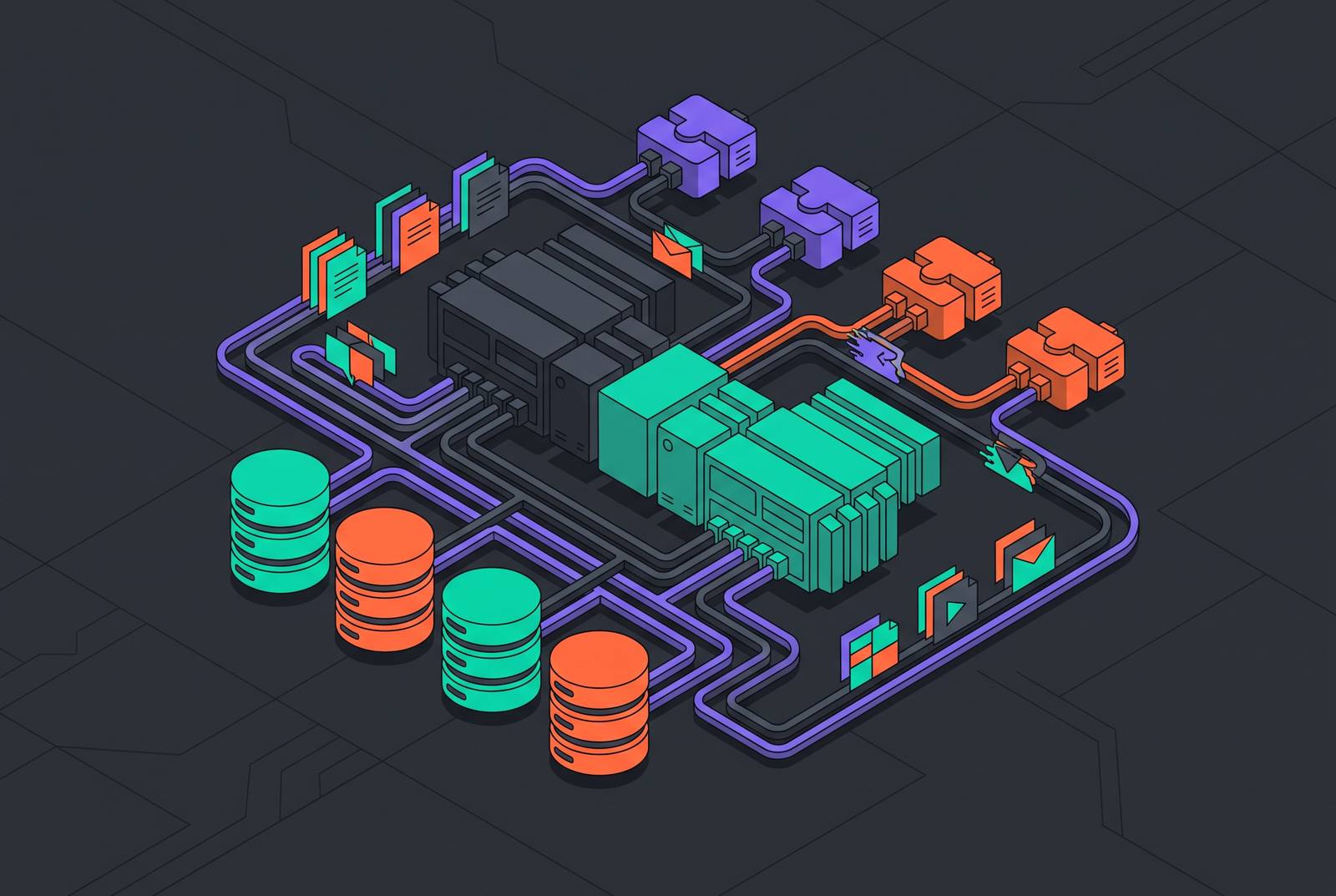
An AI agent that stalls out mid-task, loops on the same API call, or confidently reports the wrong subscription status is usually not suffering from a model problem. It is suffering from a backend problem: the structure and event-awareness of the data infrastructure produces the constraint on what an agent can reliably do inside a SaaS product, not the intelligence of whatever model is driving the wheel, as the agent's failures track the data infrastructure's limits rather than the model's. That distinction matters more than it sounds like it should.
SaaSBench, a 2026 benchmark out of the University of Science and Technology of China and Alibaba, found that more than 95% of agent task failures happen before the agent ever reaches the actual business logic it was asked to execute. Not during the hard part. Before it. The bottleneck sits in system configuration and integration, the plumbing nobody photographs for the pitch deck.
That's a strange place for failure to concentrate, and it explains something a lot of teams misdiagnose. Ambiguous or incomplete structured signals coming out of the backend are what make a perfectly capable model look dumb. Feed an agent a clean, typed answer and it acts like a clean, typed answer. Feed it a stale record or a half-synced field, and it improvises, and improvising is a polite word for hallucinating with confidence.
The trust numbers back this up. Per BetterCloud's analysis, only a small fraction of companies fully trust agents to run core business processes on their own. Fix the backend, and the trust gap starts closing on its own. According to BetterCloud's analysis, the SaaS industry is shifting from software that supports human work to agents that autonomously execute work and own outcomes, and the backend assumptions of the first era do not hold in the second.
Agentic SaaS and the exposure of invisible backend debt
Every backend built in the last decade was built for a human clicking a button and waiting a second for a page to load. That pacing assumption is baked into schemas, into caching layers, into how "read" and "write" get handled, and agentic workloads expose exactly how load-bearing that assumption was, because agents don't wait, they query relentlessly, in bursts, at machine cadence.
The industry has started sorting products into two buckets. AI-enabled apps bolt generative features onto a traditional SaaS backend. AI-native apps get built from scratch around real-time data ingestion and agent orchestration, with the outcome itself designed to run autonomously. The difference between AI-enabled apps, which layer generative features on top of traditional SaaS, and AI-native apps, built from the ground up with real-time data ingestion, agent orchestration, and autonomous outcome architectures, isn't a feature checklist, it's a backend design gap.
The debt appears concretely in the following data. The 2025 AI Agent Index, a research effort spanning Cambridge, Washington, Harvard, Stanford, Penn, MIT, Concordia AI, and Hebrew University of Jerusalem, documents that different categories of agents need fundamentally different structured interfaces to act at all. An enterprise workflow agent acts through CRM connectors and record updates. A browser-based agent acts by clicking, typing, navigating. Each one expects a clean, purpose-built action surface, and a backend that doesn't offer one forces the agent to guess its way toward a task instead of executing it.
Guessing has a cost. A multi-agent system can slip into an infinite loop, or hallucinate a tool call that kicks off a long cascade of API requests, and given that over 95% of task failures happen before agents even reach real business logic, this is strong evidence that deterministic guardrails aren't a nice-to-have but a backend design requirement most legacy SaaS stacks simply don't have.
Every agent needed a bespoke integration for every API it touched through 2025, which is a maintenance nightmare disguised as a feature list. By 2026 the industry standardized on the Model Context Protocol, MCP, letting agents discover and use tools like CRMs and SQL databases through a unified interface instead of a custom connector for every API, though MCP compatibility requires the backend to be structured well enough to expose coherent tools in the first place. MCP only works if the backend is organized enough to expose something coherent in the first place. A protocol can't fix a mess. It can only describe one more clearly.
What structured, event-aware backend architecture means for agents
Strip away the buzzwords and an agent-ready backend comes down to four properties working together: a unified data model, an event stream the agent can actually watch, tool surfaces that behave the same way every time, and a memory system that survives past a single session. Miss any one of the four and the other three don't fully matter.
Start with the unified data model. When user records, transactions, and behavioral events sit in separate systems with no shared identity layer tying them together, an agent has no way to resolve a conflict between two sources telling it different things about the same customer. Every cross-system query turns into a coin flip, and the agent doesn't know it's flipping a coin.
Then there's the event stream. Agents that only get to read static records are agents that can't react to a subscription change or a usage spike the moment it happens, because a static read is a photograph and the business moved on the second it was taken. Real-time awareness isn't a luxury feature bolted onto the backend, it's the difference between an agent that responds and one that just eventually notices.
Tool surfaces need the same rigor. The 2025 AI Agent Index confirms MCP support is now widespread, but implementation quality varies a lot from one agent category to the next, and the fix on the backend side is to expose scoped, well-typed tools rather than raw endpoints an agent could misuse by accident. A raw API endpoint handed to an agent is a loaded stapler handed to a toddler. It'll get used, just not the way you hoped.
Memory closes the loop. Short-term memory, tracked through state objects in frameworks like LangGraph (CrewAI instead leans on a retrieval-based memory system), keeps an agent oriented within a single task. Long-term memory needs an actual persistent store, something like a vector database (Pinecone and Weaviate are common choices), so an agent can recall a customer's prior decisions across sessions.
The Agentverse platform paper, from Fetch.ai under the ASI Alliance, lays out a seven-layer Agent Cloud Stack built on a Gap Taxonomy spanning eight categories, from memory and observability to security and economic primitives. The point worth sitting with is that agent infrastructure isn't one problem wearing different hats. It's a stack, and a gap in any single layer drags the whole thing down with it.
Fragmented tool stacks as an agent-ready backend
Most founders build their stack the same way: grab an auth tool, bolt on a billing tool, wire up an analytics tool, connect them all with webhooks, and call it a day. That approach worked fine for humans clicking through a dashboard. It falls apart the moment an agent starts asking each tool a question and expecting the answers to agree with each other.
Every single-purpose tool keeps its own model of who a user is. Ask an agent to check subscription status through the billing tool and session activity through the analytics tool, and it may get back two answers describing two slightly different versions of the same customer, because neither tool has any way to know the other one exists, let alone reconcile with it.
Webhooks make this worse before they make it better. A billing event that hasn't propagated to the analytics store yet looks, to an agent reading it, exactly like a customer who never paid, even though the payment already cleared and is just sitting in a queue somewhere waiting to sync.
BetterCloud's 2026 analysis captures the industry's messy response to this: consolidation and fragmentation are happening at the same time. Enterprises are cutting general sprawl while adding specialized AI tools right back in, and SaaS portfolios are expanding again after two years of shrinking, precisely because integration sprawl quietly inflates both the operating bill and the governance risk. It's a bit like cleaning out a garage and immediately buying five new power tools. The floor space argument was never really the point.
For agents specifically, this fragmentation lands hardest on authentication. The Mastra blog's July 2026 roundup of AI agent integration platforms flags credential storage, token refresh, and permission scoping, when handled tool-by-tool instead of centrally, as a maintenance burden that gets heavier every time a new integration gets added. That's not a one-time setup cost. It compounds.
A backend where every user, transaction, session, and usage event shares one identity layer removes the guesswork entirely, because there's only one version of the truth for an agent to query. Platforms built around that principle, combining authentication, payments, customer database, and AI analytics in a single system, mean an agent gets consistent, reconciled state instead of the aggregate of several partially-synced sources. That's the appeal of unifying the stack: not fewer tools for the sake of tidiness, but one less place for the truth to get lost in translation.
Agent-driven workflows and requirements for authentication and access control
Authentication built for humans assumes a human is the one making the request, at human speed, with human judgment somewhere in the loop. Once agents become the primary callers of a backend, that assumption breaks: an overpermissioned token is a systemic risk that scales with how fast the agent can act, because it is no longer a minor hygiene issue.
Scoping tokens tightly matters more for agents than it ever did for people. A token meant for pulling reports shouldn't be able to delete a user. A webhook integration shouldn't be able to export the entire customer database on a whim. Humans making that mistake do it once, slowly, and usually notice. Agents calling misscoped endpoints do it at volume and at speed, so the same design flaw that was a minor annoyance with a human operator turns into a real mess with an agent behind the wheel.
The danger isn't confined to the login screen either. Practitioners point to signup, password reset, magic links, OTP verification, invitation acceptance, token refresh, and trial activation as attack surfaces in their own right. An agent that touches any one of those flows without a properly scoped credential effectively exposes all of them, because the weakest link in that chain sets the ceiling for the whole system.
Passwordless approaches, passkeys, biometric checks, and magic links, reduce the risk of stolen credentials, and WebAuthn extends that to hardware security keys and device-level biometrics. But none of that helps unless the backend supports it natively. An agent still operating through a legacy password-based token is more exposed than one working through a modern passwordless flow, not less, no matter how good the model driving it is.
Free-tier abuse tends to appear first. Products offering free AI credits, storage, or open developer APIs get tested by bad actors earlier than most teams expect, and a backend that can't enforce per-token scoping at the authentication layer has no defense against an agent, whether misled or simply misconfigured, reaching further than it was ever supposed to go.
Usage-Based Billing Infrastructure as a Structural Requirement for Agent-Native Products
AI products throw off a staggering number of usage signals per customer: API calls, tokens burned, storage written, messages sent, each one a small event that may need to be tracked, priced, or recognized on a ledger somewhere. That's a different animal entirely from the flat per-seat pricing traditional SaaS was built on, and treating it like the same problem is how invoices stop making sense.
The sharpest argument here isn't really about pricing at all, it's about safety. The exact metering system that records usage events for billing purposes is the same system capable of catching an agent that's gone rogue. A 50-step API cascade set off by one hallucinated tool call looks, from a distance, like perfectly ordinary traffic, unless the billing layer is tracking events granularly enough to notice the pattern and raise a flag. Billing infrastructure and agent safety infrastructure turn out to be the same infrastructure, wearing different name tags.
The cost of getting this wrong is not theoretical. BetterCloud's analysis found that scaling AI features into production routinely reveals cost estimates that were off by 500 to 1,000 percent, with some invoice shocks serious enough to make finance teams break out in a cold sweat. That's not really a spending problem. It's a visibility problem, because a team that can't see usage in real time has no way to control it before the bill arrives.
A handful of platforms have built specifically around this shape of problem: Lago, open-source and event-based; Metronome, built for high-volume event ingestion; Orb, for granular usage tracking with programmable pricing rules; Maxio, leaning finance-led with SaaS metrics reporting; and Alguna, an end-to-end CPQ, billing, and revenue platform supporting subscription, usage-based, and hybrid pricing. None of these solve the same problem the same way, but their existence says the same thing: this is a solved category, not a frontier one.
Hybrid pricing, mixing a subscription base with usage on top, posts the highest median growth rate of any SaaS pricing structure, according to the Maxio 2025 Pricing Trends Report. Capturing that growth, though, depends entirely on a backend that can meter and aggregate usage events without someone manually reconciling spreadsheets at the end of every month. Backends that integrate payments and AI analytics directly into the same system as the customer database make usage events immediately visible alongside subscription state, giving founders and agents alike a real-time picture of who is consuming what.
Compliance and data residency requirements for backends serving agents processing personal data
An AI agent processing EU personal data through a SaaS backend is, as of 2026, a regulated entity in its own right, and how the backend's data is architected decides whether that regulation is a manageable checklist or an unpleasant surprise. This is load-bearing, not a legal footnote tacked onto the end of a product spec. It's load-bearing.
The EU AI Act hit its general-application date on August 2, 2026, though a chunk of high-risk AI obligations got pushed back to 2027 and 2028. It sits directly on top of the existing GDPR framework, so any company developing or deploying AI models that touch EU personal data now answers to both regimes at once, not one or the other.
Customers need to be able to switch cloud or AI providers within a short window under the EU Data Act's new portability requirement, and switching fees are on their way out entirely, fully banned as of January 12, 2027, with the 2026 Digital Omnibus making targeted tweaks to that framework rather than rewriting it. That requirement isn't something legal can quietly handle separately from engineering. It demands a data model built around open-standard exports from day one.
Audit trails are the other pressure point. Agents retrieving and acting on personal data at machine speed create a genuine need for a complete record of what got touched and when, and that record simply doesn't exist as a single coherent thing when user data is scattered across separate authentication, billing, and analytics tools with no shared log between them.
For products selling into the EU, hosting data on European infrastructure with GDPR compliance built in from the start has become the baseline expectation, not a premium add-on layered in later.
Agent-native backends and integration exposure through MCP rather than custom connectors
MCP inverts the integration model. Instead of an agent adapting to whatever quirks a backend happens to have, the backend declares what it offers in a form the agent can discover and use directly, no custom wiring required on either side.
Practically, that means an agent can find and use tools, CRMs, SQL databases, messaging platforms, through one secure, unified interface, and the connector-per-API cost that defined 2025 mostly disappears once the backend speaks a shared protocol instead of a private dialect. The Mastra blog's July 2026 roundup lays out the resulting landscape in three flavors: purpose-built agent platforms with prebuilt tools ready to go, integration infrastructure platforms that give developers more direct control over connectors, and unified API providers that normalize a pile of different services behind one consistent schema. MCP is the common thread running through all three. Platforms in that roundup include Apideck, which unifies APIs across major business software categories in a way that suits agents working across many differently-structured customer environments, alongside others spanning enterprise automation, developer infrastructure, and browser-based action.
If the data underneath is a mess, none of that works. An MCP layer built on top of a fragmented, inconsistently modeled database produces tools an agent will call with total confidence and get an unreliable answer back from anyway. MCP is a surface, not a fix. It describes what's there. It cannot invent order that was never built into the backend.
Backends that pair CLI-based setup with native MCP integrations let an agent handle the integration work on its own, discovering and wiring up capabilities directly instead of forcing a developer to read documentation line by line and hand-build webhooks. That's the practical payoff of getting the data model right before reaching for the protocol. MCP rewards a backend that was already organized. It has no patience for one that wasn't.
Verification criteria for genuinely agent-ready backends
Ask what happens when an agent queries the same customer through two different endpoints at the same moment. If the answers can disagree, the identity layer isn't unified, and no amount of prompt engineering downstream will paper over that crack.
Check whether the backend can meter an event the instant it happens or only after a batch job runs later that night. Real-time event awareness is what separates a backend an agent can react to from one it can only take a photograph of, hours after the fact.
Look at how tokens get scoped for machine callers specifically, not just for human logins. A reporting token that can also delete records is a matter of when, not if, something calls it in a way nobody planned for.
Confirm whether integrations get exposed through something like MCP or through a pile of one-off connectors that need a developer every time a new tool joins the stack. Whether the underlying data was structured before that protocol layer got bolted on determines the answer, because a clean-looking interface sitting on top of a messy database is still a messy database. It's just wearing a nicer coat.
Sources
- The 11 Best AI Agent Integration Platforms (July 2026): Features, Tradeoffs, and Use Cases | Mastra Blog
- AI and the SaaS industry in 2026 | BetterCloud
- The 2025 AI Agent Index: Documenting Technical and Safety Features of Deployed Agentic AI Systems
- Infrastructure for the Agentic Web: Gap Analysis and Architecture from the Agentverse Platform
- SaaSBench: Exploring the Boundaries of Coding Agents in Long-Horizon Enterprise SaaS Engineering