Machine-to-Machine Authentication for SaaS Backend Services
Leaked credentials expire within hours; static API keys pose permanent risk to backend systems.

Non-human identities outnumber human users 45-to-1 in a typical enterprise, according to GitGuardian's State of Secrets Sprawl 2024 report. These identities authenticate continuously, carry sensitive permissions, and often hold broader access than any human account would be granted. They are also, in most organizations, the least-managed class of identity in the system.
The hardcoded secrets problem is where this gets concrete. GitGuardian detected 12.8 million hardcoded secrets in public GitHub repositories in 2023, and 90% of valid secrets detected in 2022 were still active more than five days after detection. Most organizations store secrets outside of dedicated secrets managers, scattered across source code, configuration files, and CI/CD pipelines. That is not a niche finding; it describes the majority of production environments.
The cost of this is not theoretical. In December 2024, attackers breached the US Treasury Department using a stolen API key belonging to BeyondTrust, a third-party software provider, as reported by Reuters and confirmed in a letter from the Treasury to Senate Banking Committee leaders. One compromised credential. That was the entire attack surface — like leaving the front door of a bank unlocked because the vault felt secure. OWASP documented the systemic version of this in its Non-Human Identity Top 10, published in 2025: improper offboarding, secret leakage, overprivileged identities, long-lived credentials, cross-environment reuse. Not edge cases. Standard conditions.
The credential is the attack surface, and the mechanism that controls how credentials are issued, scoped, and retired is where security is actually won or lost. That is the problem OAuth 2.0 Client Credentials was designed to address.
How the OAuth 2.0 Client Credentials Flow Works
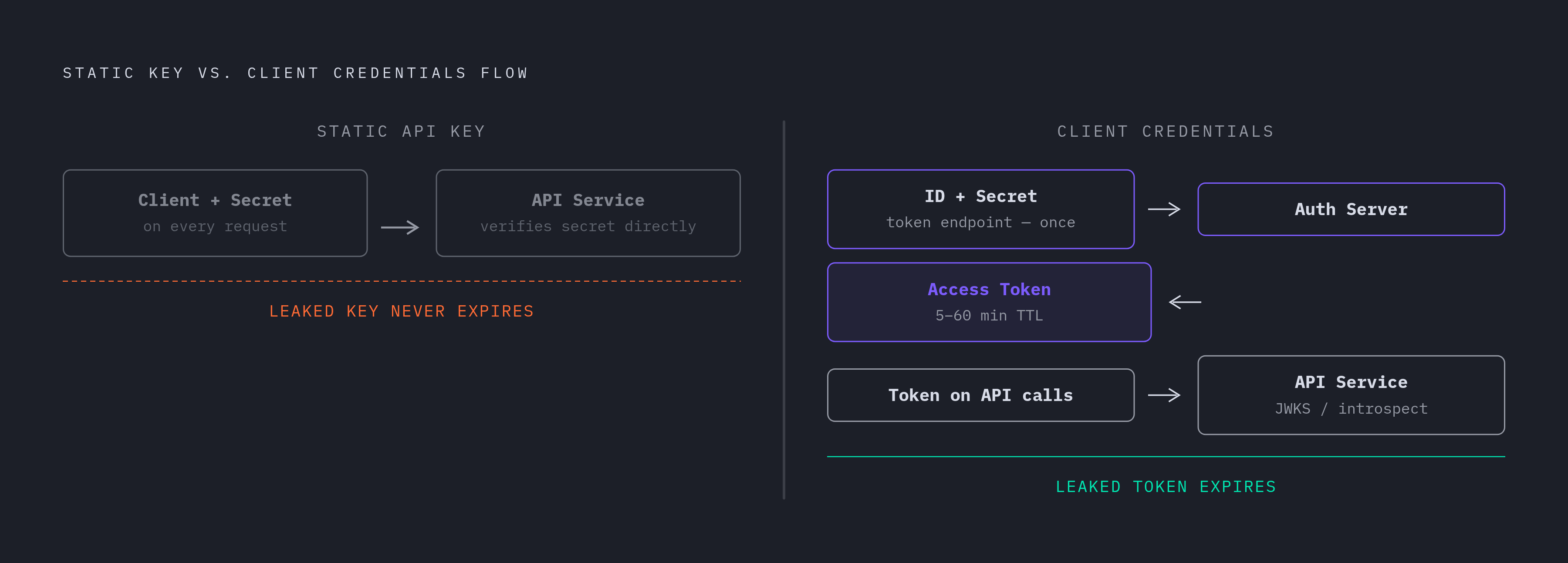
The Client Credentials flow, defined in RFC 6749 Section 4.4, is the dominant standard for M2M authentication. The security properties follow directly from how the exchange works, so the mechanics are worth understanding precisely.
The calling service holds a client ID and client secret, or a private key for a client assertion. It presents those credentials to the authorization server's token endpoint. The authorization server validates them and returns a short-lived access token, typically valid somewhere between five and sixty minutes. The calling service then presents that token on subsequent API calls. The underlying credentials never travel on those requests.
Compare this to a static API key, where the secret itself travels on every single request. With Client Credentials, the secret is exchanged once at the token endpoint, and what the API sees from then on is a time-limited token. The credential is never directly visible to the services consuming it. That structural difference has real consequences: a leaked token expires; a leaked API key does not. A static API key is a skeleton key that never wears out — OAuth Client Credentials is a timed visitor badge.
The receiving service verifies the token one of two ways: by verifying the JWT signature against the authorization server's published JSON Web Key Set, or by calling the token introspection endpoint defined in RFC 7662. Auth0, Okta, Microsoft Entra ID, AWS Cognito, Keycloak, and Google Cloud IAM all support this flow.
The flow answers two questions simultaneously: who is calling, and through scopes, what are they allowed to do. Those permissions are encoded in the token itself. The second question is actually where most of the design work lives.
Token Scoping and Why It Determines What M2M Auth Actually Protects
A token that authenticates a service but carries no scope constraints has done half the job. It establishes identity while leaving permission boundaries undefined, which means any service that can authenticate can, in principle, reach anything it wants. That is a common misconfiguration, not an edge case.
Scopes define what actions or resources a token permits. A billing service token should not carry read access to user PII. An analytics pipeline should not carry write access to billing records. GitGuardian's State of Secrets Sprawl 2024 report found that the majority of non-human identities carry excessive privileges. Overprivileging is the default condition in most production systems that have grown organically, not a problem someone is about to fix.
Practical scoping follows principles that hold up in real deployments: issue each service a token covering only the resources it actually calls. For customer-facing API surfaces, scope tokens per customer so tenant isolation is enforced at the credential level, not patched in application logic. A service that both reads and writes does not necessarily need both operations in the same credential; separating them limits the blast radius when something goes wrong.
Token lifetime is part of scope design, not separate from it. Short-lived tokens, in that five-to-sixty-minute range, limit exposure when a credential leaks. A token expiring in fifteen minutes is far less useful to an attacker than one valid for a week. Modern authorization servers issue tokens quickly enough that this is not a meaningful performance concern.
Token scope is an architecture-time decision. Retrofitting it onto a system built without it is painful, often incomplete, and always more expensive than building it in from the start. Even well-scoped tokens require a rotation and revocation strategy to stay trustworthy over time.
Credential Rotation, Secret Management, and Why Static Credentials Accumulate Risk Over Time
A substantial portion of non-human identities have not had credentials rotated in over a year. Long-lived credentials are the norm. That is the starting condition, not the exception.
Here is what actually happens to a credential over its lifetime: a secret that was secure when first issued has been logged, committed to a branch, copied into a Jira ticket, or pasted into a Slack message at some unknown point since then. The longer it lives, the larger the surface area of places it has traveled, most of them invisible to whoever holds nominal responsibility for managing it. Credential age is a proxy for exposure risk, and the relationship is roughly linear. You cannot audit what you cannot see, and secrets in motion leave traces in places nobody inventories. A credential that has been alive long enough has essentially toured the entire organization without a chaperone.
The baseline for any production system is a dedicated secrets manager. AWS Secrets Manager, HashiCorp Vault, and GCP Secret Manager are the common options. GitGuardian found that most organizations still store secrets outside these tools. Moving secrets into a manager is the most concrete step available, and organizations consistently defer it until something goes wrong.
Rotation mechanics matter more than the rotation schedule. For OAuth client secrets, automate rotation and verify that old secrets are actually invalidated after rotation, not just that new ones are issued alongside them. Those are different operations, and teams conflate them regularly. The result is a false sense of security: the team has rotated, but the old credential still works. For static API keys where they must exist, treat them like passwords: documented rotation plan, TLS-only transmission, never in version control.
Revocation matters as much as rotation. A credential on a rotation schedule but without fast revocation is still a liability if it is compromised between cycles. Token introspection per RFC 7662 and authorization server revocation endpoints exist precisely for this. They should be in the architecture from the start.
Static API Keys and mTLS: Where They Fit and Where They Don't
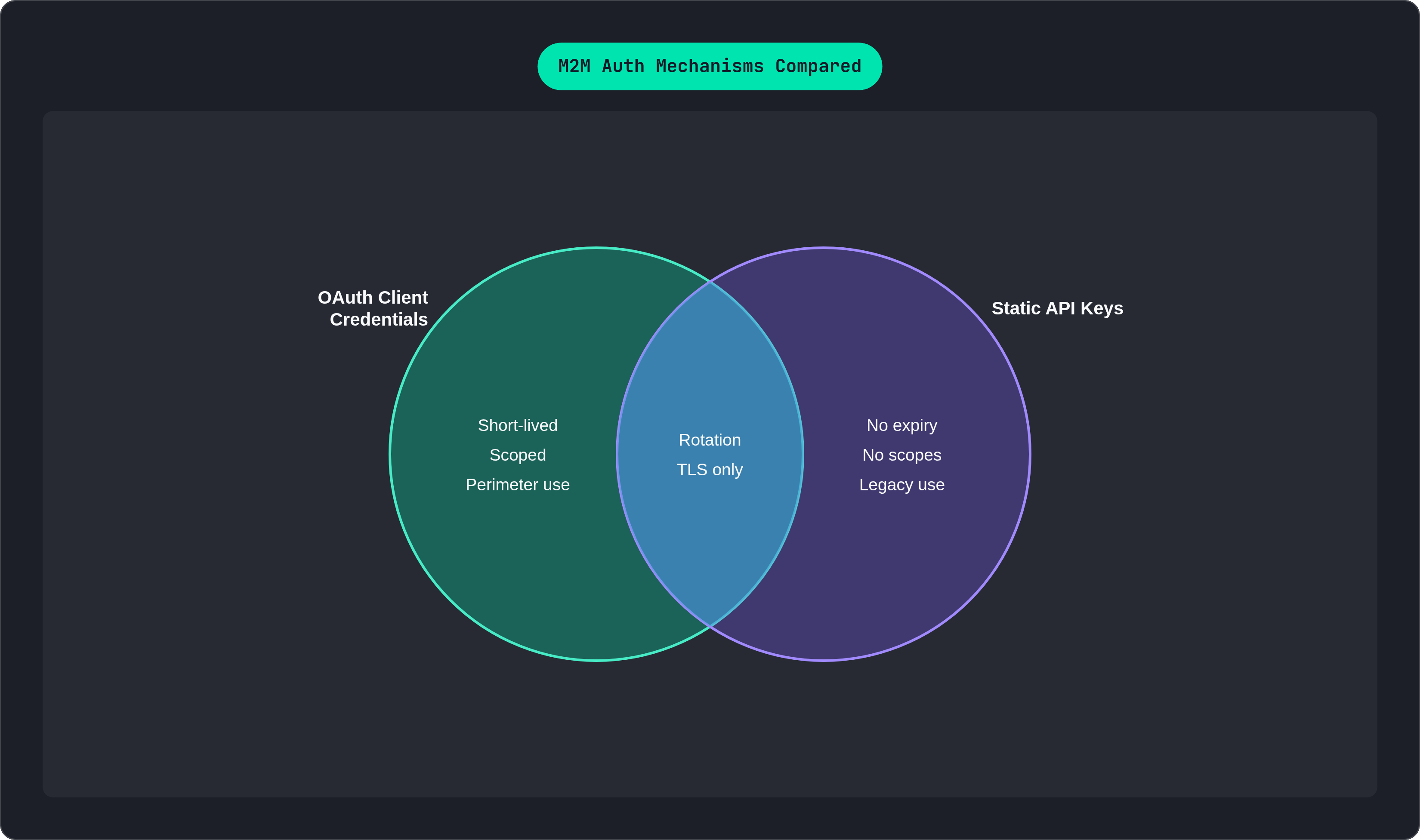
Static API keys are the simplest mechanism and the most commonly misused. A long random string in a header or query parameter; if it is valid, the request goes through. No signature, no inherent expiry, no scoping unless the issuer implements it separately. The simplicity is what makes them appealing and what makes them dangerous, sometimes simultaneously.
They are appropriate for low-stakes internal traffic with a documented rotation plan, and for legacy integrations where OAuth is genuinely not an option. They are not appropriate for multi-tenant SaaS with customer data, anything exposed to the open internet, or any credential with a realistic path to version control. If the answer to "where will this key live?" is anything other than a secrets manager, the answer is probably wrong.
Mutual TLS sits at the other end of the spectrum. During the TLS handshake, both client and server present X.509 certificates; both verify the other against a certificate authority or pinned set. It answers "who is calling" with cryptographic certainty, which is the highest-assurance option available at the transport layer.
The operational cost is real, and teams consistently underestimate it. Certificate lifecycle management, rotation, OCSP and CRL handling, and debugging when a certificate expires quietly in production are significant ongoing obligations. An expired certificate creates a different class of outage than an auth failure, but the consequences can be equally disruptive, and the failure mode is often less obvious.
mTLS is appropriate for high-security service meshes in banking, healthcare, and sensitive government infrastructure, and for zero-trust architectures where every service-to-service hop must be cryptographically authenticated. The pattern in mature deployments is mTLS for transport-layer identity with scoped JWTs layered on top for application-level authorization. They address different layers and complement each other.
The practical positioning: OAuth Client Credentials at the perimeter and wherever organizational boundaries are crossed; mTLS inside a high-security trust domain; static API keys only where the other two are genuinely impractical, with clear eyes about what that tradeoff costs.
SPIFFE/SPIRE and Automated Workload Identity for Internal Services
mTLS requires certificates. Certificates require issuance, rotation, and revocation. At scale, doing that manually recreates exactly the long-lived credential problem this piece has been describing. SPIFFE and SPIRE exist to close that loop.
SPIFFE is the Secure Production Identity Framework For Everyone, a CNCF-graduated open standard for workload identity. SPIRE is the runtime implementation: the toolchain that issues and rotates credentials automatically, without human intervention. The combination removes manual rotation from the internal service identity layer, which is precisely the layer where manual rotation fails most reliably under operational pressure. When engineers are moving fast, certificate hygiene is the first thing that slips.
The credential SPIRE issues is called an SVID, a SPIFFE Verifiable Identity Document. Two forms: an X.509-SVID, which is an X.509 certificate with the SPIFFE ID embedded in the Subject Alternative Name field and integrates directly with mTLS; and a JWT-SVID, a JWT carrying the SPIFFE ID that integrates with OAuth-based authorization layers. That duality is what makes the hybrid architecture tractable in practice rather than just theoretically appealing.
Netflix, Indeed, and Square have all described building on SPIFFE/SPIRE at scale. Indeed's published architecture combines SPIFFE, OAuth 2.0, and OIDC to provide managed identities in both X.509 and JWT formats. These are production systems processing significant load, not demonstrations.
SPIFFE/SPIRE covers workload-to-workload communication within or across federated trust domains. OAuth covers cross-organizational boundaries and public networks. The mature pattern is hybrid: SPIFFE/SPIRE inside the trust domain, OAuth at the perimeter, a trust broker translating between them. Each mechanism covers the surface the other cannot reach, and the boundary between them is the part that requires the most deliberate design.
A Practical M2M Auth Stack for a SaaS Backend in 2026
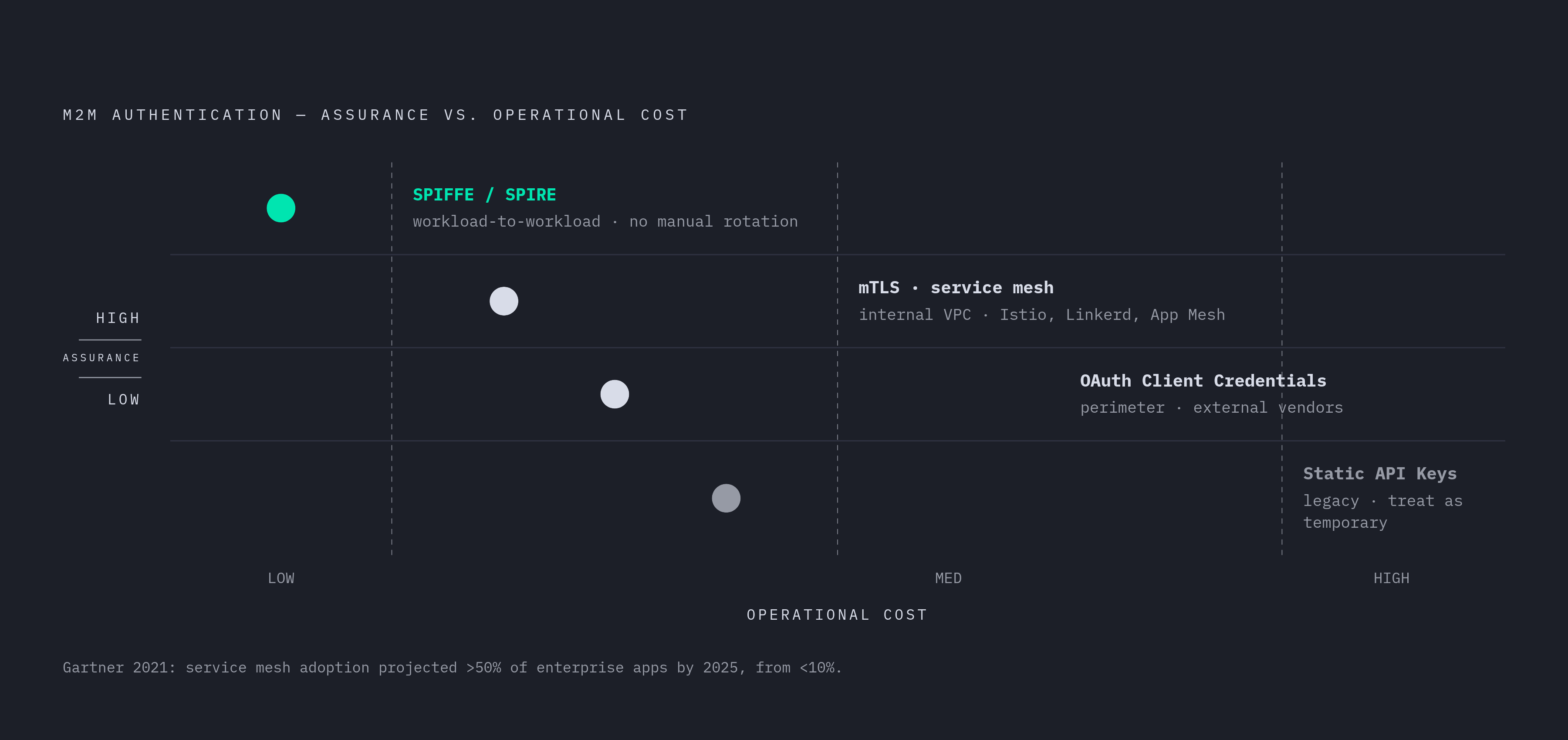
No single mechanism covers every surface. The job is matching mechanism to context and being honest about the tradeoffs.
For external integrations with vendors like Twilio or Salesforce: use OAuth Client Credentials with the vendor's authorization server and use their SDK. The protocol is standardized; the implementation details are where things go wrong, and the SDK exists to absorb those details.
For first-party API consumption by customer applications: OAuth Client Credentials with your own authorization server, scoped per customer. Tenant isolation belongs at the token level, not in application logic that can be misconfigured.
For internal service-to-service communication inside the same VPC: mTLS via a service mesh, with Istio, Linkerd, and AWS App Mesh being the common options, and scoped JWTs layered on top for application-level permissioning. A 2021 Gartner report projected that over half of enterprise applications would use service mesh technology by 2025, up from less than 10% in 2021. The internal mTLS layer is becoming standard infrastructure.
For legacy or low-stakes internal traffic: static API keys with a documented rotation plan. Explicitly the weakest option; treat it as temporary by default, because the organizational tendency is to let temporary become permanent.
For teams ready to build toward the mature pattern: SPIFFE/SPIRE inside the trust domain, OAuth at the perimeter, a trust broker at the boundary between them. This removes manual rotation from the internal layer while preserving token-based authorization flexibility for external and customer-facing surfaces.
For small teams, the sequencing is: get OAuth Client Credentials right for external and customer-facing API surfaces first, because that is the perimeter that matters most early on. Use a managed identity provider rather than building token issuance yourself; the complexity is in lifecycle management, not the protocol. For founders building SaaS or AI products who need auth alongside billing and customer data in one place, Tiun., a backend-as-a-service platform that consolidates authentication, payments, and analytics for startups into a single system, is one option worth considering before committing to a standalone identity provider. Store every secret in a secrets manager from day one. That last step closes the most common gap and is the one most reliably deferred until an incident forces it into the roadmap.