Session Management and Token Revocation in SaaS Applications
Stolen tokens and revocation delays expose SaaS apps to weeks of unauthorized access.
Session management is where most SaaS security quietly holds up or quietly falls apart. The difference comes down to four things that all talk to each other: token type, lifetime, revocation, and audit logging. Stolen session tokens are the payoff for credential theft, since a valid token skips login entirely. Curity's 2025 API security research found stolen credentials behind most web app attacks, Twilio's 2025 Auth Trends report tracked a jump in AI-assisted attack tooling since 2022, and GitGuardian found a large share of secrets leaked back in 2022 are still valid today. Detection without revocation leaves the door open with a sign that says "we noticed."
The root problem is how teams frame this stuff in the first place. Most treat session management as a setup task: configure it once during the auth build, then move on. That's why lifetimes never get retuned, why revocation paths get built but never tested, and why the whole system quietly rots while everyone assumes it's fine. These are decisions that keep talking to each other long after launch, well past whatever checklist first produced them.
The structural tension at the center of token design: statefulness vs. revocability
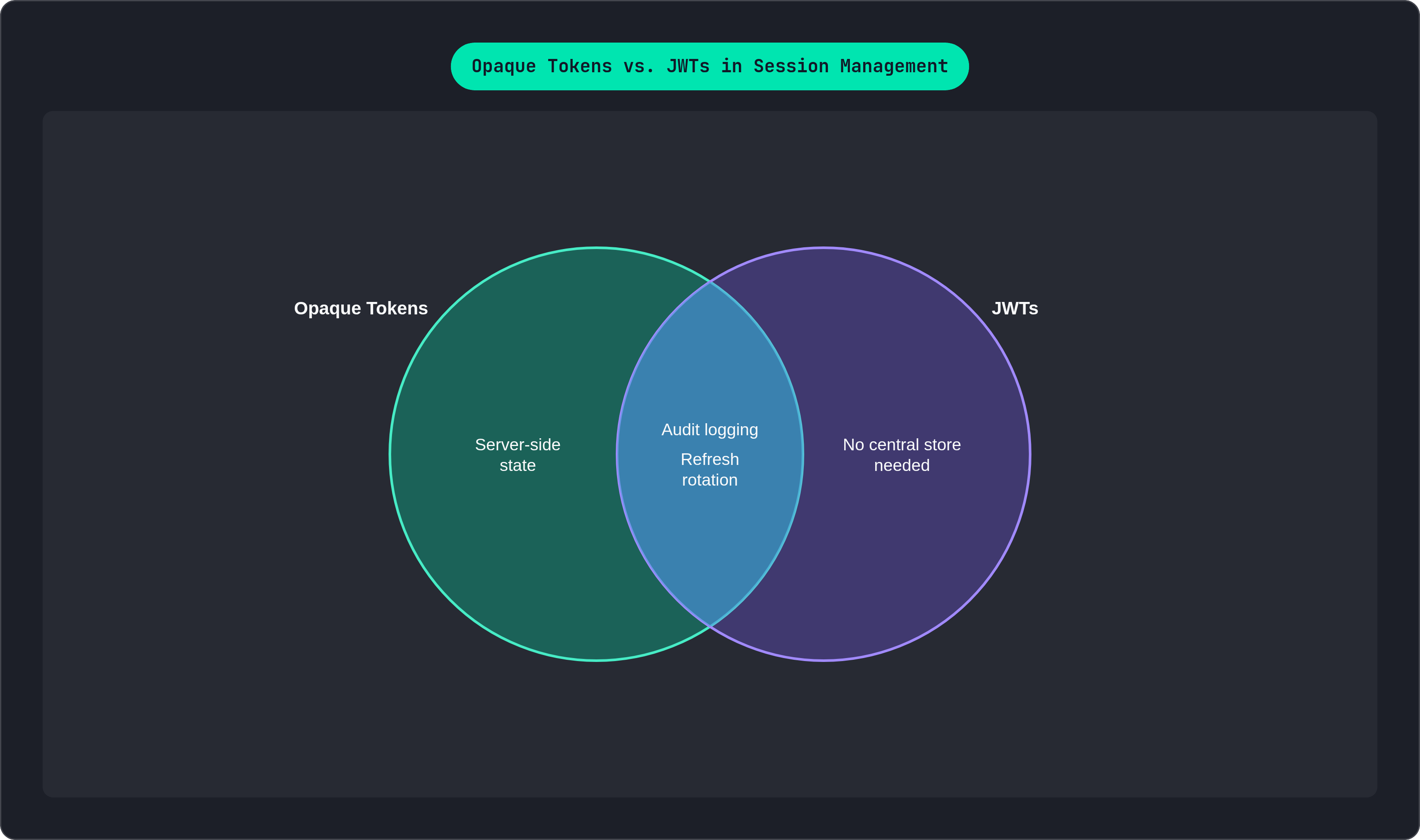
Two token setups run most of SaaS. Opaque session tokens keep the state on the server. JWTs carry everything inside themselves, so any service can check one without calling back to a central store. That's genuinely useful once you've got a dozen independently deployed microservices talking to each other.
Here's the catch. Being self-contained means the server has nothing to delete. A JWT stays valid until it expires, full stop, no matter what happens to the account behind it. Say a user resets their password because something on their account looked off. Any JWT issued before that reset keeps working right up until it naturally expires, unless someone bolted on a server-side check. And once you add that check, you've given up a good chunk of the reason you picked JWTs to begin with. That's not a bug. It's the trade-off working exactly as designed.
Opaque tokens flip the deal. The server holds the state, so killing a session is immediate: delete the record, the token's dead. The cost shows up in storage and lookup overhead instead. Neither wins by default. The right call depends on how badly your app needs to cut off access mid-session, not on whatever your framework ships with. This tension, scales easily versus revokes cleanly, runs underneath everything else in this piece.
How token lifetime choices shape the security-usability boundary
Token lifetime sounds like one number. It's really two settings working as a pair. Sliding expiration resets the clock every time the user does something, an idle timeout that logs someone out after, say, 30 minutes of nothing. Absolute expiration is a hard ceiling on session age no matter how active the user stays, which matters a lot when you don't want a session running forever just because someone left a tab open.
Short access token lifetimes are the main fix for the JWT revocation gap. A token that dies in 15 minutes gives an attacker a 15-minute window, not a standing invitation. Most practitioner guidance lands somewhere between a few minutes for high-risk actions and a few hours for low-risk ones. Refresh tokens stretch the user experience without stretching the actual access window, but they carry their own risk and need their own defense: refresh token rotation. Every time a refresh token gets used, the server issues a new one and kills the old one. If that old, already-dead token shows up again, that's a signal someone's replaying a stolen token, and the whole family of tokens tied to that session gets killed.
Here's a setup worth copying: short-lived access tokens, refresh tokens that last a week and rotate on every use, and an MFA re-check before high-risk actions. Each layer catches what the others miss. The real work isn't picking numbers off a chart, it's making short lifetimes invisible to a well-behaved user, so the refresh happens quietly in the background instead of kicking someone back to a login screen every 15 minutes and teaching them to hate your product.
Server-side revocation: why client-side session clearing is not revocation
Here's an anti-pattern that shows up constantly: a logout button that overwrites the browser's session cookie with a blank value and calls it a day. The server never hears about it. The old session record just sits there, still valid, still ready to answer requests. Anyone who grabbed the original cookie before logout can replay it, and as far as the server's concerned, that session never ended.
Real revocation happens on the server. Delete the session record, or flag it dead, and reject anything that shows up carrying that token afterward. The same gap opens up around password resets and MFA changes, where plenty of implementations let old sessions keep running after the user takes the exact defensive step meant to lock an attacker out. You changed your password because you got scared, and the attacker's session token didn't even notice.
At scale, teams solve this with revocation lists, often backed by Redis, that let you kill a JWT before its natural expiry. That's the bridge between stateless tokens and revocable sessions. It needs to track the token's ID (the jti claim), the original expiry time (so you can prune the entry once the token would've died anyway), and enough context, user, tenant, device, to scope the kill correctly. Yes, a Redis lookup adds a sliver of latency to every request. For most SaaS apps, that cost is nothing next to the alternative: sessions you simply cannot revoke. Cookie flags like HttpOnly and Secure help too, blocking JavaScript access and unencrypted transmission, but they only lower the odds of theft happening. Once a token's already stolen, those flags do nothing at all.
What revocation actually means in a multi-surface SaaS application
A modern SaaS session is a web of trust: a browser session, a mobile refresh token, OAuth grants handed to third-party apps, a SCIM-connected directory sync, maybe a service account token running quietly somewhere in the background. Kill one and you've shut down one path. The rest keep running unless someone goes and shuts them down too.
That has a direct consequence for incident response. When a session token gets stolen, the fix isn't killing that one token, it's tracing every path that token could reach and revoking each one on its own. Connected-app grants are the easy one to miss. An OAuth grant issued during that session may have handed scoped access to some external tool, and that grant keeps living long after the session that created it is dead.
AI agents make this worse. An agent running with a delegated token can chain a bunch of actions together before anyone notices the token's compromised, so the window for detection shrinks while the damage doesn't. Credentials should never touch the model layer at all; authentication belongs in the execution layer, checked before the agent's context even gets built. Multi-tenant SaaS piles on more complexity, since a token often carries tenant-scoped claims, and revocation has to respect those boundaries. Killing someone's session in one workspace should never touch their access in another. All of this points to one requirement: a session management system needs a full map of everywhere a token reaches, not just a definition of what the token is.
Audit logging as the verification layer that makes revocation trustworthy
You can't revoke what you don't know is compromised. That's what makes audit logging the thing that actually makes revocation mean something. Session logs need to capture token issuance, refresh events, scope changes, how a session ended (user closed it, system killed it, an admin forced it out), and failed validation attempts, since those often show up before a successful breach does.
Logging device context and IP address next to session records turns anomaly detection from a guessing game into something concrete. A refresh token suddenly used from a different country minutes after a normal login should trip an alarm, no question. Tracking concurrent sessions per user, and logging when someone blows past the limit, catches account sharing and token replay before they turn into bigger problems.
That GitGuardian finding, secrets leaked in 2022 still valid years later, is exactly the failure audit logging exists to catch: a leak nobody noticed, sitting there unrevoked. None of this matters if the logs themselves can be tampered with, so they need to be append-only and tamper-evident, the kind of record an attacker can't just wipe to cover their tracks. And for any SaaS company with users in the EU: session logs hold personal data (IP addresses, device IDs, timestamps tied to real people), so GDPR-compliant handling and European data hosting aren't optional extras, they're the baseline. Without a solid audit trail, there's no honest way to answer the question every security review eventually asks: was this account touched after the password reset?
How multi-tenant identity architecture changes session management requirements
Multi-tenant SaaS has to scope everything about a session, users, roles, permissions, active sessions, revocation events, to the right tenant, every single time. A session valid in one workspace has no business granting access to another. Tenant isolation at the session layer matters just as much as tenant isolation at the data layer. Treat it as an afterthought and you end up with one customer looking at another customer's data.
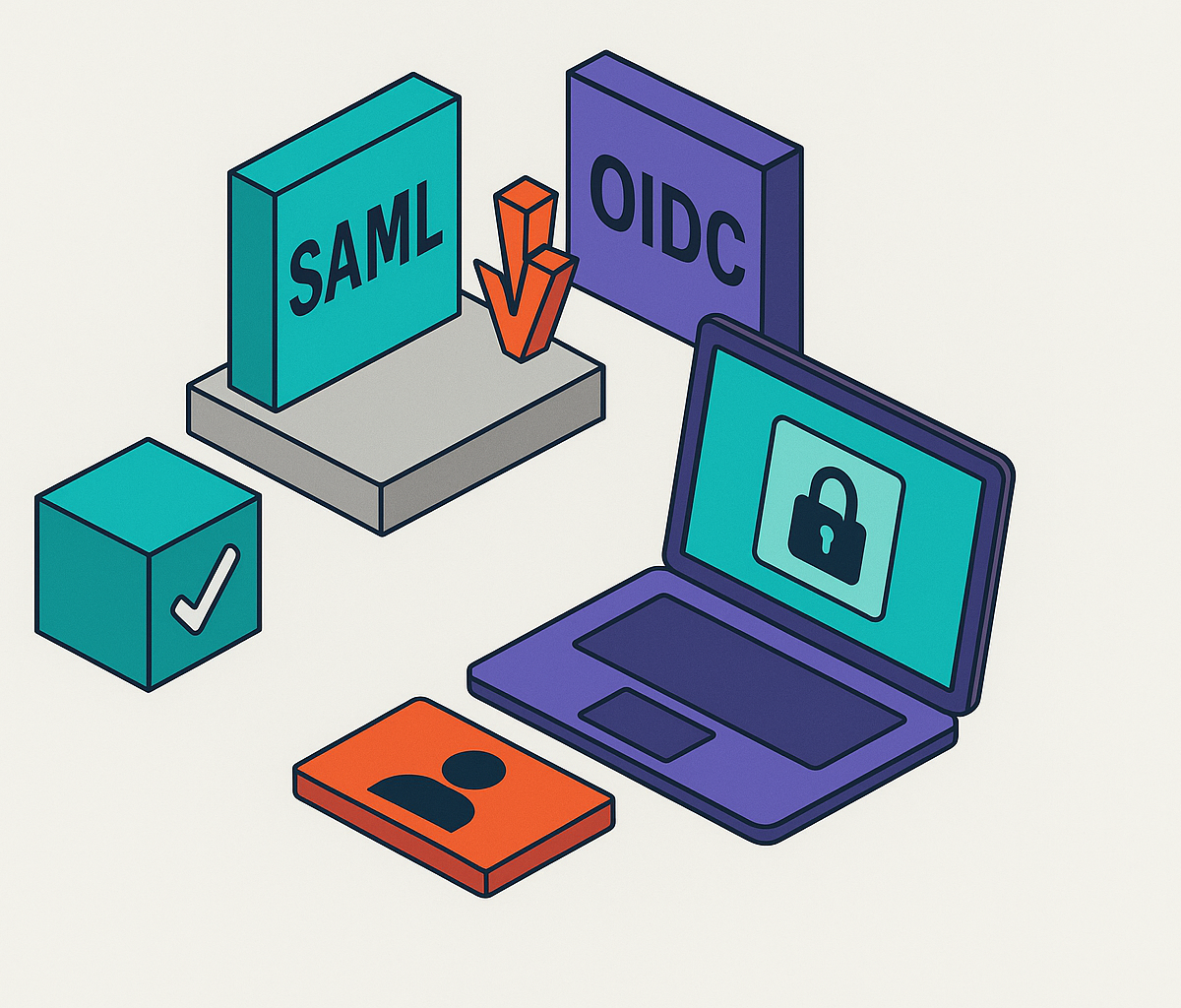
Enterprise customers bring their own checklist: SSO through SAML or OIDC (SAML tends to fit legacy enterprise identity providers, OIDC covers modern consumer and enterprise flows alike), SCIM provisioning, and the ability for an admin to force-terminate a session. Single Logout matters a lot here. When an enterprise admin deprovisions someone, every session across every connected app needs to die, not just the session with the identity provider. Auth0's Single Logout setup gets cited a lot for handling cross-application termination with token revocation built in, and Okta's library of more than 7,000 pre-built enterprise integrations is a big reason so many complex organizations lean on it.
Teams building this themselves should treat tenant-aware session management as a property of the platform, not something rebuilt by hand for every new tenant. That kind of custom logic gets expensive fast, and the cost only grows as tenant count climbs. Tiun runs authentication, the customer database, and analytics on one shared data model, which keeps tenant context consistent across every session event without syncing three separate tools that were never built to talk to each other. In microservices setups, auth sidecars sitting next to each service can check sessions locally while staying in sync with one central revocation store, fast and still working off a single source of truth.
Mapping session management decisions to a coherent implementation sequence
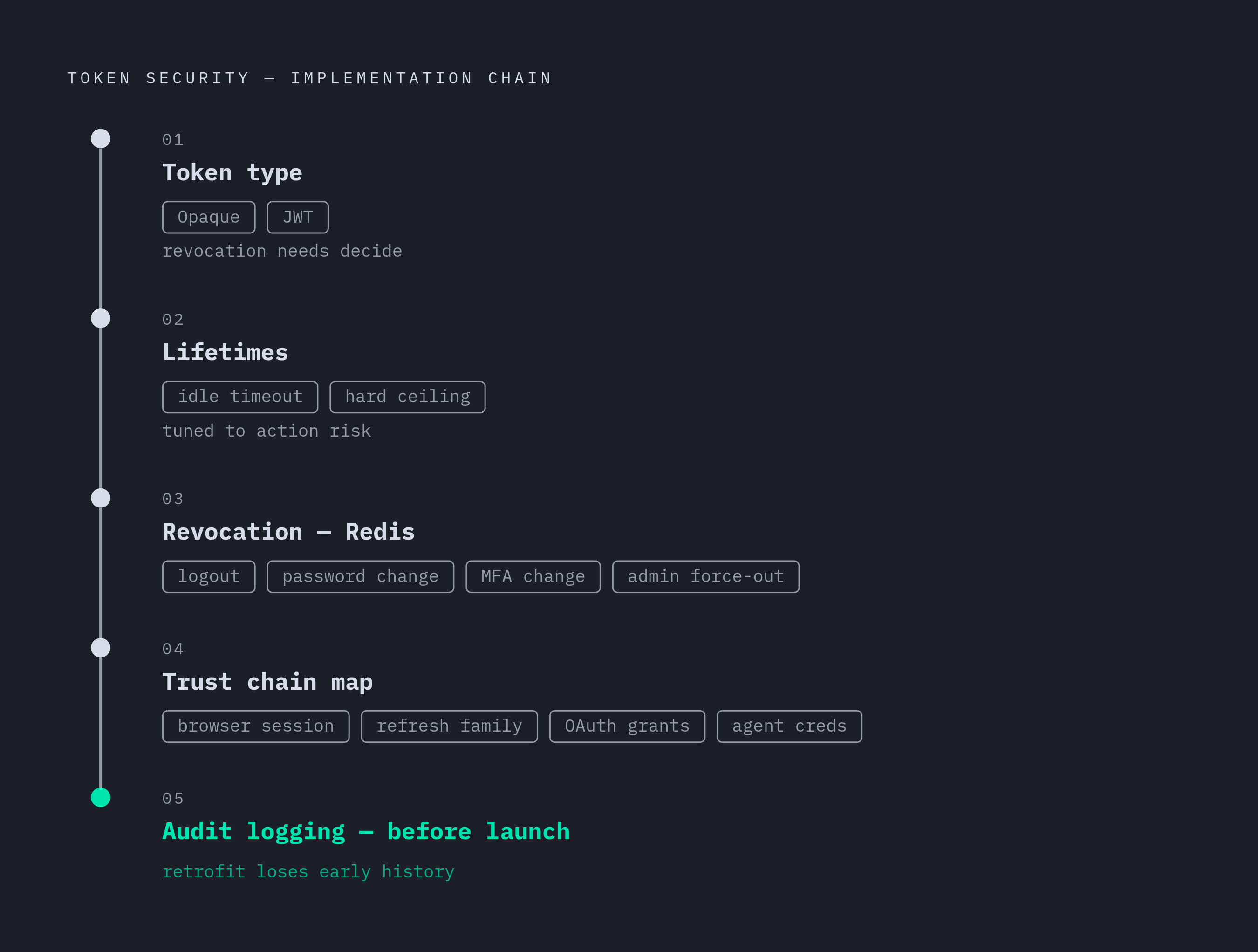
None of these decisions stand alone. Token type decides what revocation mechanisms are even possible. Revocation mechanism decides which audit events actually mean something. Audit events decide what kind of incident response you can run when something breaks. Pull one thread and the rest move with it.
Here's a sequence that holds up in practice. Pick your token setup based on what you need to revoke and how fast, not on whatever your framework defaults to. Set lifetimes as a pair, sliding and absolute together, tuned to how risky the actions behind that session actually are. Build server-side revocation on a fast lookup store like Redis, and write down the full list of triggers: logout, password change, MFA change, admin force-out, suspicious activity flagged by monitoring. Map every trust chain a token touches (browser session, refresh token family, OAuth grants, agent credentials) and give each one its own revocation path. Put audit logging in place before launch, not after; a retrofit means your early session history is gone for good, a blank spot in the record right when you'd most want to check it. For multi-tenant products, prove tenant isolation holds at every layer before you add tenants, not after you've got twenty of them depending on it.
Most teams stall on the same problem: keeping revocation state in sync across the auth service, the API layer, and whatever data stores sit downstream, especially when those pieces live in separate tools with separate data models that were never built to agree with each other. A single backend removes that sync problem instead of managing around it, which is the whole idea behind Tiun keeping session, identity, and usage data in one place. A revocation event shows up everywhere at once, instead of trickling through three systems on three different schedules.
This sequence holds up over time because it follows the actual shape of the problem. Passkeys, token binding (Microsoft Entra's conditional access research covers this well), device attestation, whatever shows up next slots into one of these five layers without forcing a rebuild. Session management maturity isn't a feature you ship, it's an operational state, one where logging, revocation, and monitoring are already running and already tested, well before an incident shows up and makes you wish they were.