Shared vs. Dedicated Database Models in Multi-Tenant SaaS
Choose your database model deliberately or pay the cost later in compliance audits and rebuilds.
The database partitioning decision in a multi-tenant SaaS product is not a detail to defer. It shapes how the product scales, what compliance posture is achievable, and how much operational weight the engineering team will carry for as long as the product exists. Most teams that regret their choice did not choose badly through careful analysis. They chose by default, picking whatever the first tutorial showed or whatever felt simplest in week two. The cost of that default shows up late, not as a bug but as an architectural rebuild triggered by a compliance audit, an enterprise deal, or a performance incident that exposes the model's ceiling. This piece does not name a winner among the three canonical models. It makes the tradeoffs visible so the choice can be deliberate.
What the Three Models Actually Are and What Separates Them
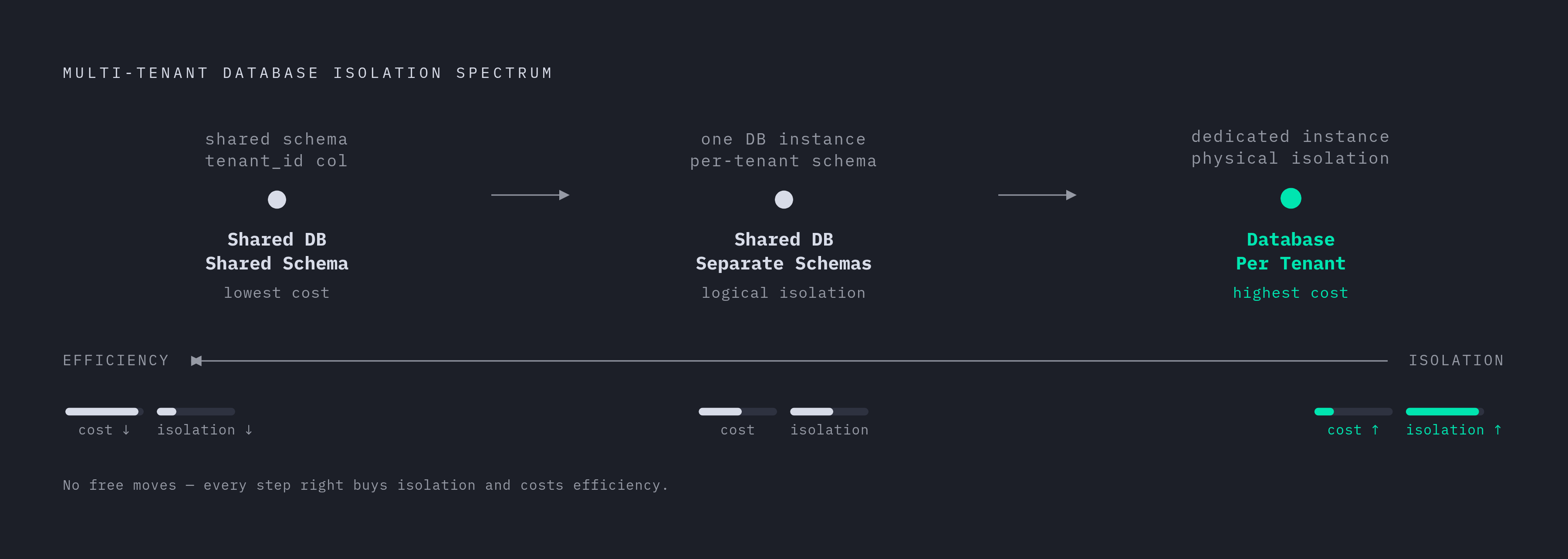
The spectrum runs from shared-everything to shared-nothing. The three canonical patterns mark three distinct positions on it, and each one embodies a different bet about where complexity should live.
The first model, shared database with shared schema, places all tenants in the same tables. A tenant_id column carries the separation. Isolation is logical, enforced at the application layer or through database-level policy controls. There is one database, one connection pool, one migration path. It is the simplest thing that could possibly work.
The second model, shared database with separate schemas, gives each tenant a dedicated logical container within the same database instance. That container holds that tenant's tables, views, and indexes. Tenants still share the underlying database infrastructure, but the boundary between them exists at the database layer, not only in application code.
The third model, database-per-tenant, gives every tenant a fully dedicated database instance. Isolation is physical. One tenant's query load, compromised credential, or database-level outage cannot touch another tenant's data path.
The organizing principle across all three: each step toward isolation trades resource efficiency for a cleaner blast radius. Neither end of the spectrum is universally correct. It is worth naming something these models do not determine: compute isolation is a separate architectural decision. A clean data model alone does not prevent one tenant's workload from degrading another's performance. That distinction matters more than most teams expect, and it gets its own treatment later.
The Shared-Schema Model's Real Strengths and Its Genuine Failure Modes
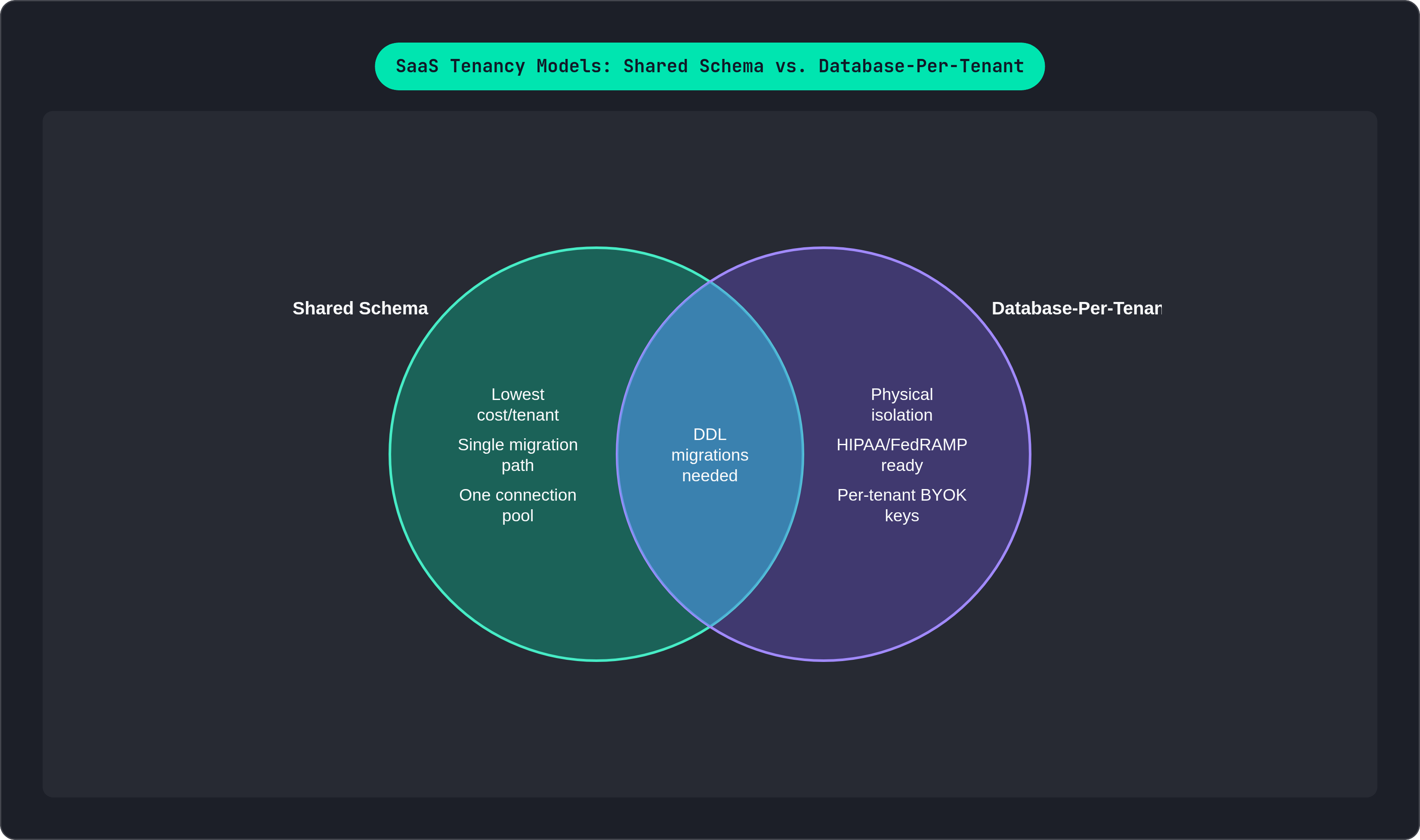
The shared-schema model has genuine strengths that deserve honest acknowledgment. It carries the lowest infrastructure cost per tenant of any model. Schema migrations run once and propagate to all tenants simultaneously, with no per-tenant rollout coordination. The operational footprint is minimal: one backup strategy, one connection pool, one monitoring surface. For a cost-constrained team serving a homogeneous customer base with low regulatory exposure, this model is not a compromise. It is the correct choice.
The failure mode is not theoretical. A single missed WHERE clause or a misconfigured row-level security policy becomes a cross-tenant data leak. The risk is not primarily in the database design; it is in the sustained organizational discipline required to enforce the boundary on every query, in every code review, from every new developer who joins the team. Think of it like a firewall made of good intentions — it holds until someone forgets to update it.
PostgreSQL's row-level security is the standard enforcement mechanism, and it is worth understanding where it actually struggles. Real-world benchmarks show that RLS latency overhead is small when indexes are in place. The bottleneck is almost always missing indexes, not the policy check itself. But the index discipline and the RLS discipline are two separate organizational commitments that both have to hold simultaneously.
There is a specific implementation hazard that warrants attention. Using SET instead of SET LOCAL with connection pooling can leak the previous tenant's session context to the next request. pgBouncer compatibility must be tested explicitly, not assumed. A disclosed PostgreSQL vulnerability, CVE-2024-10976, demonstrated this concretely: RLS policies applied below subqueries disregarded user context mid-session, meaning one tenant's query returned another tenant's rows in a connection-pooled application. That is not a theoretical edge case. That is a production incident waiting for the right conditions.
The regulatory ceiling is the other honest constraint. Logical isolation is insufficient for some customers operating under HIPAA, PCI-DSS, FedRAMP, or similar frameworks, depending on their specific compliance posture and risk requirements. The implications for sales are direct. This model can close enterprise doors before a sales conversation begins, because a security questionnaire will ask about isolation at the infrastructure layer, and "we use row-level security" is not an answer that satisfies an enterprise compliance team at a regulated institution.
Best fit: early-stage products, cost-constrained teams, low regulatory exposure, and customer bases where no single tenant demands physical isolation.
Where Schema-Per-Tenant Fits and Where It Quietly Breaks Down
The appeal of the schema-per-tenant model is intuitive. It offers stronger isolation than row-level controls without the full infrastructure cost of separate databases. It is the reasonable middle ground. At low tenant counts, that intuition is correct.
The genuine advantages are real. A misconfigured query in one tenant's schema does not expose another tenant's rows at the database layer, which is a meaningful improvement over shared tables. There are fewer databases to monitor and back up than the silo model requires. The compliance story is more credible than shared tables, even if it is not equivalent to physical separation.
The operational liability emerges with scale, and it compounds in ways that are easy to underestimate early. Every DDL migration must run against every tenant schema individually. Running them sequentially is safe but slow; running them in parallel introduces the risk of partial failures across tenants, where some schemas are updated and some are not, leaving the application in an inconsistent state. Routing connections to the correct schema adds overhead that compounds as tenant count grows. Database object limits and migration time increase as active schema counts grow into the hundreds and beyond. A benchmark from Azure SQL found that separate schemas required meaningfully more management overhead than shared schema due to schema proliferation. The isolation gain comes with a real operational tax.
Practitioners who work at scale with this model often arrive at a pointed observation: schema-per-tenant is like being halfway across a bridge — you have committed to the crossing but have not yet arrived at the stronger shore. It introduces complexity comparable to database-per-tenant without delivering the isolation level that stringent regulatory compliance actually requires. That is worth sitting with. The middle position has to earn its tradeoffs, and for teams expecting rapid tenant growth or facing rigorous compliance requirements, it frequently does not.
Best fit: mid-market products with a few hundred tenants, moderate compliance needs, and an operations team prepared to invest in migration tooling before they need it.
What Database-Per-Tenant Actually Costs and What It Buys
Physical isolation delivers specific things that no logical model can replicate. A compromised credential, a runaway query, or a tenant-level outage affects only that tenant's database. Regulatory compliance becomes straightforward in the best sense: HIPAA, PCI-DSS, FedRAMP, and SOC 2 auditors can verify isolation physically, not by reviewing application code and trusting that the policy layer held. Data residency requirements are easier to fulfill when each tenant's database can be placed independently. Per-tenant backups and restores are clean. Premium commercial features like Bring Your Own Key and Customer-Managed Keys become available, because they require per-tenant key architecture as a prerequisite. For enterprise SaaS targeting regulated industries, these are not amenities. They are table stakes.
What it costs is also specific. Infrastructure costs rise with each new tenant. The per-tenant cost floor is higher than any shared model, and industry experience shows that costs increase substantially once tenant counts exceed a few hundred without deliberate automation and cost management. The operational surface multiplies: backups, monitoring, patching, and connection management all scale per tenant rather than per product. PostgreSQL connection limits become a real bottleneck at scale, because each dedicated database brings its own connection overhead. Schema migrations still require running across all databases, and automation is not optional here. It is table stakes for operating this model at any meaningful scale.
Best fit: enterprise SaaS targeting regulated industries, products where any single customer's compliance requirement would block a deal under a shared model, and teams with the operational maturity to automate across many database instances.
How Noisy Neighbors and Blast Radius Should Drive Isolation Decisions More Than Cost Alone
The noisy neighbor problem is worth naming precisely. One tenant's heavy import, batch job, or complex query consumes shared CPU, memory, or I/O in ways that degrade every other tenant on the same infrastructure. This is not a data isolation problem. It is a resource contention problem, and it exists independently of which data model is in use.
Research on cross-tenant interference has found that memory-intensive workloads cause more cross-tenant degradation than CPU-bound ones. This matters because teams tend to plan compute scaling and memory allocation with the same model, when in practice they require separate strategies. A shared-schema product with rigorously enforced RLS can still exhibit severe noisy-neighbor behavior if compute is not independently throttled per tenant. Moving to row-level security addresses logical data isolation; it does not automatically contain one tenant's resource consumption.
Blast radius is a more clarifying decision lens than cost alone. In a shared database, a single database-level vulnerability, compromised privileged credential, or misconfigured policy exposes all tenants simultaneously. In a silo model, the same event affects one tenant. The question worth asking is not "what is the probability of an incident?" but "if an incident occurs, how many customers are affected?" The expected cost of a breach is probability multiplied by impact, and in a shared model the impact variable is as large as the entire customer base.
The global average cost of a data breach has reached multi-million-dollar levels and has continued to grow year over year. A breach in a shared-model architecture is not one tenant's problem. It is every tenant's data, simultaneously. Teams should map their customer base's sensitivity before choosing an isolation model. A product serving individual developers tolerates a different blast radius than one serving hospitals or financial institutions.
The Real Switching Cost When the Model No Longer Fits
The tenancy model is baked into application design at a level that makes it expensive to change. This is not a configuration switch. The routing logic, the connection management, the migration strategy, the compliance documentation: all of it is built around the model that was chosen first.
The trigger for most rebuilds is not a gradual realization. It is a specific event. An enterprise prospect's security questionnaire, a compliance audit, or a performance incident that exposes the model's ceiling. By the time the trigger arrives, the product is in production, tenants are live, and the cost of migration includes not just engineering time but the revenue from deals that will not wait for a rebuild to complete.
Audits of SaaS products that have hit the isolation-model wall consistently find the same pattern: the majority lose the deal that triggered the audit, and rebuilds take many weeks on average. The opportunity cost is not the engineering time. It is the foregone revenue from prospects that evaluated the product, found the isolation model insufficient, and moved on.
The migration mechanics compound the cost. Moving from shared schema to schema-per-tenant or database-per-tenant requires tenant data extraction, schema provisioning, and validation for every existing customer. Sequential migration is safe but slow. Parallel migration risks partial failures. During the transition, the application layer must support both models simultaneously, which is a period of compounded complexity that introduces its own failure modes. Retrofitting isolation controls after the fact is substantially more expensive than building the right model from the start. The cost multiplier is real and well-documented in cloud migration literature.
The implication is simple and often ignored: the right time to think about compliance and scale ceilings is before the first tenant is provisioned, not when the first enterprise deal is on the table.
How Tiered Isolation Resolves the False Choice Between Cost and Compliance
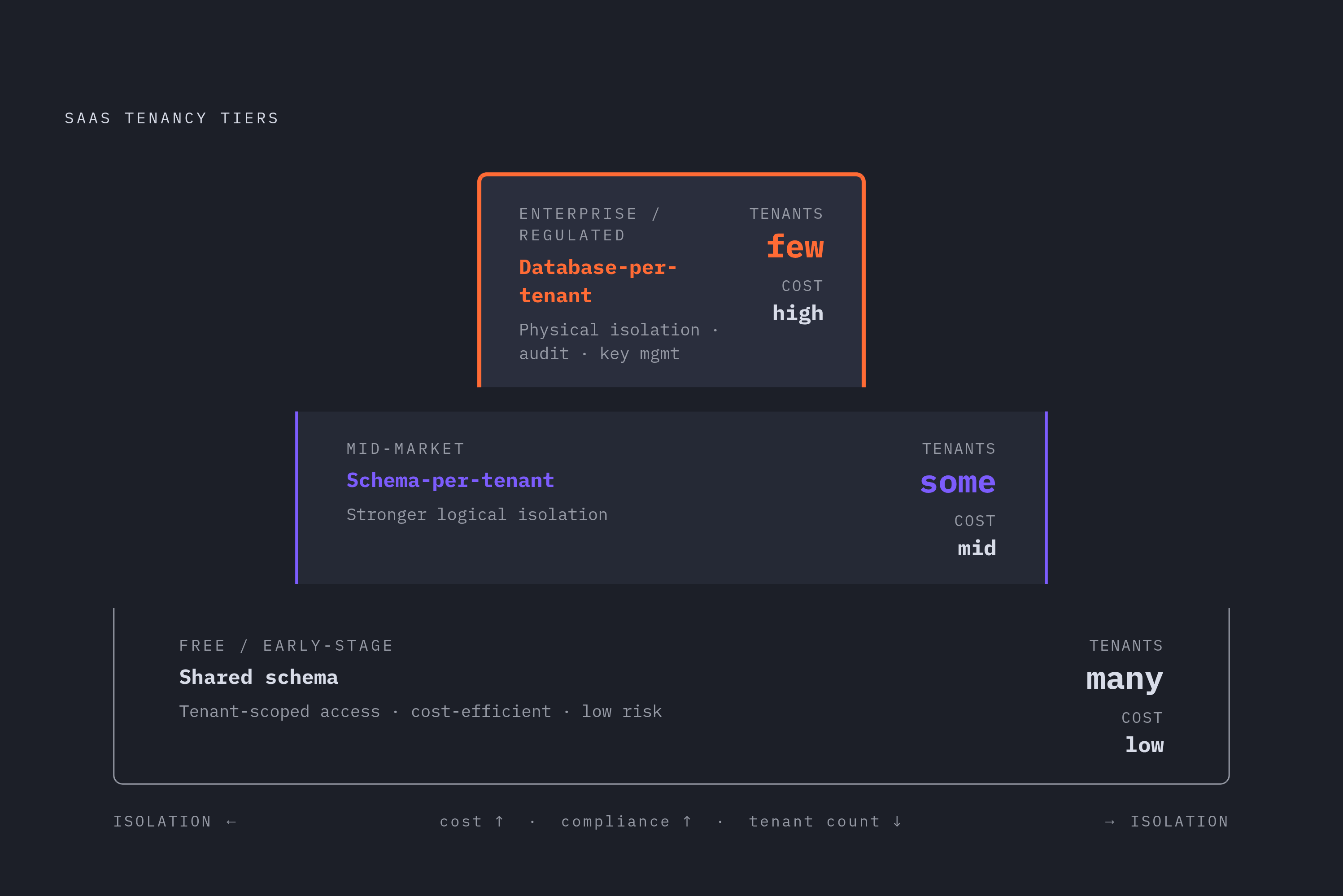
The framing of "which model should we use" is itself a premature constraint. Most mature SaaS platforms do not use a single model. They map isolation level to customer segment based on what each segment actually requires.
A common tiered pattern works like this. Free and early-stage users get shared schema with tenant-scoped access controls, which is cost-efficient and adequate for low-risk workloads. Mid-market customers with moderate compliance needs get schema-per-tenant, providing stronger logical isolation without full per-tenant infrastructure. Enterprise and regulated customers get database-per-tenant, delivering the physical isolation, auditability, and key management prerequisites that those customers require.
The commercial logic is direct. The isolation upgrade becomes a pricing axis. Enterprise customers who demand physical isolation are also the customers who can support the infrastructure cost that model carries. The cost and the value align.
What this requires from the application layer is equally direct. The application must be designed from the start to route tenants to the correct isolation tier. Tenant metadata, including which tier, which database or schema, and which encryption key, must live in a single authoritative store that the application can query reliably. Adding this routing after the fact is the same category of expensive rebuild described in the previous section.
By 2025, a hybrid approach using pooled shared tables for small tenants and dedicated databases for large or regulated ones has become the most widely adopted pattern among mature SaaS platforms. It is not a clever workaround. It is the natural conclusion of taking the tradeoffs seriously.
Tooling That Makes Each Model Operational in Practice
Good tooling does not change the tradeoffs. It determines whether a team can actually operate the model they choose at the scale they need.
For shared schema with RLS, PostgreSQL's native row-level security remains the standard enforcement mechanism. The implementation discipline around index design, connection pooling compatibility, and session variable handling is where most teams underinvest. pgBouncer compatibility with session-level variables must be explicitly tested, not assumed. The gap between "we have RLS configured" and "our RLS is correctly enforced across every query path and connection pooling scenario" is where real-world breaches live.
For schema-per-tenant at scale, Citus's schema-based sharding provides a path to horizontal scalability for teams that need schema isolation with growth headroom. It is used by high-growth enterprise SaaS platforms targeting large tenant counts precisely because it extends the schema-per-tenant model beyond the point where a single PostgreSQL instance becomes a bottleneck. Migration tooling is not optional at this scale. Teams operating hundreds of schemas need automation that can run DDL across all schemas reliably, report partial failures accurately, and roll back cleanly.
For database-per-tenant, Neon and Turso are current developer-accessible options that have seen meaningful adoption. Neon offers serverless Postgres with branching, which simplifies per-tenant provisioning and reduces the cold-start overhead historically associated with spinning up new database instances. Turso takes the silo pattern further with edge-distributed SQLite and per-database-per-tenant support, which is relevant for latency-sensitive or data-residency-constrained products that need tenant databases close to users geographically. Both platforms benefited from developer migration following PlanetScale's shift to enterprise-only pricing in 2024. For compute isolation at scale, Kubernetes namespace-per-tenant is the standard approach, giving each tenant a logical boundary for resource quotas and network policies within a shared cluster.
The tooling landscape continues to mature, which makes the database-per-tenant model operationally accessible to smaller teams than it was a few years ago. That accessibility changes the cost calculus at early stages. A team that previously could not afford the operational overhead of the silo model will find that serverless Postgres or edge SQLite changes that equation materially. The tradeoffs still exist. The question is whether the tools available today make them manageable for a specific team's capacity.