Customer Data Platform vs. CRM for SaaS Teams
CDPs track behavior; CRMs track conversations—pick the right one for your stage.
Let's be honest about what a CRM does well, because it genuinely does a lot of things well.
- It manages account hierarchies. One company, many seats, many contacts, all organized.
- It tracks your pipeline, renewals, and expansion conversations.
- It logs every human touchpoint: calls, emails, support tickets, handoff notes from the rep who quit six months ago.
- It feeds deal history into forecasting so your revenue team has something better than gut instinct to work with.
If you have a sales team managing enterprise accounts, a CRM is not optional. That's just true.
But here's where it starts to crack for SaaS. CRM data is almost entirely driven by human action. A rep logs a call. A support agent creates a ticket. Someone manually updates a deal stage. The system reflects what people chose to record, not what actually happened inside your product.
So when a user quietly stops logging in, or a team slowly abandons a core feature over three weeks, nothing in the CRM moves. No alert. No flag. The contact record looks completely fine right up until the cancellation email arrives.
That's not a bug. It's a structural limit baked into what a CRM was designed to ingest. CRMs were built for sales-led growth, where a human is present at every meaningful moment. Product-led growth doesn't work that way. Your "customer" might be a free trial user, an anonymous visitor, or someone clicking through your onboarding flow at 11pm on a Sunday. Nobody's watching. Nobody's logging anything. The CRM shows you the contact record. It doesn't show you the three weeks of disengagement that came before the churn conversation.
By the time the signal shows up in your CRM, you're already behind.
What a CDP Actually Does, and Why Behavioral Data Is a Different Animal
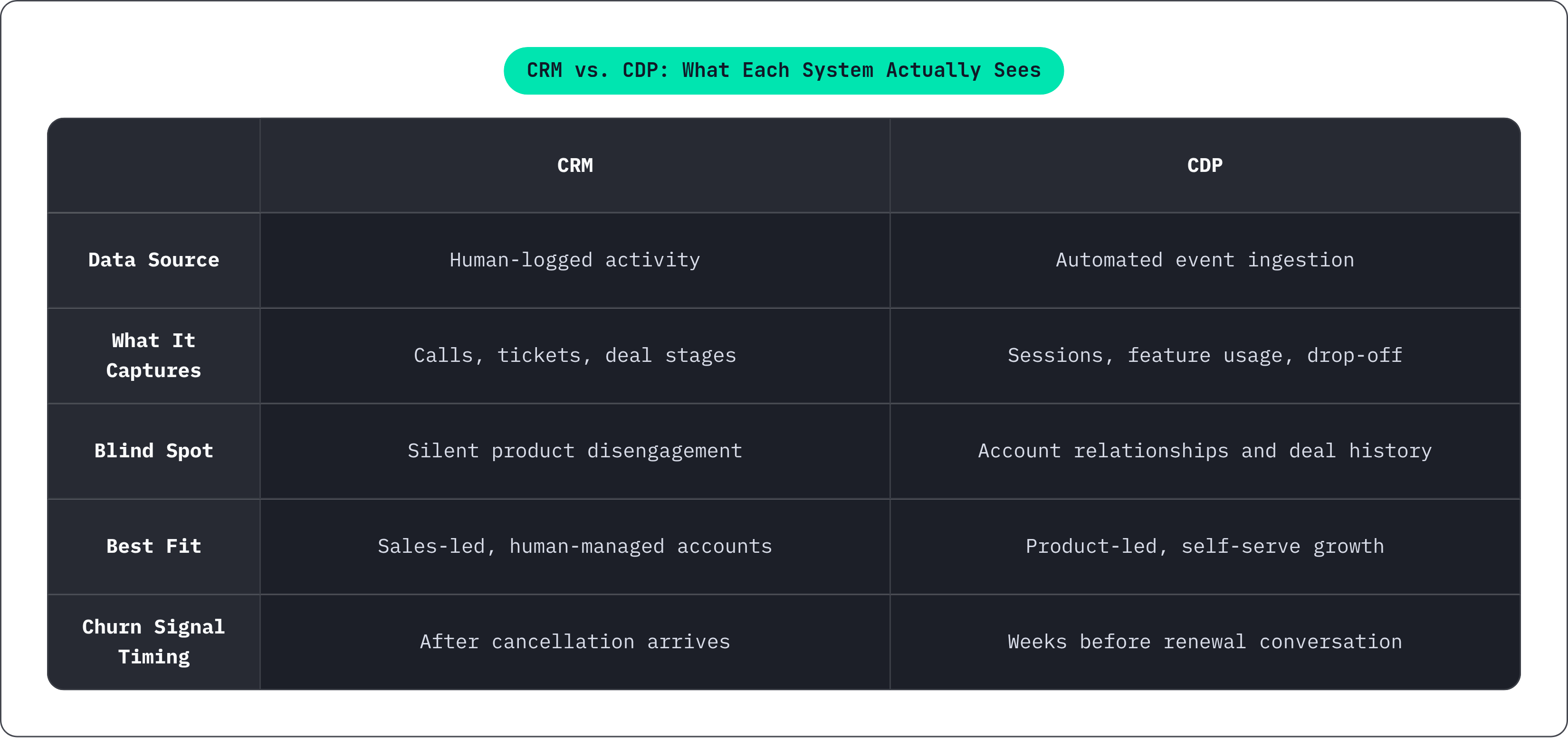
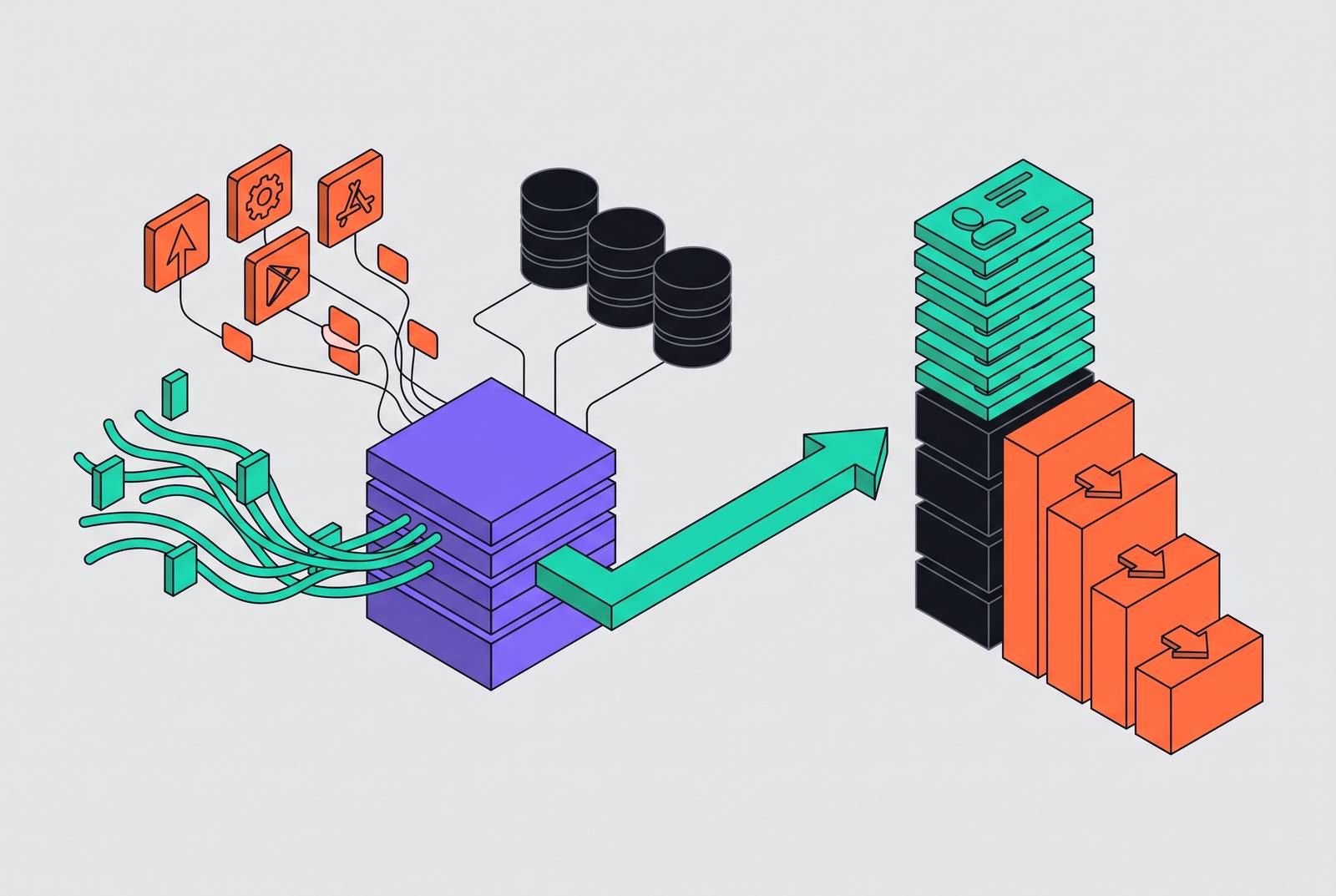
A Customer Data Platform does one core thing: it continuously ingests event-level data from every touchpoint. Web, mobile, in-product, email, third-party. Then it stitches all of that into a single profile per user or account.
That sounds abstract. Here's what it looks like in practice.
When a user visits your marketing site anonymously, the CDP tracks that session. When they sign up for a free trial, it connects that anonymous session to the new account. When they start using features, or quietly stop using them, it records all of that in real time. By the time a CS rep gets involved, there's already a complete behavioral timeline going back to the first anonymous visit.
Some things this actually unlocks:
- You can see which features a user touched before they converted from free to paid.
- You can detect churn signals, like reduced login frequency or feature drop-off, before any human on your team notices.
- You can build audience segments based on actual usage patterns, not just job title or company size from a form field someone filled out two years ago.
- You can feed those segments into automated workflows: in-app nudges, lifecycle emails, CS alerts.
The profiles update as behavior happens. It's a running record, not a filing cabinet.
The deepest shift a CDP creates is in what it means to "know" a customer. A CRM tells you what they told you. A CDP tells you what they showed you. For product-led SaaS, behavior is the more honest story. Users lie to salespeople. They don't lie to product analytics.
Your Growth Stage Determines Which Gap Actually Hurts
Here's where teams get into real trouble. They invest in the wrong tool for their stage, or they invest in both before they can actually use either.
Early stage, pre-product-market fit. Your primary job right now is learning. Which users convert? Which features drive activation? Where does everyone drop off? A CRM at this stage frequently becomes a graveyard of stale contacts, because there's no repeatable sales motion to feed it yet. You don't need contact management. You need behavioral signals.
The trap is that a CRM feels professional. It looks like something a real company would have. So teams buy it, fill it with contacts, and then mostly ignore it because their growth is product-led, not sales-led. I've watched this happen at companies that had beautifully organized CRM pipelines and absolutely no idea why 60% of their trial users never came back. The pipeline looked healthy. The product experience was a black box.
Growth stage, scaling a repeatable motion. Now both problems exist simultaneously. Your sales team needs account history. Your product team needs usage context. A CS rep managing renewals needs to walk into a call knowing whether the customer's team has been active or slowly going dark for the past month.
This is where the CRM becomes genuinely necessary, and where the absence of behavioral data starts costing real money. The rep knows the contract value. They don't know the customer stopped using the thing they're paying for. That specific gap is where revenue falls through, quietly, deal after deal.
Which problem is actually bleeding you? Are your biggest revenue leaks happening because reps lack account history, or because nobody sees the behavioral warning signs early enough? Figure that out first. The order matters more than most people admit, and getting it wrong is an expensive lesson.
The Case for Running Both. And the Integration Tax Nobody Warns You About.
When teams figure out they need both tools, the standard answer is to connect them. The CDP generates behavioral profiles and pushes enriched data into the CRM. A CS rep opens a contact record and sees usage trends alongside deal history. Marketing pulls a segment with behavioral cohort data already appended. Automated playbooks fire from CDP events and log back into the CRM as activity.
That architecture works. It's genuinely powerful when it runs smoothly, and "when it runs smoothly" is doing a lot of work in that sentence.
What doesn't show up in vendor comparison charts is what it actually takes to keep the thing running.
- Two platforms. Two contracts. Two sets of APIs with their own deprecation cycles and rate limits and support tickets going nowhere.
- Event schemas defined in one system don't automatically translate to the other. Someone has to own that mapping. And then own it again six months later when your product changes.
- When a user upgrades their plan or changes roles, that update has to propagate correctly to both systems. If it doesn't, neither system is fully trustworthy, and you end up in a meeting where two people are looking at different numbers and nobody knows which one is right.
- Every sync has its own version of the truth. At some point the two systems will disagree about something important, and figuring out which one is correct is nobody's idea of a productive afternoon.
For a team of two or three people, that synchronization work competes directly with product development time. It's not a one-time setup cost. It compounds as your product evolves and you add more tools to the stack.
Which raises a question worth sitting with: is the two-tool architecture actually a best practice, or is it a workaround for the absence of something more unified underneath?
What a Unified Backend Actually Changes About This Tradeoff
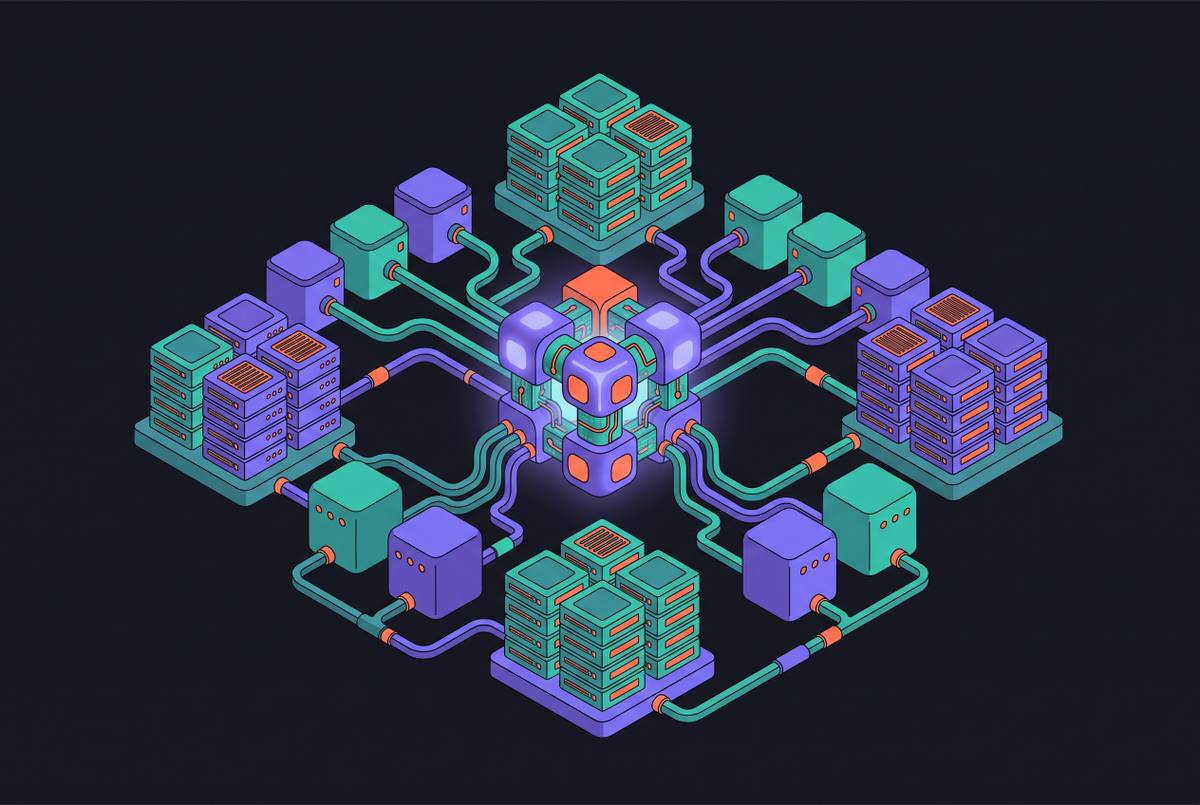
The premise behind a unified backend is straightforward. If authentication, payments, usage events, and customer records all live in the same system, a meaningful chunk of what CDPs and CRMs do separately is already handled at the data layer. Before you've written a single line of integration code.
Every user record is connected to their signup event, their billing history, and their product activity. Churn signals, plan upgrades, and feature adoption are visible in the same place as the account record. There's no synchronization problem because there's nothing to synchronize. Behavioral data and transactional data aren't two separate pictures you have to hold up side by side and squint at. They're already the same picture.
Tiun. is built around this idea. As an all-in-one backend platform for SaaS and AI startups, it consolidates authentication, payments, customer data, and analytics into a single system, so the connection between what a user did and what they paid for exists from day one, without a custom integration layer assembled afterward and maintained indefinitely. For teams where the product is the primary growth channel, that's a category of operational debt that just never accumulates.
This matters most for a few specific situations:
- Indie founders and small teams who genuinely cannot afford to run two platforms and a custom sync layer on top.
- AI and SaaS products where usage data and billing data need to inform each other continuously, not in batches.
- Teams where integration maintenance would directly compete with shipping the product, which is most early-stage teams, if they're honest about it.
A unified backend is not a replacement for a purpose-built enterprise CRM if you have a large sales org with complex deal management. That's a genuinely different problem for a different kind of business. The relevant use case here is product-led SaaS, where the product is doing most of the growth work and fragmented infrastructure creates real friction before a team is equipped to absorb it.
So What Does Your Team Actually Need Right Now
Before you buy anything, answer these.
Where are your biggest revenue leaks? In the sales motion, or in the product experience that precedes it?
Do you have human-managed accounts that require contact history and deal tracking? Or is your growth mostly self-serve?
Can your team realistically own and maintain a multi-tool integration layer, or does that work come directly at the cost of building the product?
Most teams, when they're being honest, know the answers. The answers usually point somewhere specific.
You probably need a CRM first if you have a repeatable outbound or expansion motion, your revenue depends on human relationships, and reps are losing deals because they lack account history.
You probably need behavioral event data first if you have self-serve signups churning without ever talking to anyone and you have no visibility into why.
A unified backend is worth evaluating seriously before either if you're early, your team is small, your product is the primary growth channel, and the overhead of two specialized tools would slow you down more than they'd help.
Start with the visibility gap that's costing you money right now. Add the complementary capability when the pain is concrete, not theoretical. And when you have a choice, keep behavioral data and transactional data as close together as possible. The further apart they live, the harder it is to act on either one before it's too late.