Chargeback vs Refund for SaaS Subscription Billing
Chargebacks cost far more than refunds—in fees, time, and network penalties.

A refund is a choice you make. A chargeback is something that happens to you. For SaaS subscription businesses, that difference is what separates a manageable problem from a serious one. Steering customers toward refunds before they ever reach a dispute window is one of the most underrated operational skills in the subscription world, and most founders treat it as an afterthought until the damage is already done.
So, the basics. A refund is merchant-initiated. You decide to return the money, you process it, done. A chargeback is bank-initiated. The customer goes to their card issuer, says "I don't recognize this," and the bank reverses the transaction. You're not consulted first. You find out after the fact.
That timing difference matters more than most people realize.
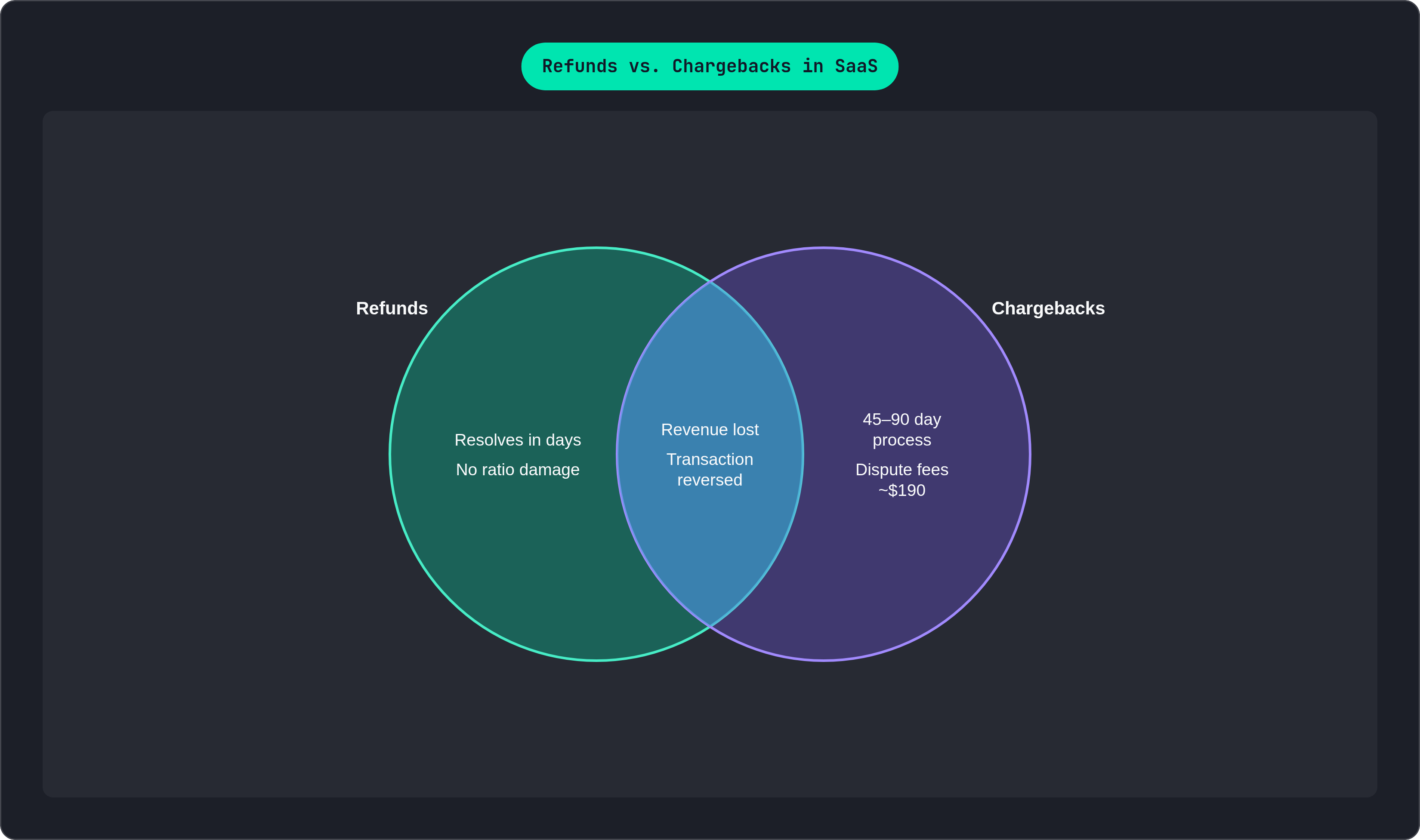
A refund resolves in days. A chargeback opens a formal dispute process that typically runs 45 to 90 days. During that window, the funds are gone, the clock is ticking, and you're building an evidence file. Think of a refund as a controlled burn and a chargeback as a wildfire — same origin, entirely different aftermath. The structural reason these two outcomes aren't interchangeable: refunds don't count against your dispute rate. Chargebacks do. That single asymmetry is why everything else in this article exists.
When a chargeback comes in, the direct hit looks like this:
- You lose the transaction amount (same as a refund, so far so good)
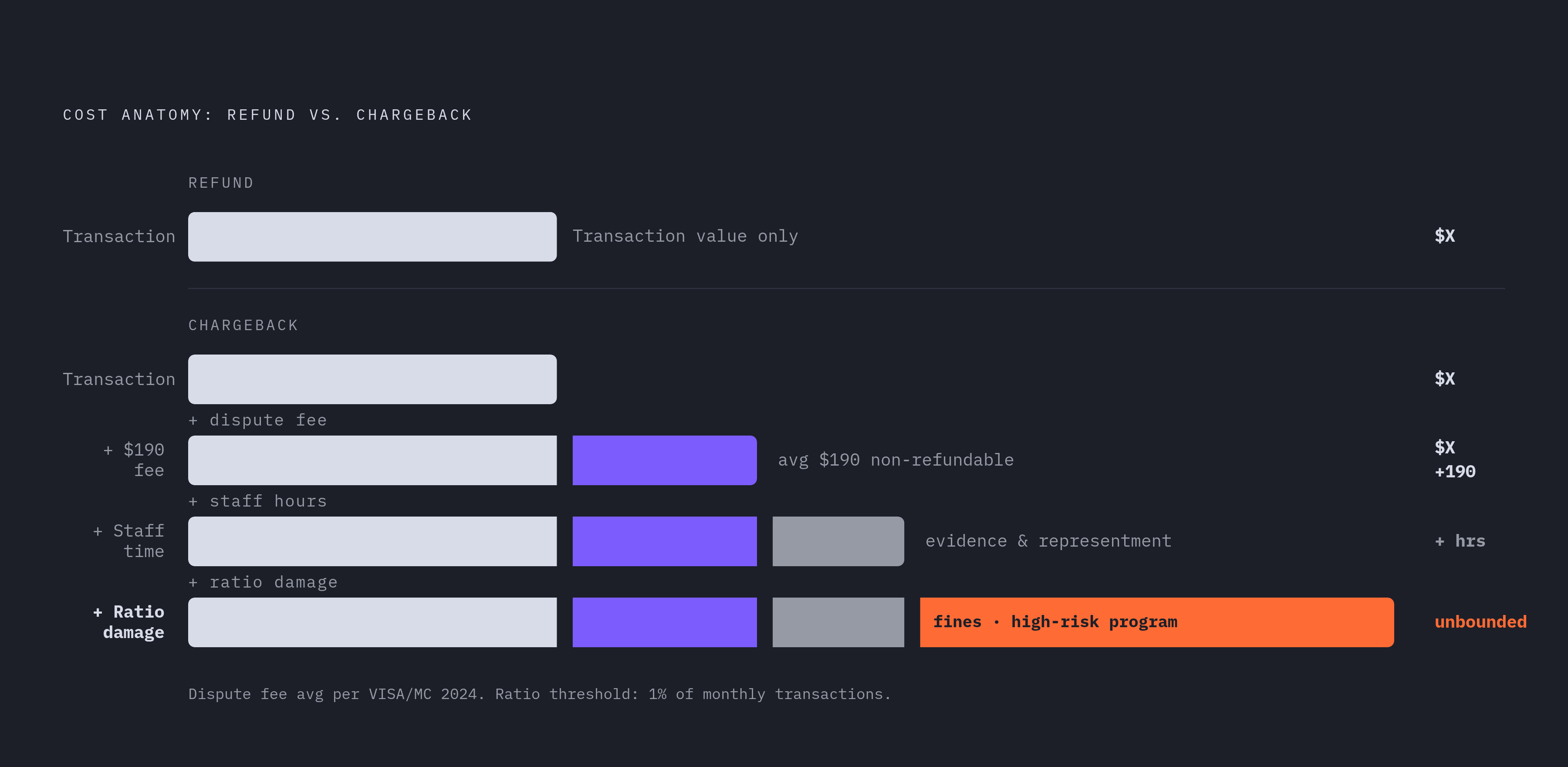
- You pay a non-refundable dispute fee per chargeback regardless of whether you win. Average dispute fees run around $190 per case
- Your team spends real hours pulling evidence, managing the representment process, and coordinating with your payment processor
Then there's the accounting headache. A chargeback reverses recognized revenue. Under ASC 606, it's treated as variable consideration, which means you're touching the AR subledger, the revenue schedule, and the general ledger all at once. Finance teams love that one.
The cost most founders completely miss is ratio damage. Card networks set thresholds for acceptable dispute rates. Exceed them and you're looking at fines, higher transaction fees, or placement in a high-risk monitoring program. Visa tightened its VAMP threshold to a lower "excessive" marker in January 2026. VAMP now counts TC40 fraud reports alongside traditional chargebacks, which means if you've only been tracking your raw chargeback count, you're likely underestimating your actual exposure.
The math isn't complicated. A proactive refund costs you the transaction value. A chargeback costs you the transaction value, plus the fee, plus staff time, plus ratio damage. And you still lose most of the time.
Why SaaS subscription billing produces chargebacks at a structurally higher rate than one-time commerce
This isn't a moral failing. It's structural, and once you see it, you can't unsee it.
When someone buys a physical product, the transaction feels finished. The package arrives, everyone moves on. SaaS billing is recurring, often invisible between charges, and tied to usage patterns customers aren't actively tracking. There's an experiential gap between "I signed up for this" and "why is this charge on my statement again." That gap is where disputes are born.
The software industry's average chargeback rate already sits above the cross-industry average. Per Sift's Q4 Disputes Index, B2C and B2B SaaS both saw chargeback rates jump sharply in 2025. B2B SaaS chargeback values rose 50% in that same period, which matters because higher contract values mean each individual dispute carries significantly more financial weight.
The highest-volume triggers in SaaS are predictable once you've seen them a few times:
- Free trials that convert to paid without a clear reminder at the moment the charge actually hits
- Annual renewals that fire without advance notice (a large annual charge appearing out of nowhere is a classic dispute trigger)
- Billing descriptors that don't match the product name the customer remembers signing up for
- Mid-cycle charges from plan upgrades the customer didn't fully anticipate
The most common reason codes: cancelled recurring transaction, card-not-present fraud, service not provided, credit not processed. Each has a specific evidence response. But most of them are preventable before they ever become disputes in the first place.
Friendly fraud as the dominant chargeback driver in digital subscriptions
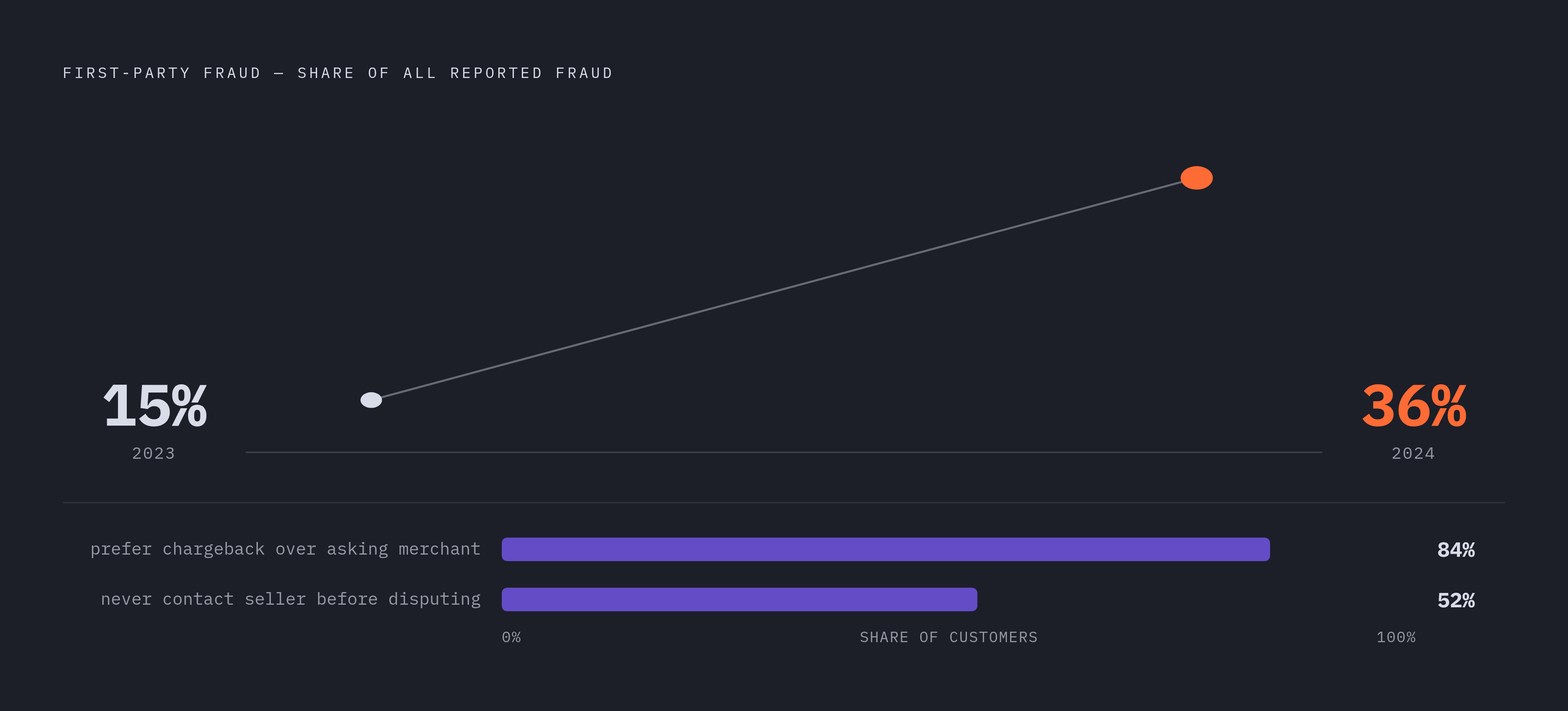
First-party fraud is when a real customer disputes a legitimate charge. No hacker, no stolen card. Your own customer calls their bank and says the charge wasn't authorized. As of 2024, this is the leading fraud type globally, representing 36% of all reported fraud, up from 15% just a year earlier. If that jump doesn't alarm you, it should.
The behavioral data is fascinating and a little depressing at the same time:
- 84% of customers say filing a chargeback feels easier than asking the merchant for a refund
- 52% don't contact the seller at all before disputing
- a large majority of consumers say they prefer going through their bank because it's faster and simpler
Some of this is accidental. Genuinely confused customers who don't recognize a charge and go straight to their bank because that's the path of least resistance. But some of it isn't accidental at all. 16% of consumers admit to filing false fraud claims despite being satisfied with their purchase. People do this because it works, and because whoever designed the cancellation flow made it easier to dispute than to cancel.
Digital subscriptions sit right in the middle of that exposure zone. And here's the part that's genuinely hard to argue with: customers dispute because they can, and because someone made it easier to dispute than to cancel or ask for help. That's not the customer's failure. That's a product design failure. The real villain isn't the fraudster — it's the friction.
How dark patterns and opaque cancellation flows turn billing friction into chargeback volume
ICPEN swept 642 subscription platforms across 27 countries in 2024 and found that the majority used at least one dark pattern. Two-thirds used two or more. This isn't a rogue minority. This is how a huge chunk of the subscription industry operates day-to-day.
The Adobe case is the clearest recent example of what this costs. In March 2026, Adobe agreed to pay a substantial sum to settle with the DOJ and FTC. The core complaint: the "Annual Paid Monthly" plan was set as the default, and the early termination fee (up to 50% of the remaining contract value) was buried behind links customers had no reason to click. People discovered the fee when they tried to cancel. Then they disputed. Of course they did.
The regulatory environment has shifted in complicated ways. The FTC's Click-to-Cancel rule, finalized in October 2024, was vacated by the Eighth Circuit on July 8, 2025. The court found the FTC failed to follow proper rulemaking procedures. But the pressure hasn't gone away. ROSCA, state laws in California, New York, Colorado, Delaware, and DC, and card network policies all enforce the same underlying principle: if signup was online, cancellation has to be available online.
The practical consequence is simple. Hidden cancellation paths and surprise fees don't just create legal exposure. They create a chargeback pipeline. Customers who can't easily cancel will dispute instead. If you design your cancellation flow to be as frictionless as your signup flow, you remove the primary behavioral trigger for friendly fraud in subscription businesses.
What it actually takes to win a chargeback dispute when one does arrive
Let's not sugarcoat it. Most disputes that reach the chargeback stage are lost. Around 73.6% of disputes escalate to full chargebacks, and merchants contest just over half the cases they receive. The net win rate via representment sits in the single digits as of 2024.
Winning is possible, but it requires having your act together before the dispute ever arrives.
What winning evidence looks like for a SaaS subscription dispute:
- Login timestamps showing the customer accessed the product after the disputed charge
- IP address and session data tying usage to the customer's device
- Email correspondence acknowledging subscription terms, renewal dates, or cancellation policy
- The subscription agreement with a clear record of when and how the customer accepted it
Companies that respond to every dispute with documented evidence win at meaningfully higher rates than those that don't respond at all. AI-driven dispute tools can reduce manual review time significantly for teams managing disputes at scale.
The key insight is that winning requires capturing this data at the point of subscription, not scrambling for it at the point of dispute. The evidence problem is actually a product instrumentation problem. If your authentication records, billing events, and usage data live in separate systems, pulling together an evidence packet becomes a manual nightmare every single time a dispute lands. And they always seem to land at the worst possible moment.
Operational strategies that steer customers toward refunds before they reach the dispute window
Every legitimate chargeback that becomes a refund instead is a net financial win. You lose the transaction value either way, but you avoid the dispute fee, the ratio hit, and the labor cost. That's the whole game.
Communication design
- Send renewal reminders 3 to 5 days before billing. Enough lead time to act, close enough that the subscription is still front of mind
- Use a billing descriptor the customer will actually recognize as the product they signed up for
- Send a receipt immediately after any charge, especially annual renewals and mid-cycle upgrades
Refund policy as a dispute-prevention tool
A clear, easy-to-find refund policy gives customers a path that isn't a dispute. It also becomes representment evidence later if a dispute comes in anyway. The customer had recourse available and chose not to use it. A short refund window costs less than the combined hit of chargeback fees, ratio damage, and MRR impact.
Proactive offers at the moment of dissatisfaction
When a customer contacts support right after a charge and they're frustrated, offering an immediate refund closes the issue. A customer who gets a no-hassle refund is more likely to come back than one who fought through a dispute process and eventually won.
Payment method and authentication choices
Bank debits, ACH, and SEPA transfers have structurally low dispute rates. The reversal mechanism is nearly absent once processed. 3D Secure 2.0 applies risk-based authentication, flagging high-risk transactions for additional verification while letting low-risk ones pass through without added friction. Tools like Rapid Dispute Resolution and Visa Order Insight can resolve certain disputes before they escalate to formal chargebacks.
All of this prevention work requires knowing who the customer is, what they purchased, when they last logged in, and what plan they're on, in one place. When that data is siloed across separate systems, both prevention and representment become slow, manual, and error-prone.
How the Merchant of Record model changes who carries the chargeback burden
A Merchant of Record is the legal seller of record from the perspective of the customer, the card networks, and tax authorities. It's the entity whose name appears on the transaction and who absorbs the dispute. The distinction sounds administrative until you realize what it actually moves off your plate.
Under the MoR model, chargebacks are filed against the MoR's merchant account, not yours. The MoR handles representment, dispute fees, and ratio management. You receive net revenue without carrying the dispute risk or the operational overhead of chargeback response. Tax compliance transfers along with the dispute risk: the MoR handles VAT, GST, and sales tax across jurisdictions, which is its own significant lift for SaaS companies selling internationally.
The chargeback rate risk is also pooled across the MoR's merchant portfolio. Individual builders don't face individual ratio penalties for small spikes in dispute volume.
Tiun operates as a Merchant of Record, handling chargebacks, tax compliance, and the full billing stack. It integrates payment handling and chargeback visibility into a unified customer database, so founders can see the real-time impact of each dispute on cash flow and compliance thresholds rather than finding out about ratio damage in a processor report three weeks later.
The tradeoff is real and worth naming: you give up some direct control over the billing relationship in exchange for offloading the legal, financial, and operational exposure that chargeback volume creates. That tradeoff gets more favorable as dispute rates rise across the industry.
Global chargeback volume is forecast to climb from 261 million transactions in 2025 to 324 million by 2028. B2C and B2B SaaS saw the steepest rate increases in 2025. The cost of managing this in-house is only going up. At some point, the question isn't whether to care about chargebacks. It's who you want holding the bag when they arrive.