SAML vs OAuth for SaaS Enterprise Identity Integration
The SAML authentication market was valued at roughly $1.2 billion in 2024 and is projected to grow at a 15.3% CAGR through 2033. That is the trajectory of a protocol with staying power. So why is SAML still growing when OIDC is technically cleaner for most new deployments?
Organizational inertia. And honestly, that is not even a knock. It just is what it is.
Enterprise IT teams spent twenty years building SSO runbooks, procurement checklists, and compliance frameworks around SAML. Workday, Salesforce, AWS Console, Microsoft 365. All of them have deep, stable SAML integrations that IT teams lean on every day. Okta's Integration Network lists over 8,000 pre-built app integrations, and enterprise admins default to SAML-first configurations because that is what their governance model was designed around. You do not rip that out because a newer token format is cleaner. Nobody is getting a budget approved for that project. SAML is the load-bearing wall of enterprise identity — you do not demolish it just because open-plan offices are in style.
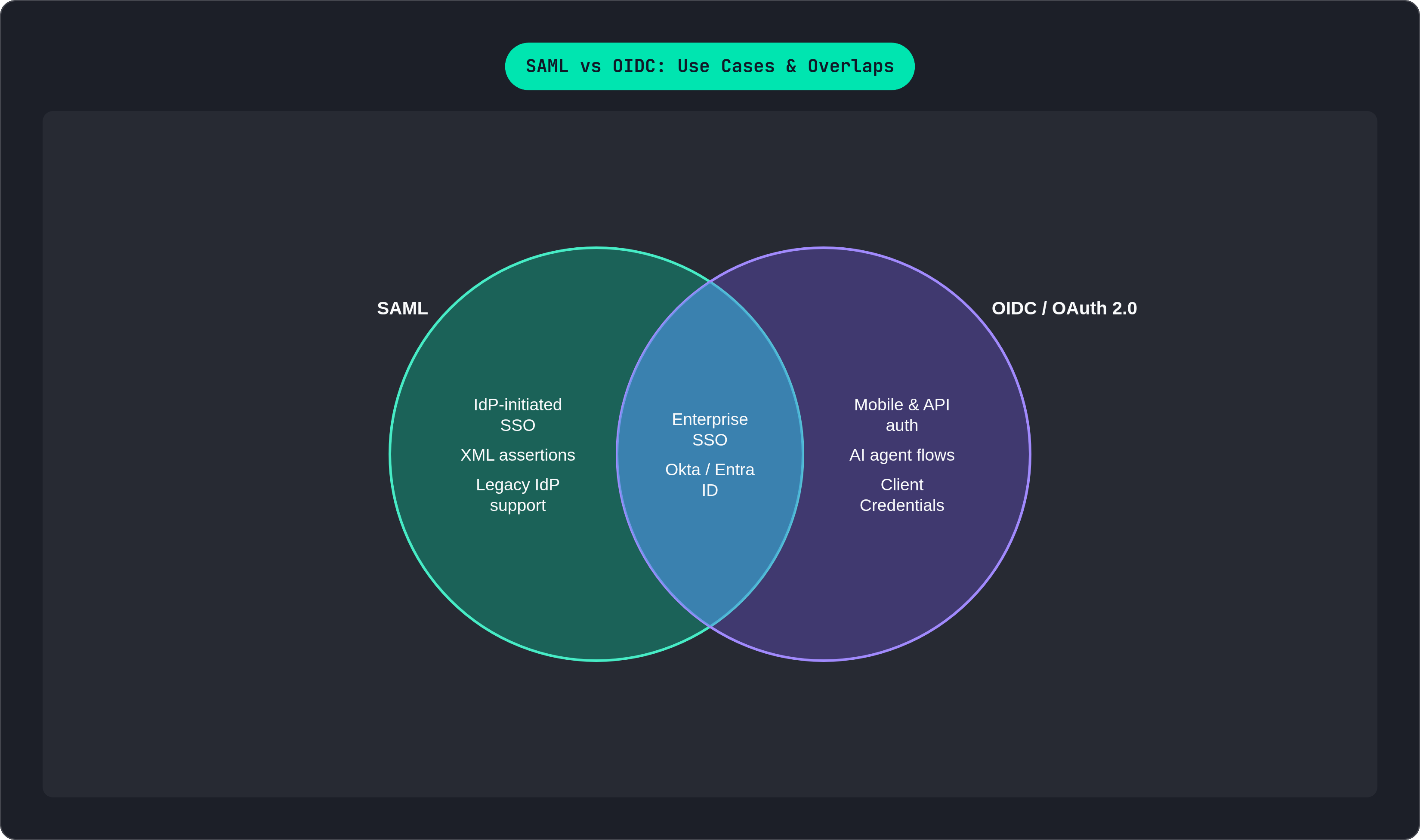
There is also a structural reason SAML persists that does not get enough attention: IdP-initiated SSO.
When a user clicks a tile in their Okta dashboard to open an app, that is an IdP-initiated flow. It maps naturally onto SAML. OIDC has no real first-class equivalent for this pattern. A login that arrives with no matching client-initiated request is exactly what OAuth 2.0 was designed to prevent, for legitimate security reasons. This is a protocol-level constraint, and enterprise IT workflows built around dashboard tile launches favor SAML by design. Those workflows are entrenched and are not going away anytime soon.
The practical upshot: most enterprises now run multi-protocol SSO environments. The question is rarely SAML versus OIDC in isolation. It is which protocols your app needs to support to close the deals actually sitting in front of you.
How Protocol Support Becomes a Sales and Go-to-Market Variable
A SaaS founder closes an early enterprise pilot. Things feel good. Then the IT admin asks for SAML SSO as a condition of procurement sign-off. This comes from a security checklist, and it is non-negotiable.
Missing SAML support does not slow the deal. It kills it. IT departments running Okta or Entra ID need a SAML connection to onboard a new app under their existing governance model. No credentials, no entry.
The same pattern plays out with SCIM. Without automated user provisioning, onboarding is slow and offboarding is a compliance liability. For larger deals, SCIM is increasingly a hard requirement, not a line item you negotiate out.
The business stakes here are concrete. Per Verizon's 2025 Data Breach Investigations Report, stolen credentials are involved in over 80% of hacking-related breaches. Enterprise IT teams are doing their jobs when they insist on federated identity over password-based login. The insistence on SAML and SCIM reflects a security posture, and one that is grounded in real risk data.
That said, over-investing in SAML before your customers ask for it is a distraction. Early-stage teams chasing SMB or product-led growth do not need enterprise auth infrastructure on day one. The protocol you ship first should match the market segment you are actually closing right now.
The right decision axis is simple: which customers do I need to close in the next 12 months, and what does their IT team require?
A Practical Decision Matrix for Choosing Your Starting Protocol
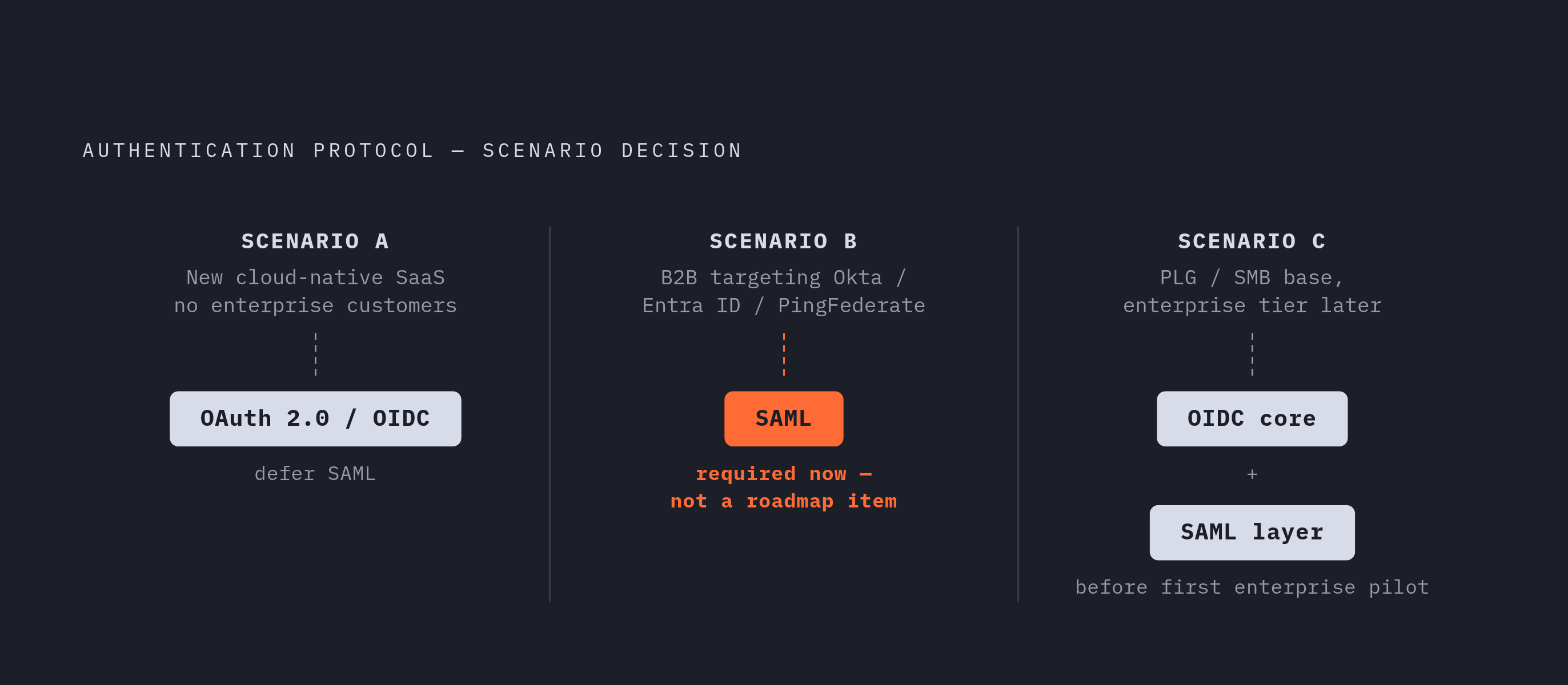
Scenario A: New cloud-native SaaS, no existing enterprise customer base.
Start with OAuth 2.0 and OIDC. It handles login, identity, and session management cleanly across browser, mobile, and API contexts. Enterprise customers on Okta or Entra ID can be connected via OIDC federation, because both IdPs support it natively. Defer SAML until a specific customer or deal actually requires it.
Scenario B: B2B SaaS with existing or targeted enterprise accounts running Okta, Entra ID, or PingFederate.
You will get SAML requests from IT admins regardless of what your app natively speaks. Enterprise IdP configurations are SAML-first by default. SAML support is a near-term requirement, not a future roadmap item. Plan accordingly.
Scenario C: Product-led growth motion with a consumer or SMB base, enterprise tier as a future expansion.
Use OIDC for the core product. But plan the SAML layer before your first enterprise pilot lands, not after. The architecture decision is harder to retrofit than it looks, and multi-tenant isolation has to be designed in from the start. The teams that learn this lesson tend to learn it the hard way.
Microsoft's Entra documentation frames the choice cleanly: OIDC suits new cloud-native SaaS and customers with modern identity stacks. SAML is a requirement-driven choice for enterprises, compliance mandates, or legacy IdPs that only speak SAML.
One practical shortcut worth knowing: the SAML broker pattern. A broker layer sits between your app and the enterprise IdP, translating SAML assertions into OIDC tokens your app already understands. Your app stays OIDC-native. The broker absorbs the SAML complexity. For teams that built on OAuth/OIDC first and then landed an enterprise customer, this is often the fastest path to procurement sign-off without a full auth rebuild.
Multi-Tenant Architecture: How Identity Isolation Actually Works at the SaaS Layer
Picture one login box serving a 20-seat startup that is perfectly happy with email and password, and a large enterprise requiring SAML, SCIM, audit logs, and proof of data isolation. The identity layer has to serve both without leaking anything between them.
That is the core problem of multi-tenant SaaS identity. There are three main ways teams solve it.
Silo: Each tenant gets its own identity store. Strongest isolation, highest infrastructure cost. Appropriate for highly regulated or very large tenants.
Pool: All tenants share a store, separated by a tenant ID on every identity record. Cost-efficient for the long tail. Requires disciplined query scoping at every layer, because a missed filter is a data breach waiting to happen.
Bridge (hybrid): Pool the small and mid-market tenants, silo the large or regulated ones. This is the most common real-world pattern for SaaS companies growing into enterprise. Cost efficiency where it matters, isolation where it is required.
SCIM: The Other Half of the Enterprise Identity Requirement
SSO handles login. SCIM (System for Cross-domain Identity Management) handles everything else: creating accounts when someone is hired, updating them when roles change, and deactivating them the day someone leaves. It runs via a REST API that Okta or Entra calls automatically.
Without SCIM, onboarding is manual and slow. Offboarding is a compliance risk. BetterCloud's State of SaaS 2025 report puts the ratio of employees to IT professionals at 1:138, up 31% over the period they tracked. IT teams managing hundreds of SaaS apps cannot do manual provisioning at scale. They physically cannot keep up.
The security detail that trips up most implementations: each customer's IdP gets its own bearer token scoped to its own user and group endpoints. The token-to-tenant mapping is the entire security boundary. A deprovision event from one customer must never touch another tenant's users. This sounds obvious until you see it fail in production. Then it is suddenly very obvious, just too late.
On offboarding behavior specifically: Okta and Entra deactivate accounts by sending a PATCH request that sets active to false. They rarely use HTTP DELETE. If DELETE is your only offboarding path, accounts will linger. Your implementation needs to treat active: false as an immediate session revocation trigger.
Also watch for the JIT plus SCIM collision. Just-in-time provisioning creates accounts on first SSO login for tenants that have not wired up SCIM yet. SCIM handles the authoritative lifecycle once they have. The two must agree on the same tenant membership model, or you will get duplicate user records when a JIT-created account collides with a SCIM push later. This is a common, frustrating, and entirely avoidable problem.
Implementation Pitfalls That Turn Correct Protocol Choices Into Security Incidents
Both protocols are secure. The risk surface is implementation defects, not protocol-level weaknesses.
Using the access token as proof of identity. An OAuth 2.0 access token proves the bearer has certain permissions. Storing an access token as a user identifier creates a confused deputy vulnerability. Use the ID token from OIDC, or a separate identity assertion, for authentication.
SAML signature validation gaps. Missing or incomplete signature validation on XML assertions is the most common SAML implementation defect. Assertions that are not properly validated can be tampered with in transit. This is an active attack vector, not a theoretical one.
Skipping audience and issuer checks. Both SAML and OAuth tokens must be validated for the correct audience (your app) and the correct issuer (the expected IdP). Skipping these checks opens the door to replay attacks and token substitution.
Certificate management as an operational failure mode. SAML relies on X.509 certificates for assertion signing. Expired or rotated certificates cause SSO failures that look like infrastructure outages to end users. At scale, certificate expiry across dozens of enterprise tenants becomes a recurring support incident without automated metadata refresh built into your stack. This is one of those problems that feels manageable until it is 3am and five enterprise customers are locked out.
Token lifetime mismanagement. Improperly long-lived access tokens or refresh tokens that are not revoked on deprovisioning leave access open after an employee departs. This ties directly back to the SCIM offboarding point: if your auth layer does not act on a deprovisioning event immediately, you have a gap.
The case for using well-maintained libraries and platforms over bespoke implementations is about the ongoing maintenance cost of catching and fixing these defects yourself, across every new enterprise customer configuration you take on.
Build vs. Buy for SAML and SCIM: What the Decision Actually Costs Small Teams
Building native SAML support from scratch means XML parsing and signature validation libraries, maintained across security updates. It means per-customer IdP configuration, because each enterprise customer's Okta or Entra setup is different. Metadata exchange, attribute mapping, and certificate management get repeated for every new customer. Then there is the SCIM server implementation: REST endpoints, per-tenant bearer token management, and handling Okta's PATCH-based deactivation correctly.
The part teams consistently underestimate is the ongoing tax of maintaining these integrations across multiple customer configurations while also building the actual product. Every enterprise customer you add is another configuration to manage and another failure surface to monitor. Think of it like adopting a pet for every enterprise deal you close — adorable at first, but the feeding schedule compounds fast.
What to Look for in an Auth Platform
If you go the buy or broker route, a few things actually matter:
- Native SAML and OIDC support without requiring your app to handle XML directly
- SCIM directory sync with per-tenant token scoping and real-time event delivery
- A self-serve admin portal so enterprise IT teams can configure their own IdP connections without filing tickets with you
- Automatic certificate and metadata refresh to prevent expiry-related outages
- Delegated administration so each partner organization manages its own users within bounds you define
Tiün is a unified backend platform that combines authentication, user management, and analytics in a single system. SAML/OIDC support, your customer database, and usage tracking are consolidated without separate tools and separate webhook wiring. When you are debugging a multi-tenant provisioning issue at midnight, having the full picture in one place matters more than it sounds on a product comparison page.
WorkOS is a specialist option for teams whose primary need is getting enterprise SSO and SCIM shipped quickly. It offers a self-serve admin portal and flat per-directory pricing, which makes the cost predictable as you scale enterprise accounts.
Neither is a wrong choice. The right one depends on whether your auth infrastructure is the whole product layer or one component of it.
OAuth 2.0 as the Identity Layer for AI Agents, and Why It Changes the Architecture Conversation
OAuth 2.0 and OIDC were built for human login flows. They are now the standard for authenticating non-human actors: AI agents, workflow engines, LLM-powered automations that interact with APIs and customer data on their own. This changes the architecture conversation in ways that most engineering orgs have not fully caught up to yet.
MCP (Model Context Protocol), the open standard for agent-tool communication, mandates OAuth 2.1 for remote server authentication. When an unauthenticated MCP client contacts a protected MCP server, it is redirected to an authorization server and runs an OAuth flow before gaining access. The protocol is the same. The actor on the other end is not a person.
Two grant types dominate agent authentication:
Authorization Code with PKCE: The agent acts on behalf of a human user. A person approves the flow, the agent receives tokens scoped to that user's permissions, and every action the agent takes is traceable back to a human principal. This is the right pattern when the agent is doing things the user explicitly authorized.
Client Credentials: The agent acts as itself, with its own identity and its own scopes. No human in the loop. This is appropriate for background jobs, system-to-system integrations, and automation pipelines where there is no meaningful human principal to tie the action to.
Why this matters for identity architecture: if your SaaS product is adding AI features, or if your customers are building agents that interact with your API, your authorization model needs to handle both human and non-human principals cleanly. An access token issued to an agent should have scopes appropriate to what that agent is allowed to do, rather than the full permissions of the user who set it up. Token lifetime, rotation, and revocation matter more when the token holder is running autonomously and making thousands of API calls without human review.
SAML has essentially no role in agent authentication. It was designed for browser-based, human-initiated flows. The agent world runs on OAuth 2.0, and that is already the specification.
The architecture implication is straightforward: teams building for both enterprise human users and AI agent interactions need an identity layer that handles both. OIDC for the humans. OAuth 2.0 client credentials or authorization code for the agents. A token validation layer that correctly distinguishes between them. Treating agent tokens the same as user tokens is how you end up with an agent that can do far more than it should. That is a real risk, and the kind of thing that becomes a very uncomfortable conversation with a very large enterprise customer.