SOC 2 Type 1 vs Type 2 for SaaS Vendors
Type 2 proves controls worked over time; Type 1 only shows they existed on one day.
SOC 2 evaluates your security controls against something called the Trust Services Criteria. Five of them exist:
- Security (mandatory, always included)
- Availability
- Processing Integrity
- Confidentiality
- Privacy
Security is the foundation. Every SOC 2 report includes it. The other four are optional and get layered in based on what you've actually committed to your customers. Promised uptime in contracts? Availability probably matters. Handling sensitive data customers expect you to lock down? Confidentiality is worth adding. Most SaaS companies start with Security only, which keeps the first audit scope narrow and the cost manageable.
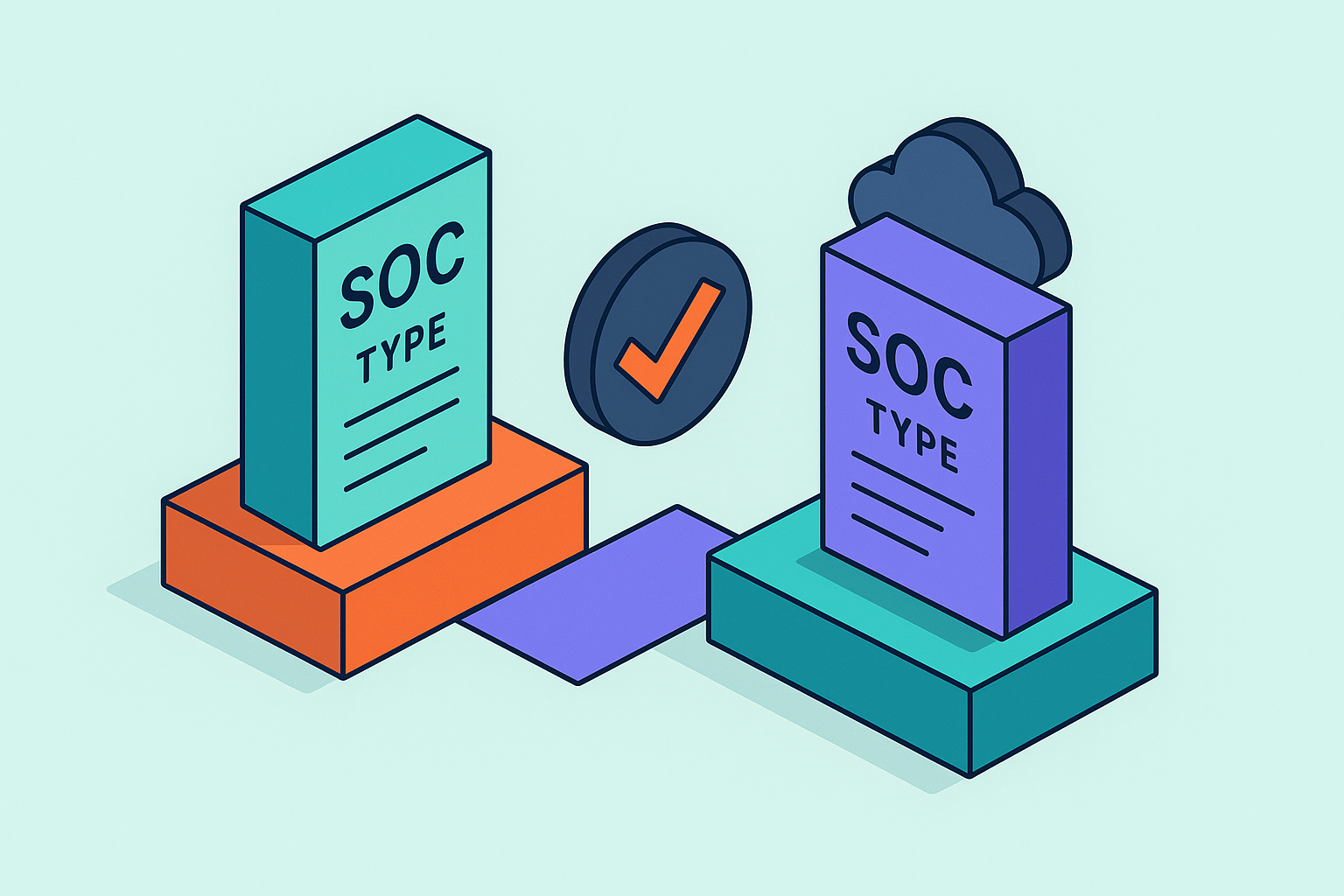
The difference between Type 1 and Type 2 is simpler than most people make it sound.
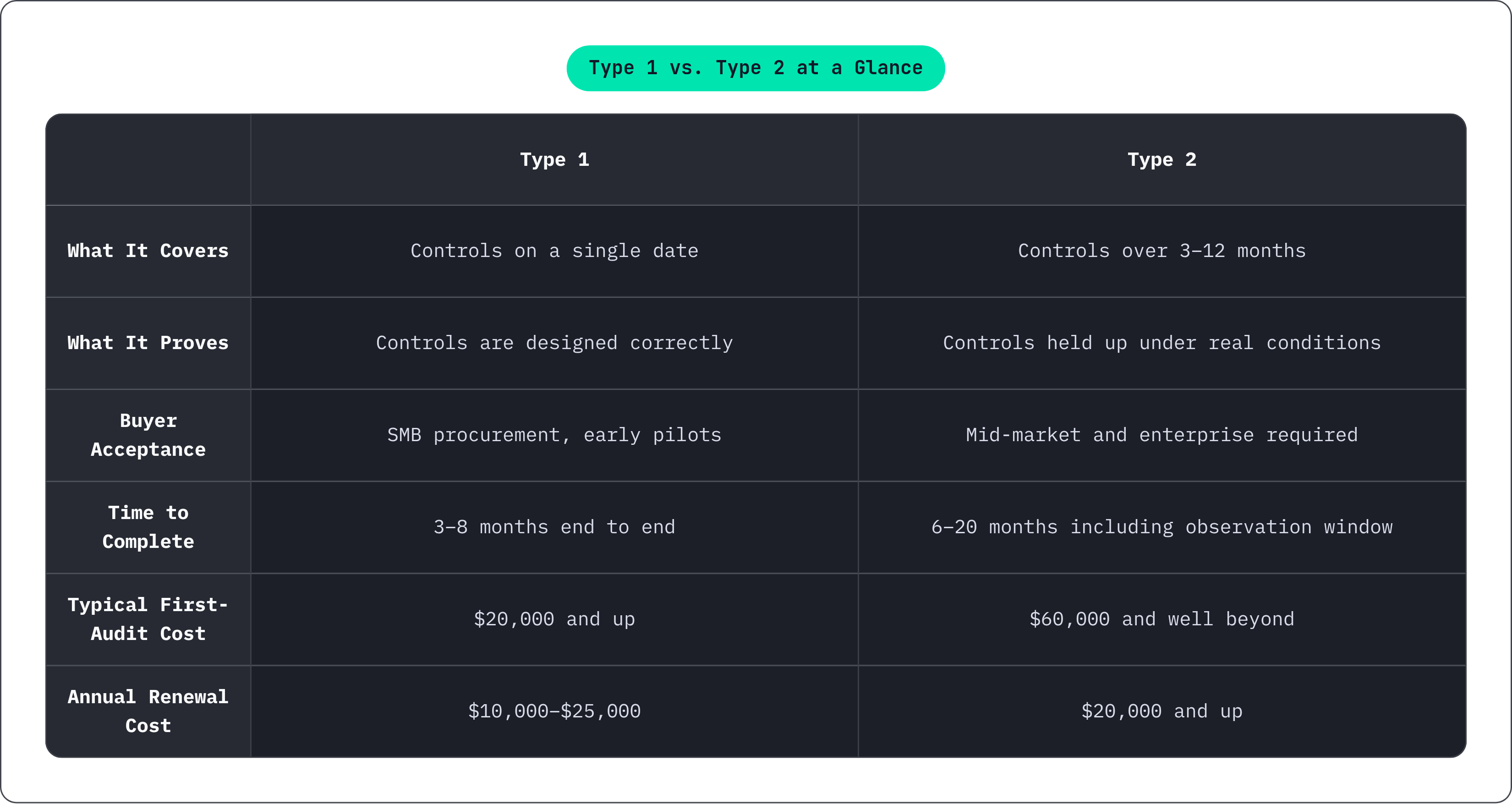
Type 1 is a point-in-time report. The auditor shows up, looks at your controls on a specific date, and confirms they're designed correctly. That's it. No checking whether those controls actually worked over time. Think of it as a photograph — it captures what things looked like at one moment but says nothing about what happened the week before or the month after.
Type 2 covers a period of time. Usually three to twelve months. During that window, auditors pull real evidence. Access reviews, vulnerability scan results, backup logs, change tickets, training records. They want proof that the controls held up under actual operating conditions, repeatedly, over time. If Type 1 is a photograph, Type 2 is a full season of footage. It shows whether your controls showed up every day, not just when someone was watching.
Design sufficiency versus proof over time. Both are valid. They just answer different questions for different buyers.
What Type 1 Is Actually Good For and Where It Falls Short
Type 1 is genuinely useful. Don't dismiss it.
Its main job is to get you in the door. It satisfies procurement teams that need something on file before a pilot or a smaller contract. It clears vendor security questionnaires. And it's fast. A Type 1 runs three to eight months end to end, compared to six to twenty months for Type 2 once you factor in the observation window. When a deal has a hard deadline, that timeline difference is real.
For an early-stage startup (up to 25 employees, Security only), the full cost shakes out something like this:
- Readiness work: $10,000–$15,000
- Audit fee: $7,000–$15,000
- Automation tooling: $6,000–$15,000 per year
- Training and legal: $5,000–$10,000
- Total: $20,000 and up
That's a manageable number for an early team that just needs to clear the first hurdle.
Type 1 has a ceiling, though. Fortune 500 procurement teams, financial services buyers, and government clients overwhelmingly require Type 2. Type 1 simply doesn't get you into those rooms. It's not a knock on the format. It's just what it is.
There's also a trust logic problem. A snapshot tells a sophisticated buyer that your controls existed on one day. It says nothing about whether those controls held up when a developer was rushing at 2am, or when a vendor got breached, or when your team doubled in six months. Enterprise buyers have learned to probe exactly that gap, and they've gotten good at it.
Practically speaking: a Type 1 report is valid for one year. Renewal runs $10,000–$25,000. If you're renewing it annually without progressing to Type 2, you're spending real money without closing the gap that actually matters to the buyers you're trying to reach.
Why Type 2 Is What Actually Closes Enterprise Deals
Type 2 answers the question Type 1 can't: did these controls work, consistently, under real conditions, over time?
Mid-market buyers require Type 2 at the majority of procurement decisions. That's not some niche demand from hyper-sophisticated enterprise security teams. It's the mid-market. The gap between "nice to have" and "required" closes fast as deal size grows.
What Type 2 actually does in a sales cycle is remove a veto. Enterprise procurement has a security review step that can kill a deal with no appeal and no real explanation. Type 2 doesn't guarantee you pass that review, but it shifts the conversation. Instead of "we have risk concerns," you're suddenly in "walk us through your controls" territory — and those are very different rooms to be sitting in.
The cost for a 50–100 person SaaS company doing a first Type 2 (Security plus Availability, six to twelve month window) looks something like this:
- Readiness: $10,000–$20,000
- Audit fee: $15,000–$30,000
- Automation tooling: $10,000–$30,000
- Penetration test: $5,000–$15,000
- Training and legal: $10,000–$25,000
- Total: $60,000 and well beyond
Annual renewal runs $20,000 or more. The right way to think about that number isn't "compliance tax." It's the ongoing cost of staying eligible for enterprise sales. Because that's what it is.
In competitive vendor evaluations where two products are functionally similar, a Type 2 report from an auditor the buyer recognizes often determines who clears security review first. That edge is more concrete than most founders expect.
How to Sequence the Two Reports Without Paying Twice
Here's a trap a lot of teams fall into: treating Type 1 as a mandatory step before Type 2, then paying full cost for both back to back, with nothing to show for the overlap.
For most B2B SaaS companies targeting enterprise, going straight to Type 2 avoids this entirely. The observation window starts when your controls are in place, not when you decide to pursue the certification. It runs in parallel with your normal operations. The only real cost is time.
If you do Type 1 first and then upgrade within 12 months, most auditors will credit a chunk of the Type 1 fee toward the Type 2. Negotiate this upfront, before you sign anything. Not after. Auditors won't volunteer that option.
Here's how to think about it by stage:
- Early-stage (pre-revenue or first enterprise pilots). Type 1 is reasonable. It clears initial security questionnaires without committing to a long observation window before your controls are mature enough to hold up.
- Growth-stage (active enterprise pipeline, multiple large deals in motion). Skip Type 1. Go straight to Type 2. The observation window is the only delay, and it runs while you're doing everything else anyway.
- Mature SaaS. Annual Type 2 renewal is the standard. Not really a decision point anymore. More of a maintenance rhythm.
Scope sequencing matters too. Starting with Security only keeps first-audit costs down. Adding Availability or Confidentiality in year two, when customers actually start asking for them, avoids paying for scope you didn't need yet. Each additional Trust Services Criterion adds meaningfully to base cost, and Privacy can add substantially more. The discipline you apply at the start compounds into real savings later.
The simplest decision framework: map your current pipeline to buyer type. If your next ten deals are mid-market or enterprise, Type 2 is the faster path to closed revenue, even though it takes longer to earn.
The Real Cost of SOC 2 Beyond the Auditor Invoice
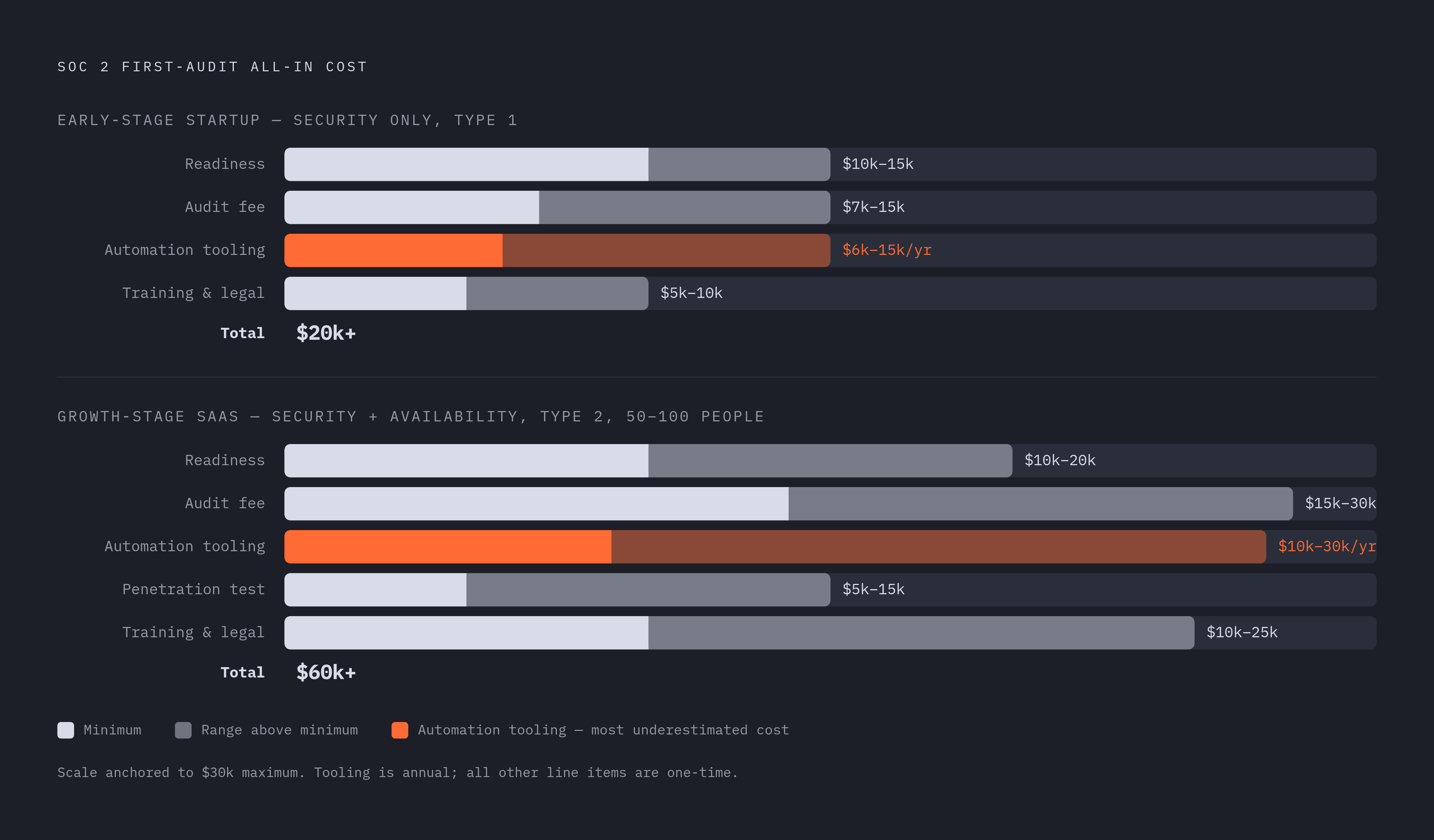
The auditor fee is often less than half of what you'll actually spend. The number you see in proposals is not the number you end up with. Ask anyone who's been through it twice.
The compliance automation platform is frequently the single largest line item, and it often exceeds the audit fee itself. If you try to do it without one, budget hundreds of hours of internal work before the auditor even shows up. Writing policies, collecting evidence, implementing controls. That time has a real cost, even when it doesn't show up on an invoice.
The full cost picture:
- Readiness and gap assessment
- Compliance automation platform (ongoing subscription)
- Penetration testing (required for most Type 2 audits)
- Legal and policy documentation
- Internal engineering and ops time (the invisible line item)
- Auditor fee
Large enterprises running complex architectures with multiple Trust Services Criteria can see full annual cycle costs well into the six figures. It adds up faster than most finance teams anticipate — which is why finance teams tend to look a little pale when this conversation comes up.
For planning purposes: the right comparison isn't Type 1 cost versus Type 2 cost. It's the total cost of your compliance program over two to three years, given that renewal obligations exist either way.
Automation tooling changes this math meaningfully. Platforms that continuously pull evidence from your cloud providers, identity providers, and HR systems reduce the internal hour burden in ways that are hard to appreciate until you've experienced the alternative. The platform subscription pays for itself in engineering time not spent chasing audit artifacts at crunch time. That particular scramble is not fun. Don't do it to yourself.
Where AI Products Introduce New SOC 2 Complexity
SOC 2 was designed around assumptions that AI products break. Static controls. Deterministic system behavior. Human-mediated access. Autonomous agents violate all three of those assumptions at once, and auditors are starting to catch up to that reality.
Per CSA/Zenity research from 2026, more than half of organizations have already reported AI agents exceeding their intended permissions. This isn't theoretical anymore. It's happening at scale.
Only a minority of organizations track AI activity end-to-end, including prompts, tool calls, and outputs. Fewer still monitor agent-to-agent interactions. Both represent evidence gaps that auditors are increasingly going to probe as AI products become more common in enterprise procurement.
CyLab research from 2025 found that manipulating a tiny fraction of a model's pre-training dataset is sufficient to launch effective data poisoning attacks. Training data is now an audit surface, not just a product asset. That one tends to catch AI founders off guard.
What AI vendors need to demonstrate that standard SaaS vendors don't:
- Model providers tracked as sub-processors in vendor management
- Prompts and outputs logged with immutable audit trails
- Least-privilege access on memory stores and model artifacts
- Agent runs documented as auditable events, with human-reviewable behavior records
- Change management controls that account for runtime code execution by agents (traditional change management assumes a human authorized something before it ran; agents don't work that way)
AI companies that have earned Type 2 reports, including OpenAI, Anthropic, Cohere, and Hugging Face, have integrated their SOC 2 programs with AI-specific frameworks like NIST 800-53 rather than running them as separate workstreams. That integration is the key. Treating AI governance and SOC 2 as parallel but disconnected programs creates exactly the gaps auditors find.
Gartner predicts a significant share of agentic AI projects will be canceled by 2027, with poor governance cited as the primary reason. SOC 2 Type 2 is increasingly the mechanism that demonstrates governance exists in a form buyers can actually evaluate. Not just a form founders can point to in a pitch deck.
For AI SaaS founders, there's a practical implication worth taking seriously: a unified backend where user sessions, API calls, agent activity, and data access all flow through a single system of record makes evidence collection substantially easier than assembling it from disconnected tools. The alternative, which most teams discover too late, is a painful pre-audit scramble to manually correlate logs from five different systems. You will not enjoy it.
What to Have in Place Before Engaging an Auditor
Auditor selection comes last. Not first.
Readiness work determines how expensive and time-consuming the audit itself will be. Engage an auditor before your controls are in place and documented, and you're paying for their time while they watch you scramble. That's more common than auditors will admit, and it's an expensive way to learn the lesson.
Here's what needs to exist before audit fieldwork begins:
- Access control policy with documented role definitions and periodic access reviews
- Incident response plan (written, tested, with evidence of a tabletop exercise or a real incident handled)
- Change management process with documented approval workflows for code and infrastructure changes
- Vendor and sub-processor inventory with security reviews on file
- Security awareness training records for all employees
- Vulnerability management process with scan cadence, remediation timelines, and tracking
- Backup and recovery procedures with tested restore evidence
For Type 2 specifically: controls must be live and operating before the observation window starts. Standing them up during the audit is too late. The window doesn't pause while you catch up.
Evidence hygiene matters more than most auditors will tell you upfront. The audit is a sampling exercise. Well-organized, timestamped, continuously collected evidence dramatically reduces fieldwork time and the volume of auditor questions. Disorganized evidence does the opposite, and the cost difference is real.
Evaluate automation tooling before readiness begins, not midway through it. Retrofitting a compliance platform mid-audit is painful in ways that are hard to fully appreciate until you've done it once. You will not want to do it twice.
For SaaS and AI vendors running unified backend infrastructure, authentication logs, session records, API activity, and event data that already exist in a single system are native SOC 2 evidence. They don't need to be assembled from multiple tools. Platforms like Tiun, which unify user, transaction, and session data, create this kind of evidence foundation as a byproduct of normal operations rather than a separate compliance project you have to staff and manage.
Scope the Trust Services Criteria before engaging the auditor. That decision shapes what controls you need in place. Starting with Security only keeps the readiness checklist manageable and the cost predictable.
Treating SOC 2 as a Living Trust Signal Rather Than a One-Time Credential
A SOC 2 report expires after one year. Enterprise procurement teams know this. They ask for current reports, not archived ones. A two-year-old Type 2 report doesn't signal trustworthiness. It signals that you used to care about this, which is worse than not having one at all.
The real competitive advantage isn't the report itself. It's the compliance posture the report reflects. Controls that are continuously operating are controls you can point to year-round, in sales calls, in security questionnaires, in renewal conversations.
Annual Type 2 renewal transforms the credential from a one-time sales tool into an ongoing signal that you operate at enterprise standards. The companies that build SOC 2 into their operational rhythm tend to find renewals getting less painful over time, security reviews getting shorter, and enterprise deals moving faster. Not because they have a certificate on file. But because the certificate reflects something real about how they actually operate.
As AI products scale and enterprise buyers get more sophisticated about what they're actually evaluating, the bar will keep moving. The snapshot matters. The posture behind it matters more. And experienced buyers — the ones who've been doing security reviews for a decade — are pretty good at telling the difference between the two.