Organization and Team Modeling in SaaS Authentication Systems
Organizations are the foundational layer where tenant isolation prevents cross-tenant data breaches.
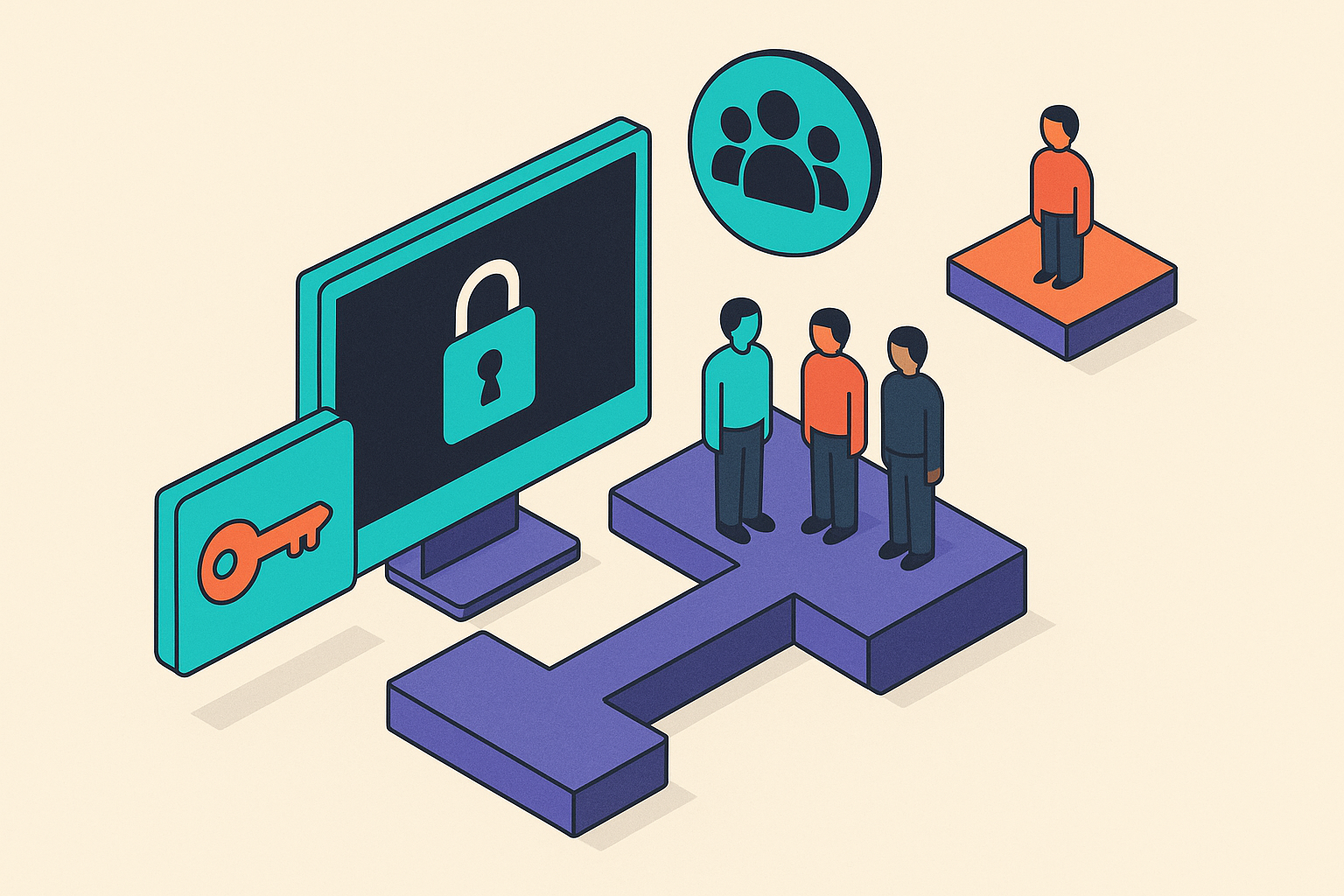
The organization is the foundational primitive. Roles, permissions, and identity providers are all evaluated within that boundary, not globally. Everything else in the identity layer sits on top of it. That sounds obvious until you watch a team spend three months untangling a global user table that was never designed to care about org context. At that point, you are not refactoring. You are rebuilding while the product is running.
Two URL routing patterns dominate production systems. The subdomain model encodes tenant identity in the subdomain: acme.app.com. Clean separation, unambiguous tenant context from the first byte of the request, and SSO enforcement is straightforward because the org is never in question. The subfolder model encodes the tenant as a path segment: app.com/acme. Simpler to deploy for teams that cannot issue wildcard certificates easily, but it requires careful handling to avoid path-based authorization bypass, where a crafted URL navigates outside the expected tenant scope. Neither is universally superior. The choice depends on your deployment constraints. Making it deliberately is the point.
Before authentication even begins, the system needs to determine which tenant a user belongs to and which login method to enforce. This is Home Realm Discovery. The system reads the user's email domain or an org identifier in the URL and routes accordingly. Without this step, you cannot enforce per-tenant SSO. You also cannot prevent a user from authenticating through the wrong connection, which is a subtler failure than it sounds and harder to explain to an enterprise customer after the fact.
Once authenticated, an organization_id stored in the session scopes every subsequent interaction to a single organization. An org switcher updates that value when a user moves between contexts. This matters because the same person can belong to multiple organizations, hold different roles in each, and switch contexts several times in a single workday. Identity in SaaS exists inside context, not in isolation.
The benign failure mode is a user scoped to org1 who navigates directly to an org2 resource URL and hits a confusing 404. That requires explicit handling: detect the mismatch, prompt a context switch, surface a clear error. Annoying, but recoverable.
The dangerous failure mode is cross-tenant authorization: a valid token issued for one tenant accepted against another tenant's resources because the authorization path never verified that the token's tenant matches the resource's tenant. That is not a UX problem. It is typically a reportable data breach. Tenant scoping must be enforced at the data layer, not just in application routing logic. Routing is a first line of defense, not a sufficient one.
Three data isolation models and when each one is the right call
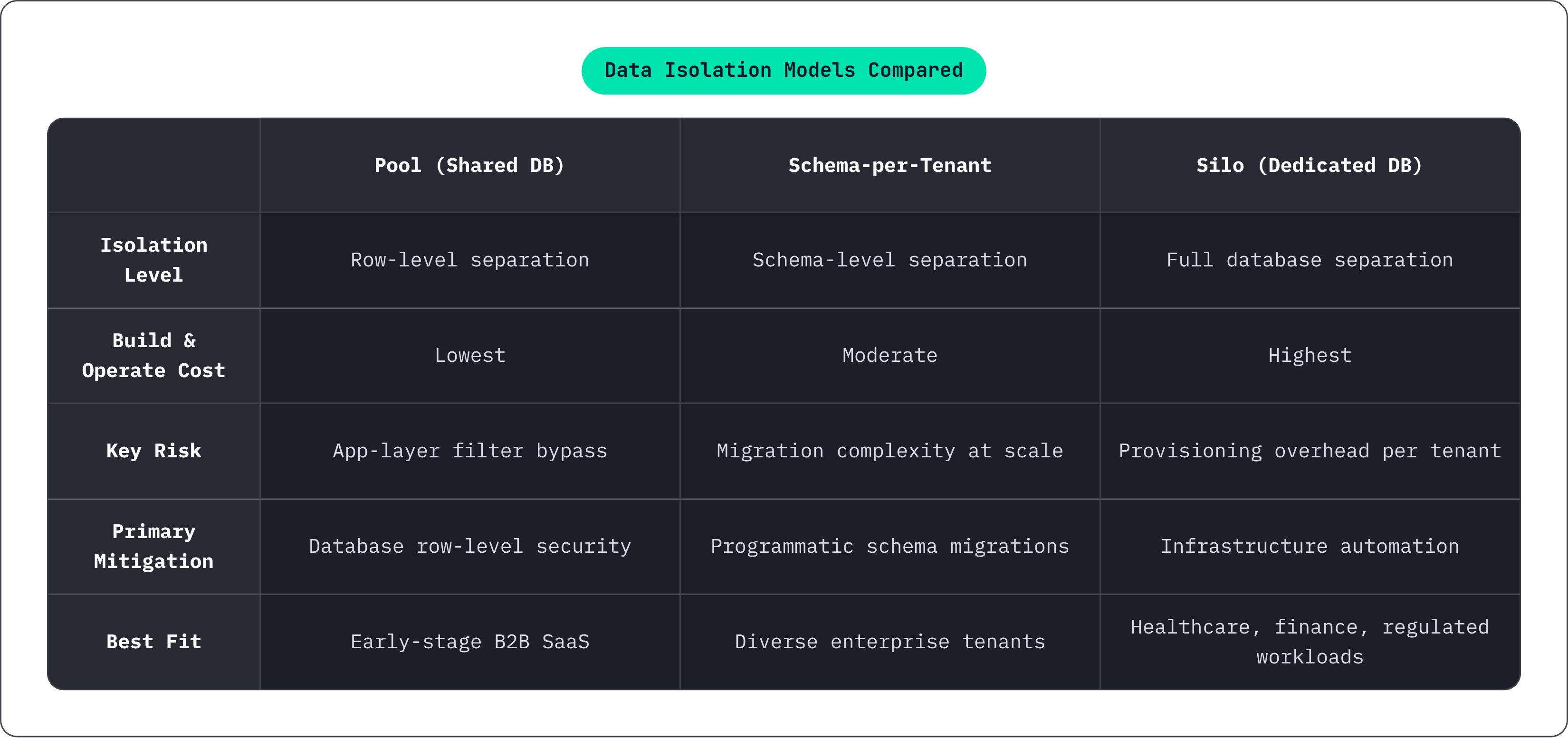
The isolation model determines data layout, blast radius on a breach or misconfiguration, and per-tenant operating cost. These are not separable decisions. The right answer also changes depending on where you are in the business, which is something teams often learn the hard way after committing too early to a model that made sense at fifty customers and became untenable at five hundred.
The pool model, a shared database with a tenant_id column on every row, is the cheapest to build and operate. It supports cross-tenant analytics without complex joins across schemas or databases. The risk is direct: if tenant filtering is enforced only in application logic, a single bug can expose data across tenants. The mitigation is database-level row-level security, which makes the filter impossible to bypass regardless of what the application layer does or fails to do. For early-stage B2B SaaS, this is almost always the right starting point.
The schema-per-tenant model provides better isolation and supports tenant-specific schema customizations. That matters for enterprise buyers who need configuration flexibility without the overhead of dedicated database instances. The operational tradeoff is real: schema migrations must be applied programmatically across every tenant's schema, and a large tenant count begins to strain database catalogs. It fits a diverse tenant base that mixes isolation needs without the economics requiring fully dedicated infrastructure.
The silo model, a dedicated database per tenant, offers the strongest security boundary and the cleanest compliance story. For healthcare, financial services, government contracts, or workloads with strict data residency requirements, it is often the only viable option. The cost is real. Every new tenant requires provisioning, monitoring, and maintaining a separate database instance. At hundreds of tenants, this demands automation just to stay tractable. Teams that discover this after the fact find themselves doing tedious infrastructure work that was always coming and just never got scheduled.
The path most teams land on as enterprise deals close is a bridge: pool the long tail of smaller tenants, silo the few large or heavily regulated ones. This is not a hedge. It is a deliberate architectural decision that matches isolation level to commercial and regulatory context.
The authorization layer above any of these models has to respect the same boundaries. A well-designed permission model cannot compensate for a leaky data model. The inverse is equally true.
RBAC as the starting point and where it begins to break
Role-based access control assigns permissions to roles and assigns those roles to users within an organization. Owner, Admin, Billing Admin, Member, Viewer. It is simpler to manage than per-user grants, familiar to developers, and sufficient for a significant proportion of enterprise access control needs. NIST SP 800-162 puts that proportion at approximately 90% of enterprise applications, which is worth keeping in mind before reaching for more complex models.
In a multi-tenant SaaS product, roles must belong to organizations, not to the platform globally. An Owner in org A is a read-only Member in org B. Those are completely independent facts and must be modeled as such. A global role assignment creates exactly the kind of cross-tenant exposure that surfaces as a breach.
The structural failure mode of RBAC at scale is role explosion. Multiply hundreds of customers by a handful of roles each, and the total count grows quickly. Tenants begin creating near-duplicate roles as edge cases accumulate: "Admin v2," "Super Admin," "Admin but not billing." You stop being able to reason about the access model globally, and the system stops reflecting the product it governs. I have seen access audits that took weeks longer than they should have simply because no one could explain what half the roles actually did anymore.
The mitigation is separating roles from resource-level permissions. Roles define broad responsibility. Access to specific workspaces, projects, or records gets decided at the resource level. Maintaining a practical ceiling on the number of roles per tenant and consolidating aggressively when that ceiling is approached keeps the model coherent enough to audit.
Role templates address the scale problem without sacrificing per-tenant flexibility. Maintain a global base set and allow tenants to extend or customize from it. Linking tenant roles back to templates via a foreign key preserves global coherence while supporting legitimate variation. In practice, the teams that skip this step are the ones who end up with hundreds of orphaned roles no one owns and no one wants to delete.
When ABAC and ReBAC become necessary and how they layer onto RBAC
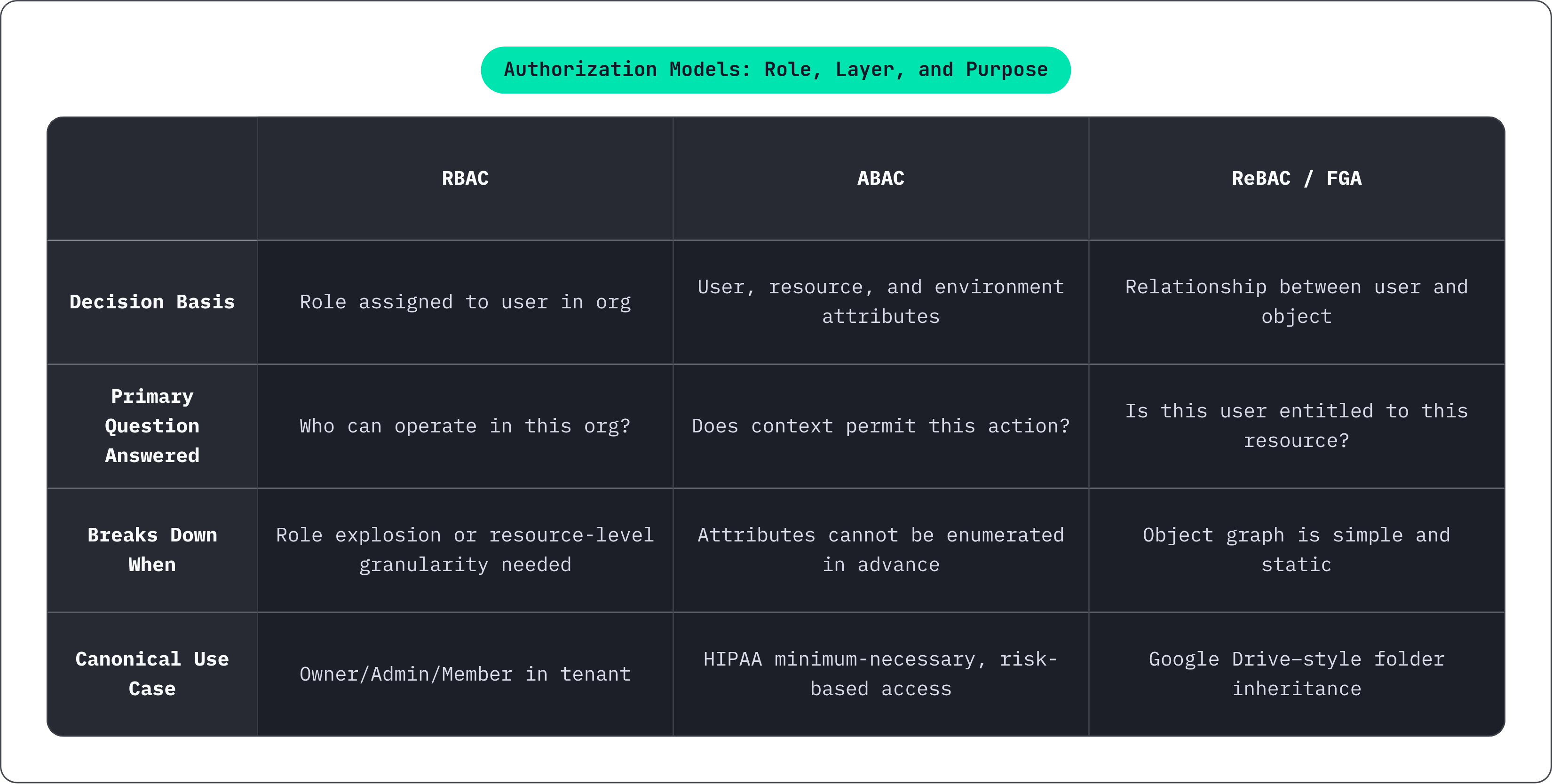
Attribute-based access control adds permission decisions based on attributes of the user, the resource, and the environment: department, location, IP address, time of day, data classification level. It becomes genuinely necessary when a role alone cannot encode the required decision. That threshold is different for every product, and teams often do not know they have crossed it until a compliance audit surfaces a policy requirement that no role assignment can satisfy.
Healthcare is the clearest example. HIPAA's minimum-necessary rule requires that users access only patient data they have a legitimate clinical need to see. No role assignment captures that specificity. Finance and defense present analogous cases where access policies depend on clearance level, data classification, or transaction risk that changes dynamically. Any context where permission decisions depend on resource attributes beyond what a role can encode is a context where ABAC earns its complexity cost.
Relationship-Based Access Control, ReBAC, grounds access rules in the relationship between a user and an object, and between objects in a hierarchy. "Alice can edit document-42 because she has access to its parent folder." This pattern is a superset of RBAC: RBAC can be fully implemented within a ReBAC model, and it handles many ABAC cases where attributes can be expressed as relationships. Practical implementations include SpiceDB, OpenFGA, and Authzed. Auth0 FGA draws directly from Google's Zanzibar and decouples authorization logic from application code, which matters for teams that need to evolve their permission model without touching application internals.
Fine-Grained Authorization takes this further. Decisions are made at the level of the individual resource and action: "Alice can edit document-42," not just "Alice is an editor." This is necessary when objects and permissions number in the millions and change rapidly. Google Drive is the canonical example.
These models are not competing choices. They answer different questions at different layers. RBAC defines baseline access: who is permitted to operate within an organization at all. ABAC refines decisions using context: device posture, location, risk score, time of day. ReBAC determines entitlement to a specific resource through object relationships. A mature authorization system uses all three, each in its appropriate place.
One thing worth naming directly, because it is arriving faster than most teams have prepared for: AI-assisted features require FGA-style models to enforce least-privilege access for AI agents. Modeling the relationships among users, agents, and data ensures an agent accesses only the specific documents or tools authorized for a given session. This matters directly for RAG pipeline security and prompt injection risk. The problem is easy to defer until it is not.
How team membership, provisioning, and deprovisioning actually move users through the org model
Two provisioning paths must coexist in enterprise-ready SaaS. SCIM, the System for Cross-domain Identity Management, handles the authoritative lifecycle: create on hire, update on role change, deactivate on offboard, driven by the customer's identity provider. Just-in-Time provisioning creates a user account on first SSO login for tenants that have not wired up SCIM. JIT is a lower barrier and useful as a starting point, but it is less authoritative because it depends on a login event occurring before the account exists.
The collision problem is real and consistently underestimated. When a JIT-created account later receives a SCIM push for the same user, the two paths must resolve to the same tenant membership record. Systems that fail to handle this create duplicate users and inconsistent access state. That surfaces as the kind of support ticket that takes a week to untangle and makes the enterprise customer question their procurement decision. The fix is not complicated, but it requires anticipating the collision before it happens rather than discovering it in production.
Delegated administration is a procurement expectation for mid-market and enterprise buyers, not a nice-to-have. Enterprise tenants need their own admins who can invite users, assign roles, and manage SSO configuration without involving the SaaS vendor's support team. The org model must distinguish between platform-level admin capabilities and tenant-scoped admin capabilities from the beginning. Retrofitting that distinction after a large customer has already signed is the kind of project that consumes an engineering quarter and still leaves rough edges.
Deprovisioning is the underweighted half of the lifecycle. A terminated employee whose SSO account is deactivated in the customer's identity provider must lose access to the SaaS product immediately. If deprovisioning runs only on next login rather than on a SCIM push, a window of unauthorized access exists. That window is a security control gap and, depending on the industry, a compliance finding.
Invitation flows fill the gap for tenants without SCIM or SSO. The design question is whether an invitation is tied to a specific email address or to a token that any authenticated identity can accept. A floating token creates impersonation risk. An email-bound invitation is more restrictive but considerably more defensible.
Provisioning and deprovisioning are the mechanism by which the org model stays synchronized with reality. They are not afterthoughts to wire up when a customer complains. They are first-class lifecycle events, and treating them otherwise is a decision that will eventually cost more than designing them correctly would have.
What enterprise SSO and identity federation require from the org model underneath
A large enterprise customer typically arrives with three requirements: SAML federation against their own identity provider, SCIM-driven provisioning, and a guarantee that their users cannot see another tenant's data. All three land on the org and team model, not just the authentication layer. The authentication layer is the part that gets discussed in the sales cycle. The org model is the part that determines whether any of it actually works.
SAML and OIDC are not interchangeable in enterprise contexts. OIDC is the modern default for newer environments; SAML remains the dominant federation standard in large organizations running Microsoft, Okta, or legacy identity infrastructure. Supporting both is the expectation.
The org model must support attaching a distinct SSO connection to each organization. A global SSO setup is insufficient for multi-tenant SaaS where each enterprise customer controls their own identity provider. Home Realm Discovery is critical here: the system must route an authenticating user to the correct tenant's SSO connection before the login flow begins, based on email domain or an org identifier in the URL. If that routing is wrong, the user either lands in the wrong tenant or fails to authenticate entirely, and diagnosing which one happened is more time-consuming than it should be.
Domain verification is a necessary precondition. Before an organization can enforce SSO or restrict login to a domain, the platform must verify that the admin actually controls that domain. Without this step, an admin can lock other users out of an organization they do not own, or claim a domain that belongs to a different tenant. This is not a hypothetical edge case.
The failure modes that emerge without a clean org model underneath federation are consistent across implementations. SSO users provisioned into the wrong tenant because domain-to-org mapping was not enforced. Role assignments from the identity provider, via SAML assertions or SCIM group mappings, arriving with no org context and getting applied globally. Deprovisioning gaps when the IdP-side account is disabled but the SaaS session has no revocation hook. These failures share a root cause: the authentication layer was built without a coherent org model underneath it.
On the compliance side, both RBAC and ABAC can satisfy AICPA SOC 2 CC6.1 logical access controls when implemented with proper audit logging, per the AICPA's 2024 SOC 2 audit guide. The logging must be scoped to the organization, not just the user. A log entry that says "user deleted a record" is insufficient. One that says "user X in org Y deleted record Z at time T" is auditable. That distinction matters more during an audit than it does during development, which is exactly when it tends to get overlooked.
Building the org model to cover both self-serve and enterprise from a single architecture
One identity architecture serves both self-serve users on day one and enterprise buyers when they arrive. Not two separate paths maintained in parallel. Not a self-serve product with an enterprise mode bolted on later, which is always more expensive and more disruptive than the team estimated when they deferred the decision. The structure you put down first determines everything that has to fit around it afterward.
At the earliest stage, that means an organization primitive with RBAC, pool isolation with row-level security, email-based invitations, and OIDC login. Each of those choices is simple, cheap to operate, and directly extensible into the requirements that come later.
As the customer base grows into mid-market, the same architecture absorbs delegated administration, per-tenant role customization backed by global templates, JIT provisioning, and initial per-tenant SSO connections. None of these require rewriting the underlying model. They require that the model was designed with the right extension points from the beginning. That is the part that cannot be faked retroactively, and it is also the part most teams underestimate when they are moving fast and the enterprise pressure feels distant.
When enterprise deals close, the architecture extends again: SAML federation, SCIM provisioning with proper collision handling, silo isolation for regulated tenants, FGA for fine-grained resource access. The org model does not change. It grows.
The rebuild happens when teams build around users globally, defer multi-tenancy, and discover that every subsequent identity requirement demands surgery rather than extension. That outcome is not random. It follows directly from a specific early decision, made without enough information about what was coming, and the teams that avoid it are the ones who treated the organization as the foundational primitive from the first commit, before there was a single enterprise customer to justify it.