ABAC vs RBAC for SaaS Permission Systems
RBAC handles 90% of SaaS permission needs, but know when context demands ABAC instead.

RBAC is predictable. Every access decision traces back to a role assignment. When an auditor asks "why does this user have access to this resource?", you have a one-step answer. That alone is worth a lot.
NIST SP 800-162 suggests RBAC covers the access control needs of roughly 90% of enterprise applications. Real enterprise applications, the kind with compliance requirements, multiple user types, and actual stakes. That figure surprises most teams when they first see it.
What it actually tells you is that most permission problems are role-shaped. The majority of SaaS use cases have stable user types with predictable, consistent permissions. Someone is an admin or they're not. Someone can edit or they can't. The access decision doesn't need to know what time it is or what department owns the document.
RBAC also fits how your customers already think about their own teams. When someone says "we need an admin, a billing contact, and read-only members," they're already describing roles. Building around that mental model means your permission system maps directly to how they talk about their organization. Onboarding gets easier. Support tickets about access stay minimal. The system scales from a five-person team to a five-hundred-person team without any architectural change.
From a compliance standpoint, both RBAC and ABAC can satisfy SOC 2 CC6.1 logical access controls when implemented properly. But RBAC's audit trail is simpler to query. "Show me everyone with admin access" is a fast query against role assignments. "Show me everyone who accessed this document given the state of all attributes at 3pm on Tuesday" is not a fast query. It's a mess, honestly.
The sign that RBAC is working well: your roles are stable, your customers recognize themselves in them, and your access questions have obvious answers.
Where RBAC Breaks Down: Role Explosion and the Rigidity Trap
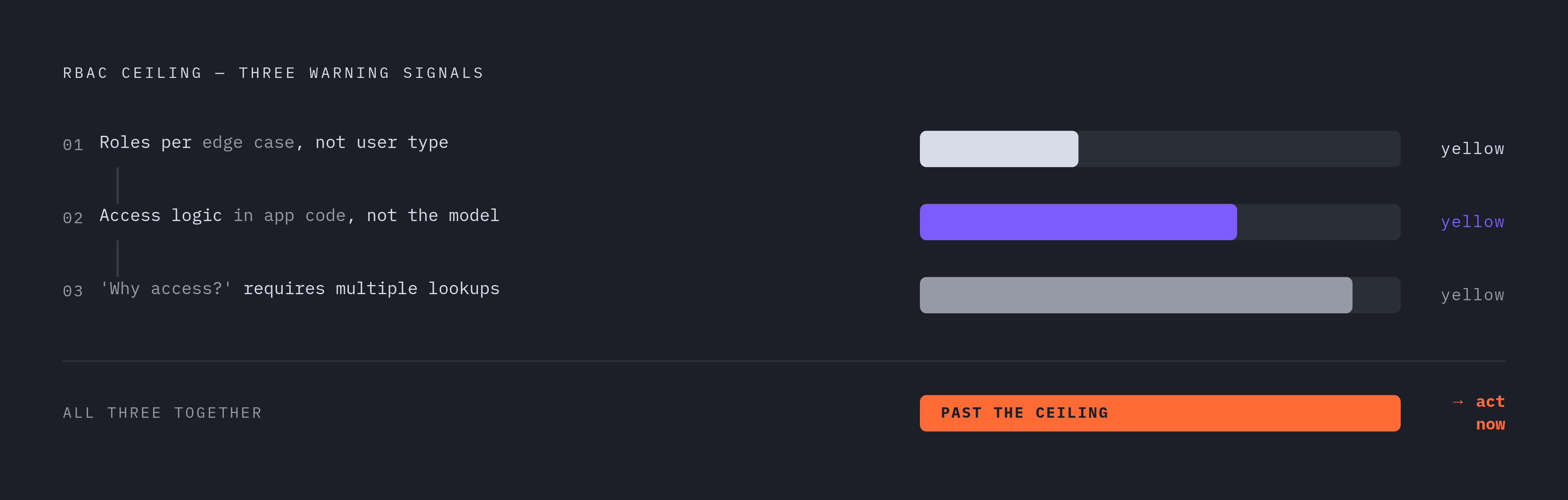
RBAC has a ceiling. It's not low, but it's real, and you'll know when you've hit it.
The first sign is role explosion. As products add features and customer segments, the number of roles required to cover every permission combination starts multiplying. You add a "Regional Admin" for one customer, a "Read-Only Billing Viewer" for another, a "Limited Editor Who Can't Delete" for a third. None of these map to actual user types. They map to edge cases, and each one is a new thing to document, audit, test, and maintain. The maintenance burden grows faster than the product does.
The second sign is rigidity. RBAC encodes access in static assignments. It can't respond to context. It doesn't know a user is trying to access a sensitive record outside business hours, or that a document belongs to a different department. It just knows the role. If you need context-sensitive decisions, you end up adding more roles, which makes the first problem worse.
The third sign, and the most dangerous one: access logic starts leaking into your application code. Developers start writing conditional checks inline. "If the user has this role AND it's their own record AND the record isn't archived, then allow." That logic belongs in your permission model, not scattered across endpoints. Once it's in the code, it's invisible to auditors and nearly impossible to enforce consistently.
There's a trap running in the opposite direction too. Teams overestimate how much complexity they actually need early on. They ship a sophisticated policy engine at seed stage, spend months building it, and then discover that the vast majority of their customers' real use cases were role-shaped the whole time. That costs real time and real money on problems that didn't exist yet.
The actual risk is failing to design for the moment when RBAC's ceiling becomes visible. If you build your RBAC layer cleanly and centralize policy enforcement early, upgrading to ABAC later is manageable. If you don't, it's a rewrite. Nobody wants a rewrite.
Watch for these signals:
- Roles are being created for individual customers or edge cases, not recognizable user types
- Access logic is living in application code instead of the permission model
- Answering "why does this user have access?" requires more than one lookup
Any one of those is a yellow flag. All three together means you're already past the ceiling.
The Verticals and Product Contexts Where ABAC Is Genuinely Necessary
ABAC is for situations where the access decision cannot be made without knowing something about the resource, the context, or the current moment. If you can describe who should have access without referring to resource properties or the user's current situation, you don't need ABAC. If you can't, you do.
Two verticals make this unavoidably concrete.
Healthcare. HIPAA's "minimum necessary" standard requires that users access only the patient data they have a legitimate clinical need to see. Encoding "legitimate clinical need" as a fixed role doesn't work in any real care setting. A nurse on the overnight shift in the ICU has a different access profile than a nurse in outpatient orthopedics, and that profile changes based on which patients are assigned to them that shift. ABAC policies built on patient assignment, department, and shift status reflect that reality. Static roles don't.
Financial services. SEC and FINRA regulations require segregation of duties and conflict-of-interest checks. A trader cannot approve their own trades. That's a relationship-and-context rule, not a role rule. The trader has "Trader" as their role in your system, but preventing them from approving their own activity requires knowing who originated the trade. That's an attribute-level check, and there's no clean way to fake it with roles.
The retrofit cost is not hypothetical. A healthcare analytics SaaS built on RBAC at seed stage hit ABAC requirements when their first hospital system customer needed PHI access policies based on patient assignment. The result was roughly twelve weeks of retrofit work and a three-month delay for the customer. That's not just engineering time. That's a delayed enterprise deal and a damaged first impression with a logo customer, and that kind of thing lingers.
The test is simple: can you describe the access rule in plain English without mentioning a specific resource property or context variable? "Editors can edit documents" passes. "Editors can edit documents in their department that aren't under legal hold during business hours" doesn't. The second one is an ABAC rule. Build it that way from the start, because rebuilding it later under deadline pressure is genuinely unpleasant.
Hybrid Models in Practice: Layering ABAC on Top of an RBAC Foundation
You don't have to choose between them permanently. Most mature permission systems use both, and the combination is stronger than either alone.
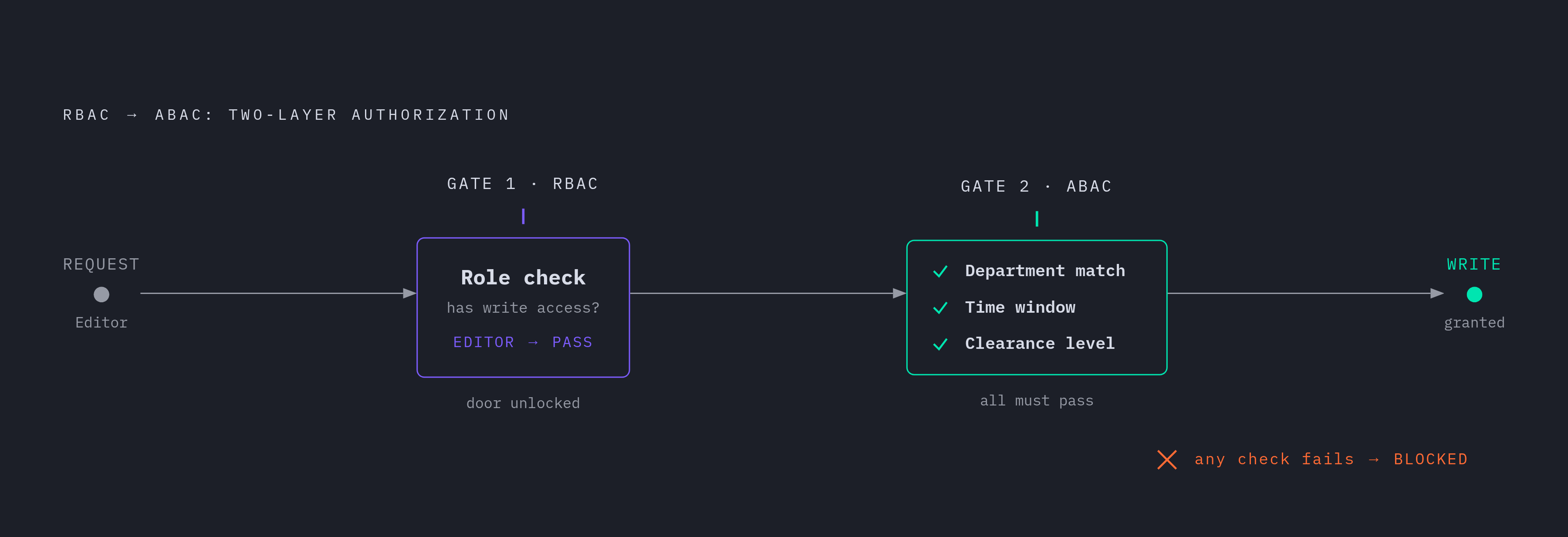
The basic pattern: RBAC establishes baseline permissions. It defines what a role can do by default across the product. ABAC layers contextual refinements on top, determining whether this specific action on this specific resource is allowed right now, given what the system knows about the user and the resource in this moment.
AWS's prescriptive guidance on SaaS multi-tenant authorization makes this explicit. Combining both models enables simpler permission administration while permitting increased flexibility and granularity. You get RBAC's alignment with business logic (which makes administration easy and audits straightforward) and ABAC's attribute evaluation (which handles edge cases without requiring a new role every time a new edge case appears).
In practice: an Editor role grants write access by default. That's the RBAC layer. An ABAC layer then checks whether the document is owned by the user's department, whether the write is happening during an allowed time window, whether the data is classified at a sensitivity level the user's clearance covers. The role unlocks the door. The attributes determine whether you can walk through it right now.
The practical advice: start with the cleanest RBAC model that covers your current customer needs. Then identify the specific access decisions where attributes genuinely matter. Add ABAC selectively to those decision points rather than rebuilding everything at once.
One more shape worth knowing: ReBAC. Relationship-Based Access Control evaluates relationships between entities rather than roles or attributes. The core question is "what is this user's relationship to this resource?" rather than "what role does this user have?" It's well-suited for collaboration tools and document-sharing products where "who shared this with whom" is the primary access question.
Google Zanzibar is the canonical example, underpinning Google Drive and Google Calendar among other Google services. It manages over 2 trillion relation tuples and processes 10 million authorization requests per second at under 10ms p95 latency. Not a benchmark to chase right now. More of a demonstration of where relationship-based access leads at scale, and why the model deserves to be taken seriously.
If your core product is collaborative, pay attention to ReBAC. For most SaaS products, RBAC plus selective ABAC gets you where you need to go.
Centralizing Policy Enforcement So Your Model Doesn't Drift Across Services
Authorization logic spreads across services over time. One endpoint denies an action. Another quietly allows it. Nobody can explain why during an audit. This is policy drift, and it is extremely common, and it hits quietly and then hurts loudly.
It happens because enforcement is easy to add inline. A developer writes a quick permission check at the endpoint level. Another developer writes a slightly different check in a different service. Over time, the two checks diverge. Neither developer realizes it because they're not looking at both simultaneously. An auditor eventually finds the gap, or worse, an attacker does.
PBAC is the structural fix. It's a centralized enforcement pattern rather than a different access model. All services route authorization decisions to the same policy decision layer. The policy lives in one place. Updates happen in one place. The audit log reflects every access decision across the entire system, not scattered inline checks that nobody can reconcile.
When policy is code that's separate from application logic, it behaves like code. It can be tested, versioned, and reviewed in a pull request. You can write a test that says "a Viewer role should never be able to delete records" and run it on every deploy. That's not possible when access logic is spread across twenty endpoints and three services that two different developers wrote six months apart.
For small teams especially, this matters. You can't manually audit every service boundary every time a compliance requirement changes. One change propagating everywhere beats twenty changes you hope someone remembers to make.
One pressure point worth flagging separately: AI SaaS products with retrieval-augmented generation pipelines. In those systems, authorization at the data retrieval layer is not optional. Tenant-aware indexing and strict access controls are the only things preventing Customer A's documents from surfacing in Customer B's queries. The authorization model doesn't just protect the application interface. It protects the data feeding the model's responses. Multi-tenant isolation has to be enforced at that layer, and centralized policy enforcement is the only reliable way to do it consistently.
How Authorization Requirements Evolve With AI Agents Acting on Behalf of Users
Authorization was designed for humans. A person logs in, gets a role, takes an action. The role tells the system whether to allow it. Clean and simple.
AI agents break that model pretty thoroughly.
An agent doesn't just read data. It takes actions. It queries a database, drafts an email, submits a form, triggers a workflow, all in a single session, all on behalf of a user who is not watching in real time. The authorization question is no longer "can this user do this?" It becomes "can this agent, acting on behalf of this user, perform this specific action on this specific resource right now, given the scope the user delegated?" Those are very different questions, and RBAC roles weren't built for the second one.
Roles assume a human user with a stable job function and a predictable set of permissions. Agents have dynamic scopes. They have delegated authority that is narrower or broader than the user's own permissions, session-specific constraints, and operating contexts that shift. A role doesn't capture any of that.
The market has noticed. Cedar has been adopted as the authorization language for AI agents in Amazon Bedrock AgentCore Policy. SpiceDB announced LangChain integration. Nearly every major authorization vendor accelerated AI agent support through 2025 and 2026. The industry is treating agent authorization as a first-class problem, not an edge case to handle later.
The consolidation signals point the same direction. CrowdStrike acquired SGNL for $740 million in January 2026. FusionAuth acquired Permify in November 2025. Authorization is moving out of standalone tooling and into integrated security and identity platforms. That's what happens when a capability becomes critical infrastructure.
For founders building AI products: the permission model you pick today needs to accommodate agents as first-class actors. ABAC's attribute-driven decisions and PBAC's centralized enforcement are better fits for agent authorization than flat RBAC. An agent's scope, the user's delegation grant, the resource sensitivity, and the session context are all attributes. ABAC can evaluate them. RBAC, by itself, cannot.
Tiun supports agent-driven workflows and MCP integrations and handles the authorization wiring that would otherwise require manual policy plumbing. When an MCP client needs to verify that an agent holds a valid delegation grant from a user who has the right permissions for the target resource, that's a multi-layered authorization check. Handling it without a platform designed for it means building it yourself, which is a significant undertaking and a consistently underestimated one.
A Decision Framework for Picking the Right Model at Your Current Stage
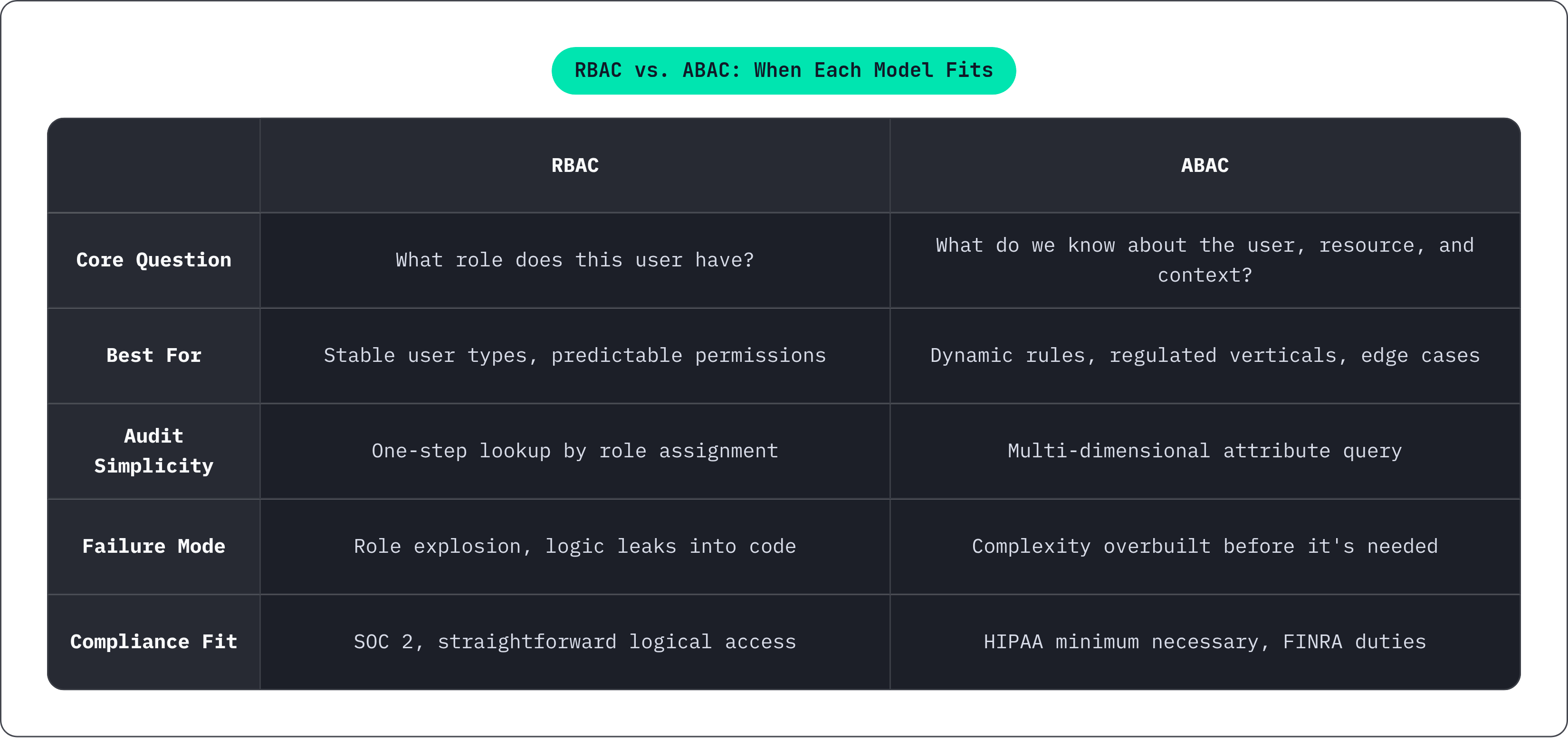
Here's the actual decision tree. Not every possible edge case. Just the ones that actually matter for where you probably are right now.
Start with RBAC if:
- Your user types map to two to five clearly distinct roles
- Access decisions don't depend on resource properties or environmental context
- Your current or near-term customers are not in regulated verticals requiring dynamic policy
- You're pre-product-market-fit and need to ship without authorizing yourself into a corner
Add ABAC when:
- Role count is growing faster than your actual user types are
- Enterprise customers are asking for access rules you can't express as roles
- You're entering healthcare, financial services, or any vertical with regulatory attribute requirements
- Access decisions need to vary by resource sensitivity, user location, or time of day
Consider ReBAC if:
- Your core product is collaborative. Documents, projects, shared workspaces. "Who shared this with whom" is the primary access question.
Regardless of which model you choose: centralize policy enforcement early. The twelve-week retrofit from the healthcare example above is a floor, not a ceiling. It grows with the number of services in your system. Every service you add without a centralized policy layer is another place where drift can happen quietly until it can't be ignored.
One thing that doesn't get enough attention: permission systems don't exist in isolation. They depend on a reliable user database, session management, and event logging. When those pieces live in different systems, synchronization gaps appear, and those gaps are exactly where policy drift starts. Tiun keeps user records, authentication state, and access context in one place, which removes the synchronization problem before it becomes a policy problem.
The choice between RBAC and ABAC is a stage-appropriate decision, and it is not permanent. The mistake is designing for the wrong stage and absorbing the retrofit cost at the worst possible moment. An enterprise deal closing. A compliance audit. Your first regulated customer asking a question your system can't answer cleanly. Pick the right model for now, design so the upgrade path to the next model is visible, and centralize enforcement before you need to. Not after.