merchant of record platforms that bundle authentication, billing, and analytics in a single integration
Most merchant of record platforms stop at payments, leaving authentication and analytics to you.

An MoR handles your payments, your tax filings, and your chargeback headaches. What it usually skips is everything else your product needs to run: knowing who your users are, tying that identity to what they've paid, and figuring out what they actually do once they're logged in. That's the gap I want to walk through, and what actually changes when a platform decides to close it instead of leaving the job to you.
Quick refresher first. An MoR sits between you and your buyer as the legal seller of record. The platform takes on liability for the transaction, which means it owes a fixed list of obligations no matter how small or scrappy your product is:
- Charging and collecting payment from the end customer
- Remitting sales tax, VAT, and GST across every jurisdiction you sell into
- Managing chargebacks and eating the dispute liability
- Staying compliant with PCI-DSS, plus whatever regional flavor of that shows up
Without an MoR, VAT registration across EU countries alone can consume weeks of setup before a single euro lands in your account. The OSS scheme cleaned some of that up, letting you file once for the whole EU bloc. But US sales tax is still a jurisdiction-by-jurisdiction maze, and Digital Services Tax rules in the UK and France run on their own calendars that never line up with anyone else's. An MoR takes that mess and puts it on its own books instead of yours.
The trade is control. Because the MoR owns the risk, it also owns the surfaces that risk touches: what shows up on the credit card statement, how a refund gets processed, how your pricing looks at checkout. Know that going in.
Handling the transaction layer well is a real accomplishment. But it's a narrower job than it looks from the outside, and most MoR vendors would rather you not poke at that too hard.
The integration gap most MoR platforms leave open
Most platforms stop at transactions and compliance. Subscription management, hosted checkout, basic billing reports show up as add-ons pretty often, but they're still payment-adjacent. Same core function underneath: move money, file the paperwork.
Here's what gets left on your desk, alone, on a Tuesday night:
- Authentication and identity: who is this person, and what plan are they actually on
- A customer record tying that identity to billing history and usage
- Analytics connecting payment events to behavior, the arc from signup to activation to churn, not just a revenue chart
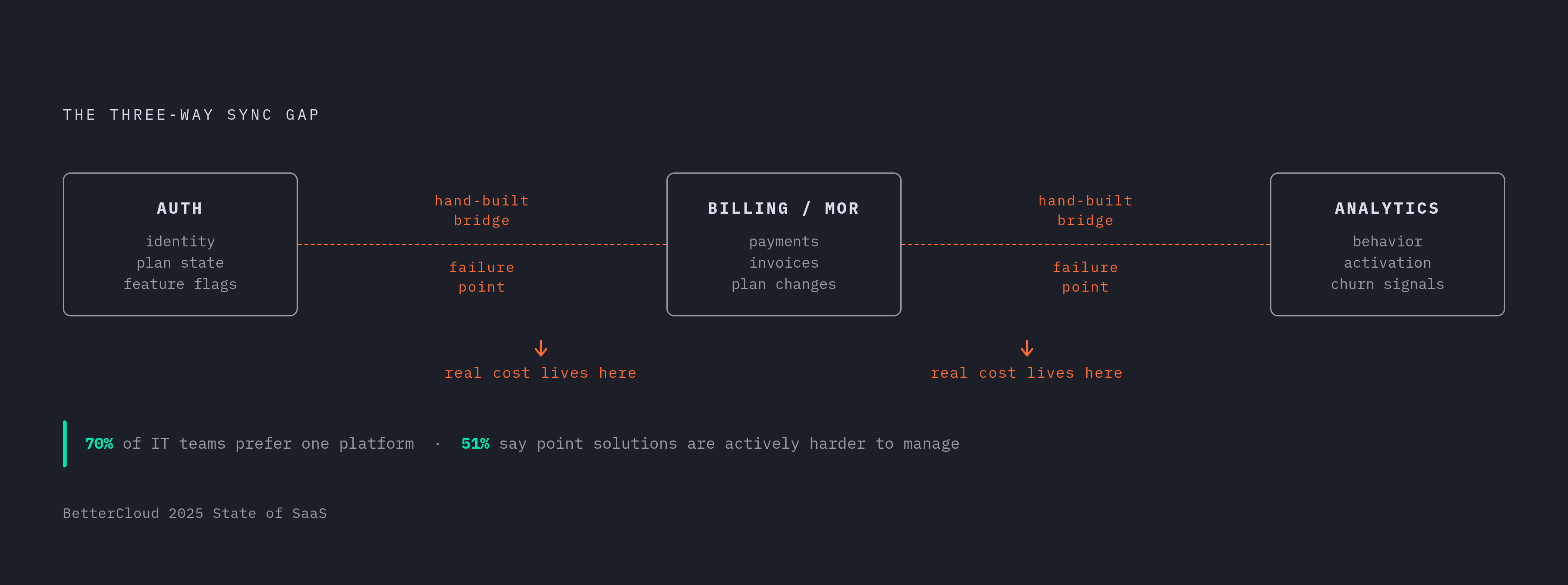
Even with an MoR handling the money, you're still stitching together an auth provider, a billing tool, and an analytics layer on your own time. Three systems, three data models, three separate places where "the truth" about a customer supposedly lives. None of them talk to each other unless you build the bridge yourself.
And that bridge needs upkeep constantly. Every pricing change, every new plan tier, every feature flag has to propagate correctly across all three systems, or you get support tickets from people who paid for something your app doesn't think they own. The tax compounds quietly as the product grows.
BetterCloud's 2025 State of SaaS report put a number on a feeling most builders already had: 70% of IT teams would rather run one all-in-one platform than juggle point solutions, and 51% say the point-solution approach is actively harder to manage. That's a lot of people describing the exact same sync headache.
None of this is a knock on MoR platforms as a category, to be clear. They were built to solve tax and compliance, and they solve it well. The real question is whether that original scope still matches what a modern SaaS or AI product actually needs from its backend.
What most MoR platforms actually offer beyond the transaction layer
Look at what's out there and the pattern holds up pretty consistently.
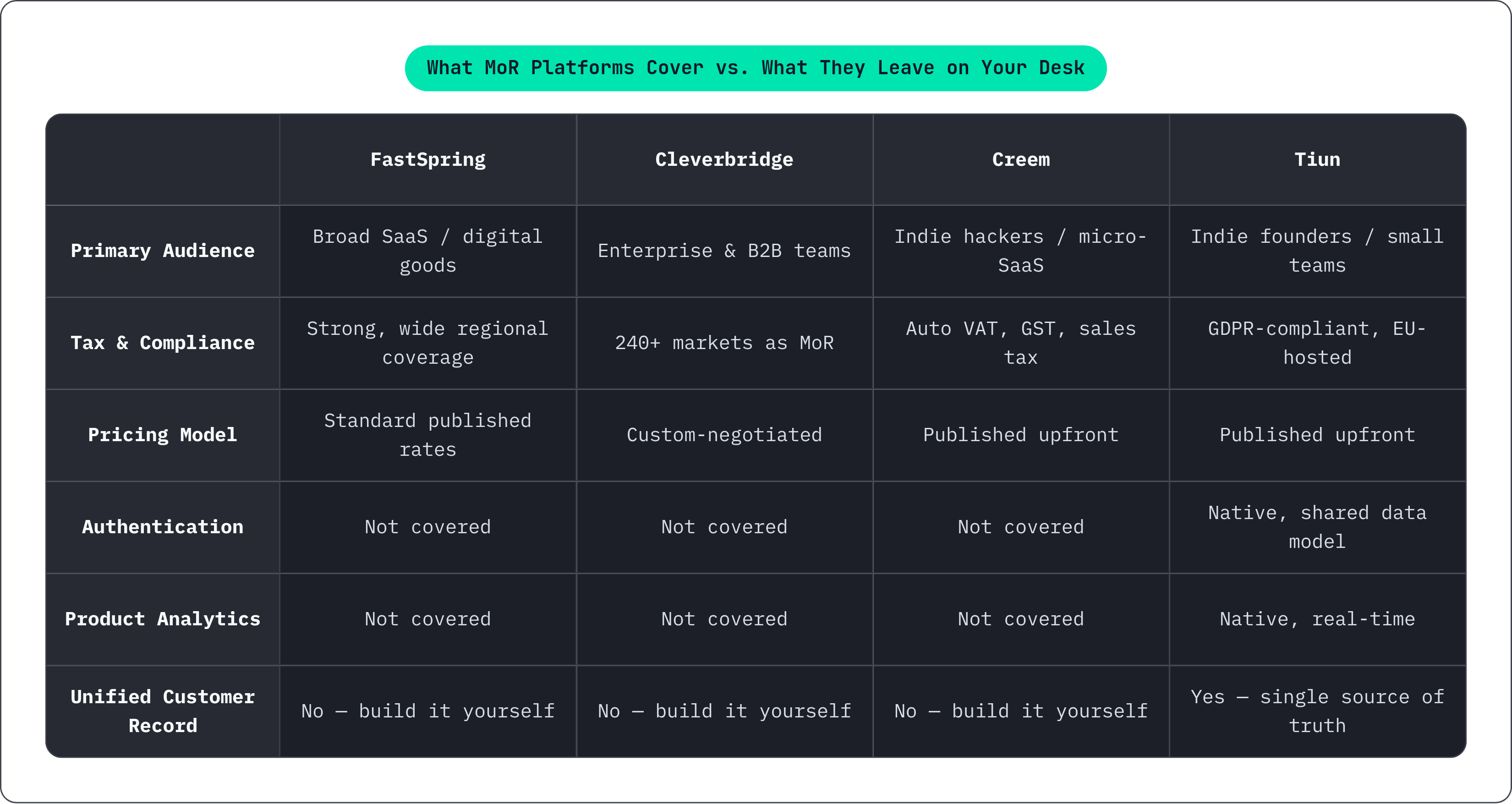
Some platforms have been around since the mid-2000s, and it shows in the good way: solid billing and subscription tooling, documentation that won't make you throw your laptop across the room, coverage across a wide range of regions. The story stops at payments and compliance though. Auth and analytics never enter the plot.
Other platforms lean enterprise and B2B, handling tax remittance across more than 240 markets when acting as MoR, which is a genuinely large footprint. Terms get custom-negotiated instead of self-serve, so it fits teams where complex global billing and retention tooling matter more than shipping by Friday.
Creem sits at the other end of the spectrum. API-first, built for indie hackers and micro-SaaS teams, automatic VAT, GST, and sales tax handling across a long list of countries, a fee structure published upfront instead of buried in a sales call. Scope-wise though, it still lives in the same payment-and-compliance lane as everyone else.
All three share the same shape: good, sometimes very good, at what MoRs were invented to do. None of them stretch into authentication or product analytics. The closest any get is a subscription health dashboard or an MRR chart, and those are revenue views, not behavior views. They'll tell you what came in. They won't tell you why a user churned three days into their trial.
Which leaves the same job sitting on your desk: connecting billing state to identity and behavior, by hand, with whatever duct tape you can find lying around.
How usage-based billing raises the cost of a fragmented stack
AI products blew a hole in the old idea that a subscription is flat and predictable. One customer's token burn can be ten dollars this week and four hundred the next, depending on how hard their agents are working that week. Invoices have to reflect real consumption or customers stop trusting them, and trust in a bill is hard to win back once you've lost it.
Usage-based pricing went from a niche experiment to a default option across SaaS broadly over the past few years, not just among AI-native companies. Metering stopped being optional infrastructure somewhere along the way and became table stakes.
Metered billing demands three things flat subscriptions never had to worry about:
- Real-time event ingestion, so usage gets captured the moment it happens, not batched up hours later
- One source of truth, so the record of what a customer used is the exact record that generates the invoice and checks entitlements
- Auth awareness, so the billing system knows a user's current plan well enough to enforce limits on the spot
Split those three requirements across three vendors and congratulations, you've built yourself a distributed systems problem on purpose. A usage event gets captured in one tool, aggregated in a second, invoiced by a third. That's lag baked into the pipeline, reconciliation work nobody enjoys doing on a Friday afternoon, and a real shot at billing someone the wrong amount because two systems disagreed about the time zone.
Building that metering infrastructure from scratch takes months, realistically. Every week spent on it is a week not spent finding product-market fit, and for an early-stage team, that's the only clock that actually counts. Usage-based pricing has become an infrastructure requirement, full stop, and the infrastructure that works best is the kind where metering, billing, and access control share one data model from day one, rather than three models introduced to each other after the fact, at 11pm, right before a launch.
What bundling authentication, billing, and analytics into one system actually changes
Bundling is, at its core, a data coherence feature. When identity, payment state, and product behavior live in one system, the relationships between them stay current by default, rather than waiting on a nightly sync job to finally finish.
A genuinely unified customer record makes a handful of things possible that a fragmented stack just can't:
- Seeing instantly which users went from free to paid, and what they were doing right before they converted
- Catching churn signals in behavior before they ever show up as a canceled subscription
- Enforcing access limits (trial expired, plan downgraded) without a webhook chain that quietly drifts out of sync over time
- Running a pricing experiment without coordinating the same change across three separate admin panels
The developer experience gap gets underrated here, honestly. A team stitching together an auth provider, an MoR, and an analytics tool is maintaining three accounts, three schemas, three sets of event mappings, plus the mental overhead of remembering which one is supposedly the source of truth for what. A unified platform collapses that into one integration surface, which sounds small until you're the one debugging why a canceled user still has API access at 2 a.m. on a Tuesday.
One newer wrinkle here. When the integration surface is small and well-defined, an AI agent can handle the setup itself, which is increasingly how development teams expect to work now. A sprawling multi-tool stack still needs a human stitching pieces together by hand, because no agent can reliably guess how three unrelated vendors' webhooks are supposed to line up with each other.
The goal is having those pieces share state from the start, instead of getting bolted together after launch and held together by whoever's still awake to fix it, all without giving up control of the payment experience or the strength of any individual piece.
Tiun's approach: MoR as one layer of a unified backend
Tiun's pitch is structural: merchant of record is one layer of a full backend that also covers authentication, billing, and analytics, built to share a single customer record instead of getting assembled from separate vendors after the fact.
On the MoR side, Tiun is European-hosted and GDPR-compliant, acting as merchant of record for tax compliance and chargeback liability. Pricing is published, not negotiated behind closed doors: 3.4% plus $0.30 per transaction, a 0.5% subscription fee, $15 per dispute. You can read the number before you sign anything, which shouldn't count as a selling point but somehow still does in this industry.
Because auth, billing, and analytics are native to the same system rather than stitched together with API calls between vendors, the customer record stays coherent without extra plumbing on your end. A plan change in billing shows up in the auth layer immediately. A usage event is queryable in analytics right away, not after some batch job finally runs overnight.
MCP integrations and CLI-based skill installation mean setup work can be handled by an AI agent, which fits how AI-focused engineering teams increasingly want to build things. It's a look at what an MoR-adjacent system can be when identity, transaction history, and behavior get built into the same place from day one, instead of bolted on and left to drift every time pricing changes.
That fit has real edges though, and I'd rather say so than pretend otherwise. This is built for indie founders and small engineering teams solving the tool-sprawl problem, not for a team already deep into a multi-vendor stack it's committed to keeping. Teams that need heavy enterprise customization on one specific component will find a unified system less bendable by design. That rigidity is the price of coherence, and it's a real price.
How to evaluate a bundled MoR platform before committing
Which platform has the most features matters less than how many systems you actually want to own and babysit day to day. That answer decides which class of solution makes sense for you in the first place.
Ask yourself a few things before you sign anything:
- Does your billing model need real-time metering, and if so, does the billing layer actually share state with auth and analytics, or are you back to building the bridge yourself?
- Where do your customers live, and does the platform's MoR coverage match the tax regimes and local payment methods those markets demand?
- What does the fee structure look like at your real transaction volume, and does it fold in chargebacks and subscription management, or bill those separately?
- Can an AI agent handle the integration through documented tooling, or are you looking at manual webhook wiring and a lost afternoon in the docs?
- If you outgrow the platform, how clean is the exit, and does it hold your customer data in a way that makes leaving expensive?
One regulatory note worth flagging on its own: the EU's ViDA package phases in mandatory e-invoicing on cross-border B2B sales through 2030 and beyond. Anyone selling to European businesses should ask their MoR, point blank, what its stated position is on EN 16931 compliance as that rollout proceeds. Vague answers now turn into expensive problems later, and there's no version of "we'll figure it out" that ages well here.
For a solo founder or small team, the real cost of keeping an auth provider, an MoR, and an analytics tool in sync isn't the invoice at month's end. It's the attention and engineering hours that go toward keeping three systems from quietly disagreeing with each other, hours that could've gone toward the product instead. A bundled platform earns its keep in what it takes off your plate, not just what it adds to a feature list.