European merchant of record providers and their pricing models
Hidden fees in European merchant of record pricing can double your real costs.

A Merchant of Record is the legal seller in a transaction. It handles tax filings, chargebacks, and regulatory exposure, not just the job of moving money from a customer's card to your bank account. That's why two companies quoting the "same" 5% fee land on wildly different bills once VAT, chargebacks, and currency conversion get tacked on. This piece walks through what you're actually paying for when you hand tax and compliance to a Merchant of Record in Europe, and how to work out the real cost for your own business.
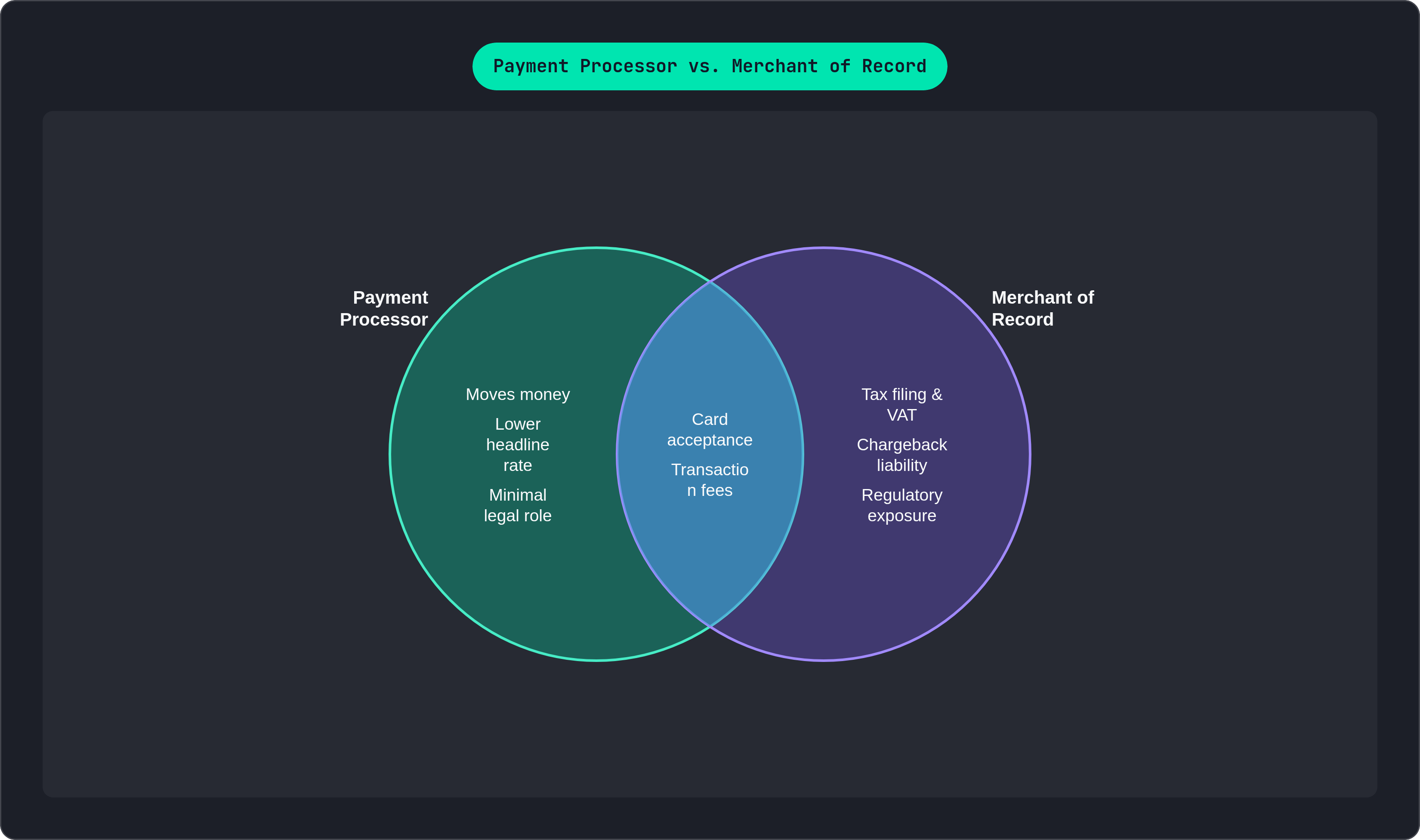
A payment processor moves money. A Merchant of Record owns the legal exposure, full stop. When a customer in Germany buys your software, the MoR collects the VAT, files it in the right place, eats the chargeback if the sale gets disputed, and answers to the regulator if one comes calling. The EU gives you no grace period on this, and there's no revenue threshold to cross before VAT kicks in. Sell your first euro of digital goods and VAT applies right then, on that transaction.
That hits European SaaS companies especially hard. B2B sales inside the EU often qualify for reverse-charge VAT, where the business customer takes on the burden instead of you, and a good MoR handles that without you thinking about it twice. A bad setup means you're hand-tracking VAT IDs in a spreadsheet somewhere, hoping you classified the sale right. Add in the fact that European buyers expect iDEAL, Bancontact, or SEPA Direct Debit sitting right there at checkout, and a bare payment processor starts looking thin for anyone selling across the continent. Rules aren't getting simpler either: the EU's ViDA package, adopted March 2025, rolls out in stages through 2035, with mandatory cross-border e-invoicing landing July 1, 2030. Whatever you're wrestling with now is the floor, not the ceiling.
So when a Merchant of Record charges a higher percentage against a processor's lower one, that gap is the price tag on someone else holding legal risk you'd otherwise be carrying yourself.
The market these providers operate in, and one major 2025 disruption
This stopped being a fintech side note a while back. The global Merchant of Record market hit an estimated $12.6 billion in 2024, with projections putting it at $38.1 billion by 2033, growing around 13.2% a year. North America and Europe hold the biggest share. Makes sense: heavy e-commerce volume plus dense regulation is exactly where paying someone else to deal with tax and compliance starts to pay for itself.
Then 2025 handed the market a gut check. Digital River, one of the oldest names in enterprise MoR, wound down its e-commerce and MoR operations in January 2025, and several subsidiaries went into insolvency. Companies that had built their entire billing stack around Digital River were suddenly migrating mid-contract, under deadline, with live revenue exposed the whole time. Not a fun Tuesday for anyone on those finance teams.
A Merchant of Record relationship is a deep integration, not a vendor you swap out over a long weekend. Your checkout, your tax filings, your customer records, all of it runs through this one company. Price is just one line on the comparison sheet; longevity, financial footing, and how a provider treats accounts under stress belong on there too. A cheap rate from a company that might not exist in eighteen months isn't cheap. It's a loan you didn't know you took out.
How MoR pricing is actually structured — the fee layers most comparisons miss
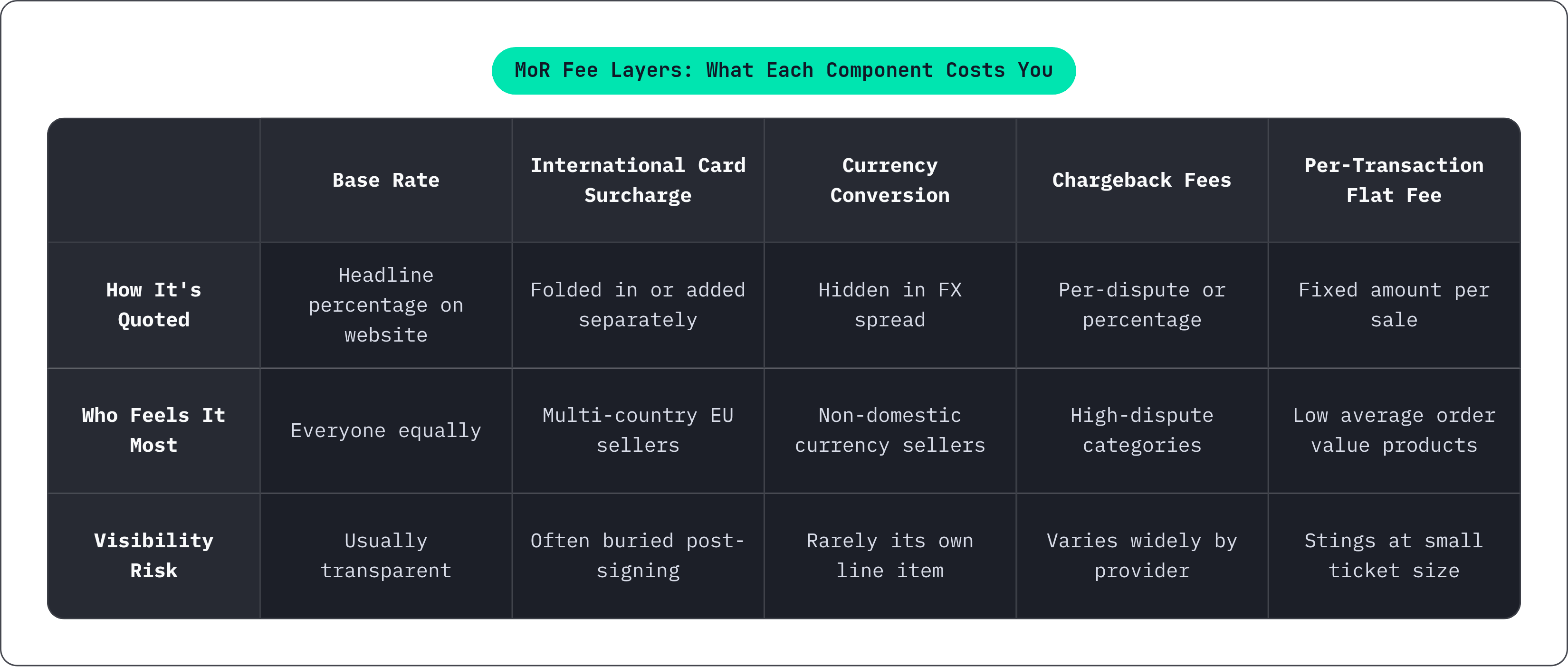
The percentage a provider quotes up front is rarely the number you end up paying. Real MoR pricing gets built in layers, stacked one on top of another, and most of them don't show up until after you've signed.
Start with a base transaction percentage, plus a flat per-transaction fee that stings more the smaller your average sale is. Then there's usually an international card surcharge, often around 1.5%, which some providers fold into the headline rate and others charge separately and quietly. Subscription billing sometimes carries its own add-on fee. Currency conversion markup tends to hide inside the foreign exchange spread rather than appear as its own line item. Chargeback fees and dispute handling vary by provider and by product category, and a handful of providers still charge monthly platform fees, though that's gotten rarer over the past few years. Payout timing, and how deductions get pulled out of your balance, matters for cash flow even when it never touches the headline math.
The biggest distortion for a European business is whether that international surcharge sits inside the quoted rate or gets tacked on after the fact. A provider advertising a lower headline number but adding 1.5% on every non-domestic card can end up costing more than a competitor with a higher, honest, all-in rate, once you're selling into a dozen EU countries plus the UK. Coverage breadth adds a second cost that's harder to pin a number on: fewer supported jurisdictions means more manual workarounds on your end, and that engineering time costs real money even when it never shows up as a line on an invoice.
Providers with published, all-in rates: what you're actually paying
Some providers just put the rate on the website. That transparency tells you something about how they compete, and it makes the comparison a lot less painful for everyone involved.
Tiun is a European-hosted, GDPR-native Merchant of Record that bundles authentication, payments, a customer database, and analytics into one platform instead of making you stitch four tools together with duct tape. For a European founder, the part that matters is that customer data stays hosted in Europe by default. That's a structural fact, not a checkbox you flip after signing. Tax compliance and chargeback handling live in the same backend as your user data and analytics, so nothing's syncing across three systems while you cross your fingers and hope it doesn't drift.
The fee structure is published, and it doesn't bury the international surcharge in fine print somewhere on page nine. Usage-based billing works natively, which matters if you're running an AI product where people pay per token or per API call instead of a flat monthly fee. Setup runs through CLI tooling and MCP integrations, meaning an AI coding agent can handle a good chunk of the integration itself. That cuts down the engineering hours other MoR setups tend to eat, and engineering hours cost real money whether or not they show up as a percentage anywhere.
PayPro Global runs on quote-based, volume-tiered pricing instead of one published number, but it earns a mention for specialization: strong coverage in categories with heavier chargeback exposure, decent multilingual billing, broad global payment method support. It holds a very highly on G2 on G2. Trustpilot tells a messier story, mostly because those reviews skew toward end customers rather than the merchants who actually signed the contract. Worth keeping those two audiences separate when you're reading reviews for any provider in this space.
Providers with negotiated or opaque pricing — what to expect in those conversations
Not every provider prints a number on the page. Usually that just means pricing depends on your volume, your category, or how much custom infrastructure you need built out.
Fungies.io, based in Warsaw, is an EU-native Merchant of Record where GDPR alignment comes from jurisdiction, not from a Data Processing Agreement you negotiate after the fact. It handles subscription billing across monthly, annual, and usage-based models, plus chargebacks and fraud prevention. For a founder who specifically wants a provider headquartered inside EU jurisdiction, that's a structural argument, not a marketing line: data residency and regulatory alignment sit in where the company is, not in a contract clause bolted on later.
As with any smaller EU-native provider, it's worth asking pointed questions about platform stability, support response times, and how the tooling holds up at higher revenue scale before committing. Where those practical ceilings sit, nobody's quite said out loud yet.
A few questions consistently separate a good negotiated deal from a bad one. Ask for the blended effective rate at your expected monthly recurring revenue, not just the base percentage. Also ask whether international cards are included or additive to that number. Ask about the chargeback dispute fee structure by name, since that's where costs quietly balloon for certain categories. Ask about the payout schedule, and ask which jurisdictions the provider covers natively versus which ones need a workaround built by your own team.
Volume changes the conversation too. Most providers get a lot more flexible once you're past a certain threshold of monthly recurring revenue. Walk in with your projected 12-month gross merchandise volume, not today's number: providers price for where you're headed, not where you've been sitting.
How to model the true cost across providers for a specific business
Comparing published rates side by side isn't the number that matters. What matters is your effective cost per unit of gross merchandise volume, run against your actual transaction mix, not some industry average pulled from a blog post.
Build it from five inputs: your average transaction size, since a small ticket price makes flat per-transaction fees hurt disproportionately more; the share of revenue coming from international customers, specifically EU, UK, and non-US buyers; the split between subscription revenue and one-time purchases; your chargeback rate, which shifts a lot by category; and the number of jurisdictions where you have real customer volume, versus the ones where you get one sale a year and call it coverage.
Take a solo founder running a low-priced monthly SaaS product sold mostly to a European audience. An all-in, international-inclusive rate beats a lower headline rate with a per-card surcharge almost every time in that scenario, because nearly every card hitting the checkout is non-domestic anyway. Jurisdiction coverage matters more here than shaving a few basis points off the base rate.
Two costs get left out of these comparisons constantly. First, the engineering time it takes to integrate and maintain the billing system, which drops a lot with providers that support AI-native setup instead of demanding months of custom work from your team. Second, the time cost of handling chargeback disputes by hand versus letting the Merchant of Record absorb that work entirely. Add a third if you're routing EU customer data through infrastructure hosted outside Europe: the ongoing overhead of managing that data flow properly under GDPR, which is its own small job.
The fee a provider quotes reacts to your specific transaction profile; it doesn't sit as a fixed number floating outside your business. Two founders paying the same nominal rate can walk away with very different real costs once someone actually runs the math.
What European data hosting and GDPR compliance add to the MoR decision
Most comparisons treat every Merchant of Record as equal on compliance and just argue over basis points. That's an expensive assumption to get wrong.
Where a Merchant of Record processes and stores your customer's transaction data is a GDPR question, not a footnote. Billing details, transaction records, behavioral data flowing through a MoR: all of it counts as personal data under EU law. If that provider is headquartered or hosted outside the EU, you're now dealing with data transfer mechanics, Standard Contractual Clauses at minimum, ongoing adequacy monitoring if you're doing it properly. Providers that are EU-hosted and EU-headquartered remove that whole category of overhead, simply because the data never leaves the jurisdiction to begin with.
This gets sharper for AI SaaS specifically. When billing data and usage or session data live in the same system, you end up with a much richer personal data profile than a typical e-commerce transaction produces. Who's the data processor and who's the data controller stops being an academic question you skim past, and becomes something worth asking your provider directly.
Providers built EU-native from day one, like Fungies.io in Warsaw or Tiun with its European hosting, treat GDPR compliance as a baseline property of the business rather than something you bolt on through a Data Processing Agreement after signing. Data residency isn't a premium feature here; it's risk you don't have to carry, and retrofitting it later costs real money through migrations, renegotiated contracts, or a regulatory inquiry nobody wants sitting on their calendar. Founders selling into EU enterprise accounts are going to hit GDPR due diligence during procurement more and more often, and walking in with a Merchant of Record that's EU-hosted by design skips a negotiation you really don't want to have under deadline pressure.