Friendly Fraud vs. Legitimate Disputes in SaaS Billing
SaaS companies lose money either way when they misclassify chargebacks.
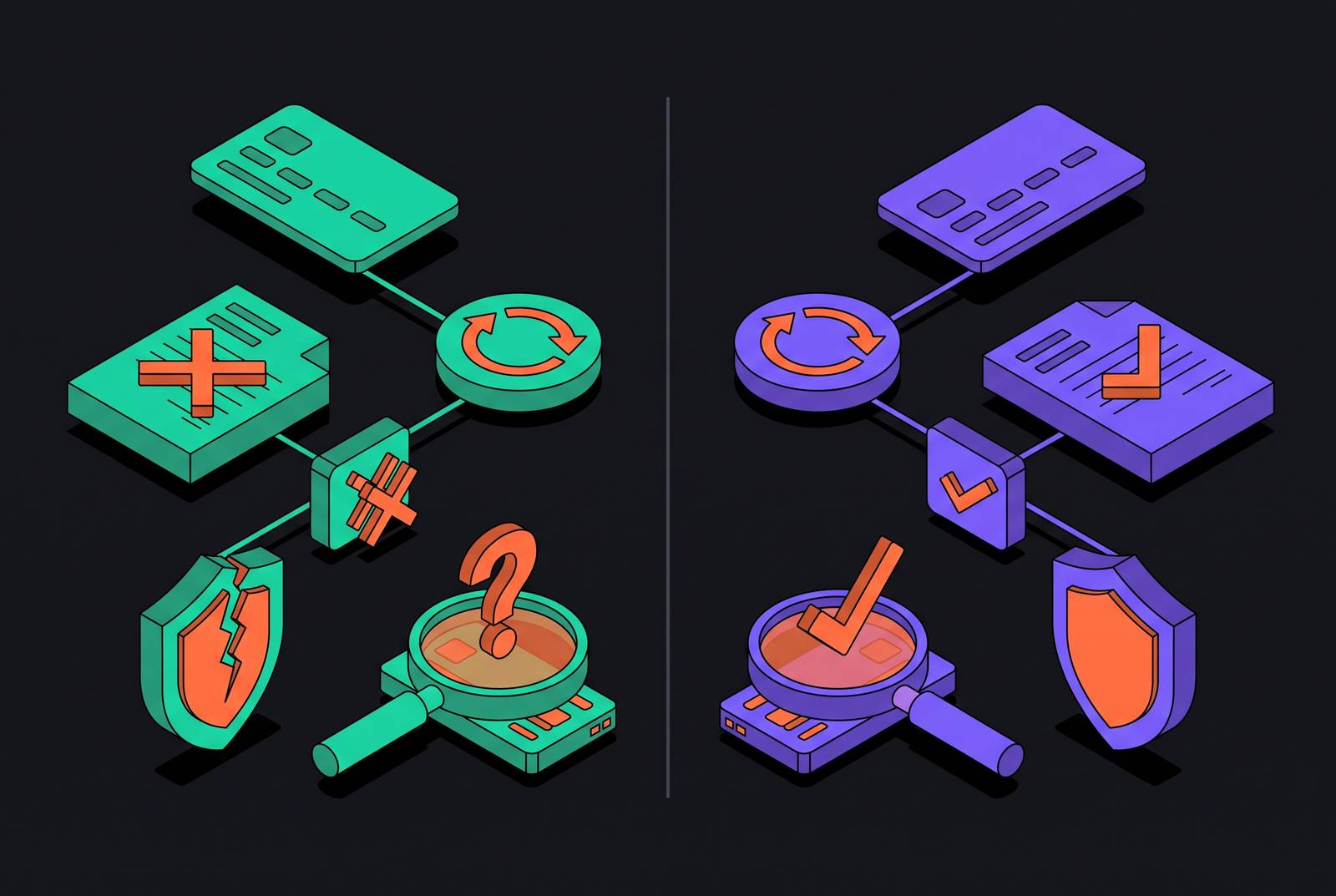
Two customers file the exact same chargeback. One got confused by a weird line on their bank statement and just wants their money back. The other used your product for four months, knew exactly what they were paying for, and disputed it anyway because it's free money if you don't fight back. Your payment processor shows you the same notice for both. This article is about telling them apart, and why getting it wrong costs SaaS companies money either way.
What friendly fraud and legitimate disputes actually are, and how they get conflated
Three different things get lumped into the word "chargeback," and only one of them is actually fraud in the way most people mean it.
True fraud is a stolen card. Someone other than the cardholder made the purchase, the cardholder had no idea, and they're a victim who deserves their money back with zero friction. Nobody's arguing about this one.
A legitimate dispute is different: the merchant screwed something up. Maybe the billing descriptor on the statement looks like gibberish, maybe a cancellation request got lost, maybe the service just didn't get delivered. The customer has a real complaint, and the business is the one that needs to fix it.
Friendly fraud sits in a weirder spot. The original purchaser, the actual cardholder, is the one filing the dispute, even though they're still using the product or clearly got what they paid for. Sometimes it's deliberate. Other times it's just someone who forgot they signed up for something and would rather call the bank than think too hard about it.
Here's the problem: all three show up on a merchant's dashboard looking identical. Same notice, often the same reason code from the card network. You don't get the backstory, you get the outcome. A lot of that confusion traces back to something as boring as the statement descriptor. Confusing or unrecognizable billing descriptors were the single biggest reason cardholders gave for filing disputes in the Chargebacks911 2024 Cardholder Dispute Index, and a third of merchants surveyed didn't even know how their own descriptor showed up on a customer's bank statement.
Get the classification wrong and you pay twice. Treat a real billing mistake like fraud, and you torch a customer relationship you could've saved with a refund and an apology. Treat friendly fraud like an honest mistake, and you're training that customer to do it again. Research indicates that a significant share of friendly fraudsters repeat the behavior within 60 days. Miss it once, expect a sequel.
The signals that separate friendly fraud from a genuine billing mistake
The good news: these two situations leave different fingerprints, if you know where to look.
Friendly fraud tends to show up with no warning shot. A large share of cardholders (53%, in surveyed data) never contact the merchant before going straight to their bank. Pair that silence with active usage, meaning login events, API calls, feature activity happening right up to the charge date, and you've got a strong signal something's off. Add a few more tells: prior transactions on the same card that were never disputed, timing that clusters suspiciously around cancellation or renewal, or a dispute reason that flatly contradicts the account's own activity log ("never received the service" when your logs show forty login sessions).
A legitimate dispute usually looks the opposite. The customer contacted support first, got nowhere, and escalated out of frustration rather than malice. Sometimes the descriptor on the statement is truncated into something unrecognizable, which is a configuration problem on your end, not theirs. Other times there's just no usage logged at all during the period they were charged, meaning the service genuinely wasn't delivered. Or they cancelled before the billing date and got charged anyway, which is a broken cancellation flow, full stop.
Then there's the gray zone, and it's bigger than people assume. The "forgot I had this subscription" case isn't quite fraud and isn't quite a merchant error either. It's inattention meeting weak renewal communication. Intent is genuinely fuzzy here, but the distribution of first-party fraud tells you where to lean: buyer's remorse, intentional abuse, and genuine misunderstanding each account for a substantial and overlapping share of first-party fraud cases. The forgotten-subscription case falls mostly in that last bucket, which means it deserves a different response than someone deliberately gaming the system.
How the scale of friendly fraud has shifted what builders are actually dealing with
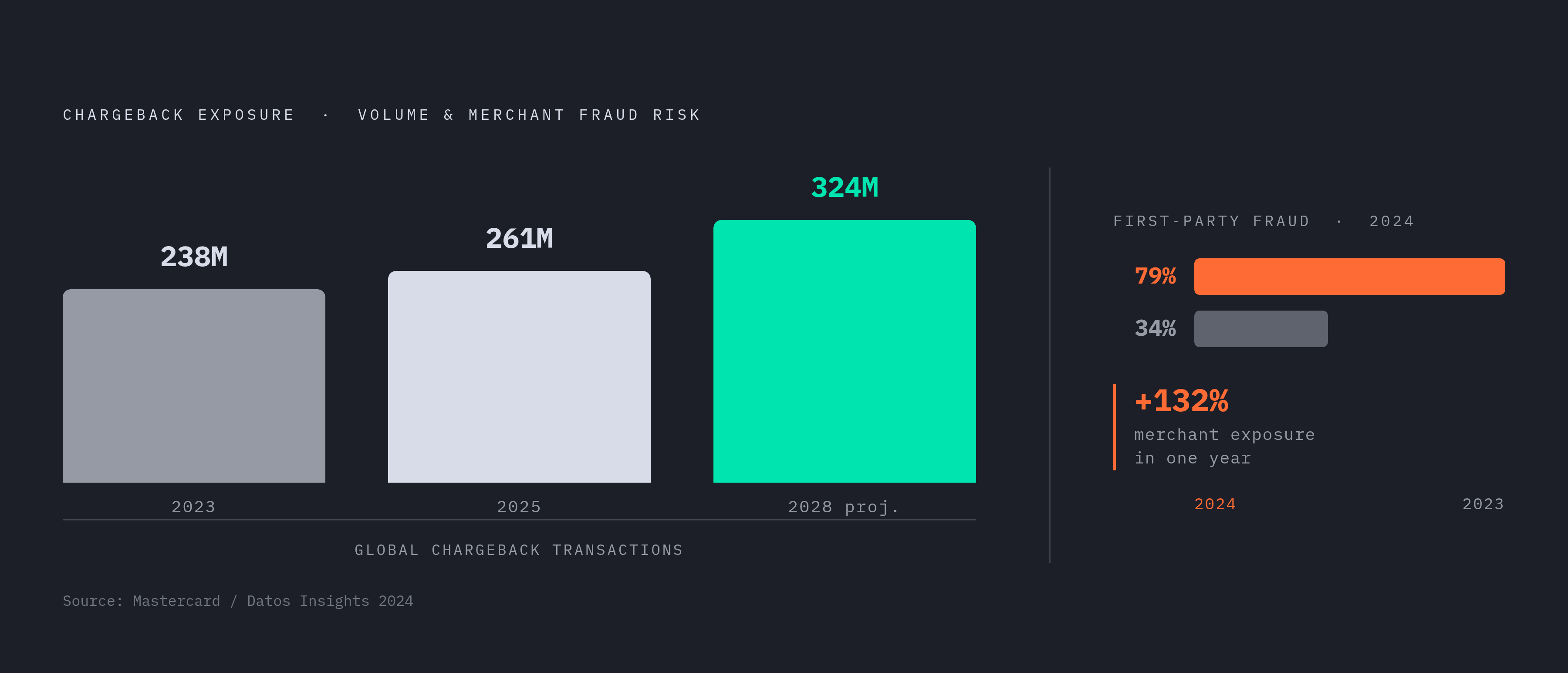
This isn't a fringe annoyance anymore. Global chargeback volume hit 261 million transactions in 2025, up from roughly 238 million in 2023, and Mastercard projects it climbing to 324 million by 2028. Nearly half of all chargebacks now trace back to friendly fraud, per Mastercard's 2025 State of Chargebacks report, and in digital businesses specifically, that share is estimated to be substantially higher.
The growth curve among merchants is the part that should get attention. Visa Acceptance Solutions found that 79% of merchants reported first-party fraud in 2024, up from 34% in 2023. That's more than doubling in a single year, not a slow creep.
Money-wise, the damage compounds past the sticker price of the disputed charge. The average dispute cost to merchants runs around $74, with businesses losing up to 1.8% of revenue to fraud-related chargebacks overall, according to Juniper. A 1% dispute rate on a $50 monthly subscription sounds like rounding error, until you stack the chargeback fee, the lost revenue, the staff hours spent responding, and the slow creep toward your payment processor's risk threshold on top of it.
This isn't some rare edge case pulled off by professional scammers, either. A Sift survey of US adults found 16% admitted to filing a false fraud claim despite being satisfied with their purchase. That's a mainstream consumer habit now, not a shadowy exploit.
Responding to legitimate disputes: fix the process, save the customer
A legitimate dispute is a product failure wearing a billing costume. Treat it that way. The fix is remediation, not a fight.
Start with the descriptor. If a customer can't recognize the charge on their statement, nothing else you do matters much, because that's the trigger for the whole chain of events. The descriptor should match your product name, stay consistent across every transaction, and the first characters especially should never change. Visa's Compelling Evidence 3.0 framework actually requires descriptor consistency across submitted transactions, so this isn't just good manners, it's a prerequisite for winning disputes later.
Renewal communication matters more than most teams give it credit for. Messaging customers a few days before an annual renewal is a documented way to cut down on "wait, what is this charge" disputes. That notification does double duty: it's customer service, and it's evidence you can point to later if a dispute does land.
Cancellation flows need to actually work in real time. If someone hits cancel and gets charged anyway, that's a legitimate dispute by definition, no argument needed. Billing state has to update the moment cancellation happens, with a confirmation sent immediately, not eventually.
When the evidence says you're wrong, just refund it. If usage logs show no real delivery, or a cancellation clearly got missed on your end, fighting that dispute costs more in fees and staff time than it recovers, and it burns a customer who might've stuck around. Speed matters here too: many cardholders cite slow or inaccessible resolution as the reason they went to the bank instead of the merchant in the first place. A fast, visible refund path removes their main reason to skip you entirely. Refund fraud is real, but the fix for that is better fraud detection on the front end, not making genuine refunds harder to get.
Responding to friendly fraud: building a representment case that holds
Friendly fraud gets a completely different playbook. Here the goal is representment: proving to the card network that the cardholder actually got and used what they paid for, so liability shifts back to the issuing bank.
Visa's Compelling Evidence 3.0 is the main tool for this now. As of October 2025, transactions authenticated through Visa Secure (3DS) or Visa Data Only automatically qualify for CE 3.0 protection. If you're already running 3DS2 at checkout, you may already have this coverage without doing anything extra.
The qualifying bar itself isn't complicated: two prior undisputed transactions on the same card, with matching data elements. Subscription billing is almost built for this, since recurring charges rack up that transaction history faster than a one-time purchase business ever could.
This is where most representment cases actually die though: the IP address and device ID. Those two data points determine CE 3.0 qualification, and they only exist if you captured them at the moment of checkout. You cannot go back and reconstruct them after the fact with some server-side tool. If you didn't grab them during the payment session, they're gone.
So capture, at checkout, and keep:
- IP address and device fingerprint from the payment session itself
- Login timestamps and session records tied to the account
- Feature usage events logged during the billing period in question
- Support tickets or in-app messages, if any exist
- Descriptor consistency across the disputed charge and the prior transactions you're citing as evidence
Worth knowing the limits of 3DS liability shift too: it covers fraud-coded disputes, not "product not received" or "I cancelled" reason codes. It helps with one category of the problem and does nothing for the others. In Europe, 3DS is mandatory under Strong Customer Authentication rules. In the US it's optional, and it adds real friction at checkout, so it's a genuine tradeoff to weigh against how much dispute volume you're actually seeing.
Last piece: flag repeat offenders. Given that a meaningful share of friendly fraudsters repeat the behavior quickly, document any account with a prior dispute before letting them sign up again under a new email.
How usage-based billing creates a distinct dispute category that needs its own prevention logic
Usage-based pricing creates its own flavor of dispute, and it's not really about fraud at all. It's about surprise. A customer who'd never blink at a flat $49 monthly charge might absolutely dispute a $340 invoice they didn't see coming, even if every dollar of it is technically correct.
Call it bill shock. From the customer's side, it often feels completely legitimate, even when your billing logic did exactly what it was supposed to. The real failure here is communication, not fraud, and it needs a different fix than representment or refunds.
The fix is staged alerts. Send usage notifications at meaningful thresholds, by email and in-app, before the invoice ever generates. A customer who saw three separate warnings that they were racking up usage has a much harder time claiming total surprise later. Those notifications aren't just good UX, they're a timestamped paper trail showing the customer knew what was coming before the charge posted, which is directly useful if a dispute shows up anyway.
None of this works without usage data flowing into billing continuously. If there's a lag between when someone actually uses the product and when that usage gets reflected in billing, you get gaps, and gaps show up later as disputes or as access-versus-charge mismatches nobody can explain. Billing state needs to update from real events as they happen, not batch-processed overnight.
There's also a quieter benefit worth naming: meaningful product engagement in the first 48 hours of a subscription builds a backend record that the customer actually got value, which matters a lot for digital products with no physical proof of delivery to fall back on.
Some data-intensive platforms serve as useful reference points here, feeding real-time consumption data directly into billing through event-driven pipelines so pricing applies continuously rather than in batches. Not every SaaS company needs that scale of infrastructure, but the underlying pattern, usage and billing talking to each other constantly instead of once a month, is worth copying at whatever size you're operating at. When sessions, transactions, usage events, and billing records all live in one place, pulling evidence for a dispute becomes a database query instead of a scavenger hunt across four different tools.
How the Merchant of Record model changes who handles disputes — and when that trade-off makes sense
A Merchant of Record sits between you and the card networks as the legal seller of record. That means the MoR takes on payment processing liability, tax remittance, fraud, and chargebacks. Disputes get filed against the MoR, not against you, and the MoR handles the response and eats the loss if it goes badly.
The tradeoff is straightforward: you exit the chargeback process entirely. That removes a real operational burden and protects your own merchant account from dispute-rate thresholds that could get it shut down. What you give up is direct visibility into your own dispute patterns and customer behavior, since someone else is now the one seeing the raw data first.
There's a blending effect too. MoRs spread dispute volume across many merchants at once, run alert systems to catch disputes before they escalate into full chargebacks, and apply policy tools at a scale no single SaaS company could justify building alone.
Payment recovery is an underrated piece of this. Involuntary churn, meaning customers who leave because a payment failed rather than because they wanted to cancel, accounts for about a quarter of all customer churn according to Focus Digital's 2025 SaaS research. Smart retry timing and automated card-updater tools can recover a significantly higher share of those failed payments than basic retry logic alone. An MoR that handles that loop is closing off a revenue leak sitting right next to the dispute problem, not just the dispute problem itself.
Usage-based and hybrid billing add another wrinkle an MoR can absorb: pro-rating for mid-cycle plan changes, configurable billing logic across tiers, that whole category of invoice confusion that turns into disputes if it's handled sloppily.
So when does this actually make sense? Early-stage teams and solo founders who have no bandwidth to run a dispute operation. Companies selling across multiple countries where tax and regulatory complexity multiplies fast. Any product where dispute rates are creeping toward the threshold that puts a merchant account at risk.
Tiun runs as a Merchant of Record, is GDPR-compliant, and is hosted in Europe, combining chargeback handling with authentication, a shared customer database, and usage analytics in one system. That matters practically: the session logs, usage events, and transaction history you'd need for any dispute evidence are already sitting in the same platform, instead of scattered across four separate tools you have to stitch together under deadline.
Worth saying plainly though: an MoR doesn't make the underlying question disappear. You still need to know whether a given dispute was friendly fraud or a genuine mistake, because that distinction feeds back into product decisions and billing design, even when someone else is the one filing the paperwork.
The prevention infrastructure that makes the distinction easier to act on over time
The whole point of everything above is this: telling friendly fraud apart from a legitimate mistake is easy when the evidence already exists, and brutal when you're reconstructing it after the fact. Build the product so investigation is a lookup, not an archaeology project.
In practice that means a handful of things running quietly in the background:
- Checkout sessions capture IP address and device ID at the moment of payment, not pieced together weeks later
- Login events and feature usage get logged with timestamps and tied directly to billing records
- Descriptors are consistent, recognizable, and actually checked against what shows up on a real bank statement
- Renewal and usage-threshold notifications go out automatically and get timestamped, so good UX quietly doubles as a paper trail
- Cancellation events update billing state instantly, closed-loop, not "eventually consistent"
- Payment retries run on smart timing logic instead of a dumb fixed schedule, catching failed payments before the customer even notices
None of this is exotic. It's just the difference between having the receipt and needing to remember where you put it.