Tax Invoicing Requirements for SaaS Businesses Across Jurisdictions
Different countries tax the same SaaS product three different ways.
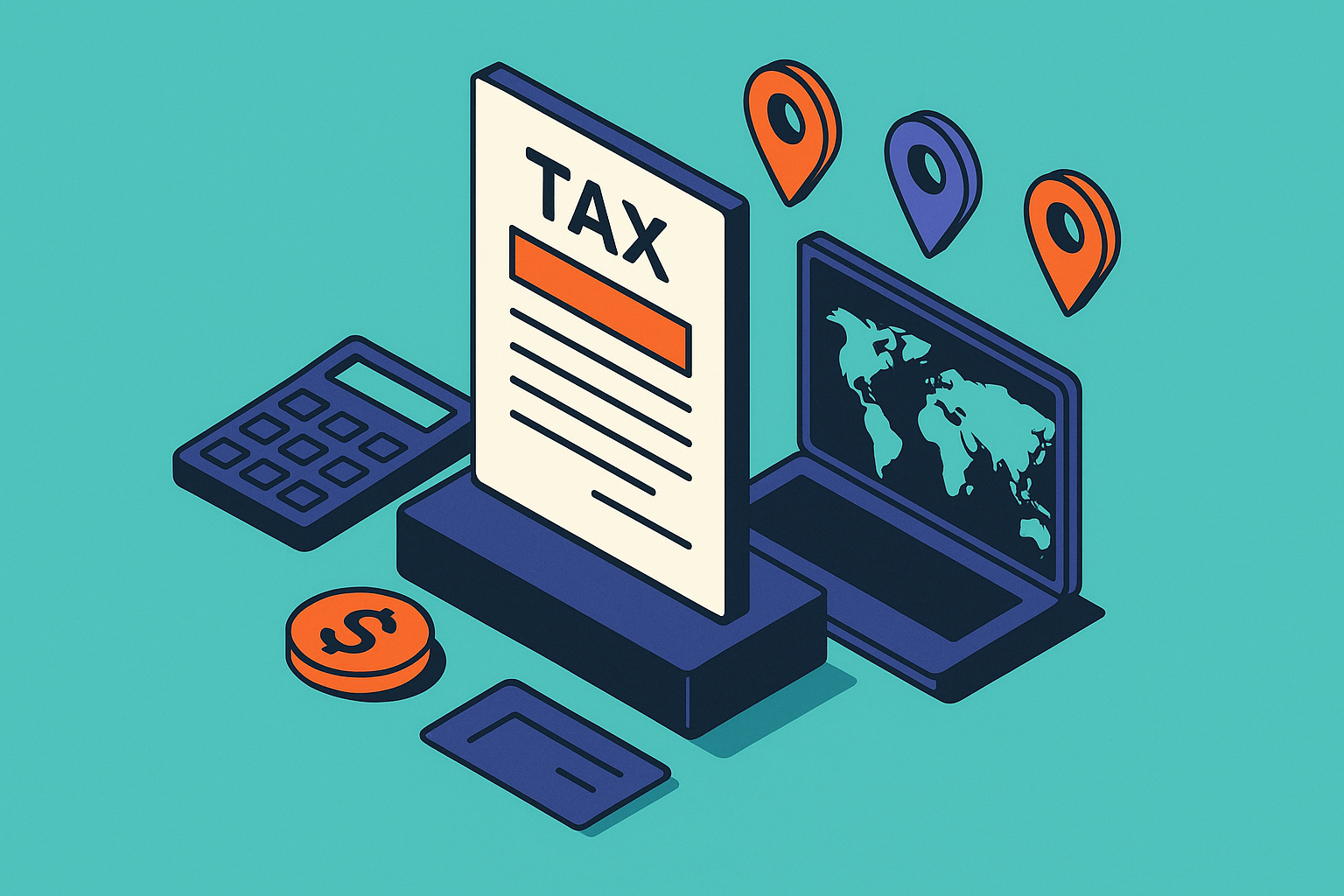
A SaaS company can sell the exact same product to a customer in Munich, a customer in Mumbai, and a customer in Minneapolis on the same afternoon, and owe three totally different tax treatments for it. No single invoice template works everywhere, no single filing calendar applies, and no two governments even agree on what SaaS actually is. Some call it a service, while others call it prewritten software. India calls it something else entirely, and that naming choice alone changes the invoice fields, the filing rhythm, and who's on the hook for what. Get the details wrong and the cost isn't an awkward email from an accountant; it's penalties, back taxes, and customers stuck holding VAT they can't get back.
How the US taxes SaaS: a state-by-state patchwork with no federal floor
As of March 2025, 25 states tax SaaS outright, while the rest either exempt it or attach so many conditions that the rule might as well come with a flowchart. There's no federal definition of SaaS for tax purposes, so states made up their own logic and landed in different places. Here's the part that trips people up most: the label a state picks decides everything downstream.
Call it prewritten software, and it's usually taxable, but call it a service, and it's usually exempt. A few states file it under "digital goods," a bucket vague enough to have generated years of lawsuits on its own. Several states even charge a different rate depending on whether the buyer is a consumer or a business, so the same product sold twice in the same month can carry two different tax bills depending on who's swiping the card.
None of this is settled, and treating any state's rulebook as fixed is the mistake that gets companies fined. Vermont added SaaS to its taxable base on July 1, 2024, and California widened its net in June 2024 to catch data extraction, analytics, and digital advertising services. A compliance setup that was correct last year can be wrong today, and the states show no sign of slowing down.
Then there's economic nexus, the framework that changed everything after the 2018 Supreme Court ruling in South Dakota v. Wayfair. Before Wayfair, a business needed a physical presence, an office, a warehouse, an employee, to owe sales tax in a state. After Wayfair, revenue or transaction volume alone can trigger the obligation, and that shift is the single biggest reason midsize SaaS companies now need a tax person before they need a tenth salesperson. Midsize businesses feel it hardest: 77% report that expanding into new US markets has gotten harder because of it. Fifteen states dropped the old 200-transaction threshold as of July 2025, which cleans up one corner of the puzzle, but plenty of other thresholds sit untouched. Physical nexus never left either; one remote employee working from a kitchen table in a new state can be enough on its own to trigger it.
Local rules complicate things further, and this is where most compliance plans quietly fall apart. Home-rule jurisdictions let cities and counties run their own sales tax systems, complete with their own returns, rates, and deadlines. Chicago charges a 9% Personal Property Lease Transaction Tax on SaaS used within city limits, triggered by where the customer sits, not where the vendor is headquartered. A company based in Seattle with a handful of Chicago users can owe a tax it's never even heard of.
Tax exposure in the US tracks the customer's billing address, the product's place of use, or a remote employee's zip code, and it never tracks the company's home address, no matter how badly a founder wishes it did. Registration rules, payroll obligations for distributed teams, and personal property tax stack on top of all this, and the compliance surface grows every time headcount or customer geography shifts. Enforcement keeps climbing at the state and local level both, and because there's no federal invoice standard, every state with a tax claim gets to write its own idea of what a compliant invoice looks like.
EU VAT for SaaS: destination-based rules, B2B versus B2C distinctions, and mandatory invoice fields
Europe runs on the opposite logic. EU VAT for digital services is destination-based: the rate that applies is the customer's country rate, never the seller's. Sell to someone in Hungary, charge Hungary's rate; sell to someone in Luxembourg, charge Luxembourg's. Luxembourg sits at 17%, Hungary at 27%; that gap isn't rounding error, it's a real swing in what gets charged and sent to the tax office.
Whether the seller collects that VAT at all depends entirely on who's buying, and this is the one distinction worth memorizing above all others. For B2B sales, reverse-charge kicks in: the business customer accounts for the VAT itself, and the seller collects nothing. For B2C, the seller charges VAT at the customer's rate and remits it directly. Telling the two apart takes one check: does the buyer have a VAT number? Run it through VIES, the EU's lookup tool. A valid number means reverse charge applies, while no number means VAT gets charged. That's the whole decision tree.
Before 2021, selling digital services to EU consumers meant registering for VAT separately in every member state where sales crossed a threshold, 27 different doors to knock on. The One Stop Shop scheme fixed that. Once cross-border B2C digital sales pass €10,000 a year across the bloc, a business registers for OSS and files one quarterly return in a single chosen country, paying in euros instead of juggling two dozen local filings. Non-EU companies (US, UK, India, Singapore, wherever) use the Non-Union OSS scheme, same mechanics. Records under OSS need to survive 10 years and come out electronically on request, not out of a filing cabinet.
A compliant EU SaaS invoice needs specific fields, and missing one isn't a paperwork slip, it can block a customer's VAT reclaim outright:
- Seller VAT ID, plus buyer VAT ID for B2B sales
- OSS registration number, where OSS applies
- The VAT rate and amount, stated plainly
- A clear note on whether VAT was charged or reverse-charged, with an "EU OSS scheme" tag where relevant
- Discounts shown on the invoice itself, cutting the taxable base directly, and refunds handled as credit notes tied to the original invoice number
Some member states go further than the EU baseline and demand fully compliant VAT invoices even for consumer sales, with language rules that shift country to country. None of this is decoration. A missing VAT ID or a wrong rate notation can stop a business customer from reclaiming VAT they're legally owed, and that mistake tends to surface during an audit, exactly when it hurts most.
What ViDA changes about EU e-invoicing and reporting from 2025 onward
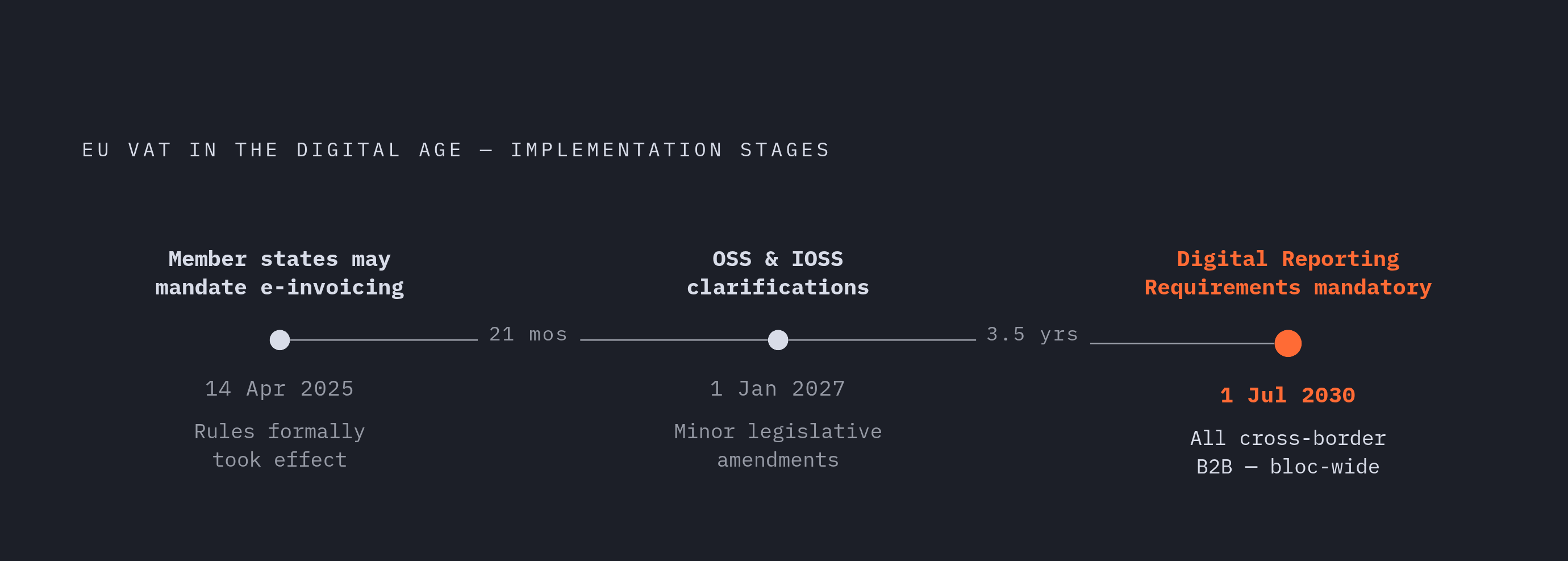
The EU's VAT in the Digital Age package, ViDA for short, cleared ECOFIN approval in March 2025, and the European Commission followed with an implementation roadmap in September 2025. The rollout comes in stages, not one clean cutover, and treating it as a single 2030 deadline is how a company misses the parts that land years earlier.
On April 14, 2025, the rules formally took effect: member states gained the power to introduce mandatory e-invoicing under specific conditions, alongside improvements to the Import One-Stop-Shop framework. On January 1, 2027, smaller legislative clarifications land, mostly touching OSS and IOSS users. The real deadline is July 1, 2030, when Digital Reporting Requirements become mandatory for cross-border B2B transactions across the bloc.
Worth flagging separately: DAC7 is already live, meaning digital platforms now report seller information to tax authorities automatically. The old approach, saying nothing and hoping nobody asks, stopped working the moment that rule landed.
"E-invoicing" in the EU sense has nothing to do with a PDF attached to an email. It means structured data submitted straight into a tax authority's system, in a format their software can parse. That distinction decides how billing infrastructure gets built. A system that produces pretty invoices for customers but can't spit out structured data for a government portal needs rework before 2030, not after, and pretending otherwise is how a company ends up running a company-wide fire drill in year one of enforcement.
Five years sounds distant for a company shipping features every sprint, but it isn't. The billing architecture, invoice data models, and OSS reporting pipelines built today decide whether 2030 is a quiet software update or an all-hands scramble. Companies already running OSS should take this as the warning it is: invoice data needs to match structured formats a tax portal can read automatically, not just formats that look good on a customer's screen.
India's OIDAR and GST framework for foreign SaaS providers
India took its own naming path entirely. Foreign SaaS providers fall under OIDAR, Online Information Database Access and Retrieval, a classification introduced in 2017 covering any digital service delivered over the internet with minimal human involvement. If a bot mostly runs the show, it's OIDAR.
The GST rate on OIDAR services sits flat at a high rate, and there's no revenue threshold before registration kicks in. That's the detail that catches foreign providers off guard most: registration is required from the very first taxable sale in India, with no grace period and no floor to clear first.
The B2B and B2C split works backward from how the EU handles it. For B2B imports, the Reverse Charge Mechanism applies: the Indian business customer pays IGST directly at that rate and offsets it through Input Tax Credit. For B2C sales, the burden lands squarely on the foreign provider, who has to collect and remit GST with no domestic buyer standing in as tax collector.
A compliant Indian GST invoice needs the GSTIN (GST Identification Number), the place of supply, the correct HSN/SAC code (the product classification code, either Harmonized System of Nomenclature or Services Accounting Code), the GST rate and amount, and a clear service description. Domestic registered businesses file GSTR-1 for outward supplies and GSTR-3B as a summary return. Foreign OIDAR providers file GSTR-5A, and it's due monthly, not quarterly, which catches a lot of first-time filers off guard.
India's e-invoicing net keeps tightening. Starting October 1, 2025, the mandatory e-invoice turnover threshold drops from ₹5 crore to ₹2 crore, pulling a much bigger group of smaller businesses into the system. E-invoicing in India means reporting invoice details to the Invoice Registration Portal, run by the GST Network, which sends back a unique Invoice Reference Number and QR code. This is government validation and stamping, not an emailed PDF. India's GST council revisits these rules on a regular basis, so treating the current framework as permanent is a mistake waiting to happen.
Other major markets where SaaS tax invoicing obligations are emerging or maturing
More than 110 countries now require some form of VAT or GST registration for cross-border digital sales. The EU, the US, and India get the attention because they're the biggest markets, but plenty of smaller regimes have just as much bite, and ignoring them because they're small is exactly backward.
A few patterns repeat across nearly all of them. Destination-based taxation is close to universal now: tax where the customer sits, not where the seller is set up. Registration thresholds for foreign providers tend to be low or missing entirely, following India's lead of requiring registration from sale one instead of waiting for revenue to clear some arbitrary bar. And structured invoice fields, seller tax ID, customer tax ID where applicable, tax rate, and amount, show up as the baseline almost everywhere.
Several Asia-Pacific jurisdictions have established their own GST rules for digital services, with regional adoption continuing to spread. Some major markets outside the EU and India have similarly extended their indirect tax regimes to cross-border digital sales, with subnational variation adding further complexity. Other markets operate their own indirect tax systems independently, meaning a company that assumes one registration covers multiple jurisdictions is likely carrying exposure it hasn't noticed yet.
Add it up, and a SaaS company spread across a dozen countries can be staring down a dozen invoice formats, a dozen filing portals, and a dozen record-retention clocks running on different timers. The list of countries enforcing this stuff keeps growing, and nothing on the horizon suggests it will shrink.
What compliant SaaS invoices actually need to contain, broken down by region
No universal invoice template satisfies every tax authority on earth. Line the required fields up region by region, though, and the shapes repeat, which is the part worth remembering when the details start to blur together.
In the US, wherever a state taxes SaaS, the invoice needs the seller's information and state tax registration number, the customer's billing address (since that's what sets the rate), the taxable amount, tax rate, and tax amount broken out as separate lines, and a service description detailed enough to back up the taxability classification claimed. No federal standard ties any of it together; state rules govern each piece on their own.
In the EU, for OSS-registered sellers, the invoice needs the seller's VAT ID and OSS registration number, the buyer's VAT ID for B2B sales (since that decides whether reverse charge applies), the customer's country and correct VAT rate, an explicit statement on whether VAT was charged or reverse-charged, discounts itemized on the invoice itself, and credit notes referencing the original invoice number for refunds.
In India, under OIDAR and GST, the invoice needs the GSTIN, the place of supply, the HSN/SAC code, the GST rate and amount, the IRN and QR code for businesses above the e-invoicing threshold, and an RCM notation on B2B cross-border supplies where it applies.
A handful of obligations show up almost everywhere, regardless of region. Record retention runs long, 10 years under the EU's OSS, and most other jurisdictions land somewhere in that same multi-year range. Producing records electronically on request, instead of pulling paper out of a drawer, is becoming the norm rather than the exception. And sequential invoice numbering, no gaps, no repeats, shows up as close to a universal rule across every system here.
The real challenge isn't any single rule in isolation, it's the sheer number running at once. A billing system has to hold multiple invoice templates at the same time, each pulling from the correct tax logic for wherever the customer happens to be sitting. Get one field wrong in one region, and that's a rejected VAT reclaim, a failed audit, or a customer who quietly never comes back.