Production Readiness Checklist for SaaS Backend Systems
Ensure backend systems launch with documented operational readiness, not just passing tests.
Most production incidents trace back to the same root cause: nobody wrote down what "ready" actually meant before launch day arrived. Passing tests proves the code does what it was told to do. It says nothing about what happens when a real incident hits and no alert fires, no runbook exists, and rollback was never tested because nobody thought they'd need it. Cortex's State of Production Readiness report found that 98% of engineering leaders reported real fallout from launching services that weren't actually ready. That's basically the whole industry, tripping over the same rock, in slightly different shoes.
The stakes are higher for SaaS than almost any other kind of software, because the users are live and the billing is running right now, not in some future sprint. Downtime or a stray error hits paying customers and revenue immediately, and it doesn't fail quietly. It fails mid-transaction, in front of the person paying for the thing, and the cost compounds by the hour. Cortex's report also found that 66% of engineering leaders point to inconsistent standards across teams as their biggest blocker to readiness at scale. Most engineers already know what "ready" should mean. The failure is that nobody agreed on it in writing before launch day showed up uninvited, wearing muddy boots, tracking dirt across the carpet. Without that agreement, a builder isn't managing a skills gap; a builder is managing a coin flip every time someone ships.
So, to be clear about what this checklist is not: it's not a code quality gate, not a QA sign-off, not a security scan you run once and forget about forever. It's a single, blunt question, asked over and over at every layer of the system: can this be operated, by a human, under pressure, without the person who built it standing over their shoulder? Answer yes with actual evidence at every layer below, and launch day gets boring. Boring, in this line of work, is the whole point.
SaaS Backend Structure
Coverage of 2026 SaaS trends keeps making the same point: AI stopped being a side experiment and became a budget line. Companies now plan for data readiness, orchestration, and operational reliability before a single new feature ships, not after. That shift changes what a backend even needs to do. Traditional SaaS backends were built around CRUD: create a record, read it, update it, delete it. AI-native backends add a different set of verbs: predict, recommend, automate, personalize. Each one needs its own kind of readiness, because "the database is up" doesn't tell you whether the recommendation engine is quietly serving garbage to half your users.
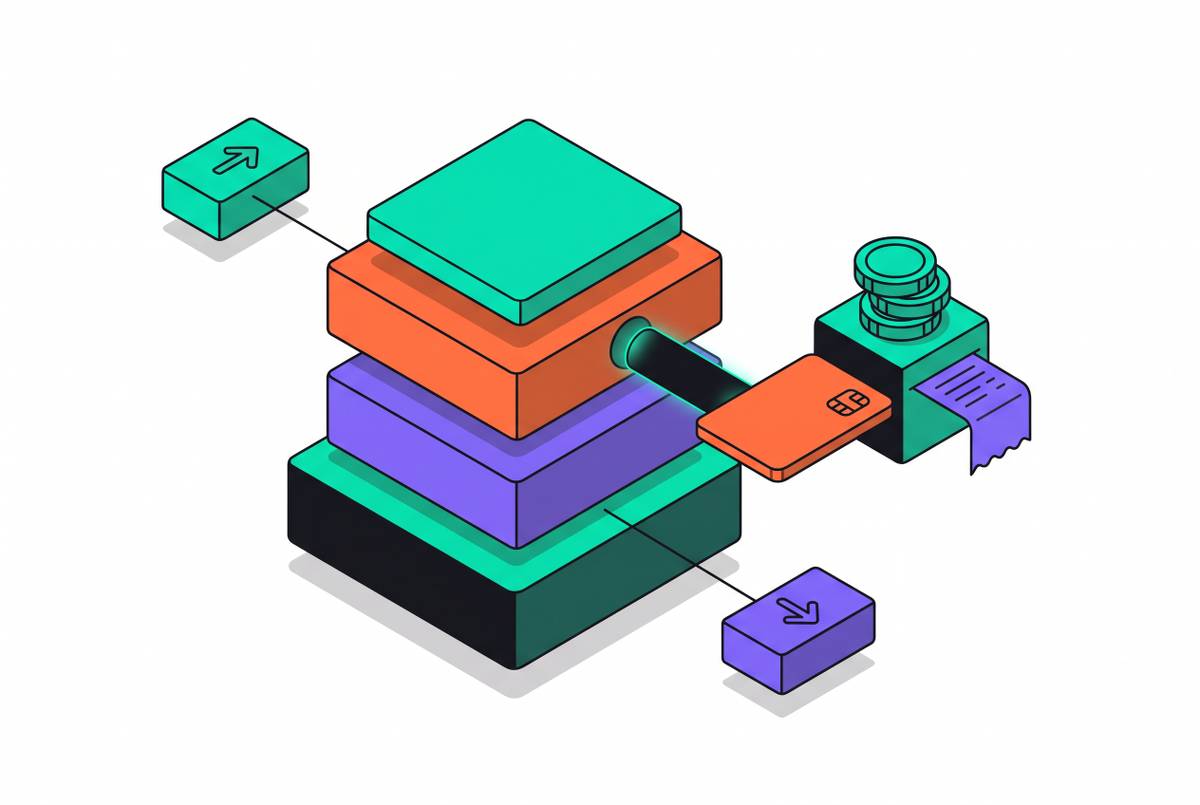
When a modern backend is stripped down to its studs, the layers look pretty consistent across companies. An API gateway handles authentication, rate-limiting, routing, and load balancing. Below that sits a service layer, ideally split into microservices so something like AI inference can scale on its own without dragging the rest of the app down with it. Then a subsystem for auth and user management, one for billing and payments, a customer database and event store, and an observability stack tracking logs, metrics, and traces.
Most teams get into trouble in a place that has nothing to do with writing bad code: they stitch these layers together from separate single-purpose tools, each with its own login, its own webhooks, its own sync logic that somebody has to babysit at 2 a.m. BetterCloud's State of SaaS report found that 70% of IT teams now prefer one all-in-one platform over managing a pile of point solutions, and 51% said managing through separate tools is flatly harder than using one comprehensive system. Fragmentation is a readiness risk wearing a productivity costume. It's a readiness risk wearing a productivity costume, and it deserves to be named as the thing actually slowing teams down, not "growing pains" or "scaling issues."
When auth, billing, and analytics all live in different tools, a production incident doesn't stay in its lane. It crosses tool boundaries, and the on-call engineer ends up with four browser tabs open, four login screens, trying to piece together a timeline that should have lived in one place from the start. Nobody can observe a system split across four dashboards, no matter how good any individual dashboard is. That's how a 20-minute fix turns into a 3-hour incident report, and too many logins rather than bad engineers is the honest answer to why so many teams miss their own response-time targets.
Unified backend platforms, where auth, payments, the customer database, and analytics all live under one roof, cut that cross-tool complexity down and make every checklist item below easier to prove, not just easier to do. Tiun builds specifically for that model, aimed at AI and SaaS companies trying to avoid juggling four different tabs for auth, payments, the customer database, and analytics. The sections that follow map onto these same layers: auth, billing, observability, resilience, compliance. Each one gets checked against whether it's operable, not whether it technically works. Those are different questions, and conflating them is how a system passes every test suite and still falls over in week one of production.
Authentication and user management readiness
Getting a user logged in is roughly 10% of the job. The other 90% is user profiles, role-based access control, team structures, permission enforcement, and multi-tenant architecture for B2B customers who expect their data walled off from every other customer on the platform. Teams that treat "auth" as "login screen" find out the hard way, usually during an incident, that the login screen was the easy part.
A few things are now table stakes. Email and password logins need breach-detection and credential-stuffing protection paired with them, or they're a liability wearing a login form. Social OAuth through Google or GitHub is expected at this point. Passwordless options like magic links and passkeys (WebAuthn) are becoming the norm because they resist phishing in ways passwords structurally can't.
Most teams treat MFA as a nice-to-have security feature, something to bolt on after the "real" auth work is done. Microsoft's analysis found that MFA would have stopped 99.9% of account compromises. That number is close enough to "always" that skipping MFA counts as a decision, not an oversight, and it should sit at the top of the auth checklist, not the bottom. SMS-based MFA doesn't clear the bar anymore, given how easy SIM-swapping has gotten. TOTP and FIDO2/WebAuthn are the actual floor now. For anyone chasing enterprise deals, SSO through SAML or OIDC is the gate. No SSO, no deal, no matter how good the product is underneath.
Authorization needs its own checklist, separate from login. Role-based access control has to be implemented and auditable, rather than implied by a few if-statements scattered around the codebase like landmines. Least-privilege has to be enforced for real: no over-scoped service accounts, no admin tokens sitting in plaintext environment variables waiting to be found. Sessions need defined expiry, the ability to revoke them, and rotation whenever someone's privileges change. An audit log has to track who accessed what and when, which enterprise buyers will ask for by name and compliance frameworks will require regardless.
Multi-tenancy earns its own line item, because it fails differently than everything else on this list. Data isolation between tenants has to be enforced at the query layer, not bolted on at the UI where a clever user could route around it in an afternoon. A misconfigured tenant boundary is an incident with a name attached, a very uncomfortable customer call, and possibly a breach notification depending on what leaked.
Ready, here, means something concrete: an on-call engineer can revoke a compromised session, rotate a leaked credential, and confirm no data crossed tenant lines, all without touching a single line of application code. When auth lives in the same system as the customer database and billing, revocation events and access logs sit right next to payment state and account status. No detective work required at 2 a.m., no tab-switching between four systems that don't talk to each other.
Billing and payment infrastructure readiness
Billing readiness has a much bigger footprint than most teams plan for: webhooks, the full subscription lifecycle (trials, upgrades, downgrades, cancellations), invoicing, refunds, and failed-payment recovery. Most teams build the happy path, the one where the card works and the customer is thrilled, and then discover in production that the unhappy paths are where the real engineering actually lives.
The lifecycle checklist runs long, and it should. Trial-to-paid conversion needs testing end-to-end, including what happens when the card fails right at the moment of conversion. Upgrades and downgrades need correct proration math, not an approximation. Cancellation needs a defined flow, immediate versus end-of-period, with a data retention policy that's actually communicated to the customer instead of buried in a terms page nobody has ever read. Failed payments need a retry schedule with backoff, dunning emails, and a defined grace period. Every payment webhook, including the failure cases beyond the happy path that always works in the demo, needs testing, and invoices and receipts need to generate correctly for whatever jurisdiction the customer sits in.
Tax is where this turns genuinely ugly. Anrok's Global Tax Compliance Report found that SaaS companies burn more than 30 hours a month on manual tax compliance work. SaaS is taxable across 26 US states. Selling B2C in the EU or UK means VAT registration is required (B2B sales generally run through reverse charge, and the EU's non-Union OSS scheme allows one registration to cover all member states, which helps, but doesn't make the underlying complexity disappear).
This is where the Merchant of Record decision turns into a readiness question, not a pricing one, and most early teams get it backwards by treating it as a cost line to minimize instead of a liability to offload. Under a MoR model, the provider becomes the legal seller on every transaction: it collects the gross revenue, remits the tax, handles disputes, and takes on the liability. Without the MoR, the builder owns all of it: tax registration in every relevant jurisdiction, VAT remittance, chargeback liability, fraud exposure, and in some markets, a local legal entity just to sell there legally.
The numbers make the case on their own. Global chargeback volume is projected to hit 337 million cases by 2026, a 42% jump from 2023, with worldwide chargeback losses climbing from $33.79 billion in 2025 to $41.69 billion by 2028. First-party fraud, the kind where a customer disputes a charge they actually authorized, now makes up roughly 45% of merchant dispute volume. None of that is theoretical. It's a spreadsheet with a number on it, and the number gets worse every quarter someone puts off dealing with it.
For early-stage SaaS companies, the case for a MoR is that the alternative means burning significant hours each month on payment operations that have nothing to do with building the product. A MoR typically runs higher than a bare payment gateway's cut, but that gap buys tax compliance, fraud handling, and chargeback coverage that would otherwise require a dedicated hire, a lawyer on retainer, or both. Anyone still weighing that trade-off purely on percentage points is asking the wrong question.
For AI SaaS specifically, usage-based billing raises its own bar. The metering system has to be accurate and auditable, because a billing discrepancy is a trust problem with a dollar sign attached to it. Usage events need to be idempotent, or a retry turns into a double-charge, and nobody wants to explain to a customer why they got billed twice for one API call. Cost has to be queryable per tenant and per feature, giving useful detail beyond one big aggregate number.
Tiun's role here follows the same logic as the auth section: it acts as Merchant of Record, handles tax compliance and chargebacks, and ties billing into the same customer database as everything else, so usage, payment state, and identity sit in one place instead of scattered across separate systems. Ready, for billing, looks like this: a support engineer can pull up payment and subscription state without switching between separate dashboards.
Observability readiness: the minimum bar for logs, metrics, and traces
Most production incidents are caused by ordinary gaps that nobody closed before launch. No alert fired. No dashboard showed the spike. By the time anyone noticed, the damage had already compounded for an hour, sometimes longer, quietly racking up a bill nobody's watching.
Logs need to be structured (JSON, not a wall of unformatted text), centralized in one place, and carrying a request or trace ID on every single line. Unstructured logs scattered across separate files are useless the moment someone actually needs to search them fast, which is always the moment they're needed most. Metrics need defined SLOs for p95 latency and error rate, dashboarded and not just quietly collected somewhere unread, with alert thresholds set and actually tested against real failure conditions. Traces need to follow a request across every service it touches, not just the one it started in, because a distributed trace is the only thing that turns a multi-service incident into something diagnosable instead of a guessing game with a clock running.
SLOs need to be treated as their own readiness artifact, not an afterthought bolted on after launch. They need to be written down and agreed on before launch, full stop. "It's fast enough" is a vibe, not an SLO, and vibes don't page anyone at 3 a.m. Error budgets give a team a clear, unambiguous signal for when to stop shipping new features and go stabilize instead. SLOs also need to explicitly cover the auth and billing layers, because a payment failure sitting undetected for hours is a trust incident with a real customer on the other end of it.
Alerting runs on its own logic, and most teams get it wrong even after everything else is dialed in. Alerts need to fire on error rate crossing a threshold, a much earlier and more useful bar than "the server is down." Alerts need to route to an actual human who can act, not to a Slack channel that's been muted since March. On-call rotations need to be defined and written down somewhere findable, not living in one person's memory. Every alert needs a runbook linked directly to it, because the last thing an on-call engineer needs at 2 a.m. is a scavenger hunt for the fix while production burns.
AI backends add a few observability line items nobody else has to worry about. Token usage and inference cost per request need tracking, because a cost spike in an AI SaaS product is an operational incident just as real as a downed server, just quieter. Model response latency needs its own monitoring, separate from general API gateway latency, because the two can move in opposite directions without either appearing on the other's dashboard. Cost guardrails need to exist per tenant and per feature, so each customer's actual bill burn is visible, rather than hidden in one global budget.
Ready, for observability, means the on-call engineer finds the root cause of a p95 latency spike using nothing but dashboards and traces, without ever needing to log into a server directly through a remote terminal session.
Resilience and recovery readiness: backups, failover, and rollback
An untested backup is a hope wearing a backup's clothes. The widely-cited baseline calls for multiple copies of the data, across different media types, with at least one copy stored off-site. That rule only means something once it's paired with actual RPO and RTO targets, so recovery has numbers attached to it instead of a shrug and a "we'll restore from backup," which is a wish dressed up as a plan.
The backup checklist itself is short, and unforgiving. Database backups need to run automated, on a fixed schedule, not whenever someone remembers. Restores need to be tested on a separate environment. Backups need to include the application database, user-uploaded files, configuration, and secrets, kept separately, for obvious reasons. Retention periods need to be defined and actually enforced, which happens to double as a GDPR requirement, not just good hygiene for its own sake.
Infrastructure resilience runs on similar logic. Nothing that serves user traffic should run on a single instance with no replica standing by. Health checks and readiness probes need configuring so the orchestrator can route around anything unhealthy without a human stepping in first. Every outbound call needs a timeout, because an unbounded wait on a flaky dependency is how one slow service drags the whole system down with it. Retries need exponential backoff with a hard cap, and they should only ever apply to idempotent operations, since retrying a billing charge without idempotency is how a customer ends up charged twice for the same transaction. Non-critical dependencies failing should degrade the app gracefully, not take it fully offline just because the analytics service had a bad afternoon.
Deployment and rollback follow that same standard. CI/CD pipelines need zero-downtime deploys, no exceptions. Rollback needs to be documented and actually tested, beyond being theoretically possible in someone's head six months after they wrote the migration. Feature flags should support gradual rollouts, so a bad deploy gets switched off in seconds instead of triggering a full rollback under pressure. Database migrations need to stay backward-compatible with the previous app version, because a migration that breaks the currently running binary makes rollback impossible at the exact moment it's needed most.
Load testing closes the loop. Systems need testing at a meaningful multiple of expected peak traffic, beyond whatever counts as a normal Tuesday afternoon. A sustained longevity test without errors catches memory leaks and connection pool exhaustion, failures that appear only after sustained load, long after a quick smoke test would've already handed out a false all-clear.
Ready, for resilience, means a restore drill actually happened, rollback got tested recently, and the on-call runbook names the engineer who initiates recovery and what they do first. No improvising required, no group chat consensus needed at 3 a.m.
Compliance and data governance readiness
The sources checked for this guide are listed below.