Friendly Fraud Detection Patterns for SaaS Subscription Products
Three billing patterns reveal how to spot friendly fraud before disputes arrive.
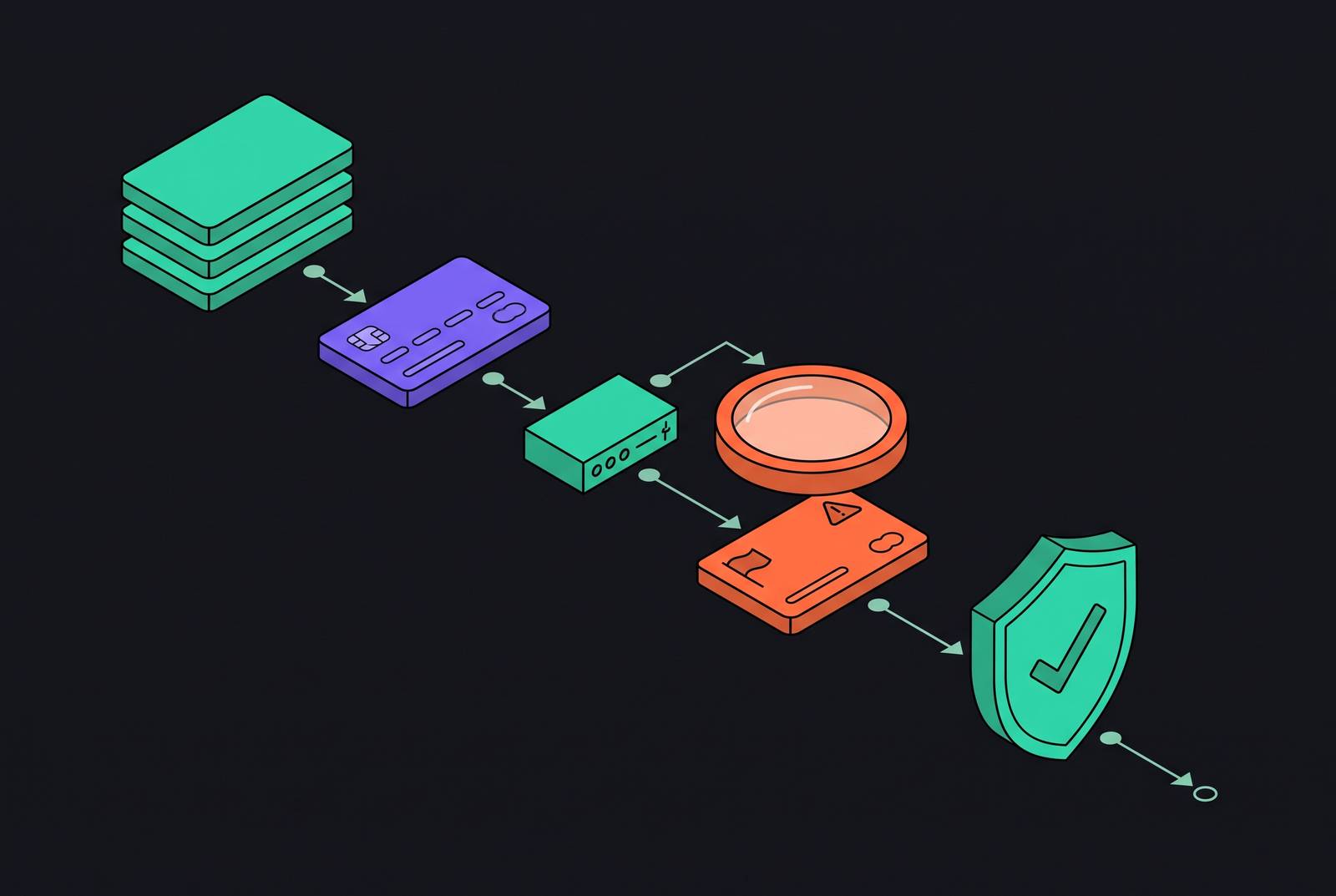
SaaS subscription businesses lose money to friendly fraud in ways that follow a script. Three billing patterns cause most of it, and the evidence to fight them already sits inside most billing systems. The problem isn't detection. It's that most SaaS teams never built the plumbing to pull that evidence out when a dispute actually lands.
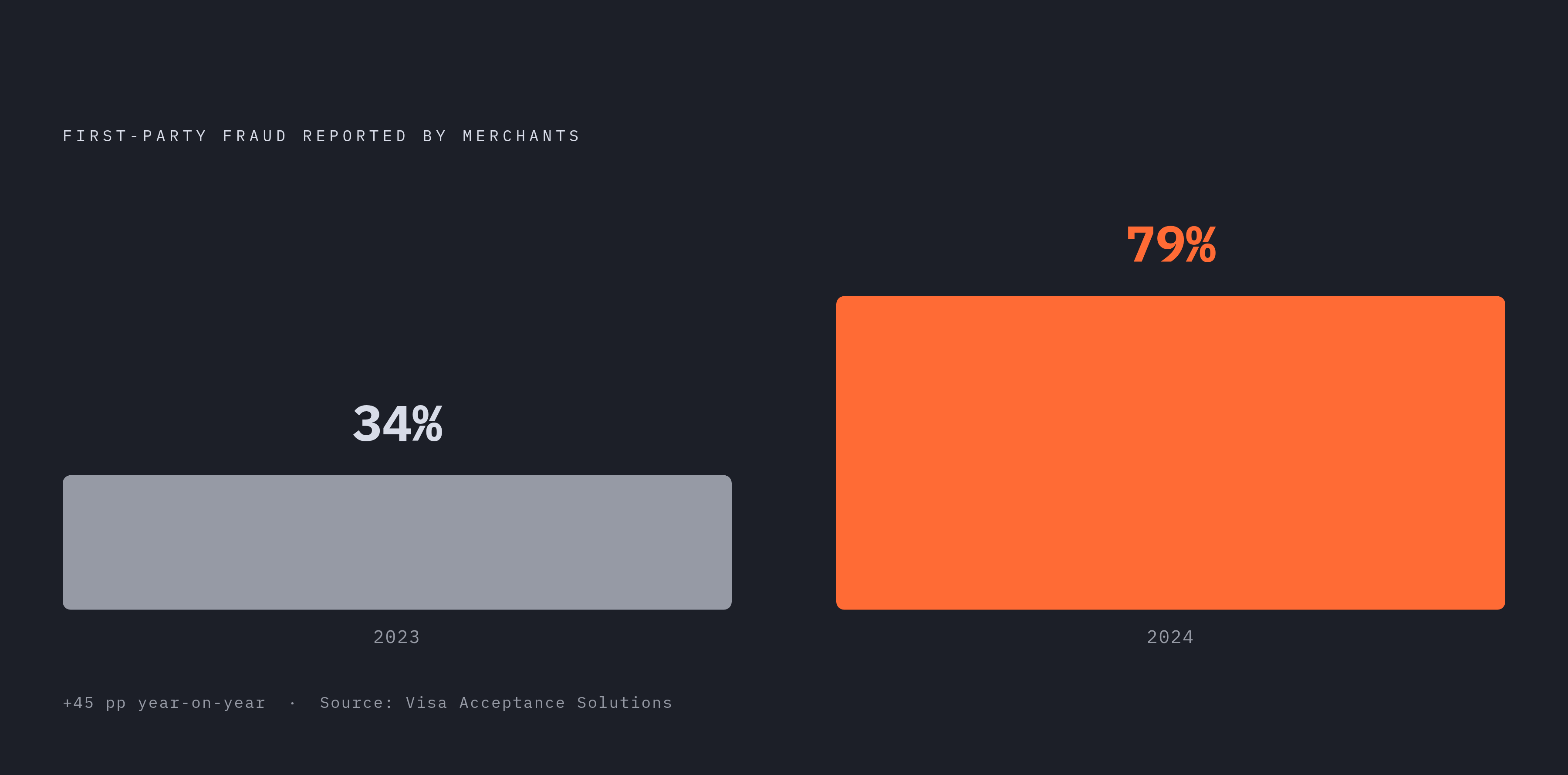
The number that should worry founders isn't the overall chargeback rate. It's the shift inside it: Visa Acceptance Solutions found 79% of merchants reported first-party fraud in 2024, up from 34% the year before. That's not a slow creep, that's a cliff, and subscription products sit closer to the edge than almost any other category.
There's a structural reason for that. Every renewal is a fresh chance to dispute a charge, not just the first one. A cardholder remembers signing up for "Acme App" in March, but by September they've forgotten what it even does, let alone why it's on their statement. Unlike a package on a porch, there's no physical object to point at and say "yes, this arrived." Digital delivery leaves no receipt, no box, nothing to hold up as proof. Add in the moment a free trial flips into a paid plan, which feels like a totally different transaction to the customer even though authorization never lapsed, and it's easy to see why disputes cluster around subscriptions specifically.
Visa pegs friendly fraud at around 20% of all fraudulent disputes globally, climbing to 30% for high-volume online merchants. Subscription businesses often run higher, because the whole billing model depends on recurring charges and descriptors that don't always match what the customer remembers buying. The patterns are recognizable, though, and the evidence to fight them is stronger in SaaS than in most other verticals, but only if the plumbing behind it actually works.
The three recurring billing patterns that produce the majority of SaaS friendly fraud disputes
Three patterns account for most reason code 10.4 disputes (the "unauthorized transaction" code) in recurring billing. None of them are random. All of them are fixable, and the fix is boring: log the right thing at the right time.
Pattern 1: Descriptor confusion. The name on the bank statement doesn't match the product the customer thinks they bought. Someone signs up for "Acme App" and sees "XYZ Ltd London" show up on their card statement two weeks later. They don't recognize it, so they dispute it, and they're not even lying when they say so. Confusing billing descriptors are widely cited as a leading cause of chargebacks among cardholders. A significant share of merchants don't actually know how their own descriptor shows up on a customer's statement, so a chunk of this problem is self-inflicted. Descriptors also drift over time: signup, trial-to-paid conversion, upgrades, and failed-payment retries can each trigger a different descriptor from the payment processor, and every swap is a fresh shot at confusing someone who already forgot they signed up.
Pattern 2: Forgot-I-subscribed. Customer signs up for a free trial, forgets to cancel, gets charged, and disputes it, often without ever contacting the merchant first. Justpricing.com found that 53% of cardholders never reach out to a merchant before filing a chargeback. Chargeflow.io's numbers are worse: 84% of customers find filing a chargeback easier than going through a company's actual cancellation or refund process, and 72% treat the chargeback itself as a stand-in for a refund. This is the cleanest form of friendly fraud in the subscription world. The charge was authorized, the service got delivered, and the customer is using the dispute button as a shortcut around customer support because it's faster than finding the cancel link.
Pattern 3: Continued-use-then-dispute. The cardholder disputes a charge for a service they're actively logged into and using. This one's the hardest to read for intent, because on the surface it looks identical to real fraud. It also produces the strongest evidence trail, assuming the usage data got captured correctly in the first place. There's a household variant too: a family member, a roommate, an ex who still has the card saved, using the account while the named cardholder disputes the charge without necessarily meaning to commit fraud.
All three land as reason code 10.4. All three qualify for Compelling Evidence 3.0 representment, covered further down, because it matters that much.
Behavioral signals in the account lifecycle that distinguish opportunistic disputes from genuine fraud
Here's the annoying part: at the moment a dispute lands, all three patterns look identical to the card issuer. Same reason code, same "unauthorized transaction" label. So the differentiation has to happen earlier, before the dispute is filed or during representment, because by the time the issuer reviews it, the distinction is already gone.
At signup, a handful of signals matter most. Device fingerprint and the real client IP (not a masked or proxied one) captured at account creation. Email domain reputation and whether that address has any verifiable history anywhere. Whether billing address geography lines up with the signup IP. Whether several accounts are being created from the same device, which flags both trial abuse and future dispute risk.
Signup data alone isn't enough, though. Signals across the whole subscription lifecycle matter just as much, maybe more. A customer logging in weekly and touching core features is a different risk profile than someone who vanished right after the trial ended. Watch for sudden silence right before a renewal date, or a login spike right before a dispute gets filed. Flagright.com's analysis found dynamic risk scoring, updated continuously across the customer lifecycle rather than checked once at signup, produces the highest detection rates for subscription fraud. For pattern 3 specifically, active session data at or right after the billing date is about as close to a smoking gun as it gets: it shows the service was in use at the exact moment someone claims they didn't authorize the charge.
Renewal timing tells its own story. Disputes filed within days of a renewal, especially annual ones, skew heavily toward friendly fraud rather than actual card compromise. Since 53% of cardholders never contact the merchant first, the absence of any support ticket or cancellation attempt in the days before a dispute is itself worth flagging. Watch too for the customer who cancels a subscription and then also files a chargeback for the same billing period, trying to get paid twice for the same cancellation.
Account sharing adds another layer. Multiple accounts tied to one device but different emails suggests trial cycling that often precedes dispute abuse. Frequent payment method swaps on a single account are worth a second look too.
None of these signals matter if they only exist in someone's head. They have to get logged against the actual transaction record the moment they happen, not pieced together after a dispute shows up in an inbox six weeks later.
Why the database layer determines whether any of these signals are usable in a dispute
A detection signal is worthless if nobody can pull it up and match it to a specific transaction months after the fact. That's the whole ballgame. Compelling Evidence 3.0 requires matching digital fingerprints across two prior transactions, so the underlying data has to get logged consistently at the transaction level, every time, not just once at signup.
Here's the failure mode that shows up constantly: device ID and IP get captured when someone creates an account, but not on every login during every billing cycle after that. So there's a clean record for the very first transaction and nothing usable by month three or month seven, right when a dispute is most likely to land.
A unified customer database fixes this by linking every transaction to the same session record: email, device ID, IP, feature usage events, all in one place. Every login gets timestamped and stored against the account, so showing active use next to a disputed charge becomes a query instead of an investigation. The descriptor sent to the processor gets logged per transaction too, so a merchant can prove consistency or explain exactly when and why it changed.
Fragmented tooling produces the opposite outcome, and this is where most SaaS teams get it wrong: they assume the data exists somewhere, so it can be found later. It usually can't. Authentication lives in one system, billing in another, usage events in a third, and no single query can pull together the evidence package a dispute actually requires. The pieces were never tied together at the time, so they can't be linked back to the disputed transaction after the fact, no matter how good the intentions were. Synchronization gaps make it worse. If a webhook fails between the billing system and the session database, the usage record for an entire billing period can go missing, with no error message and no way to know it happened until a dispute exposes the hole.
This is exactly where a unified backend architecture, like the one Tiun runs on, changes the math. When authentication, payments, and session data all live in the same system, the evidence chain builds itself as a side effect of the product running normally. Nobody scrambles to assemble it after a dispute shows up. For a founder stitching together point solutions instead, the integration cost isn't just a dev headache. It's a recurring liability that resets with every billing cycle.
How Visa Compelling Evidence 3.0 converts logged session data into winnable dispute cases
Compelling Evidence 3.0 launched in April 2023, and by 2026 it's enforced globally. It applies specifically to reason code 10.4 disputes, which happens to be the exact code all three SaaS friendly fraud patterns produce.
The standard itself is fairly mechanical: a merchant has to show two prior undisputed transactions, somewhere between 120 and 365 days old, matching on at least two of four data points (device ID, IP address, email address, or physical address). Match those, and the argument becomes "this is the same person who's been paying us without complaint for months," which is a hard thing for an issuer to argue against.
Subscription businesses are unusually well positioned to make that case, and this is where most founders underestimate their own leverage. A customer on a monthly plan racks up qualifying transactions fast. By month seven of an annual contract billed monthly, there are already five prior undisputed transactions sitting inside that 120-to-365-day window, per cside's 2026 playbook, so qualification often happens on volume alone. The bottleneck isn't whether the transactions exist, it's whether the evidence attached to them is good enough. Merchants lose CE 3.0 cases because the matching fingerprints are missing, not because the history isn't there. Call that what it is: an infrastructure failure dressed up as a fraud loss.
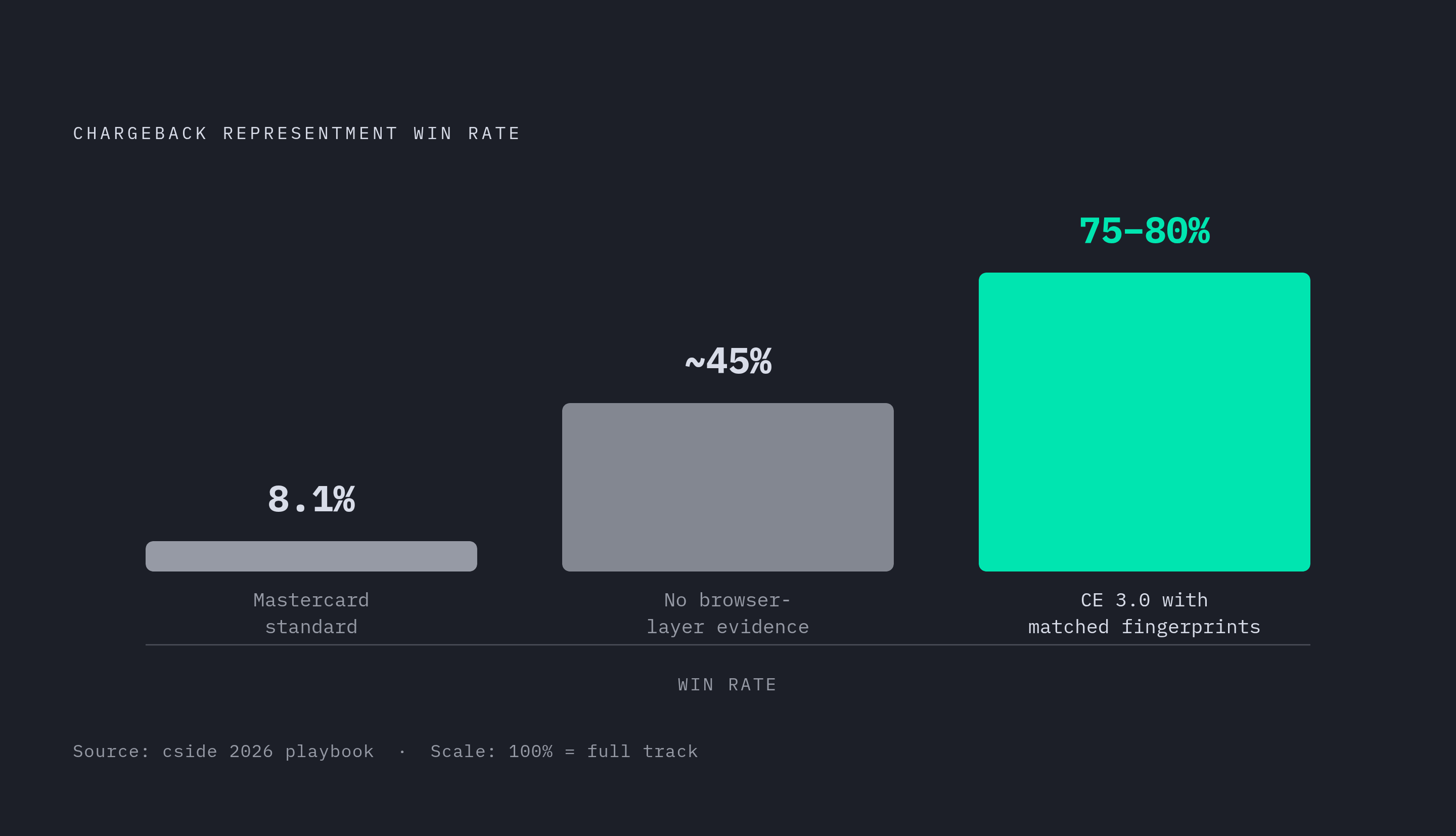
The gap in outcomes backs that up. Cside's analysis puts representment win rates at 75 to 80% for subscription merchants using proper browser-layer evidence, against a baseline of around 45% without it. There's a second, quieter benefit too: CE 3.0 representment gives merchants a structured path to challenge disputes under Visa's Acquirer Monitoring Program, which matters a lot more starting in 2026. For context on how rare wins normally are, Mastercard found merchants win only 8.1% of disputes they represent under standard processes. CE 3.0, done right, is a different game entirely, and treating it as optional paperwork instead of core infrastructure is the mistake that costs the most.
The VAMP threshold change that makes getting this right urgent in 2026
On April 1, 2025, Visa folded its separate dispute and fraud monitoring programs into one: the Visa Acquirer Monitoring Program, or VAMP, according to solidgate.com. The Excessive Merchant threshold drops to 150 basis points (1.5%) effective April 1, 2026, across the AP, Canada, EU, and U.S. regions, with monitoring kicking in once a merchant crosses 1,500 disputes.
That threshold sounds generous until you check where SaaS businesses actually sit. Chargeback.io puts the average SaaS chargeback rate at 0.66%, already four times higher than a typical restaurant's rate. So the gap between normal SaaS operations and tripping the VAMP threshold is a lot narrower than most founders assume. It doesn't take much of a bad quarter to close it.
The cost of breaching that line isn't small either. Merchants inside the program can get charged roughly $8 per disputed or fraudulent transaction, on top of the lost sale and the standard chargeback fee. Keep the rate high long enough and processors can cut a merchant off entirely. Chargeflow.io found that for every $1 lost directly to chargebacks, businesses eat at least $5.13 in total costs once fees, labor, and lost goodwill get counted in.
This is exactly why CE 3.0 stops being just a revenue play and turns into a compliance tool. A solid CE 3.0 representment program becomes a direct lever for keeping VAMP numbers under control, not just a way to claw back lost sales. For any SaaS founder still running on disconnected tools with no unified session-and-transaction database, this regulatory shift is a slow leak. It doesn't show up all at once. It compounds, one billing cycle at a time, until it's suddenly a very expensive problem to have ignored.
Practical detection system design: what to log, when to log it, and what to act on
Three kinds of data need to get logged at the transaction level, not just once at account creation.
Identity signals: device ID, the real client IP (not one masked by a CDN or proxy), and email address, captured at every billing-cycle login, not only at signup. Session signals: timestamps, feature usage events, and anything meaningful happening around the billing date, since this is what proves continued use for pattern 3 disputes. Descriptor signals: exactly what billing descriptor got sent to the processor for that specific transaction, logged per transaction so drift gets caught before it turns into a dispute.
Descriptor hygiene deserves its own attention, because it's prevention, not detection after the fact. Lock the first six characters of the descriptor at the payment processor level across every stage: signup, trial-to-paid conversion, upgrades, failed-payment retries. Consistency alone kills off the leading cause of pattern 1 disputes. Audit what the descriptor actually looks like at each payment state, since what shows up during trial activation can quietly differ from what shows up at the first paid renewal, and that drift is entirely preventable if someone's actually checking for it. Include a recognizable product name somewhere in the descriptor string too, not just a legal entity name that means nothing to the person squinting at their bank statement.
None of this needs exotic tooling. It needs the systems that already handle auth, billing, and usage tracking to actually talk to each other and log consistently, every time, without gaps. The patterns are predictable, and the evidence already exists inside the product. The only open question worth asking is whether the infrastructure was built to catch it before the dispute button ever gets pressed.