Data Processing Agreements for SaaS Vendors Under GDPR
SaaS vendors need a signed DPA before processing EU user data.
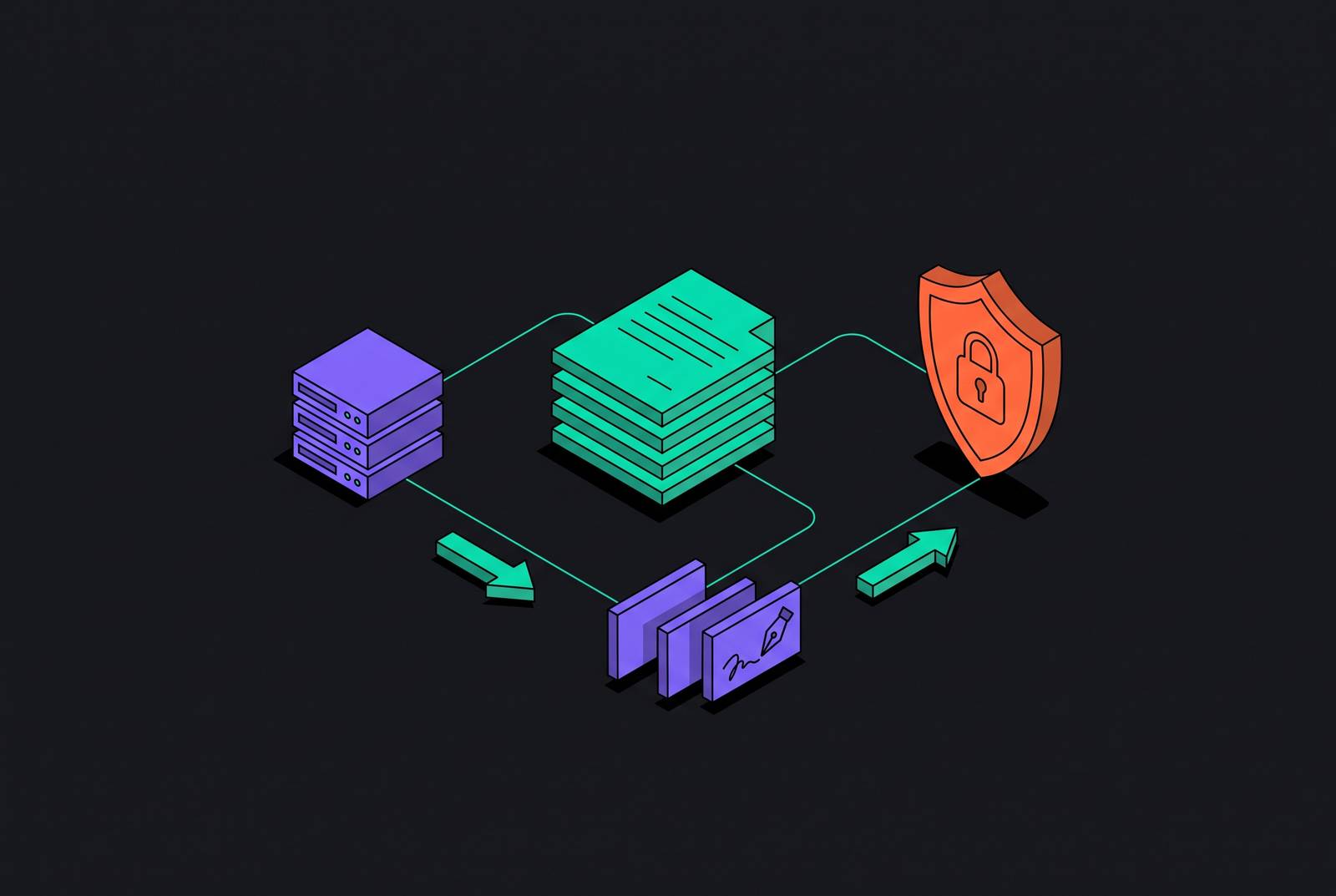
GDPR applies based on whose data you're touching, not where your servers live. A SaaS vendor in Austin processing data from a single free-trial user in Berlin is inside GDPR's reach just as much as a company headquartered in Munich. Territory is defined by who shows up in your database.
That means the "we're a US company, this doesn't apply to us" argument has been dead for years, and yet it keeps showing up in Slack threads right before a compliance deadline. Any product with EU users, whether through freemium signups, active marketing into Europe, or a handful of trial accounts, is in scope. And it doesn't take a big feature to trigger the regulation. Product analytics, session recordings, behavioral tracking; these all count as systematic observation of people, and GDPR treats that observation as the thing that matters, regardless of the intent behind it.
Everything downstream of that starts with one distinction: controller versus processor. The customer using your SaaS product almost always decides why data gets collected and what happens to it. That makes them the controller. The vendor, meanwhile, acts on the controller's instructions and handles the data on their behalf. That makes the vendor the processor. This sounds like paperwork trivia until you realize it determines who signs which side of the agreement and who's on the hook when something breaks.
Something did break, loudly, in 2023: the Irish Data Protection Commission hit Meta with a €1.2 billion fine. That number tends to stick in people's heads, and it should, because it's proof that GDPR enforcement isn't theoretical and isn't limited to companies the size of Meta. It's also why finance, healthcare, and public-sector buyers now ask for signed proof of GDPR readiness before they'll even look at a contract. Vendors without a Data Processing Agreement ready to go don't get a grace period. They just lose the deal.
What Article 28 actually requires a DPA to contain
Article 28 says the written agreement has to exist before any personal data changes hands, not after onboarding starts, and not as a follow-up email once the customer asks nicely. The DPA needs to spell out the subject matter, duration, nature, and purpose of the processing; the type of data involved and who it belongs to; the rights and duties of the controller; the security measures the processor will actually use; how sub-processors get approved and tracked; breach notification timelines; how the vendor helps with data subject rights requests; and what happens to the data once the contract ends.
Each item on that list is a commitment to do something in practice. A DPA that just lists these obligations without saying how they're carried out is a DPA that falls apart the moment an auditor or a breach forces someone to ask, "okay, but what do you actually do?" SaaS vendors typically need three separate versions of this relationship handled: one with customers, where the vendor is the processor; one with the third-party tools in their own stack, where the vendor becomes the controller managing sub-processors; and one covering any internal teams or partners who touch the data along the way.
Defining the processing scope precisely enough to hold up
Purpose limitation is a core GDPR principle: the vendor can only use data for what the controller has actually signed off on. "Providing the software service" doesn't cut it as a description if the vendor is also running analytics, sending transactional emails, or feeding user data into a model somewhere.
The common failure mode looks like this: a vendor bundles product analytics and core service delivery into one vague purpose, then later uses behavioral data to train a model without ever asking the controller directly. Or a product team runs an A/B test on user data that was never covered by the original stated purpose in the first place. AI-driven SaaS products run into a real structural tension here, because the personalization and model improvements that make the product better depend on using customer data in ways the DPA may not actually authorize. Wanting better product outcomes doesn't override the paperwork.
The fix is almost boring in its simplicity: list every processing activity as its own numbered item, with a short description of the purpose and the data types touched. That single habit makes scope auditable and cuts down on negotiation fights later, because there's nothing left to interpret. Duration needs the same treatment. Processing shouldn't run past the contract term, and the DPA should say plainly what happens to the data the moment the contract ends.
Security measures: what "appropriate technical and organizational measures" means in practice
GDPR doesn't hand vendors a checklist of approved technologies. It asks for measures appropriate to the risk, which sounds vague until you realize that vagueness is the point: the DPA has to describe, specifically, what the vendor does.
A credible baseline includes encryption at rest and in transit (named plainly, AES-256 and TLS 1.2 or higher, not just "encryption"), access controls built around least privilege with multi-factor authentication on admin accounts, audit logging that tracks who accessed what and when, a real patch and penetration-testing cadence, and an incident response process that covers detection, containment, and notification. Skip any of these and a bad audit is the least of the risk; GDPR fines for inadequate security measures can reach into the tens of millions of euros or a significant percentage of global annual turnover, whichever number makes the point harder.
The DPA should point to the vendor's security policy documents rather than copy them in line by line. That way the security posture can evolve without triggering a full contract renegotiation every time a patch cadence changes. Certifications like ISO 27001 or SOC 2 Type II aren't required by GDPR itself, but regulators and enterprise procurement teams treat them as the difference between "trust us" and "here's the audit." Vendors hosting entirely within the EU get a bonus here too: cross-border transfer risk disappears, and data residency becomes a fact you can point to in infrastructure documentation instead of something you have to argue for in a contract clause.
Managing sub-processors: the obligation most SaaS vendors underestimate
Here's the part that trips people up: under GDPR, the processor is liable for what its sub-processors do. The controller's risk flows straight through to every tool in the vendor's stack: cloud hosting, email delivery, analytics, customer support software, payment processing, error monitoring, all of it.
The DPA has to handle this head-on. The vendor needs the controller's authorization, either specific and named or general with a right to object, before bringing on any new sub-processor. Controllers need to be notified of changes with enough lead time to object before the new sub-processor goes live. And every sub-processor needs the same GDPR obligations flowed down to them in writing, not assumed.
Operationally, that means keeping a sub-processor list that's current and public (enterprise customers will ask for it, and "we'll get back to you" is not an answer they accept), actually reading each sub-processor's own DPA instead of rubber-stamping it, and checking back periodically, because a sub-processor that passed review at onboarding can drift out of compliance later without anyone noticing. A changelog page or an email list for notifications solves most of the manual follow-up problem. Infrastructure providers usually offer their own comprehensive DPAs, but having a DPA available and having actually reviewed and signed it are two different states of being, and only one of them protects you. This is where compliance gaps hide best: quietly, several links down the chain, in a tool nobody remembers signing up for.
Breach notification: the 72-hour clock and what vendors must have ready before it starts
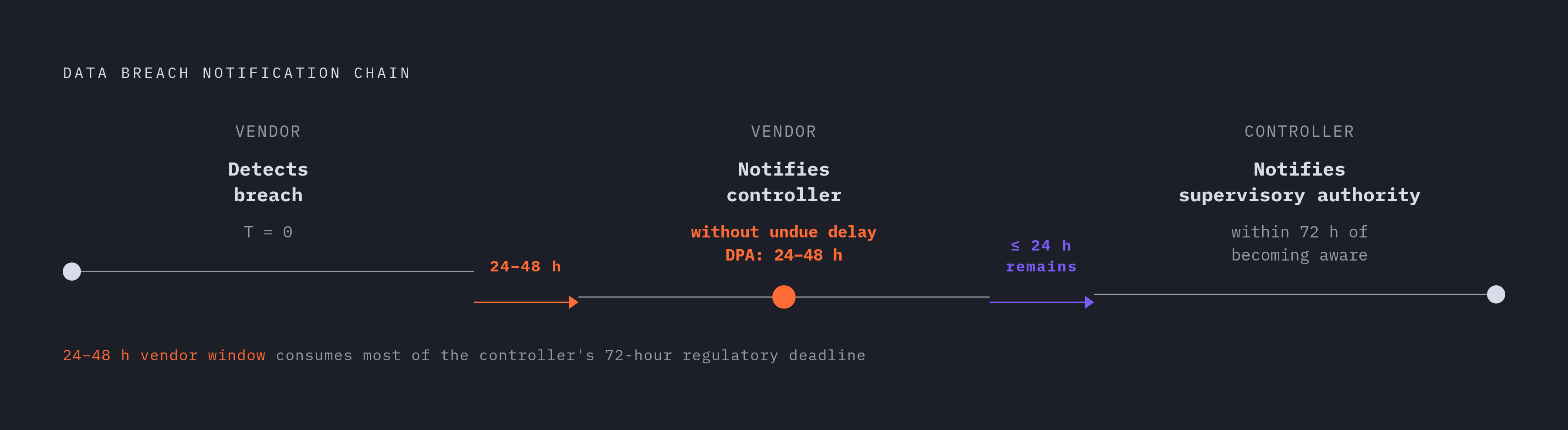
GDPR gives controllers 72 hours from becoming aware of a breach to notify their supervisory authority. The DPA has to define exactly how the vendor supports that deadline, because the controller can't hit a 72-hour clock they don't know is running.
The processor's job is to notify the controller "without undue delay," which is a phrase lawyers love and operators hate, so the DPA should pin it to a real number, commonly 24 to 48 hours, giving the controller enough runway to meet their own deadline. The clause needs a named notification channel (a contact, a secure email address, an incident ticketing system), a minimum set of information to include (nature of the breach, roughly how many people are affected and what categories of data, likely consequences, steps already taken or planned), a process for updating that information as the investigation continues, and a clear answer to who inside the vendor's organization is actually authorized to call something a breach.
None of that matters if the internal incident response process behind it has never been tested. A vendor that's never run a breach drill will not suddenly move fast when it counts. Detection is usually where the clock gets lost, so logging and monitoring need to catch unauthorized access quickly, and a notification template drafted in advance, before anything happens, means the first message to the controller is accurate rather than half-finished and defensive.
Data subject rights: how the processor assists without becoming the decision-maker
Individuals get real rights under GDPR: access, correction, deletion, portability, restriction, and objection. Requests need answers within 30 days, and while the controller owns that response, the vendor's DPA has to commit to help in a way that actually makes the deadline realistic.
That commitment has to be built, not just promised on paper. The vendor needs to export all personal data tied to a given user across every system that holds it, delete or anonymize data on request including in backups (with clear retention periods and erasure timelines spelled out), export data in a structured, machine-readable format, and flag records so they're frozen from processing while a dispute is pending.
Fragmented backend architecture is where this all falls apart. If a user's data lives across an authentication service, a separate CRM, a third-party analytics tool, and a billing system, a single erasure request means coordinating deletion across four systems with no guarantee they finish at the same time. A single, unified customer database turns that scramble into a process you can actually run on a schedule. The DPA should set a real SLA for the vendor's own response time, leaving the controller enough room to communicate with the data subject before the 30-day window closes on them.
Cross-border data transfers and what the DPA must say when data leaves the EEA
GDPR doesn't ban sending data outside the EEA. It requires that any such transfer rest on a documented legal basis, and the DPA needs to name which one applies.
The main options: the European Commission's Standard Contractual Clauses, which get incorporated into or attached to the DPA directly; adequacy decisions, covering countries the Commission has already recognized as offering equivalent protection, which need no extra mechanism layered on top.
SCCs alone don't always cover it. A Transfer Impact Assessment, evaluating the legal environment of the destination country, may be needed too, and the DPA should note that this assessment actually happened rather than assuming SCCs are self-sufficient. UK customers add another layer, since UK GDPR uses its own separate transfer instruments, and most vendors end up keeping one DPA that covers both EU and UK requirements through separate annexes rather than maintaining two documents. Hosting entirely inside the EU sidesteps this whole section: no SCCs, no TIAs, no adequacy analysis needed for the primary data flows. That's a real simplification, and worth weighing as an infrastructure decision, not just a legal one. A DPA that says processing happens "globally" without naming regions or transfer mechanisms isn't saying anything at all.
Building a DPA template that reduces negotiation cycles without sacrificing substance
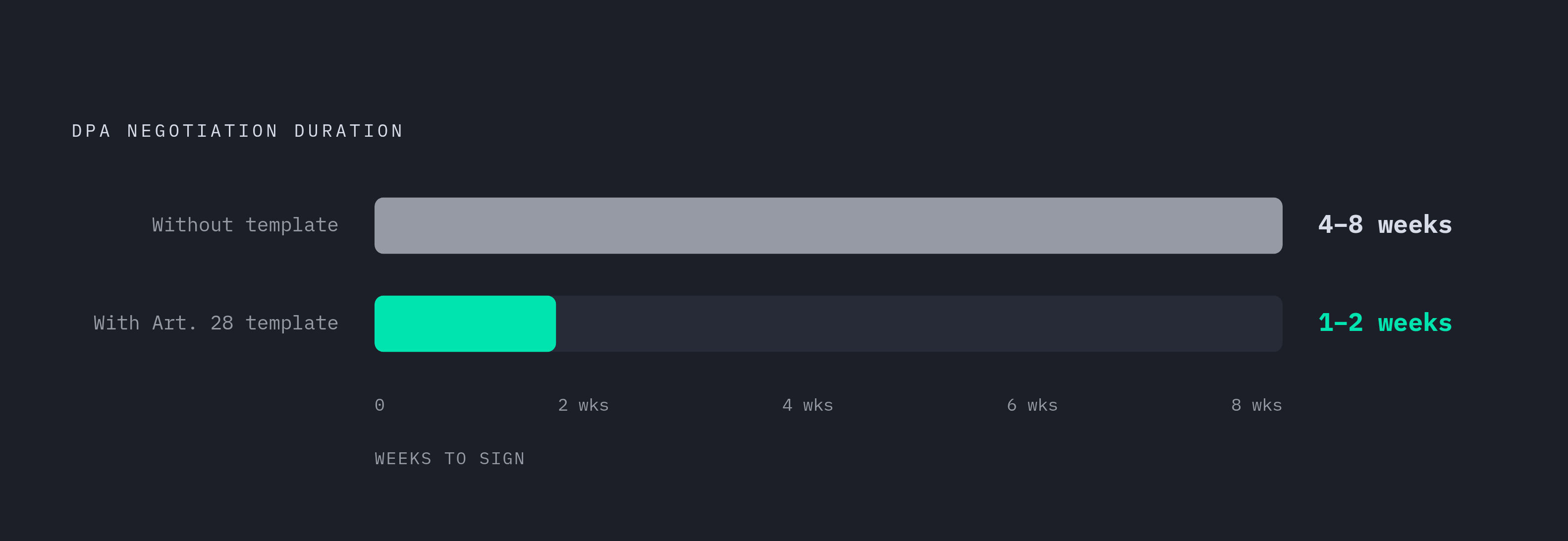
Enterprise EU customers show up with their own DPA templates more often than not, and a vendor without a pre-built, pre-approved version of their own starts the negotiation already behind. A well-built vendor template can take negotiation time from something like 4 to 8 weeks down to 1 to 2, and the difference usually comes down to whether the template covers every Article 28 element clearly enough that the customer's legal team has nothing left to push back on.
A negotiation-ready template addresses every mandatory element directly instead of waving at some outside policy document, keeps a maintained sub-processor list linked or attached, treats the security annex as a living document that updates without triggering a full DPA amendment, states jurisdiction and governing law for both EU and UK requirements, and has SCCs or DPF references already built in for non-EU scenarios.
None of this matters if the signed document then disappears into someone's inbox. The DPA has to be stored, versioned, and easy to pull up later, because regulators can ask for proof of signed agreements and enterprise customers will expect a copy at renewal without having to chase anyone for it. Automated signing and management tools cut the overhead of tracking dozens of these agreements and keep an audit trail that holds up under scrutiny; that's basic housekeeping for anyone selling to more than a couple of enterprise customers, not a luxury reserved for large vendors. Making the DPA publicly available and self-serve, something a customer can review and sign without a month of back-and-forth, turns a recurring legal bottleneck into a non-event.