Chargeback Dispute Process for SaaS Subscription Businesses
SaaS companies lose twice as many chargebacks as they should.

U.S. card disputes hit 158 million in 2025, up 29% since 2021. Worldwide volume climbed 46% over the same stretch, and SaaS companies are eating more than their share of that growth. Industry estimates put SaaS chargeback rates at roughly double what physical goods eCommerce merchants deal with, and the gap comes down to a documentation problem nobody warns you about at launch.
A company selling sneakers has shipping confirmations, delivery photos, a signature on somebody's doorstep. A SaaS company has logs. That's the whole toolkit. Every dispute turns into the customer's word against your server records, and if those records are a mess, you lose by default. Auto-renewals, vague billing descriptors, and cancellation flows that take three clicks and a small act of faith all make the problem worse.
Here's the part that surprises people: most of this isn't fraud, it's forgetting. Industry observers tracking the surge in disputes point to forgotten subscriptions and unrecognized merchant names as bigger drivers than actual card theft. Cash-strapped consumers have also gotten a lot more comfortable disputing charges they know perfectly well are real. Bloomberg found TikTok tutorials walking people through filing a dispute instead of asking for a refund, step by step, like a cooking video except the recipe is "how to get a free month" and your revenue is the ingredient getting used up. For SaaS, that kind of friendly fraud usually means something broke in the customer experience, not that you're dealing with a career criminal. Worth remembering before you fire off an angry rebuttal letter.
B2B SaaS has its own strange flavor of this. A former employee at a client company, someone who paid on a personal card, might dispute the charge months later out of fear they won't get reimbursed, or plain spite on the way out the door. Sneaker companies never deal with this particular headache. You will, eventually, and there's no polite way to see it coming.
The dollar figures make the stakes hard to ignore. Global chargeback value hit $34 billion in 2025, according to a Mastercard and Datos Insights report, with volume projected to grow 24% to 324 million transactions a year by 2028. That's not a rounding error tucked at the bottom of your P&L. It's a line item that grows on its own if you leave it alone.
What actually happens after a customer files a dispute — the full lifecycle
The mechanics are simpler than people assume, even though the process drags on forever.
A customer contacts their bank, not you, and disputes the charge. The bank reverses the transaction and pulls money out of your account before anyone's proven a thing. You get a notification, and that notification starts the clock. From there, you eat the loss or you contest it through representment: you submit evidence, the issuing bank reviews it, and eventually rules. Win, and the funds land back in your account. Lose, and the cardholder keeps them, this time for good.
Start to finish, from the customer's initial call to a final decision, usually runs two to three months. You can't route around that timeline no matter how urgently you'd like to. It's just how long banks take to sort these things out.
Where you do have some control is the response window, and it's tight. Depending on the card network and the reason code, you get somewhere between seven and twenty-one days to submit evidence. Miss it, and you lose automatically, no matter how airtight your logs are.
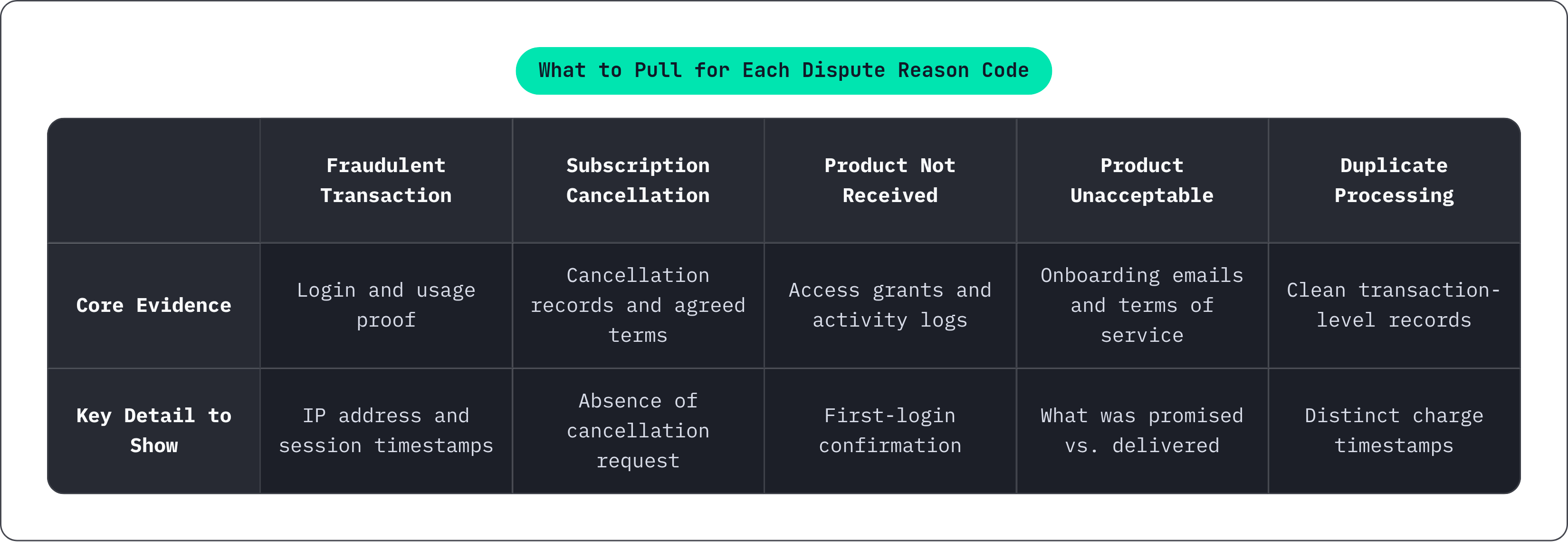
Reason codes matter more than most founders think, because each one tells you exactly what to go pull from your systems:
- Fraudulent transaction: customer says they never authorized this. Pull login and usage proof.
- Subscription cancellation: customer says they canceled but got charged anyway. Pull cancellation records and the terms they agreed to.
- Product not received: customer says the service never got delivered. Pull access grants and activity logs.
- Product unacceptable: customer says it wasn't what they were promised. Pull onboarding emails and your terms of service.
- Duplicate processing: customer says they got billed twice. Pull clean transaction-level records.
Here's a number worth sitting with for a second: a $1 fraudulent chargeback cost U.S. merchants $4.61 in 2025, a 37% jump from 2020, plus an average $128 in fees and operational overhead stacked on top of the lost revenue itself. Rolling over on every dispute isn't the cheap option once you run those numbers at scale. It just feels cheap because it takes zero effort today, and the bill shows up later.
The card network thresholds every SaaS founder must know before they become a problem
Somewhere above a 0.9% chargeback-to-transaction ratio, Visa and Mastercard stop treating you like a normal merchant and start treating you like a risk. Cross it, and you can land in a monitoring program, or lose the ability to accept cards at all.
Mastercard's specific trigger is called the Excessive Chargeback threshold: a 1.5% ratio, or 100-plus monthly chargebacks, whichever hits first. Visa rolled out its own tighter version starting April 1, 2025, called VAMP (Visa Acquirer Monitoring Program). The direction here is unambiguous. These thresholds are tightening, not loosening, and card networks don't grade on a curve, ever.
Landing in a monitoring program is not a slap on the wrist. Expect monthly fees stacked on every chargeback above the threshold, a processor demanding a remediation plan, and sometimes a reserve fund holding a chunk of your own cash hostage. Keep violating terms and you can lose card acceptance altogether, which for a SaaS business is close to losing the ability to get paid at all.
The cruel irony is that growth itself creates this risk. A viral launch or a big marketing push can spike transaction volume overnight, faster than your dispute-prevention setup can keep up with. Winning individual disputes matters, sure, but keeping the overall ratio under control matters just as much, and those two jobs have to run in parallel, not one after the other.
Building the evidence package that actually wins at representment
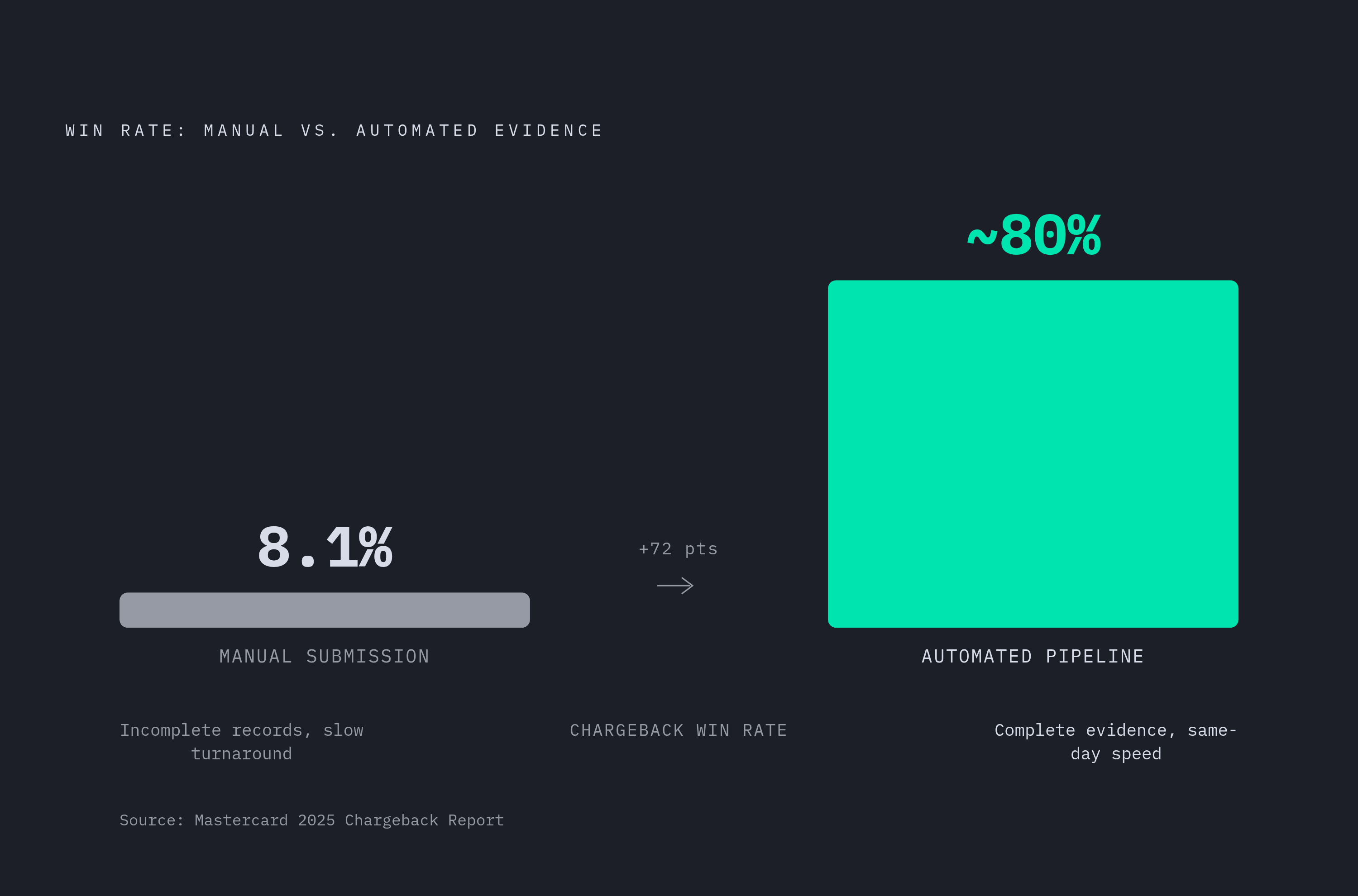
Merchants win only 8.1% of disputes on average, according to Mastercard's 2025 Chargeback Report. That number looks brutal until you realize it's an average dragged down hard by merchants submitting weak, half-finished evidence, or nothing at all.
Representment just means re-presenting the original charge to the issuing bank, along with proof the transaction was legitimate. Simple idea. But SaaS merchants have to prove a specific set of things physical goods sellers never have to think about:
- The customer knowingly signed up: account creation records, the IP address at signup, a confirmation email that was actually sent and delivered.
- The customer used the service: session logs with login dates and times, features touched, API calls, file activity, anything proving a human was in there clicking around.
- The customer was informed: a billing descriptor that matches the invoice, terms of service they agreed to, renewal reminders sent ahead of the charge.
- Cancellation didn't happen, or happened after the charge: cancellation timestamps, any support ticket trail showing what was said and when.
The rebuttal letter itself matters more than founders give it credit for. Address the specific reason code head-on; a generic "our customer definitely used our product" letter ignores what the bank reviewer is actually deciding. Keep the tone neutral and factual, since you're writing for a bank employee, not arguing with the customer directly. Structure it so each paragraph makes one claim, backs it with one piece of evidence, and states the implication plainly, then close with a clear, polite ask for reversal that points back to what you submitted.
Documentation needs shift by dispute type. Fraud claims want login timestamps, device fingerprints, and IP geolocation matching the cardholder's actual location. Cancellation claims want your cancellation policy from the terms of service, the absence of any cancellation request in your records, and proof a reminder email went out before the charge hit. "Product not received" claims want access grant records, a first-login confirmation, and support history showing the customer was actually using the thing.
Manual evidence submission tends to produce those single-digit win rates. Moving to an automated evidence pipeline can push win rates toward 80%, and the gap isn't a smarter argument, it's completeness and speed. Teams logging user activity as a matter of routine, not scrambling to reconstruct it after a dispute lands, are the ones winning consistently. The evidence package gets built during normal operations. Nobody should be assembling it in a panic three days before a deadline.
When not to fight a chargeback — the refund-first calculus
Run the math before deciding to fight everything on principle. A refund costs you the transaction value. A disputed chargeback costs you the transaction value, plus a fee, plus staff time chasing down evidence, plus a hit to your ratio if you lose. Fighting isn't automatically the tougher, more profitable path; sometimes it's just a more expensive way to lose the same amount of money.
A proactive refund almost always wins in a few specific situations. A customer reaching out to support within days of a charge, while the window to refund before they call their bank is still wide open, is an easy call. So is someone converting from trial to paid who swears they didn't mean to, especially if usage logs show they barely logged in. Same goes for an annual renewal catching someone off guard, where they reach out the moment they see the charge, genuinely having forgotten it existed.
Prevention beats cure here, and it's cheap. Sending a reminder email seven days before a free trial converts to paid can cut resulting chargebacks by 40 to 60%. That single email does two jobs at once: it catches people who genuinely meant to cancel, and it puts your billing descriptor in front of them early, so the charge doesn't ambush them as a mystery line item weeks later.
Treat support as your first line of defense, not a cost center to be minimized. Every customer who contacts support before disputing is a chargeback that never happened. Answer fast, make refunds easy to get, and you close the case before the bank ever gets involved. Making cancellation deliberately hard backfires badly here; it just pushes frustrated customers toward the dispute button instead of the refund request, and the dispute route costs more every single time. Track how many refunds happen before a dispute versus how many disputes show up with zero prior support contact. That ratio tells you whether your prevention layer is actually working, or just sitting there for show.
How billing infrastructure and dunning directly affect dispute rates
Involuntary churn and chargebacks come from the same root cause: a failed payment nobody managed properly. Involuntary churn makes up 20 to 40% of total SaaS churn, and a good chunk of those same lapsing cards turn into disputes, because the customer doesn't notice the interruption until an unexpected charge shows up on their statement.
Annual billing raises the stakes considerably. One failed annual payment can represent a meaningful chunk of ARR, so getting it wrong costs far more than the equivalent mistake would with monthly billing. Pre-dunning for annual accounts needs to start well ahead of the charge date, not the day the card actually fails. Having a customer success manager check in on accounts that have gone quiet adds a human layer automation just can't replicate.
Billing descriptor clarity might be the cheapest fix on this whole list. The text on a customer's card statement has to match something they actually recognize from using your product. A descriptor reading like a parent company's cryptic abbreviation, something the customer has genuinely never laid eyes on, generates "I don't recognize this charge" disputes on its own, with zero fraud anywhere in the picture. Include a support phone number or URL in the descriptor wherever the card network allows it.
Usage-based billing brings its own particular headache: bill shock. As of 2026, a large majority of software vendors had adopted usage-based pricing, and more than half expected usage-based revenue to grow by 2027. Surprise invoices are a persistent complaint with this pricing style, over and over. The fix is visibility, plain and simple: real-time usage dashboards, alerts as customers approach their limit, mid-period usage summaries. Customers who watch their usage climb in real time don't get ambushed on billing day, and ambushed customers are the ones calling their bank.
None of this works if your billing data and your product usage data live in separate systems that don't talk to each other. Dunning sequences, usage alerts, pre-billing reminders, all of it depends on billing and activity data staying in sync, or better yet, sitting in the same system entirely. A fragmented stack makes proactive prevention close to impossible to run day to day, no matter how good your intentions are.
What using a Merchant of Record changes about chargeback exposure
A Merchant of Record, or MoR, is the legal entity that takes on the entire payment lifecycle for you: processing, tax compliance, refunds, and dispute management, in every market where you sell.
When a chargeback happens under an MoR arrangement, a few things shift immediately. The MoR's name shows up on the customer's card statement instead of yours, which alone removes a chunk of the "I don't recognize this charge" disputes before they ever start. Dispute liability moves to the MoR too; they absorb the chargeback and run representment on your behalf. Your company gets a payout minus fees and never has to sit across the table from a bank reviewer at all.
That handoff carries real practical upside. MoR providers typically run chargeback prevention alert services, flagging an incoming dispute before it formally lands, which gives you a chance to refund it and keep it off your ratio entirely. Stronger fraud screening upstream means fewer bad transactions ever reach the dispute stage in the first place. Standardized descriptors and cancellation flows across every customer shrink the "unrecognized charge" category driving so much of the SaaS dispute problem to begin with.
The scale argument is worth sitting with for a minute. Building this in-house means dedicated staff, dispute tooling, and relationships with prevention alert networks you'd have to build from zero. Expanding into new markets solo is steeper still: local entity creation alone can run more than $2 million per market and take over two years, according to Freemius data. A Merchant of Record sidesteps that math entirely, which is the whole pitch in one sentence.
There's a real tradeoff, though, and it's worth naming plainly. Going the MoR route means giving up direct control over individual dispute decisions. If you're a founder who wants to personally review and contest every single chargeback, an MoR arrangement will feel restrictive. The model's built to manage volume, not to hand you a case-by-case veto, and no amount of wishing changes that.
Keeping the dispute rate in a safe range over time — the ongoing operational layer
The dispute rate itself is a lagging indicator. By the time it spikes, the failures that caused it happened weeks earlier, which means chasing the rate always puts you a step behind. The smarter approach is watching the signals that show up before disputes do.
Support contacts mentioning an unrecognized charge are one of the clearest early warnings you'll ever get. A customer emailing "what is this charge on my statement" is telling you, in real time, that your billing descriptor or your communication has a gap, and that gap turns into a dispute a few weeks later if nobody closes it first. Watching that volume, and acting on it before it becomes a formal dispute, is the difference between a rate that creeps up quietly for months and one that just stays put.