Dead Letter Queue Patterns for Failed Webhook Processing
How to distinguish transient webhook failures from permanent ones and route each type correctly.
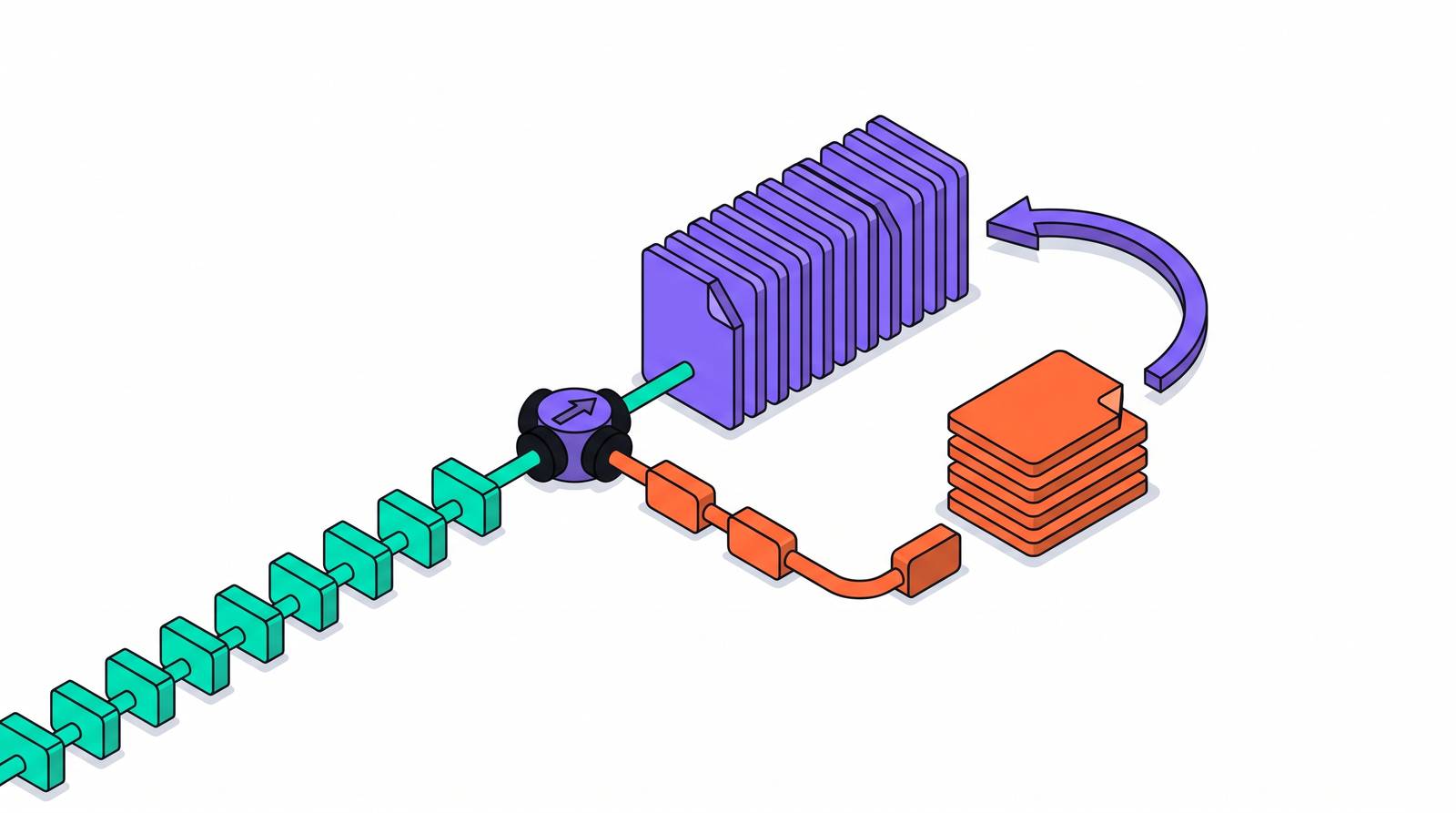
The postal analogy is genuinely useful here. Before email, post offices maintained a "dead-letter office," a place where undeliverable mail was held for human handling rather than discarded or sent back through the system indefinitely. A dead letter queue works the same way: a secondary queue that receives messages the primary system cannot successfully process, so they land somewhere reviewable instead of vanishing.
In a webhook system, a DLQ preserves the original event payload, captures error context and failure metadata, and isolates the problematic message so it stops blocking healthy events behind it. That is its entire job.
Here is where teams consistently go wrong: they mistake the DLQ for a fix. It is not. It makes failures survivable and reviewable instead of silent. It is not a retry mechanism; events arrive in the DLQ after retries are exhausted. And a DLQ nobody watches is just a slower, slightly more dignified way to lose data. I have seen teams instrument a DLQ, feel good about the architecture, and then never look at it until a customer calls.
The DLQ is the boundary between automated recovery and human-in-the-loop resolution. Events that cross into it require a decision: diagnose, fix the underlying cause, replay. Not another automatic retry.
The Failure Types That Determine How Events Should Be Routed
Not all webhook failures are created equal. Treating them as if they are leads to one of two equally bad outcomes: retrying events that will never succeed, or dead-lettering events that would have recovered on their own within seconds.
The foundational distinction is between transient and permanent failures. Transient failures, network hiccups, pod restarts, database timeouts, are recoverable. The event is well-formed, the destination exists, and given enough time the delivery will succeed. Permanent failures are categorically different: consistent rejections of a well-formed event, authentication failures from expired or revoked credentials, malformed payloads that fail schema validation. These will not resolve without human intervention. Retrying them wastes worker capacity and obscures the real problem.
Certain failure signatures should bypass the retry pipeline entirely. An HTTP 410, a consistent 404, a DNS failure: the destination is gone. Repeated 400-level rejections mean the payload itself is the problem. Auth failures from expired credentials mean every retry will fail until someone rotates a key. Send these straight to the DLQ.
The poison message problem is where this routing taxonomy earns its keep. Suppose a webhook arrives with a new field your schema validation does not recognize. The handler throws a validation error, the queue requeues the message, and that same event gets processed and rejected dozens of times. Consumer logs flood with the same error. Legitimate events pile up behind it. The retry logic, without routing rules that recognize a permanent failure, actively makes the system worse. This is not a hypothetical. It is one of the most common failure patterns in webhook systems at scale, and it is entirely preventable.
Timeout handling deserves separate attention because it introduces something pure routing rules cannot resolve alone. Most providers enforce tight windows: some allow 30 seconds, GitHub 10 seconds, Shopify just 5 seconds. When a handler partially processes an event and then times out, the provider retries and the handler runs again. Duplicate charges, duplicate records, duplicate everything. Idempotency keys are the countermeasure, a mechanism that lets the handler recognize it has already processed a given event and return a successful response without re-executing the side effects. Without idempotent handlers, replaying events from the DLQ carries exactly the same risk.
The routing rule that falls out of all this: route 4xx responses, excluding 429s, to the DLQ immediately. Route 5xx responses and timeouts to the retry pipeline.
Queue-First Ingestion as the Prerequisite for Any Reliable DLQ Pattern
Before any DLQ pattern can work, the ingestion architecture has to be right. Synchronous processing is the root cause of most retry storms and timeout failures, and it makes DLQ routing structurally unreliable.
Billing cycles and bulk import operations generate bursts of thousands of events in seconds. Synchronous handlers hit timeout limits, drop connections, and trigger provider-side retry storms that compound the original failure. The queue-first pattern resolves this: validate the incoming request, enqueue the event, return a 200 or 202 immediately. All actual processing happens asynchronously, at whatever pace the downstream system can sustain.
When Shopify expects a response within 5 seconds, the only reliable way to guarantee that response is to decouple receipt from processing. Acknowledge the event, queue it, let a background worker handle it. There is no clever synchronous alternative that holds up at scale.
The queue buys more than throughput. It creates a natural insertion point for retry logic and a natural attachment point for a DLQ. It is what holds the message while retries are attempted and what routes to the DLQ when they are exhausted. Without it, DLQ patterns are bolted onto a fundamentally fragile foundation.
If you do not have queue-first ingestion in place, address that before anything else in this article applies to you.
The Retry-Then-DLQ Pipeline and How to Set Its Parameters
The standard pipeline is: retry with exponential backoff for transient failures; if all retry attempts fail, move the event to the DLQ. Never discard. Discarding is the one behavior this entire architecture exists to prevent.
A tiered structure handles the reality that different transient failures have different durations. An immediate retry catches sub-second network hiccups. Short-term retries with exponential backoff handle outages lasting minutes. A long-term retry queue handles extended outages lasting hours. The DLQ receives what will not succeed without someone intervening. For billing-critical events, a practical schedule looks like: immediate, then 30 seconds, 5 minutes, 30 minutes, 2 hours, 8 hours, 24 hours, then DLQ. This covers most real outage durations, including deployment windows and incident response cycles, without holding events in limbo indefinitely.
Jitter is not optional. Pure exponential backoff creates a thundering herd: every event that failed in the same burst retries at exactly the same moment. If the receiver just recovered from a partial outage, a synchronized retry wave can push it back under. Jitter randomizes retry timing across a window, distributing load on a receiver that is still stabilizing.
The retry count threshold is the most consequential parameter to set correctly, and it is the one teams most often get wrong by intuition. Too low, and events that would have recovered get dead-lettered unnecessarily, creating operational noise and requiring manual intervention for failures that were always going to self-resolve. Too high, and poison messages consume worker capacity for extended periods and, on ordered queues, block everything behind them while burning through their retry budget. Start conservative, two or three attempts, observe the actual failure distribution in production, and raise the threshold only where the data shows most failures resolve within a small number of retries. Do not set this by feel.
Provider retry windows define the outer boundary of what you can rely on before your own infrastructure must take over. Shopify retries up to 8 times over 4 hours before removing the webhook subscription entirely. Some providers retry over a 3-day window. GitHub retries over 72 hours. Your internal retry pipeline needs to account for the gap between when provider retries are exhausted and when your DLQ takes custody.
Implementing DLQ Patterns Across SQS, RabbitMQ, and Kafka
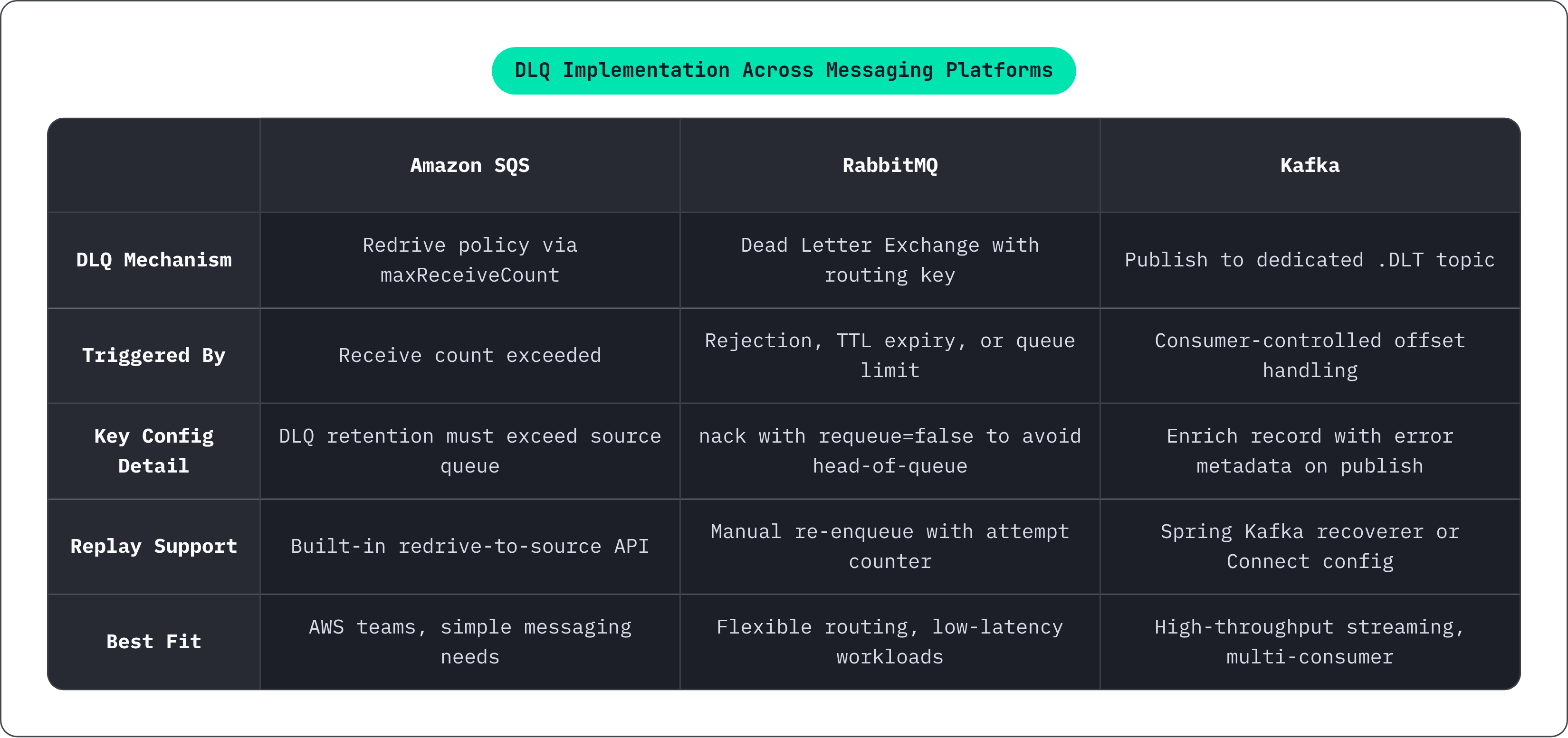
The pattern is portable. The primitives differ significantly. Choose a platform based on existing infrastructure, throughput requirements, and operational overhead tolerance, not on DLQ capability specifically, since all three major options support the pattern adequately.
Amazon SQS
SQS implements dead lettering through a redrive policy with a maxReceiveCount parameter: the number of times a consumer can receive a message before SQS moves it to the DLQ. Setting this to 1 is almost always wrong. Set it high enough to accommodate the retry schedule you have actually defined.
The DLQ retention period should always exceed the source queue's retention period. An event that expires from the DLQ before someone investigates it is data loss, just slower data loss. SQS's redrive-to-source feature allows replaying DLQ messages back to the original queue with a single API call, which simplifies resolution workflows considerably. For teams on AWS who want zero infrastructure management and have straightforward messaging requirements, SQS is the natural fit.
RabbitMQ
RabbitMQ implements dead lettering through a Dead Letter Exchange, declared on the source queue with x-dead-letter-exchange and x-dead-letter-routing-key arguments. Messages dead-letter on rejection with requeue=false, on TTL expiry, or when the queue length limit is exceeded.
One implementation detail matters enough to call out explicitly. A nack with requeue=true puts the message at the head of the queue, in front of legitimate events waiting behind it. That is almost never the intended behavior. Explicitly re-enqueuing the message with an incremented _attempts counter puts it at the tail, which is correct for a retry pattern. RabbitMQ suits teams that need flexible routing, low per-message latency, and traditional work queue semantics.
Kafka
Kafka has no built-in dead letter mechanism. The consumer controls its own offset. A bad message is a position in the log the consumer can advance past, skip, or reprocess. The standard pattern is to publish the record to a dedicated dead letter topic, typically named with a .DLT suffix on the original topic name, enriched with error metadata, and then commit the offset to advance past it.
Spring Kafka provides a DeadLetterPublishingRecoverer out of the box. Kafka Connect supports dead lettering via the errors.deadletterqueue.topic.name configuration. Kafka is the right fit for high-throughput event streaming, replay at scale, and architectures where multiple consumers read the same data for different purposes.
Circuit Breakers as a Companion to DLQ Routing
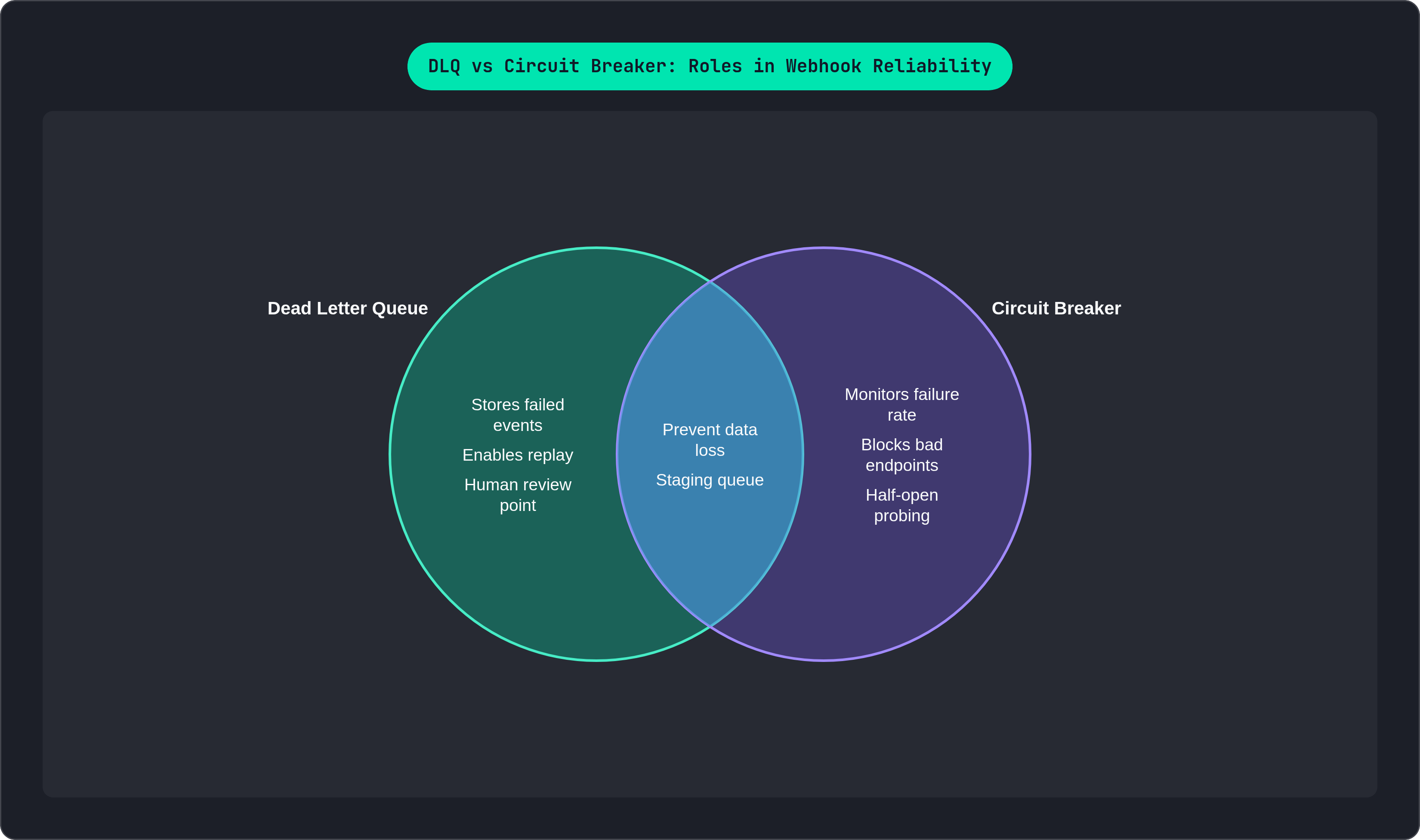
Circuit breakers and dead letter queues address different parts of the same problem. A DLQ is where events go when all delivery attempts are exhausted. A circuit breaker stops making delivery attempts against an endpoint that is clearly unavailable, so events route toward the DLQ faster and worker capacity stops being burned on requests guaranteed to fail.
The circuit breaker operates in three states. In the closed state, delivery proceeds normally and failures accumulate against a configurable threshold. When the failure rate exceeds that threshold over a defined time window, the circuit opens, and subsequent delivery attempts fail immediately without making HTTP requests; events go to a staging queue or table for later replay. After a cooldown period, the circuit moves to a half-open state, where a single probe request tests whether the endpoint has recovered. Success closes the circuit. Failure reopens it.
A circuit breaker is not a substitute for a DLQ. Events rejected by an open circuit must still go somewhere. Without a DLQ or staging queue to receive them, the circuit breaker just causes faster data loss. I have seen this mistake made by teams that implemented circuit breakers specifically because they were worried about losing events.
Two scenarios in webhook systems are where circuit breakers provide the most leverage. First: when the webhook handler makes outbound API calls as part of processing, an order creation event that triggers a call to a shipping provider, for instance. A circuit breaker around that downstream call lets the system back off intelligently rather than burning through retry budget against a known-down service. Second: destination-level isolation. A receiver that is consistently timing out should not consume concurrency allocated to healthy destinations. Per-destination circuit state prevents one failing endpoint from degrading delivery to the entire system.
When the circuit closes and the endpoint recovers, events sitting in the DLQ or staging queue must be replayed. A circuit breaker without a replay mechanism does not prevent data loss. It delays it.
Replaying, Resolving, and Draining the DLQ Without Creating New Problems
The DLQ is a holding state, not a final destination. Events there need a resolution path, or the queue grows indefinitely and becomes a source of operational dread rather than a tool for recovery.
Before any replay, diagnose. The error metadata captured when the event was dead-lettered should tell you whether the failure was a transient infrastructure issue, a schema mismatch, an auth failure, or something in the handler logic. The resolution path differs for each. Replaying an event whose root cause has not been fixed just dead-letters it again, and now you have done the same work twice.
When the underlying cause is resolved, replay should be rate-limited. The instinct is to drain the DLQ as fast as possible, especially when billing events are involved. The risk is that a large replay burst recreates the conditions that caused the original failure, particularly if the receiver is still in a recovery state. Throttled replay, with monitoring on receiver health during the drain, is the safer approach. Patience here is not timidity; it is how you avoid re-triggering the incident.
Idempotency is what makes replay safe rather than dangerous. Every event handler that processes webhook payloads should handle receiving the same event more than once without creating duplicate side effects: checking for idempotency keys before executing operations, storing processed event identifiers, returning a successful response if the event has already been handled. Without this, replaying from the DLQ risks creating exactly the duplicate charges and duplicate records the system was supposed to prevent.
Partial replays are often preferable to full drains. If the DLQ contains a mix of transient failures from an outage and persistent failures from a schema issue, replaying everything at once processes the recoverable events but also re-queues the unrecoverable ones, generating work for both the retry pipeline and the engineering team. Filter by error type, time window, or destination before replaying.
Finally, DLQ depth must be monitored with alerts. A queue that fills silently and gets drained manually on an ad hoc basis is operationally indistinguishable from having no DLQ at all. Set thresholds. Alert on them. Treat sustained DLQ depth the way you would treat a sustained error rate anywhere else in the system: as a signal that something requires attention, not as background noise to be acknowledged and ignored.