Merchant-of-Record Billing Solutions Built Into SaaS Backend Stacks
Why SaaS companies need tax and billing built into their core architecture, not bolted on afterward.
Selling software to a customer in Germany, France, or Japan can trigger tax obligations the seller never signed up for. VAT, digital services tax, and reverse charge rules each carry country-specific details, but the exposure appears on transaction one, not once the business gets big enough to notice. That's why the Merchant of Record model exists. It's a legal fix for a problem that starts the moment money crosses a border. It's a legal fix for a problem that starts the moment money crosses a border.
B2B sales in Germany and France usually shift VAT liability to the buyer through reverse charge, reducing the seller's direct filing obligations in those transactions. Japan works the same way for B2B, and for B2C sales sold through designated platforms, the platform operator eats the liability instead of the seller. Fine, except none of that touches US sales tax, which doesn't know what reverse charge is and doesn't care. Vertex's 2025 tax data counts more than 12,400 taxing jurisdictions in the US, each running its own rates, thresholds, and filing calendar. Get the classification wrong across enough of those, and the damage compounds into the gap between a business that grows and one that quietly bleeds out.
The fragmentation is already visible in how companies cope with it. A third of companies selling internationally run four or more separate tools just to manage global payments. It's the current state for companies that haven't even hit serious volume yet. It's the current state for companies that haven't even hit serious volume yet.
What a Merchant of Record is and what it takes off the seller's plate
An MoR is the legal entity that sells the product to the end customer. Not "helps sell." Sells. The SaaS company delivers the software, but the MoR transacts with the buyer. Every purchase is actually two transactions: the customer pays the MoR, and the MoR pays the SaaS company its net, after fees and taxes come out. A credit card statement or a tax receipt from an MoR purchase shows no trace of the SaaS company's name. The credit card statement or tax receipt displays the MoR's name instead.
That legal position is what separates an MoR from a payment processor. A processor moves money from point A to point B and calls it a day, leaving every legal obligation sitting with the seller: tax calculation, tax remittance, fraud liability, chargebacks, PCI-DSS compliance, consumer protection duties. An MoR picks all of that up instead. Real-time tax calculation by location and product type, tax collection and filing, fraud liability, full chargeback management, PCI compliance, regional consumer rules, all of it. A delivery driver just delivers, while a business partner owns the truck, the warehouse, and the insurance policy on both.
The jurisdictional maze is exactly as messy as it sounds. In the EU, B2C SaaS charges VAT based on where the customer sits, B2B uses reverse charge, and the OSS scheme trims the filing paperwork without getting rid of the ongoing admin. Canada layers a flat 5% federal GST with combined GST/HST rates that swing from 5% to 15% depending on the province, and some provinces tack their own separate sales tax on top (PST, QST, RST, pick your acronym). Japan, South Korea, and Singapore each run their own digital goods tax regimes, and none of these systems talk to each other.
Handing this to an MoR isn't free, and nobody should sell it as free. Sellers give up some control over checkout, over the billing relationship, over direct access to certain payment data. Handing this to an MoR isn't free, and nobody should sell it as free: sellers give up some control over checkout, over the billing relationship, over direct access to certain payment data, and that's the trade. Whether an MoR is useful isn't really up for debate anymore. It clearly is. That MoR responsibility should live inside the business is the real question, and that's what the rest of this piece is about.
How the MoR market grew into a distinct infrastructure layer
The market numbers make it hard to wave this off as a niche trend. MoR was valued at $13.2 billion in 2025 and is projected to hit $35.5 billion by 2032, a 14.9% compound annual growth rate, inside a SaaS market expected to grow from $315.68 billion to over $1.1 trillion in the same window.
Growth like that isn't just more companies signing more invoices. As tax rules spread across more jurisdictions and subscription pricing gets more elaborate, compliance overhead grows faster than revenue does, not in step with it. Founders are catching on that handling this by hand is a growth tax, paid out in engineering hours and finance-team headaches instead of dollars.
Below roughly $20,000 to $30,000 in monthly recurring revenue, doing compliance by hand can still make sense. The volume just isn't there yet to justify outside help. Above that line, the real cost, tax software subscriptions, finance staff time, audit exposure, tips the math firmly toward an MoR. None of this settles where MoR responsibility should sit inside the stack. It just confirms MoR stopped being optional a while back. It's infrastructure now, the same way a payment gateway or an identity provider is infrastructure.
Why treating MoR as a bolt-on integration creates synchronization debt even when the MoR itself works perfectly
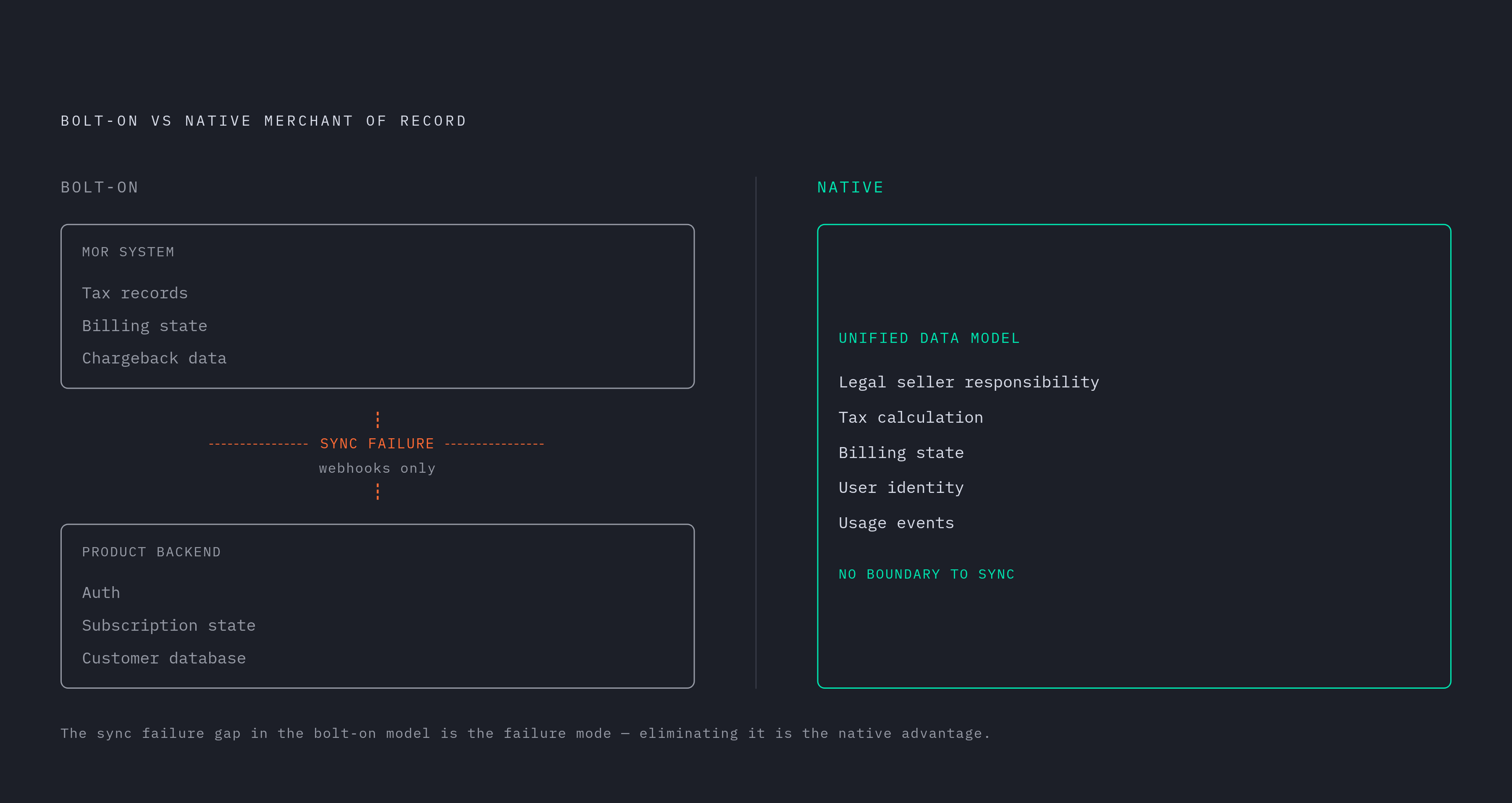
A SaaS company builds its backend with auth, payments, and a customer database as separate systems, then bolts an MoR onto the outside with its own webhooks, its own customer records, its own event model. The MoR does its job. Taxes get calculated, chargebacks get handled, filings go out on time. And the architecture is broken anyway, structurally, before a single bug ever ships.
There are now two sources of truth for every customer: one inside the MoR, one inside the product backend. There are now two sources of truth for every customer: one inside the MoR, one inside the product backend. Subscription state, billing status, access permissions, tax records, all of it has to stay synced across two systems that were never built to agree with each other automatically.
Sync failures are the expected outcome of webhook-driven integrations under real load, especially during subscription changes: upgrades, downgrades, pauses, cancellations, proration. They're the expected outcome of webhook-driven integrations under real load, especially during subscription changes: upgrades, downgrades, pauses, cancellations, proration. Each one is a chance for the two systems to fall out of step, and when they do, it isn't abstract. A customer pays and can't log in. A cancellation goes through on one side and never reaches the other, so the customer keeps getting billed. A tax record shows one status while the auth system shows a different one entirely, and now somebody in support is manually reconciling two databases that were supposed to talk to each other on their own.
The surface area only grows from there. Every new market entered, every pricing tier added, every new type of subscription event is one more seam where the two systems can drift apart. And once checkout, tax handling, billing, reporting, and support are all wired into a particular MoR setup, unwinding it later gets expensive fast: more engineering hours, slower launches into new markets, more compliance risk sitting quietly in the gap. This isn't a knock on any particular MoR provider's product quality. Synchronization breaks down no matter how good the MoR is, because it's a structural consequence of treating MoR as something outside the backend instead of inside it.
What standalone MoR providers offer and where each fits
The standalone MoR field has real range, and each option earns its place for a different kind of seller. MoR responsibility lives inside their system, not inside the product's own backend. The synchronization failure above applies to all of them equally, no matter how well each one runs its own side of the operation.
Freemius targets SaaS, AI products, desktop apps, browser extensions, and WordPress plugins and themes. It bundles global tax compliance, payments, subscriptions, licensing, upgrade flows, cart abandonment recovery, and affiliate management natively, no extra add-on cost. Pricing runs 4.7%, scaling down at higher volume, onboarding is self-serve and close to instant, and it tends to fit best from early startup stage up through roughly $500K MRR.
Fungies.io leans toward indie developers and bootstrapped founders who want MoR protection without wading into enterprise complexity. Coverage includes VAT/GST and US sales tax handling across multiple jurisdictions, subscription billing with trial support, webhook and API access, and license key management. Pricing is 5% plus $0.50 per transaction, no monthly fee, no setup cost, self-serve onboarding.
2Checkout covers 200+ countries, fitting enterprise and B2B SaaS that need compliance, invoicing, renewals, and a hybrid go-to-market motion. Pricing is custom, negotiated per account.
PayPro Global aims at enterprise and government sales along with volume licensing. It markets coverage across more than 13,000 tax jurisdictions and includes machine-learning-based smart retry for failed payments. Pricing is negotiated, and onboarding requires a sales call.
None of that changes the underlying math. Picking the best standalone MoR on this list still ships with the failure to keep the MoR and the product backend in sync.
How usage-based and hybrid billing models are making it harder to keep systems synchronized
Usage-based pricing is the default now. Usage-based pricing is now the default. Metronome's state of usage-based pricing report finds 77% of the largest software companies now build consumption-based pricing into their model somewhere, and on the AI side, the 2025 SaaS Benchmarks Report from High Alpha finds 42% of companies monetizing AI features through usage-based or hybrid pricing.
The dominant shape going into 2026 is hybrid: a flat base subscription plus metered overages on top. Atlassian's approach shows the pattern clearly. Standard plans include 25 Rovo AI credits per user per month, and as of June 9, 2026, overage billing for Rovo credits on standard plans hasn't started. It's scheduled to begin December 3, 2026. That gap between included usage and metered overage is exactly where fragmented backends fall apart.
Four things have to stay in sync here: subscription state, metered usage events, credit balance, overage calculation. In a fragmented system, those four things live in four different places. The MoR sees the transaction. The product backend sees the usage. Neither one has the whole picture, so neither one can answer a simple customer question like "why was I charged this amount" without pulling data from somewhere else first.
Pricing experimentation is widely recognized as a growth lever, yet most teams run experiments far less often than they intend to. That gap isn't ambition. Most teams already know pricing experimentation matters. The gap is infrastructure. Pure usage-based billing produces invoice amounts nobody can predict in advance, and hybrid models exist specifically to soften that with caps, alerts, prepaid credits, and included usage tiers. Every one of those controls needs the billing layer to see product usage in real time, not after the fact through a webhook. A standalone MoR that processes payments but never sees usage data can't deliver the billing intelligence modern SaaS and AI products need to compete.
What native MoR infrastructure looks like when billing, auth, and the customer database are one system
Picture a backend where legal seller responsibility, tax calculation, billing state, user identity, and usage events all sit inside one data model. There's no sync step in that picture, because there's no boundary left to sync across. That's the structural difference between native MoR and bolt-on MoR, and it isn't a subtle one.
What does that unlock in practice? A cancellation revokes product access in the same operation that records the billing event, atomically, not eventually. Usage events that trigger billing get captured by the same system enforcing plan limits, so there's no lag and nothing to reconcile after the fact. A single customer record shows who signed up, what plan they're on, what they've paid, and how they actually use the product, all in one place, immediately actionable by support or by an automated system. Tax calculation runs off the same customer location data that drives auth and provisioning, inside the infrastructure itself, instead of through a separate webhook call out to some external tax service.
BetterCloud's State of SaaS report found 70% of IT teams prefer all-in-one SaaS management platforms over stitching together point solutions for discovery, security, automation, and spend management, and 51% say managing SaaS through point solutions is harder than managing it through one unified platform. That preference isn't just about the tools a company buys to manage other software. It applies just as much to the backend choices a company makes about its own product.
The same instinct is visible in AI-native backend design, where production-grade systems need one unified API, model orchestration, observability, and cost controls in a single place rather than scattered across five vendors. That's really an argument about where legal and financial responsibility gets anchored, and whether that anchor shares a data model with everything else the business runs on.
How Tiun embeds MoR responsibility inside a unified backend rather than wrapping it around one
Tiun builds this idea directly into its architecture, combining authentication, payments, the customer database, and analytics into one unified backend platform, where MoR responsibility sits in the core rather than at the edge as an add-on integration.
That distinction is the whole argument this piece has been building toward. An MoR bolted onto a backend can still do its job well: correctly calculating tax, correctly handling chargebacks, correctly filing on time, and still leave a business exposed to the sync failures baked into running two sources of truth. Anchor that same legal and financial responsibility inside the same data model as auth and usage tracking, and the synchronization failure doesn't get solved after the fact. It never arises to begin with.
Sources
- 7 best merchant of record platforms for software in 2026
- Top 7 merchant of record providers by SaaS stage (2026)
- 10 Best Merchant of Record Software for SaaS Companies in 2026
- The Best Merchant of Record Platforms for SaaS in 2026
- How to Choose a Merchant of Record for SaaS: The Complete 2026 Guide
- bettercloud.com