SAML vs OIDC for SaaS Enterprise SSO Integration
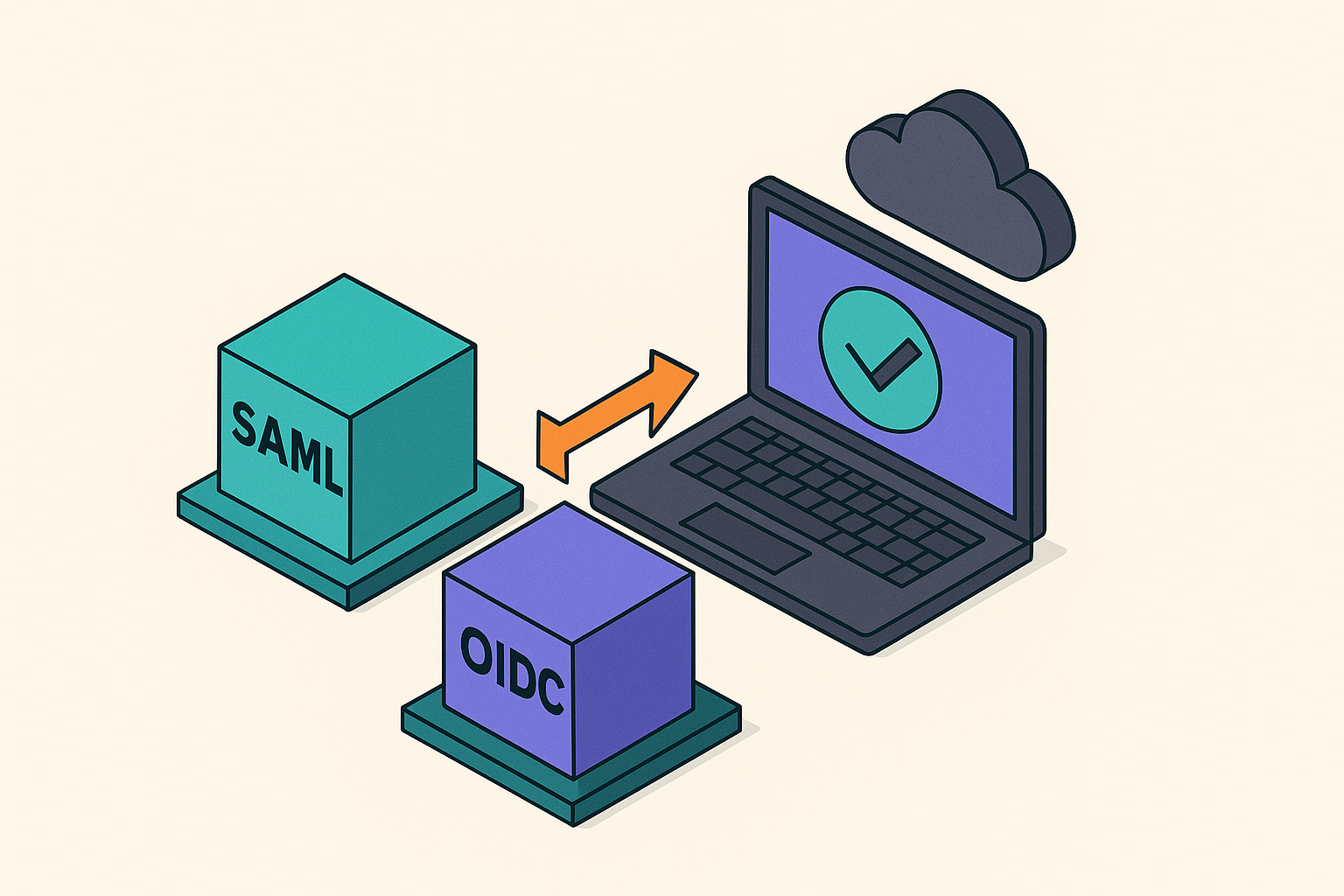
The identity and access management market hit $25.96 billion in 2025, headed toward $42.61 billion by 2030 at a 10.4% compound annual growth rate, according to MarketsandMarkets. None of that money buys anything new, though; it buys the same login screen, wrapped in different acronyms, sold back to companies that already paid for it once. SAML and OIDC both answer the same question (is this person who they say they are), but they were built twenty years apart, and that gap explains most of the pain enterprise buyers put SaaS teams through during procurement.
B2B IAM, the slice covering partners, suppliers, and scattered contractor workforces, is growing faster than the rest of the market. Translation: your buyer already has identity infrastructure, and it's already paid for, so nobody's ripping it out for you. Your protocol support is a checkbox on a form, and missing the box means the deal doesn't reach legal review — it just dies quietly in someone's inbox.
What SAML 2.0 actually does and why enterprises still depend on it
SAML 2.0 got standardized in 2005, back when "app" meant something you clicked on inside a browser window. It's XML-based, built so one company could vouch for a user's identity to another company without either side blindly trusting the other.
The mechanic is simple. The Identity Provider (the company running the employee directory) generates a signed XML document called an assertion, which says: this person is who they claim, here's their department, here's when the claim expires. Your product, the Service Provider, checks the signature and trusts it, with no phone call back to the IdP needed.
That signature model buys you a few things. Verification is stateless, so your app doesn't need a live connection to the IdP at login, just a signature it can check on its own. The assertion carries everything in one payload: identity, attributes, session conditions. Trust gets set up once, through a certificate exchange, not renegotiated every time someone logs in.
SAML is still the default in a recognizable set of places: HR systems, CRM platforms, ITSM tools, internal portals built before 2014. Government and regulated-sector deployments under FISMA or FedRAMP lean on it heavily. A lot of enterprise identity infrastructure, Active Directory Federation Services, older Okta tenants, on-prem Shibboleth setups, assumed SAML as the native language from day one and never looked back.
SAML also supports single logout (SLO), which lets a user log out of every connected app in one motion through browser redirects or backend SOAP calls. In practice, coordinating logout across five service providers works about as well as you'd guess. I watched a support ticket sit open for three days once because a user logged out of the CRM but stayed logged into the billing portal, and nobody could explain why until someone traced it to a stale SLO endpoint.
SAML solved a genuinely hard problem at a time when nothing else solved it: federated browser login across company boundaries. The installed base you're dealing with today is the fossil record of that win.
What OIDC does differently and where it has a structural advantage
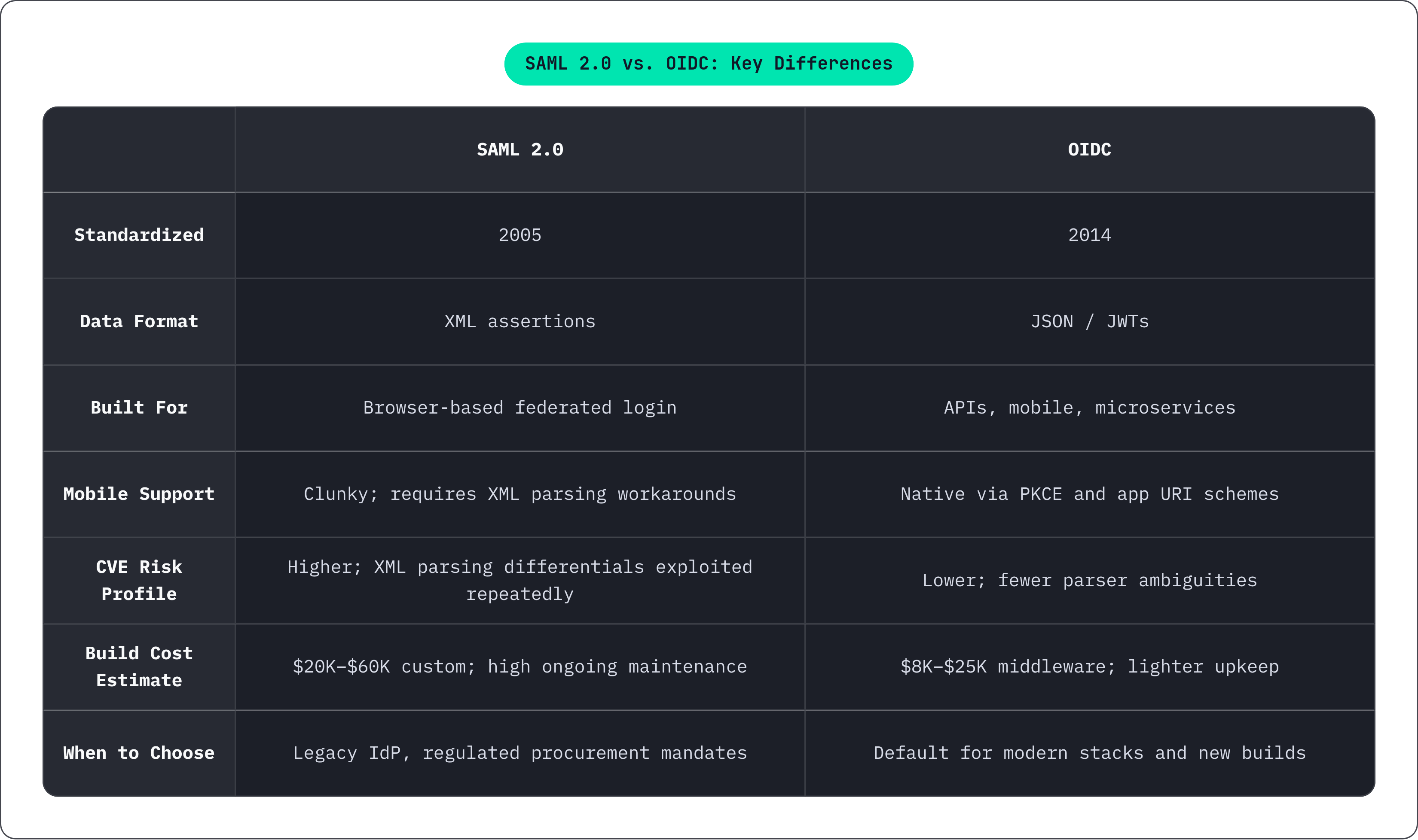
OIDC showed up in 2014, sitting on top of OAuth 2.0. Where SAML speaks XML, OIDC speaks JSON and JWTs, and it was built for a different planet: APIs, mobile apps, services chattering to each other constantly instead of authenticating once and calling it a day.
The core flow, Authorization Code Flow, works like this. The client gets a short-lived code, trades it for an ID token (a JWT), and often an access token alongside it. The JWT carries claims, facts about the user, that the client reads and verifies locally, with no round trip required.
Mobile is where OIDC pulls ahead hard. Authorization Code Flow with PKCE was built specifically for apps that can't store a secret safely, which is every app on your phone, and it plugs straight into iOS custom URI schemes and Android App Links. Meanwhile, SAML needs XML parsing libraries and clunky webview workarounds just to limp onto mobile at all.
Single-page apps benefit the same way: a JWT slides into an Authorization header without ceremony, while XML assertions were never built for that. Microservices benefit too, since downstream services verify a token locally instead of pinging the identity provider on every call. Developer experience is just better as well, with standardized discovery endpoints, solid SDKs in nearly every language, and JSON parsing instead of XML canonicalization, a phrase that still makes me twitch after a project years back ran two weeks over because two libraries disagreed about what counted as "the same" XML document.
OIDC handles logout more cleanly too, supporting front-channel and back-channel options natively, so session management across distributed services is more predictable than SAML's SLO patchwork. Its spec also baked in security mechanisms SAML's era never had to think about: PKCE, token expiry, refresh token rotation.
This doesn't make OIDC universally better, though. If your product is API-driven or mobile-forward, the advantages compound fast. Running a browser-only enterprise portal talking to a legacy IdP barely registers most of this, and building OIDC-first there would be solving a problem you don't have.
The security gap neither protocol escapes — and what the recent CVEs reveal
Both protocols have shipped serious, exploited vulnerabilities, and neither gets to claim the high ground. Still, SAML's XML attack surface produced a noticeably heavier run of bypasses between 2024 and 2026: signature wrapping attacks, canonicalization mistakes, parser differentials between competing XML libraries.
CVE-2025-25291 and CVE-2025-25292, both in ruby-saml, scored 8.8 out of 10 on CVSS. A parser differential between REXML and Nokogiri opened the door to signature wrapping attacks that skip authentication entirely, and GitHub found it, with fixes landing in ruby-saml 1.12.4 and 1.18.0.
CVE-2025-47949, in samlify, is a critical signature wrapping flaw that lets an attacker impersonate any user, admins included, using nothing more than one legitimately signed XML document from the IdP, restructured cleverly. CVE-2024-8698, in Keycloak, disclosed September 2024, lets a low-privileged attacker craft a SAML response that skips signature verification altogether.
Look at what these three share. Every one traces back to how brutally hard it is to get XML signature processing right when different libraries parse the same document slightly differently. JSON and JWT don't reproduce that problem at anywhere near the same scale, since there's much less room for two parsers to argue about what a JSON object means.
Practically, choosing SAML is a bet on your library's maintenance discipline and your team's habit of tracking CVE feeds, which is nobody's favorite Tuesday task. A managed authentication layer that owns patching closes this gap far better than an engineer glancing at a security mailing list between sprints.
OIDC isn't clean either. JWT validation mistakes, the deprecated implicit flow still showing up in old tutorials, missing state parameters: these have all caused real breaches. Implementation quality drives security outcomes more than protocol choice does. Picking OIDC doesn't make you safe; it just changes which mistakes are available to make.
How enterprise customers' IdP reality shapes which protocol you actually need
The rule floating around the industry in 2026, per Authgear, is blunt: start with OIDC unless you're stuck integrating with a legacy IdP that only speaks SAML. Microsoft's own guidance lands in the same spot, treating SAML as something you adopt because a compliance mandate or procurement checklist forces your hand, not because you wanted to.
What does "legacy IdP that only speaks SAML" look like on the ground? Older ADFS setups that never got migrated to Entra ID, on-prem Shibboleth deployments common in academic and government federation networks, and enterprise buyers in federal agencies, defense contracting, or certain healthcare systems whose procurement checklist names SAML 2.0 compliance by line item.
Here's the twist. Most new enterprise IdP deployments, Okta, Entra ID, Google Workspace, support both protocols out of the box, so the protocol you actually need often has less to do with what the IdP can technically do, and more to do with what some IT team configured five years ago and never revisited.
Before locking in a starting protocol, get honest about the pipeline. What industries and company sizes are actually showing up, and what does their IT environment look like, and have you asked, or are you guessing? Does your product need to act on a user's behalf via API, or is a basic authenticated session enough, and does mobile matter to the roadmap this year or next?
The uncomfortable truth for anyone selling into mid-market and enterprise: you'll eventually need both protocols. The real question was never whether to build SAML support, only when it lands on your desk.
The SSO tax and what it signals about how the market has priced this capability
The SSO tax is the industry's open secret. Lock SSO behind the priciest tier, and mark it up so hard it reads like a typo. The catalog at sso.tax tracks roughly 150 vendors as of June 2026. Of those, 104 show a computable markup, and 44 just route you to "contact sales," which is corporate speak for "let us find your budget first."
Some real numbers: GitHub jumps from $4 to $21 per user per month for SAML, a 425% markup, while Figma runs around 275% and Notion sits near 88%. Slack lands around 72%, Railway's markup runs close to 9,900%, and Mixpanel comes in around 4,065% — no, that's not a typo.
Why does SAML get gated harder than OIDC? Because asking for SAML is a tell. It means an enterprise buyer with a real IdP and a real procurement budget is standing behind the request, and vendors price toward willingness to pay, not toward what the feature costs to build.
The actual engineering cost makes these markups look absurd. Standard federation through a major cloud identity provider runs around $0.015 per monthly active user, so try defending a four-digit percentage markup against that number with a straight face.
CISA's "Secure by Demand" guidance from 2024 calls SSO-as-paid-add-on a security anti-pattern, flat out, which tells you which way the regulatory wind is blowing. Buyers are catching on too. The SSO tax might goose a quarter's revenue, but it's also a trust signal, and not the kind you want stapled to your brand. Offering both protocols without gouging is turning into a real edge.
The real cost of building SSO in-house versus using a managed layer
Building this yourself costs more than most roadmaps assume. TechConcepts published estimates in 2025 that break down like this: a pre-built connector runs $3,000 to $8,000, OIDC middleware runs $8,000 to $25,000, a custom SAML 2.0 build runs $20,000 to $60,000, and a full in-house OAuth2/OIDC implementation can run $60,000 to $150,000 or more. Add SCIM provisioning at $8,000 to $20,000 and audit logging at $5,000 to $15,000, plus ongoing maintenance, and the iceberg starts showing its shape.
Stack that across three years of patching and library upgrades, and total cost of ownership for a full in-house build climbs toward $1.1 million. That money buys plumbing: XML parsing, assertion validation, SLO coordination, someone getting paged at 2am for the next CVE disclosure. None of it is your product, and none of it is what your customers actually pay for.
SAML costs more to build and keep alive than OIDC, full stop. Canonicalization edge cases and the CVE pattern already covered mean ongoing engineering overhead that a JSON-based OIDC implementation mostly sidesteps.
Timing makes it worse. Most SaaS teams put off SSO until an enterprise deal forces it, then build under deadline pressure with sales hovering, which is exactly when XML complexity does the most damage. A managed authentication layer that already handles parsing, validation, and SLO coordination turns this from a build problem into a configuration problem, and that's a very different kind of week for your engineering team.
This is also where keeping authentication inside a unified backend, instead of bolted on as a separate silo, pays off. Tiun keeps authentication alongside payments, the customer database, and analytics in one system, so an SSO login event (who logged in, through which IdP, when) connects immediately to subscription status and usage data. A standalone auth service has no idea if the person logging in is a paying customer or someone whose trial expired last Tuesday. The unified version gives you a business signal riding along with the login record.
The hybrid reality: why most SaaS products eventually support both and how to sequence the build
Auth0 has flagged the pattern across the industry: most companies end up running both protocols side by side, OIDC for anything new, SAML for legacy enterprise federation that refuses to die. It makes sense once you remember your customer base spans companies founded in 2023 and companies still running infrastructure from 2011.
The identity broker pattern is how most teams survive this without losing their minds. A broker takes SAML assertions from an enterprise IdP on one side and issues clean OIDC JWTs internally on the other. Your product speaks OIDC only, and the broker eats the SAML complexity quietly in the background. It's a translation layer, and your core codebase never has to touch XML canonicalization directly, which your engineers will thank you for.
A sensible sequence: early on, targeting SMB customers, build OIDC first. It's lighter, covers most modern IdPs, and handles mobile and API access you'll probably need regardless. Moving upmarket, SAML stops being optional the moment your first enterprise IT department asks for it point blank, and that moment always arrives faster than the roadmap predicted. That's when the broker pattern becomes your scaling strategy: keep OIDC native, hand SAML federation to a managed layer that translates it behind the scenes.
Once SSO ships, enterprise customers start expecting automated provisioning and deprovisioning through SCIM (System for Cross-domain Identity Management). Worth flagging now, even though it's a separate build entirely.
Here's the moment that actually matters: an enterprise prospect's IT team asks for your SAML metadata URL, and you need an answer that same day. A roadmap slide doesn't count, and "targeting Q3" doesn't count either. For solo founders and small teams especially, trying to build SAML from scratch under deal pressure is the single most expensive move available, and it always lands at the exact moment you have the least slack to absorb it. Call it what it is: a resourcing decision dressed up as a technical one.
A structured decision framework for choosing your starting protocol
No universal answer exists here, only the right answer for your customer mix, your architecture, and whatever deals sit in your pipeline this quarter. A few things do cut through the noise, though.
Default to OIDC. It's cheaper to build, lighter to maintain, has a smaller CVE footprint, and covers the modern IdP landscape plus mobile and API-first patterns. Treat this as your resting position, and only move off it when something specific pulls you there.
Move toward SAML the moment one of these shows up on your desk: an enterprise prospect whose IT team explicitly requires it, a regulated customer (federal, defense, healthcare) with SAML 2.0 named on their procurement checklist, or a legacy IdP in the pipeline (old ADFS, on-prem Shibboleth) with genuinely no OIDC path.
Once both protocols are live, use the broker pattern so your core product speaks one language internally while a managed layer handles translation for customers stuck on the older standard.
Price it honestly. Don't let the SSO tax dictate your enterprise tier just because everyone else does it that way, since it closes deals now and breeds resentment later, and buyers are getting sharper about spotting the pattern every year.
Build for the question before it lands, not during the call where someone asks it. Know your pipeline's actual IdP mix, and know whether SCIM is coming next. Remember that the day someone asks for your SAML metadata URL, "we're working on it" is the wrong answer, no matter how good it sounds in the moment.