Machine-to-Machine Authentication Patterns for SaaS Backend Services
API traffic is now 83% of all web traffic, according to Akamai's 2024 State of the Internet report, and most of it never touches a browser. It's services calling services, pipelines swapping tokens, agents hitting endpoints on schedules no human set. The old "user logs in, clicks around" model still exists, sure, but it's not the main character in a SaaS backend anymore.
The non-human identity problem that makes M2M auth urgent
Machine identities, service accounts, API tokens, AI agents now outnumber human identities in most SaaS infrastructure, and by a lot. Entro Security's H1 2025 research shows that gap widening, not stabilizing, and there's no sign of it leveling off anytime soon.
The mess this creates shows up in the numbers, too. GitGuardian's 2026 State of Secrets Sprawl report counted more than 28 million new secrets exposed in public GitHub repos in a single year. Most of that isn't some hacker running a zero-day exploit at 2 a.m. It's a hardcoded credential someone committed on a Tuesday and forgot existed.
Non-human identities break the old playbook for a few reasons, and they compound.
There's no working hours or geography to anchor a behavior pattern. A service account hitting an API at 3 a.m. from a data center isn't suspicious, it's just Tuesday, and the SIEM rules built to flag a human logging in from Belarus never fire. These things also run around the clock with standing access, so a compromised service account looks exactly like legitimate automation right up until the moment data walks out the door. And you can't exactly put a fingerprint scanner in front of a cron job. MFA doesn't apply, so teams fall back to static credentials, which happen to be the weakest thing on the shelf.
Underneath all this sits a visibility problem. Plenty of SaaS platforms don't cleanly separate machine identities from human users in their IAM layer, and you can't govern what you can't see. OWASP's NHI Top 10 for 2025 spells out the practitioner's checklist: improper offboarding, weak authentication, credentials with way more privilege than they need, no discovery process to catch any of it. Every item on that list maps back to a pattern decision, which is the rest of this piece: three patterns, ranked roughly by trust and complexity, each with a home turf where it earns its keep.
API keys: where most teams start and where many get stuck
An API key is a string that sits in a header or a query parameter. That's the whole mechanism, and the simplicity is both the entire pitch and the ceiling.
Teams reach for keys first because there's no auth server to stand up, no token exchange to wire together. You hand someone a key, it works, and everyone gets back to their actual job, at least until it doesn't. Then time passes and the cracks show.
Keys get hardcoded into source, which is probably the single biggest contributor to that 28 million figure from GitGuardian. Rarely malicious, usually just a test credential nobody stripped out before the commit. Keys also live forever unless someone actively kills them, so a key issued once and never rotated becomes a permanent credential the second it leaks, and it stays that way until someone notices, which might be never. There's no scope baked in either, so a key opens the door or it doesn't, and least privilege has to be bolted on from the outside, because the key itself has no idea what "read-only" means.
And nearly every team, at some point, logs the access token by accident, almost like a rite of passage at this point. The actual fix is structured logging with token fields redacted at the log adapter layer, not some engineer manually scrubbing values at each call site, because that gets forgotten the one time it actually matters.
API keys still have a place: legacy systems, or traffic that's genuinely low stakes, where a team writes down a real rotation plan and accepts the tradeoff on purpose instead of by accident. "Low stakes" comes with strings attached, though. Somebody's name needs to be on the credential, and rotation needs to be enforced by a secrets manager, not a Slack reminder that says "rotate this quarterly" that nobody reads past the first time.
Once a service is customer-facing, reachable from outside your network, or touching tenant data, a static key's ceiling is too low. That's your cue for OAuth.
OAuth 2.0 Client Credentials: the standard for service-to-service authentication
The flow is simpler than the acronym suggests. A client service authenticates to an authorization server with a client ID and client secret. The auth server hands back a short-lived access token, usually a JWT, and the client shows that token to the resource service on every request. No user shows up anywhere in this chain, and RFC 6749 Section 4.4 wrote this grant type for exactly that scenario.
The short lifespan is what actually changes the math. A leaked API key sits there valid until someone manually kills it; a leaked OAuth token expires on its own, often within minutes. That shrinking window of exposure is the real upgrade, not the extra syllables in "OAuth 2.0."
Scopes are where least privilege becomes achievable instead of aspirational. Each token should carry only what's needed for that specific call, nothing extra tagging along for convenience. Build scopes around resource actions, things like billing:read or users:write, rather than one blanket scope per service. Get lazy here and you've rebuilt the exact same "works or doesn't" problem from API keys, just wrapped in nicer packaging.
Multi-tenant products add a wrinkle. If customer applications hit your first-party API, scoping needs to happen per customer, not just per service. A token minted for tenant A that somehow reaches tenant B's data isn't a bug ticket, it's an incident report with your name on it.
Someone has to run the auth server: issuing tokens, checking them, revoking them on demand. Some teams build this themselves with libraries like node-oidc-provider or oauthlib. Others hand it off, trading a measure of control for the ongoing grind of keeping an auth server patched and staffed. Tiun sits in that second bucket, a backend platform bundling authentication with payments, a customer database, and analytics, aimed at teams who'd rather not stand up a whole separate auth service for this.
The logging pitfall from the last section doesn't go away just because the token looks fancier than a plain API key. It's still the same mistake wearing a nicer suit.
And if you're integrating with a third-party API or vendor SDK, use their auth server and their SDK rather than reimplementing the OAuth dance yourself. That's where the subtle bugs live, the kind that pass every test you wrote and then fail in exactly the one edge case you didn't think to check.
Mutual TLS: cryptographic identity for high-assurance internal traffic
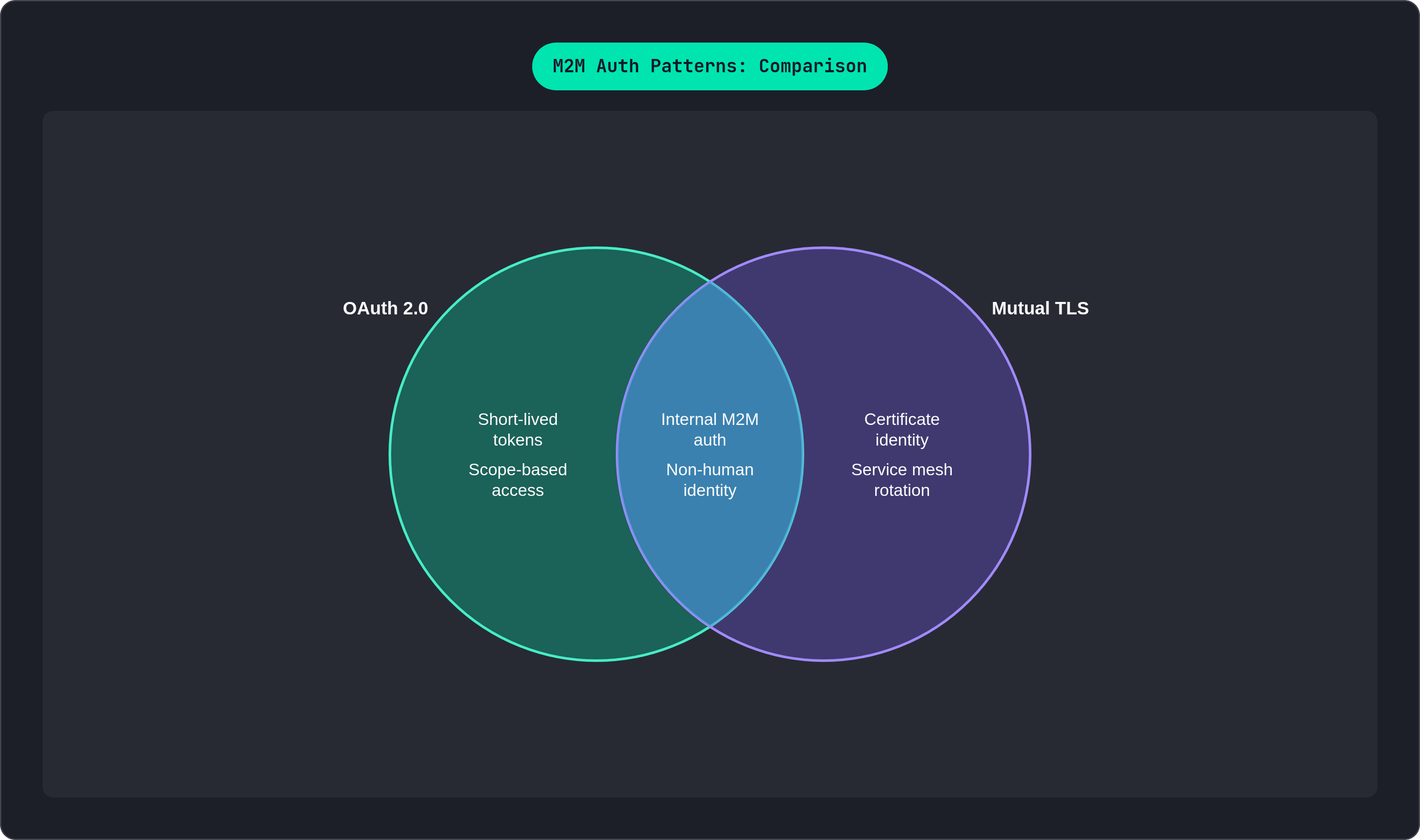
OAuth proves a caller holds a valid token. mTLS proves something more basic: both ends of a connection present a certificate, so the server proves its identity to the client and the client proves its identity to the server, before any application code runs at all.
This pattern earns its keep on internal traffic, service to service, inside the same VPC or private network. That's where the setup cost is worth paying, and where tooling makes it manageable instead of a nightmare. Service meshes like Istio, Linkerd, and AWS App Mesh handle certificate issuance and rotation automatically, and that automation is really the only reason mTLS is workable at scale. Try managing certificates by hand across forty services and you'll stall out somewhere around service twelve.
The two layers answer different questions, and you need both answered. mTLS answers "is this actually the billing service talking to me?" while a scoped JWT riding on top answers "is the billing service allowed to read this specific tenant's invoices?" Transport identity and application permission aren't the same question, and treating them as one lets gaps open up fast.
mTLS is overkill for most external integrations, honestly. Swapping certificates with a third-party vendor means coordinating PKI on both sides, which is a lot of ceremony for a boundary where OAuth already does the job fine. The complexity cost is real too: certificate lifecycle, rotation, revocation all need real investment. Reach for mTLS because your threat model actually demands it, not out of habit.
AI agents are pushing more teams toward that higher bar anyway. An agent hitting internal APIs at high frequency with access to tenant data looks less like a background job and more like a caller that deserves real scrutiny. mTLS paired with scoped JWTs is becoming the sane default for that kind of traffic.
Matching each pattern to its SaaS scenario
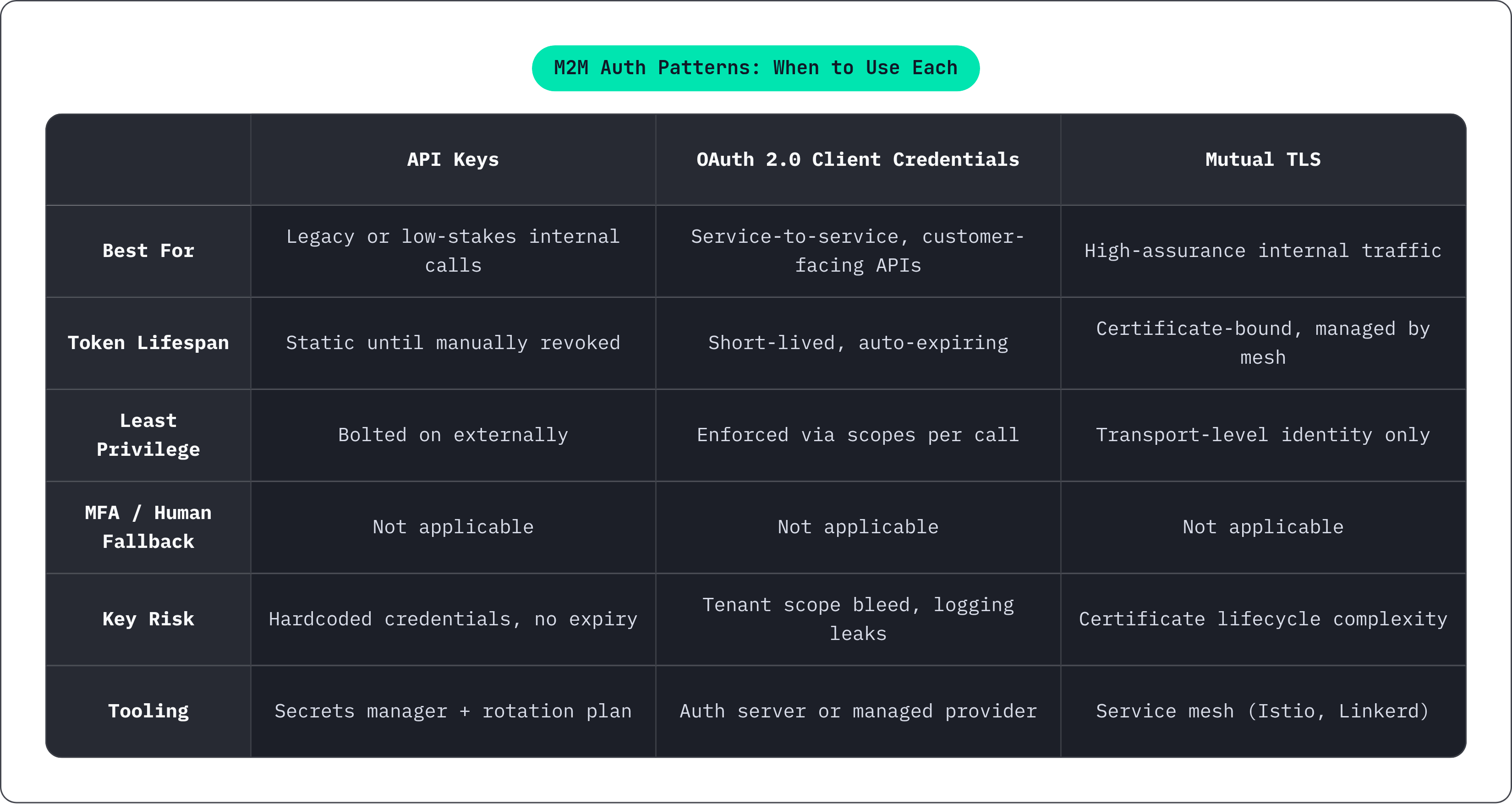
Rough tier system, not scripture carved into stone:
Calling a third-party API means OAuth Client Credentials, using the vendor's own auth server and SDK. Customer apps consuming your first-party API means OAuth Client Credentials on your own server, scoped per customer and per resource action. Internal service-to-service traffic on a private network means mTLS through a service mesh, with scoped JWTs handling application-level permissions. Legacy systems or genuinely low-stakes internal calls can still get away with static API keys, provided there's a documented rotation plan and someone's eyes open about the tradeoff.
AI agents cut across all four tiers at once, which is exactly what makes them a headache. An agent calling an internal API is a non-human identity like any other, and it needs credentials scoped tightly to what it actually does, with a named human accountable for it. Agent frameworks and MCP integrations that handle OAuth natively cut down on the temptation to just hand the agent a hardcoded key because it's Friday afternoon and the demo's in an hour. Tiun's agent-native setup, with CLI-based skill installs and MCP integrations, lets an agent handle its own auth wiring instead of someone stitching webhooks together at midnight.
Multi-tenant SaaS is where scope design either earns its keep or quietly costs you later. Tenant isolation has to live at the token level; leaning on network topology and hoping it holds isn't a strategy. A token that crosses from one tenant into another isn't a config mistake, it's an architecture failure, and it means tenancy wasn't part of the scope design from day one. Retrofitting that after launch costs a lot more than building it in up front, same lesson that applies to nearly every multi-tenancy decision you'll ever face.
The AI angle isn't hypothetical anymore, either. IBM Security's 2025 report found 43% of enterprises had already dealt with an AI-specific security incident somewhere in their SaaS stack. Treat agent credentials with the same seriousness as any other service account, designed in from the start.
Secret lifecycle management: rotation, storage, and ownership
Picking a pattern is the easy part. Keeping it secure six months later is where the actual incidents happen, not at the moment a credential gets issued but long after, once it's gone stale, forgotten, or ended up sitting in a repo nobody's opened since March.
Secrets managers aren't optional at this point. AWS Secrets Manager, HashiCorp Vault, GCP Secret Manager, any of them kill hardcoded credentials if the team actually uses them right. The pattern that works: a service fetches its own credentials at startup, straight from the secrets manager, and never pulls them from an environment variable baked into a container image sitting in some registry.
Rotation should be a property of the system, not a task on someone's calendar. The secrets manager enforces the cadence; a human remembering to do it by hand isn't a plan, it's a hope, and hope is not a security control. Services need zero-downtime rotation built into the architecture from day one, not bolted on after an outage teaches everyone the hard way.
Every non-human identity credential should trace back to a named human owner in your identity inventory. This is the actual fix for "improper offboarding" on OWASP's NHI list, the zombie service account still running two years after the engineer who made it left the company. And you can't rotate or revoke what you don't know exists, so the real first step for most teams is an honest audit: how many service accounts and API keys are floating around, and how many are still doing real work versus quietly doing nothing at all.
That 28 million figure from GitGuardian is a story about operational discipline that didn't happen, not sophisticated attackers doing anything clever. And if any of those exposed credentials touch personal data, the incident can trigger a data breach notification obligation under GDPR if it poses a real risk to people's rights and freedoms, which raises the stakes considerably for anyone serving EU customers.
What a production-ready M2M auth setup actually looks like
Before picking a pattern, ask the question underneath all of them: does this team actually have the bandwidth to run and maintain auth infrastructure, or does building that bandwidth become its own tax that slows down everything else?
Running your own auth server gets you full control over token issuance, scope design, revocation, all of it. That's the right call when auth is core to what you're building, or when compliance requires it outright. It also comes with a cost that grows alongside your service count, since every new service is one more thing the auth team has to track.
Using a managed auth layer trades some of that control for a lot less operational weight. For most SaaS and AI teams, whose actual product has nothing to do with building auth infrastructure, that's the sane trade. Tiun bundles authentication with payments, a customer database, and analytics in one place, so teams aren't stitching together a separate auth service, billing service, and analytics pipeline and hoping the data stays in sync across all three. One customer record, one place where tokens, transactions, and sessions actually live.
Worth naming the anti-pattern directly: auth logic scattered across every service instead of centralized somewhere sensible. Once each service validates tokens its own particular way, revoking access reliably becomes nearly impossible, and scope enforcement turns into a patchwork instead of an actual policy.
A defensible setup heading into 2026 looks something like this. Short-lived tokens should show up everywhere OAuth is used, with scopes built per resource action and enforced per tenant wherever multi-tenancy applies, and mTLS belongs on internal high-assurance boundaries, run through a service mesh. Every secret should sit in a managed store with rotation happening automatically, and every non-human identity credential should be inventoried with a real person's name attached to it. Structured logging needs token fields redacted at the adapter layer, and AI agent credentials deserve treatment as first-class non-human identities, with the same lifecycle discipline as any other service account.
Get those pieces in place, and most of the rest of the security conversation takes care of itself.