Usage-Based Billing for AI Agent Consumption in SaaS
AI agents shatter seat-based pricing, forcing SaaS founders toward usage or outcome billing.
Seat-based pricing was never really about seats. It was a bet that one human, logged into one account, would produce one roughly predictable slice of value every month. AI agents break that bet in every direction at once, and this piece is about what SaaS founders need to build instead.
How seat pricing was built
You can fit the logic behind charging per seat on a napkin. One person uses one login. That person works business hours, takes weekends off, and produces output in a fairly narrow band, not wildly more or less than the next person on the team. Multiply the number of seats by the price per seat to get a number that both sides can live with.
That simplicity is why the model spread everywhere. Everybody built their planning around the same steady assumption.
That assumption survived two decades of SaaS because the "user" stayed a constant. Marginal cost stayed close to zero, so the price per seat didn't need to track usage. Seats were a reasonable proxy for value because the cost of serving each one barely moved.
AI agents don't log in. A company that replaces twenty human support reps with one AI agent still shows up as a single seat on the invoice, but that one seat now completes more work, costs more to run, and delivers more value than the seat price was ever built to capture. Flat, per-seat pricing and variable, per-task AI compute cost don't just drift apart, they split. They were never the same kind of number to begin with.
Why the economics of AI inference worsen the mismatch
Traditional SaaS earned its near-zero marginal cost because software, once built, mostly just sits there waiting to be clicked. AI agents don't sit. Every single interaction, every API call, every decision an agent makes about which tool to use next, draws on real infrastructure: tokens processed by a model, GPU cycles spent computing a response, orchestration logic stitching steps together. None of that is free, and none of it stays constant.
Two customers on the exact same plan can generate wildly different costs depending on how long their conversations run, how many tools the agent calls along the way, and which model handles the request. A long one involving several rounds of tool use and a larger model can cost many times more. That spread isn't a rounding error, it's a structural feature of how these systems work, and it means the vendor's cost to serve one customer can look nothing like the cost to serve the next.
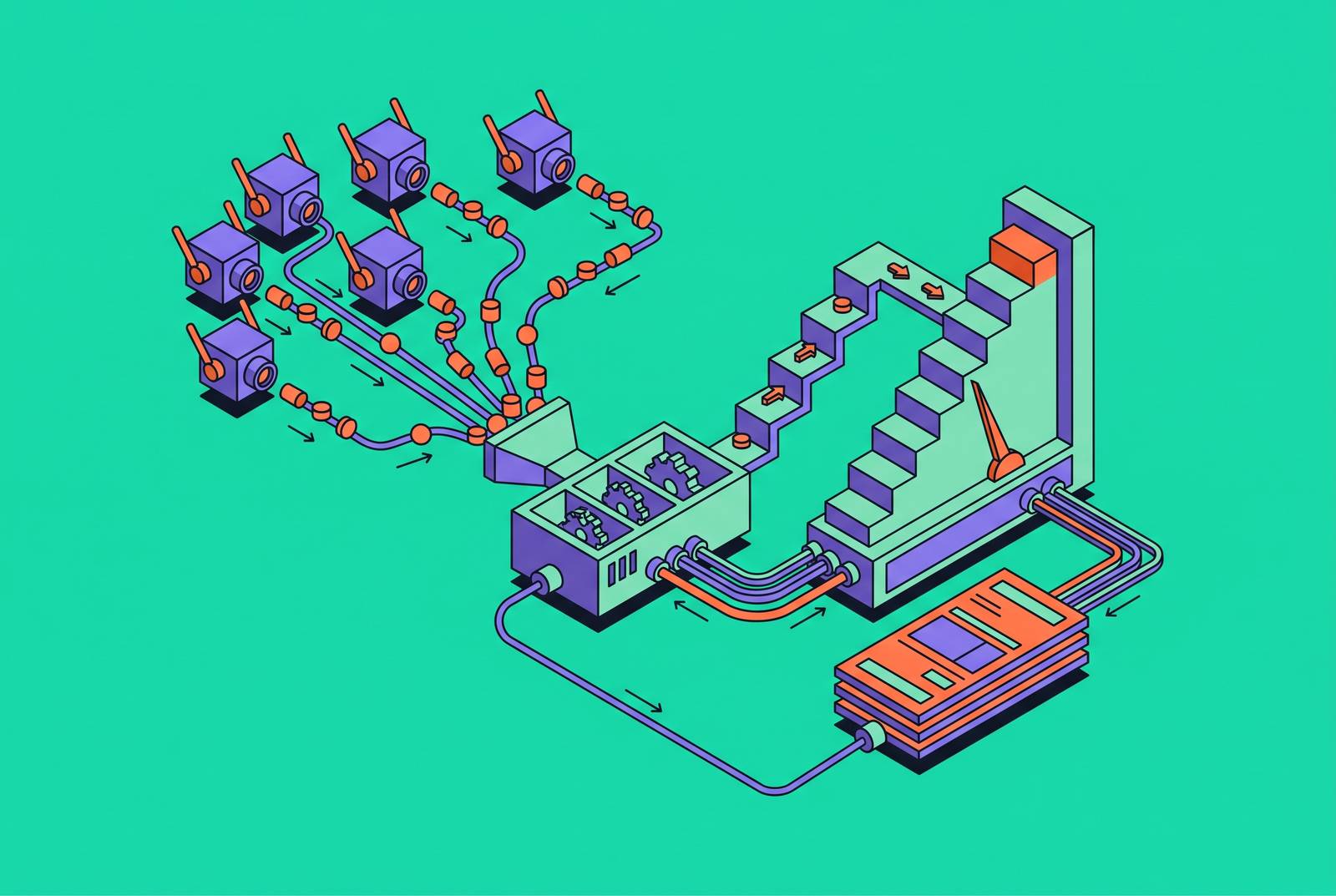
Scaling that across a customer base makes the billing arithmetic even harder to track. A single agent conversation can spin off hundreds of tiny actions, each one costing a sliver of a cent, in a volume that traditional invoicing systems, built to record a handful of line items a month, were never designed to track. Trying to run that through old-school billing is like trying to count grains of sand with a bathroom scale.
Flat pricing turns this into a direct subsidy. If the price doesn't move with usage but the cost does, customers who barely use their AI agent end up propping up the invoice for customers who run theirs around the clock. That's the reverse of healthy unit economics, where the heaviest users should be the ones paying the most, not getting a free ride from everyone else on the plan. Consumption-aligned pricing is how a vendor protects margin in a world where the cost of serving each customer is no longer predictable by default.
Platforms that bring metering, invoicing, and customer data into one place, the way Tiun combines auth, billing, and analytics into a single system, make token-level consumption visible and actionable from the start, instead of turning into an integration headache six months after launch.
The three models replacing seat pricing
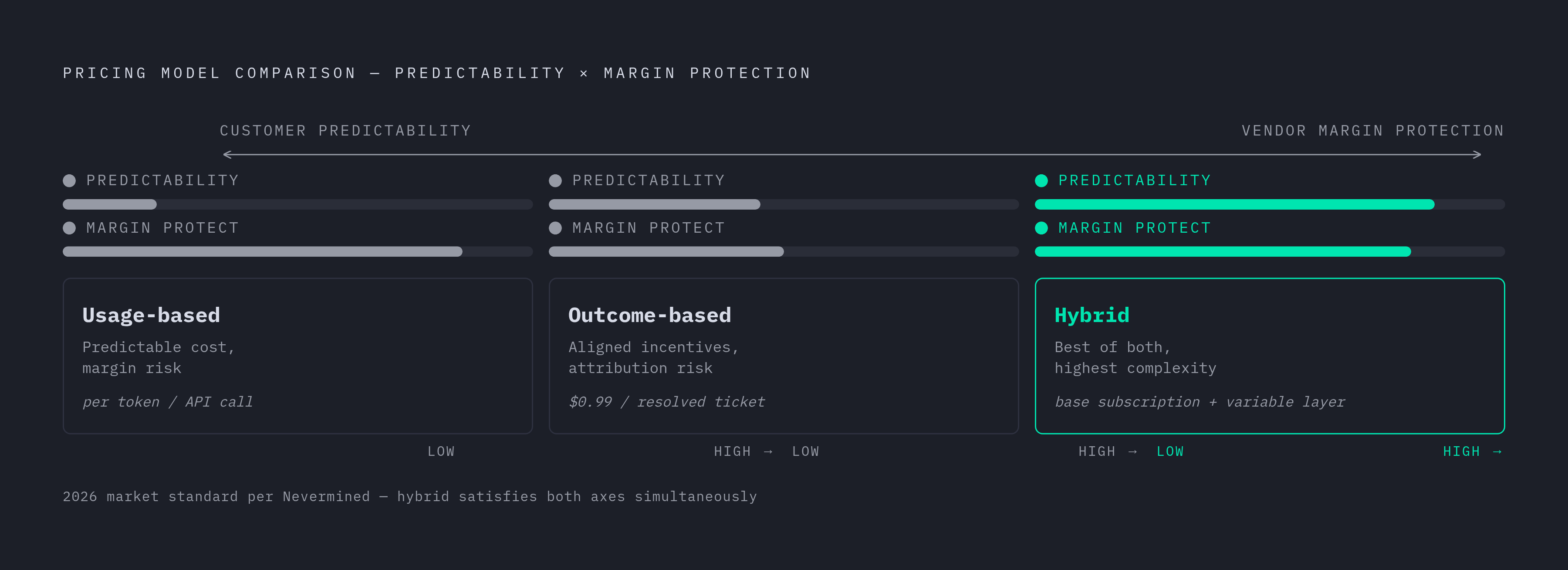
Three pricing models have emerged to replace the seat, and each one trades predictability, trust, or complexity for something else. None of them is free of downsides, so the right choice depends on what a product actually does and who's buying it.
Usage-based pricing charges for what gets consumed: tokens processed, API calls made, tasks completed, compute cycles spent. Nevermined's 2026 billing patterns guide names per-token, per-API-call, and per-GPU-cycle pricing as the basic building blocks for AI agent billing, and you can see the appeal. Cost and revenue move together, so flat pricing's margin erosion mostly disappears. Heavy users pay for being heavy. Light users pay less. Unpredictable bills make budgeting hard for the customer, and a surprise invoice can end a pilot program before it ever gets a second look, especially with buyers who don't think in tokens or API calls for a living. This model works best when the thing being billed is tightly tied to real consumption and the customer is technical enough to reason in those units.
Outcome-based pricing changes what triggers the bill. Instead of charging for the compute an agent burns, it charges only when the agent delivers something specific: a resolved support ticket, a booked meeting, a qualified lead. Intercom Fin charges $0.99 per successful outcome, defined as a resolution or a handoff to a human, and it prices lead qualification separately at a higher rate. HighRadius took the model to its logical extreme at its February 2026 Radiance conference: it announced zero implementation fees and zero subscription costs before go-live, and charges customers only a percentage of the savings the product actually delivers. The trade-off is attribution. Finance teams don't love variable monthly totals either, and when an agent runs for a while and produces nothing billable, vendors eat the cost. It's no accident that customer service adopted outcome pricing first: a ticket is either closed or it isn't, a clean signal that sales and marketing attribution rarely offers.
Hybrid pricing splits the difference. A base subscription gives the customer a predictable floor to budget against and gives the vendor a revenue guarantee, while a usage or outcome layer sits on top to capture the variable part. Nevermined's pay-per-use guide calls hybrid the 2026 market standard, and the reasoning holds up: it's the only one of the three that manages the customer's need for a forecastable number and the vendor's need to track real cost at the same time. The price of that balance is complexity. Hybrid plans take more explaining at the sales table and more engineering to meter and invoice correctly, so the billing infrastructure underneath it becomes as important a decision as the pricing tiers themselves.
Why credit systems bridge usage and outcomes
Credit systems have become the go-to way to implement usage-based pricing without drowning customers in micro-charges. The idea is straightforward: sell prepaid packs of credits, assign a credit cost to each type of action an agent performs, and let customers draw down from that pool as they go. Instead of a bill that lists four thousand sub-cent line items, a customer sees a credit balance dropping at a pace they can watch and understand.
Enterprises are moving the same direction from the top down. Salesforce announced the Agentic Work Unit on February 25, 2026, and it defines one as a discrete task an AI agent accomplishes. Whether it's called a credit or a work unit, the pattern is the same: translate raw, volatile consumption into a denomination a human can actually hold a conversation about.
Outcome-based pricing fits neatly inside this same logic from the backend's point of view. Rather than tracking every token and API call as it happens, the system just records the outcome event, a resolved ticket, a qualified lead, once, then aggregates and bills it later. That's a cleaner integration story than metering raw usage, particularly when one backend already owns both the agent's workflow and the billing engine behind it.
Credits solve the customer-facing half of the problem, the surprise invoice, the incomprehensible token count, the three-decimal-place line items nobody wants to read. Every credit still has to map back to a real infrastructure cost, or the vendor quietly loses margin on expensive operations while overcharging for cheap ones. Getting that mapping right requires building the same real-time metering a vendor would need for raw usage billing. Credits are a customer-facing simplification sitting on top of backend complexity that hasn't gone anywhere.
What the billing infrastructure for agent consumption has to do
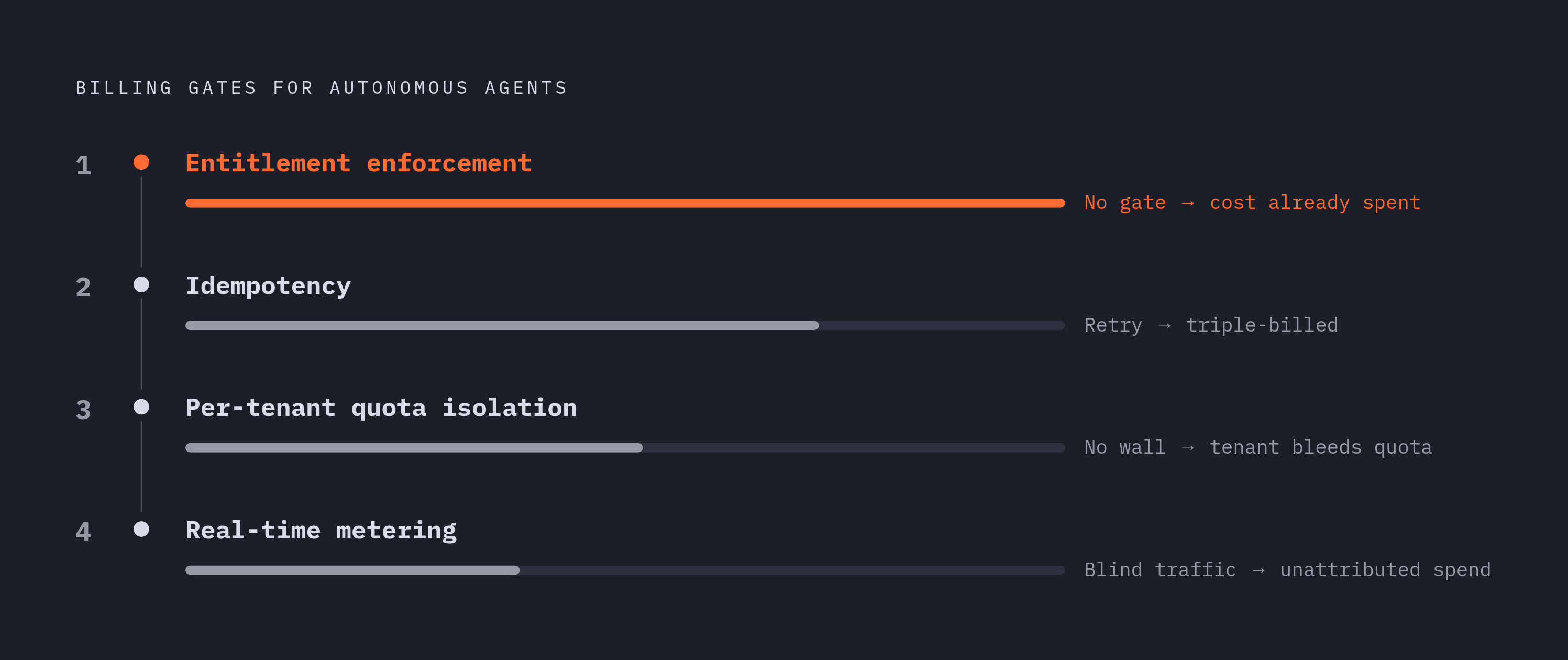
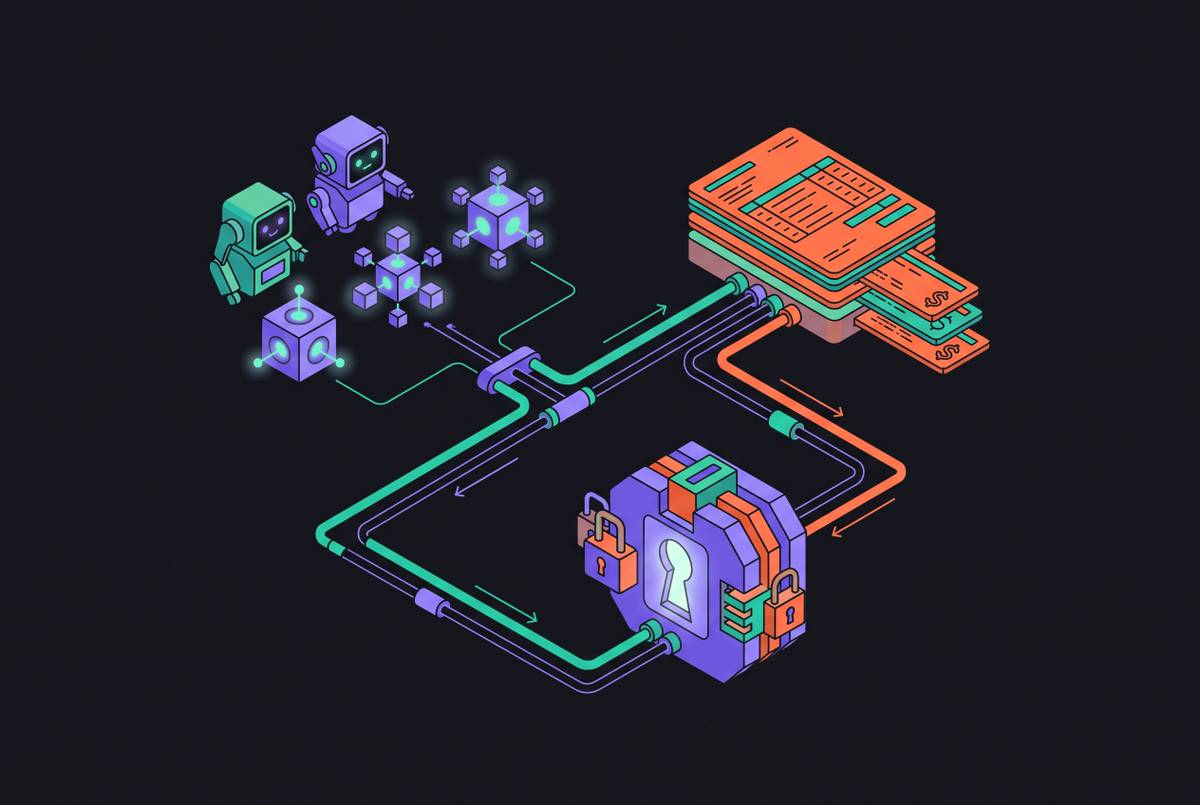
That backend complexity is the real work, and it asks for things traditional SaaS billing never had to build. Billing an autonomous agent rather than a human clicking buttons creates four specific problems: checking entitlement before the agent spends money, preventing duplicate charges from retries, keeping one tenant's runaway agent from starving everyone else, and metering costs that can run below a cent per action.
Entitlement enforcement has to happen before the LLM call goes out, not after. If a check only runs once the API call returns, the cost has already been spent regardless of what the check decides. The fix is the token reservation pattern: the agent claims a budget before it calls the model, that claim reduces the available pool immediately, and a reconciliation step afterward adjusts for the gap between estimated and actual consumption. Build enforcement as a gate before dispatch, not an audit after the fact.
Idempotency is non-negotiable once agents start retrying their own actions. If an agent gets confused and tries to create the same invoice three times, it should generate one billable event, not three. Every action needs a unique idempotency key so the billing system can recognize a repeat attempt and ignore it, a pattern borrowed directly from payments infrastructure and now required for agent billing specifically.
Per-tenant quota isolation matters most when a multi-tenant platform shares one LLM API budget. The fix has to sit before the model gets called, enforced architecturally, not caught later in a dashboard. Treat it as a design requirement, not a monitoring afterthought.
Metering has to run in real time and at real scale. Pure pay-as-you-go without that infrastructure is now the exception rather than the rule, because token, inference, and agent-call costs are inherently usage-based by nature. Tagging traffic by feature, tenant, plan, region, and model lets a team answer basic operational questions, like what's expensive and which tenant is noisy, without bolting on a separate observability system later.
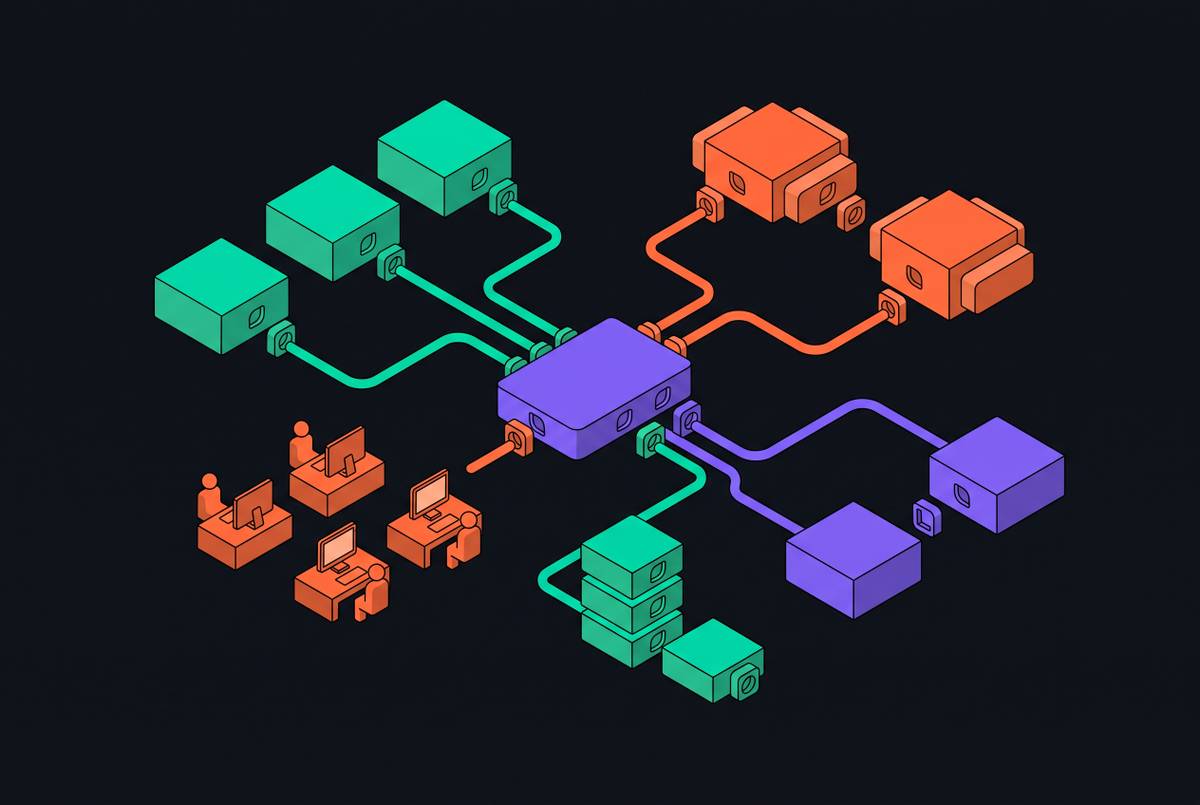
A Tool Gateway between the LLM and raw system APIs handles one more piece of this. Connecting a model directly to production systems hands it credentials and a full API surface it can misuse the moment it hallucinates a bad call. A gateway layer is where both billing and security get enforced at the same time, which makes it less of an add-on and more of a load-bearing wall.
A tightly integrated platform keeps that logic in one place, so changing a tier or redefining an outcome doesn't mean updating three disconnected systems and hoping they stay in sync.
Choosing billing infrastructure: what the platform decision determines
The billing platform a founder picks decides more than how invoices get generated. It decides whether the pricing model can change later without a rebuild, whether tax compliance belongs to the platform or the founder, and whether agent consumption data sits next to customer and revenue data or lives in a separate tool that someone has to remember to check.
Tiun is built specifically for AI and SaaS companies, bringing authentication, payments, a customer database, and AI analytics into one system. Agent consumption data, user identity, and billing all live in the same place instead of needing to be synced across three separate vendors by hand. It supports integrations and command-line-based skill installation, so an AI agent can handle a meaningful chunk of the integration work itself, a practical match for the agent-native billing patterns described above. Because the customer database is unified, the full picture, who signed up, who's paying, how their agents are actually consuming resources, is visible without building a separate data pipeline just to answer that question. Its pricing is transparent: 2.9% per transaction on the Free plan, by Tiun's own published pricing, and its Merchant of Record model removes the stacked cost of running a separate processor, a separate tax tool, and a separate chargeback system side by side. It's a strong fit for indie founders, solo builders, and small engineering teams who want metered billing and MoR coverage without assembling and babysitting four different vendors.
Flexprice takes a different angle, positioning itself as enterprise-grade billing and monetization infrastructure built for AI workloads, with credits, usage metering, and enterprise contract support. Its own 2026 roundup points it at teams that need deep metering capability paired with the kind of contract terms larger enterprise buyers expect. It does not act as Merchant of Record, so tax and chargeback compliance stay the founder's responsibility.
Nevermined sits in a narrower lane: payments infrastructure built specifically for agent-to-agent transactions, with native support for Google's Agent-to-Agent protocol and MCP, and settlement available in both fiat and cryptocurrency. For businesses where agents are transacting directly with other agents rather than with human customers, that's a genuinely different problem than the one most SaaS billing platforms solve.
None of these three are competing to do the same job. The real decision a founder is making is which platform matches the shape of the business: a unified, agent-native backend for teams that want billing, auth, and analytics under one roof, a deep metering engine for enterprise contracts, or dedicated rails for machines paying machines.