Entitlement Enforcement in AI Agent Workflows
An AI agent, doing its job in a real workflow, authenticates into a system, calls an API, writes a record to a database, kicks off a downstream process, and sometimes moves money. It does all of this without a human clicking "approve" at each step. That's the whole premise of entitlement enforcement in agent workflows: the old assumption, built into every SaaS product for the last two decades, is that a human starts every action and the system can check billing or access rules the moment that action is requested. Agents break that assumption the moment they act on their own, unpredictably, and faster than any person could watch.
Traditional SaaS entitlements were built on a tidy three-part structure. Entitlements sit in the middle, deciding who gets to touch what. Agents don't move at human speed.
Prompt controls are the first thing teams reach for, and the first thing that fails. Telling an agent, in its instructions, not to export sensitive data or not to spend above a certain amount reduces the odds of a bad action. It doesn't stop one from happening. A rule written into a prompt is a suggestion the model is statistically likely to follow, not a wall it cannot get through.
Billing checks fail for a different reason: timing. There's no "undo" button in retroactive accounting.
Most systems have microservices each doing their own limit-checking, some against a database, some against a cache, and some not checking at all, and this structural mess sits underneath both failures. Testing and code review catch some of this, but an agent's actual path through a task gets decided at runtime, based on live context, not written down anywhere a reviewer could have read it in advance.
What makes agents structurally different from users
Agents aren't just humans with a faster typing speed. Putting those three into one actor creates something existing governance models were never designed to watch.
There's a clean way to say what separates a model from an agent: a model generates text. An agent authenticates, invokes tools, and changes records in a system that matters, like a CRM or a financial ledger. That's a different category of actor, and it's why a whole separate set of governance expectations has formed around agents specifically, distinct from the ones applied to generative AI outputs.
Identity inheritance makes this worse. When someone invokes an agent, the agent usually runs under its own credentials, not the credentials of the person who triggered it, and sometimes it inherits the full access level of whoever built it. The system worked exactly as configured, and that's the problem: the configuration itself was the leak.
That exposure compounds fast at scale. An agent with broad access and no runtime check can pull, move, or alter data far faster, and the damage can be done long before any monitoring dashboard lights up.
Multi-agent pipelines add another wrinkle: accountability. An orchestrator hands a task to a sub-agent, which calls a tool, which modifies a database. The audit trail doesn't get thin, it disappears.
Unlike a person who logs in, does their work, and logs out, an agent can sit on service account credentials, OAuth tokens, and live system access indefinitely, often well past the point where anyone remembers why it needed that access. A forgotten agent credential just sits there, armed.
The three-layer enforcement architecture that runtime checks require
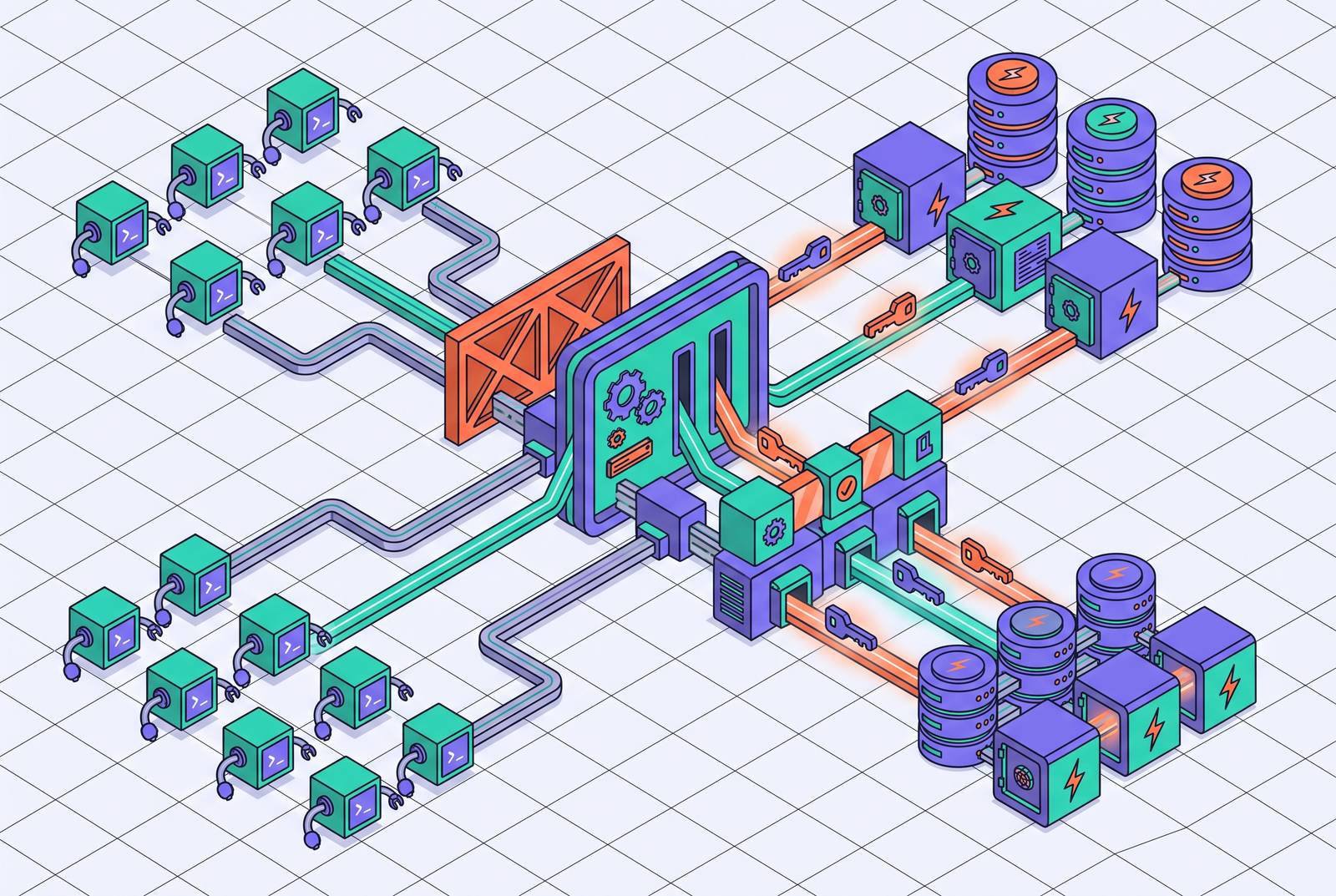
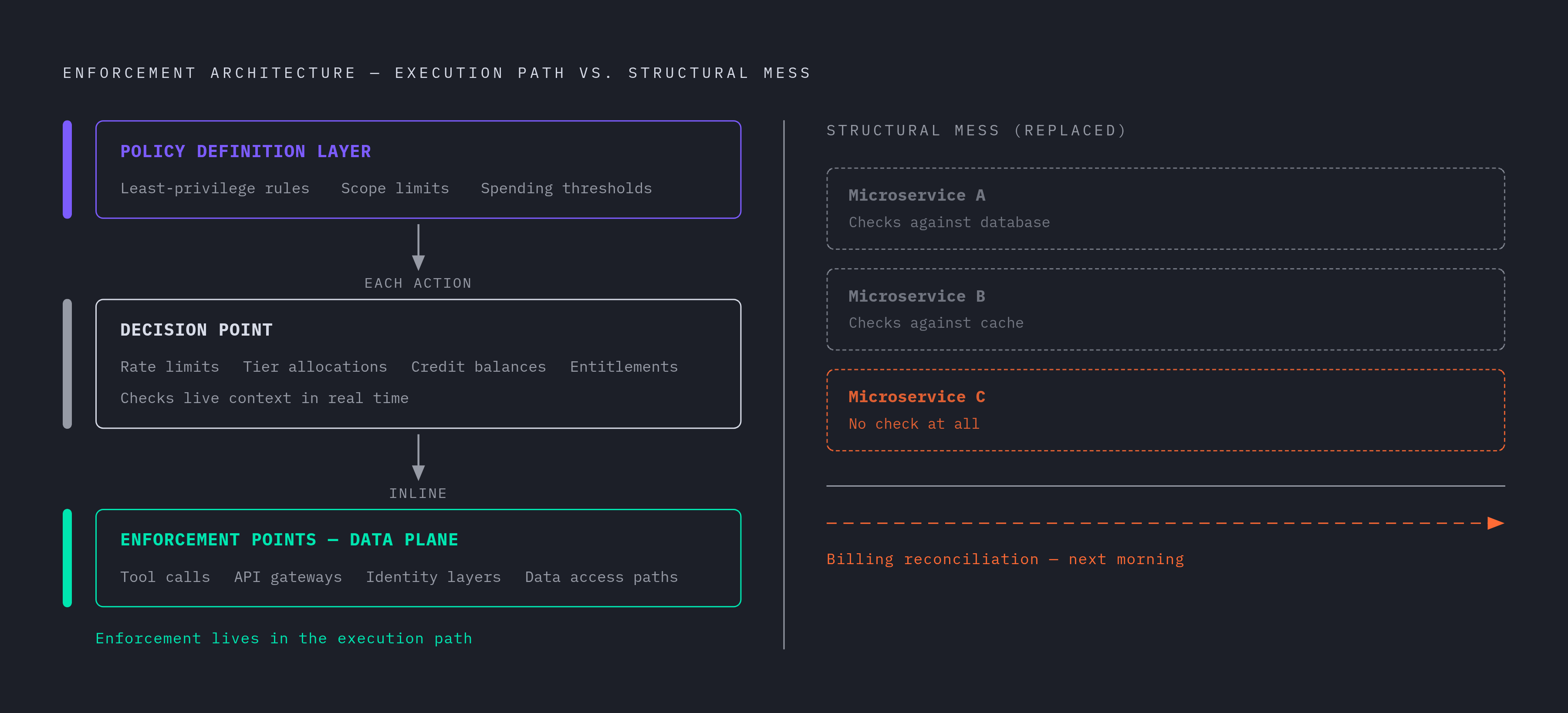
Fixing this requires three separated functions, working together rather than bolted onto each other as afterthoughts: a policy definition layer, a decision point that checks each action against live context, and enforcement points built directly into the path where actions actually happen.
The policy definition layer is where intent gets written down in a form a machine can act on, not a form a model can be talked out of. Least-privilege rules, scope limits, spending thresholds: all of it belongs in machine-readable policy, not in an agent's prompt. A prompt can be bypassed through prompt injection. A policy enforced outside the model's own reasoning cannot be talked into ignoring itself.
The enforcement points, the data plane, are the inline interceptors sitting at tool calls, API gateways, identity layers, and data access paths that actually carry out the verdict the decision point handed down. The enforcement lives in the execution path itself, not in a billing reconciliation job and not in someone reviewing logs the next morning.
One useful way to think about how this holds together across a whole system: every request passes through a single evaluation path that checks rate limits, tier allocations, credit balances, and entitlements in sequence, rather than leaving each microservice to improvise its own checks. And building resource consumption directly into that same evaluation path, instead of reconciling it later in a separate billing system, is what lets enforcement keep up with an agent that moves faster than any human review cycle. Auditability and real-time enforcement aren't a tradeoff. Building the architecture right gets a system both.
Tiered gates and agent identity as the two operational mechanisms inside that architecture
Two mechanisms do most of the heavy lifting inside that three-layer structure: a tiered gate system that matches the amount of oversight to how much damage an action could cause, and a per-agent identity record that makes every action traceable back to something specific and revocable.
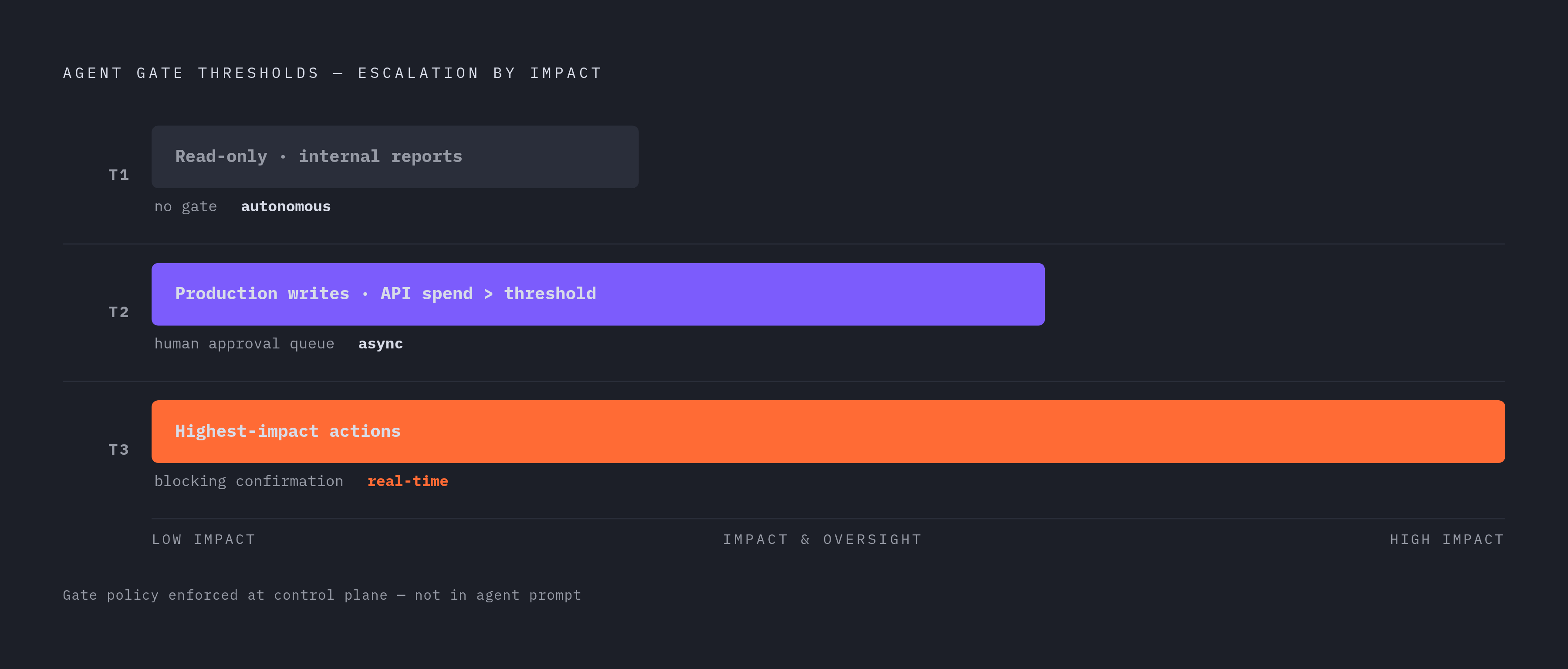
The tiered gate structure breaks down by impact. Tier 1 covers read-only queries and internal reporting: these run on their own, no interruption needed. Tier 2 covers writes to production data and external API calls above a cost threshold someone has defined in advance: these need a human to approve them asynchronously, within a set time window, before they go through. These need a human to confirm them in real time, before the action fires.
The gate thresholds have to live in machine-readable policy at the enforcement layer, not inside the agent's prompt. A threshold written into a prompt can be bypassed by a prompt injection attack. A threshold enforced at the control plane cannot be talked around, because the agent's own reasoning never gets a vote on whether the rule applies.
Each agent also needs its own identity. Each agent needs its own identity record, not a repurposed service account, not a copy of whoever invoked it. That's what makes it possible to inspect, revoke, or audit one agent without touching the rest of the fleet. Teams running a mix of tools across different vendors still need to build equivalent identity isolation themselves, because the blueprint approach doesn't travel outside its own ecosystem on its own.
Multi-agent pipelines need this treatment at every link in the chain: each agent gets its own identity, its own scope, and its own slice of the audit trail, and the orchestrator needs its own policy checks so one agent can't delegate a sub-agent into territory it was never authorized to enter. Where possible, actions should carry delegated user context, tying each step back to the person or organization that actually set it in motion. A timestamp and an actor name, the old human-era log format, doesn't come close to covering a multi-step agent workflow.
Where runtime enforcement stands in production today
The gap between the architecture described above and what's actually shipping in production today is wide, and most organizations are currently operating inside that gap.
Runtime enforcement in the strict sense, an action blocked as it's attempted, exists in production for a narrow slice of platforms. For most enterprise agent tools right now, the honest posture is discover-and-govern: find out what agents are doing, build visibility, and treat full runtime enforcement as something on the roadmap.
Some recent moves show where things are headed. Auth0's "Auth for MCP" went generally available on May 6, 2026, and Okta shipped its own MCP server as a secure protocol abstraction layer, enforcing least-privilege access at each tool call. Neither one is a full entitlement lifecycle system on its own.
AWS open-sourced Dogwood on August 6, 2026, a temporal policy language built into Bedrock AgentCore that checks whether a whole sequence of agent actions holds up against policy. That's a meaningful step toward enforcing an agent's entire path, not just its individual moves.
ServiceNow expanded its AI Control Tower in May 2026, adding five risk frameworks aligned to NIST and EU AI Act standards, useful for governance posture and reporting. Teams working in financial services or insurance, where decision evidence is a legal requirement, still need to build a custom decision execution layer of their own, because a framework for governance posture isn't the same thing as a decision engine.
Google added granular, resource-level IAM permissions for individual Gemini Enterprise apps and data stores on September 28, 2026, letting admins lock down access without handing out project-wide rights. That strengthens infrastructure access control. It is not, on its own, a policy engine built for regulated decisions.
The pace of deployment means the gap is worth taking seriously. A large majority of technical teams have already moved past the planning stage and are testing or running agents in production, while only a small fraction of organizations have full IT and security approval across their entire agent fleet. Teams are shipping autonomous execution before they can answer the basic audit questions a regulator or a customer might ask tomorrow.
Legal exposure from the EU AI Act and GDPR when runtime enforcement is missing
Missing runtime enforcement is a compliance problem, not just an engineering gap, because the EU AI Act and GDPR both attach legal obligations to what an agent actually does while it's running, not to how someone configured it ahead of time. A system without runtime enforcement cannot produce the evidence these laws expect a provider or deployer to have on hand, because that evidence can only come from watching actions as they happen.
The EU AI Act's enforcement powers became active on August 2, 2026. The Act reaches any provider placing an AI system on the EU market, no matter where that provider is headquartered.
Spain's data protection authority, the AEPD, issued guidance that addresses automated processing by AI agents directly, making clear that data minimization and purpose limitation apply at every step of an agent's decision chain, not just at the human-written prompt that kicked things off.
Most teams building with AI agents aren't the ones training the underlying model. Buyers in regulated industries have gotten sharp about spotting that distinction.
Usage-based billing and the shift away from per-seat pricing as a product architecture requirement for runtime enforcement
Pricing has quietly caught up to the same problem security teams are wrestling with. Per-seat pricing treats entitlements as a static gate, checked once when someone buys a seat. Usage-based pricing turns entitlements into a live accounting problem, and a billing system that reconciles usage after the fact can't solve a problem that needs to be solved in the moment.
Separate them, and the two drift apart the moment an agent starts acting faster than any dashboard can refresh.
When an agent is making decisions and taking actions on its own, a billing system that checks usage after the fact can only report that a limit got blown through. It can only report the breach after it happens. For agent workflows, metering and enforcement need to live in the same execution path, not split into a usage log on one side and a billing run on the other, hours or days later.
That has a direct consequence for how products get built. Any feature priced on usage, where an agent is the one doing the consuming, needs an entitlement layer that knows in real time how much of a limit is left, can throttle or block right at that threshold, and writes down that decision as it happens. A platform that treats authentication, entitlement checks, usage metering, and billing as one connected system, rather than a pile of services stitched together with webhooks, has a real structural advantage here. The policy, the decision, and the record all sit on the same data model instead of needing to be kept in sync across five different tools that were never built to talk to each other.
A production-ready entitlement enforcement posture for teams building AI products today
None of this gets solved by buying one product off a shelf. A production-ready posture is a set of architectural choices, made in roughly the right order, starting with what a team can put in place now and building toward full runtime enforcement as the agent fleet grows.
Start with agent inventory as a real, documented control. There's no enforcing entitlements for agents nobody has written down. Auditors increasingly want proof of what an agent actually did inside a connected system, not a screenshot of a settings page.
Write entitlement thresholds and gate logic into machine-readable policy at the control plane, never into a prompt. A rule in a prompt lowers the odds of something going wrong. A rule enforced at the control plane stops it from happening, and it survives prompt injection attempts that would walk straight through a prompt-level instruction.
The standard to build toward is unique agent identity, task-scoped authorization, runtime policy enforcement, human accountability, immutable audit trails, and scope isolation across multi-agent workflows. Each piece is a design decision made ahead of time, and each one costs more to bolt on later than it does to build in from the start. Governance for autonomous agents belongs in the same category as reliability and security: infrastructure, not paperwork. Organizations that treat it that way build it early. The ones that treat it as something to satisfy an auditor pay for it twice, once to build the product and again to rebuild the parts they skipped.