Agent Orchestration Without Vendor Lock-In for Small SaaS Teams
Build agent systems on open protocols to survive vendor price hikes and API deprecations.
A pricing change from an orchestration vendor is an inconvenience for a company with a platform team. For a small SaaS team, it can break the product. This piece is about why that gap exists, and how to build agent orchestration so it never turns into an emergency.
Why small SaaS teams face a different lock-in problem
Picture a five-person SaaS team that built its entire support-agent workflow on one orchestration vendor. The vendor raises prices substantially overnight, or worse, deprecates the API the whole product runs on. A large company absorbs that with a phone call to its account rep and a migration plan staffed by people whose whole job is exactly this. A five-person team absorbs it with a weekend, a lot of coffee, and a prayer.
Big organizations like EY and Salesforce run agent orchestration with dedicated governance architecture and control planes built for exactly this kind of disruption, while a small team faces the same disruption with none of that leverage. They can negotiate contract terms, ask for SLA carve-outs, and run two environments side by side while they migrate. A small team has none of that leverage and none of that spare capacity. There's no platform team standing by to absorb a vendor's bad quarter. There's just the product, the founders, and whatever architecture decisions got made back when nobody thought they mattered yet.
That's also why this has to get solved early, at the architecture level, instead of late, during a crisis. The category itself has moved fast enough to make this urgent. What counted as prototype territory from 2023 through 2025 is turning into production infrastructure in 2026, even though plenty of agentic projects still stall somewhere between pilot and production. As the ecosystem matures, it also consolidates. Pricing and deprecation decisions increasingly get made at cloud-provider scale, not startup scale. Small teams are riding on infrastructure decisions made by companies that will never know they exist.
How the framework-vs-platform choice encodes a lock-in decision
Every team that starts building agent orchestration makes a decision early, whether or not anyone calls a meeting about it: framework, or platform. That one choice sets the lock-in terms for everything built after it.
Developer frameworks, things like LangGraph, CrewAI, the OpenAI Agents SDK, AutoGen (also known as AG2), SmolAgents, Pydantic AI, and the Strands Agents SDK, put engineering teams directly in charge of the orchestration logic. The team owns deployment. That ownership is extra work up front, but it also means any single layer can be swapped out later without asking anyone's permission.
Managed cloud platforms work differently. Azure AI Foundry Agent Service (now folded into the Microsoft Foundry brand), AWS Bedrock AgentCore, and Google's Gemini Enterprise Agent Platform (the product formerly known as Vertex AI Agent Builder) take care of the infrastructure for you. The dependency deepens later, as the team grows more reliant on one cloud provider, with tighter coupling at both the runtime layer and the billing layer.
Some of these platforms tie the knot tighter than others. n8n sits in the middle, a workflow-style platform with self-hosting available, useful for teams that want a visual builder without signing their whole stack over to one cloud.
None of this is a ranking. It's a spectrum, and every team sits somewhere on it whether they picked a spot on purpose or not. The thing to remember is that agentic workloads burn through token costs faster than almost any other compute pattern in software. The pricing exposure from a platform decision doesn't wait for scale; it appears early.
What MCP and A2A do to the lock-in calculus
Open protocols are what actually make any vendor replaceable, because they separate the interface a team builds against from whatever happens to be running behind it. Two protocols matter most here: the Model Context Protocol (MCP) and the Agent-to-Agent protocol (A2A).
MCP standardizes how an agent finds and calls a tool. It's the universal connector between agent and tool. Write a tool integration once against MCP, and it keeps working no matter which orchestration runtime or model sits underneath it later. That cuts integration costs and takes a serious bite out of vendor lock-in, because the tool-calling logic doesn't have to be rewritten every time the underlying engine changes.
A2A does something different: it standardizes how agents talk to each other. MCP is the agent-to-tool layer. A2A is the agent-to-agent layer. They solve different problems, and a team needs both answered, not just one.
Both protocols are now Linux Foundation standards, which addresses the obvious worry: what happens if the standard itself ends up controlled by whichever vendor benefits most? The Agentic AI Foundation, launched in December 2025 with OpenAI, Anthropic, and Block as co-founders, and with Google, Microsoft, AWS, Bloomberg, and Cloudflare backing it as supporting members, exists to keep governance spread across competitors instead of concentrated in one company's roadmap.
For a small team evaluating orchestration tools, MCP support has become one of the cleanest early filters available. A tool with real, native MCP support and a working connector ecosystem has production portability built in. A tool that just talks about openness in its marketing copy does not. The practical test is simple: if swapping the underlying model or runtime means rewriting tool-calling and routing schemas, lock-in has already been accepted at the wrong layer. MCP-native tool definitions are built to survive exactly that kind of swap.
Three orchestration patterns and their exit options for small teams
Protocols are only half the story. How a team wires agents together matters just as much as which tools it picks, and the pattern should get chosen before the platform does, not after.
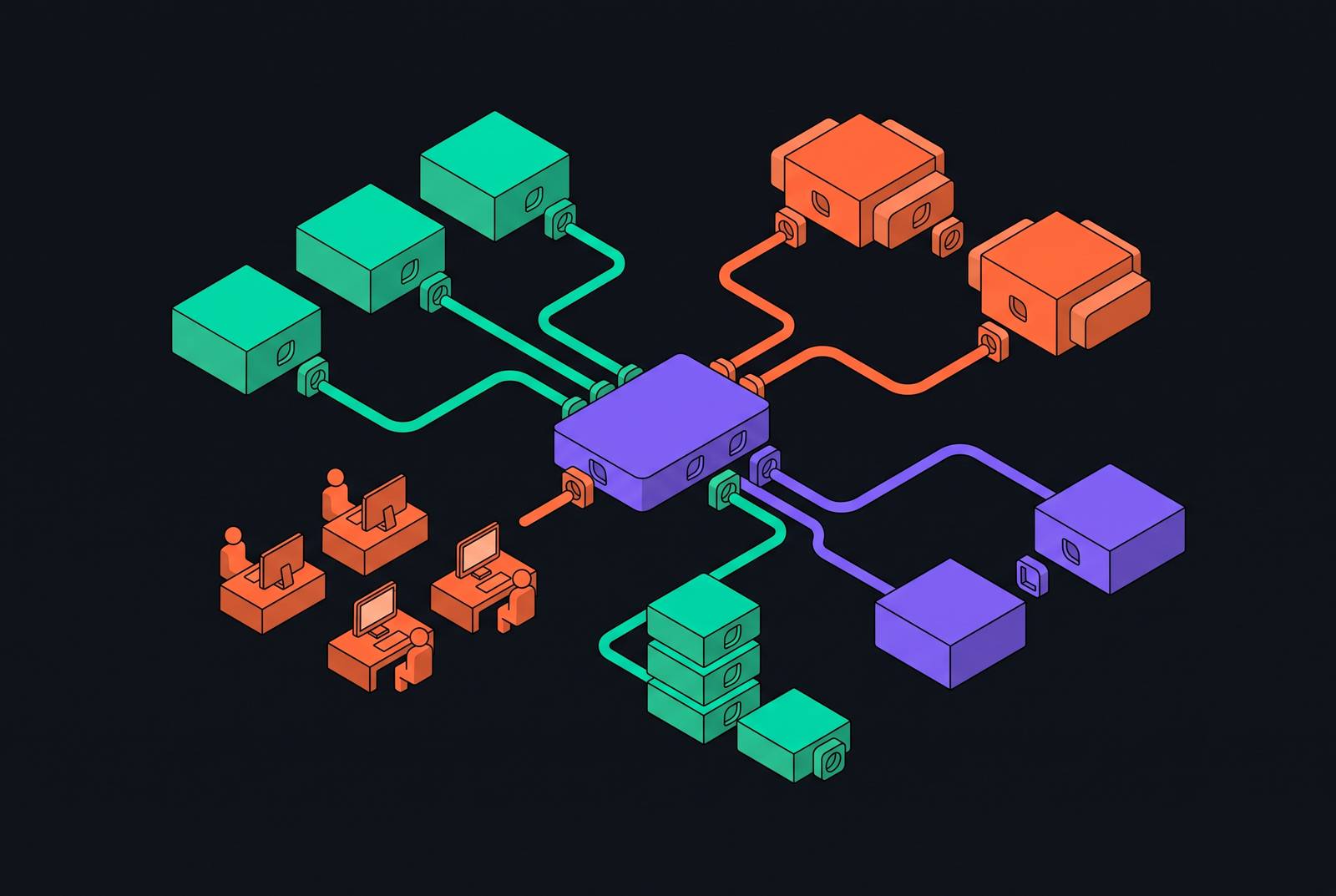
Sequential pipelines, hierarchical delegation, and swarm (or parallel fan-out) orchestration are the three patterns seen constantly in production systems. Each has a different lock-in profile.
Sequential orchestration is the simplest: Agent A's output feeds directly into Agent B, like an assembly line processing a document from intake to summary to filing. It's also the easiest to migrate. Each agent is a self-contained unit with a clean interface, so replacing one agent with a different vendor's version only requires that the interface contract, ideally MCP, gets honored on both sides.
Hierarchical orchestration puts a supervisor agent in charge of routing tasks to specialist agents below it, the pattern behind most customer-facing support bots handling triage and resolution. It works well, but it's also where platform lock-in tends to pile up, because the supervisor's routing logic often gets written in a platform-specific scripting language that doesn't travel. Keep the supervisor thin and keep the specialist agents MCP-native, and replaceability survives even though the pattern itself is more complex than a straight pipeline.
Swarm orchestration lets peer agents share state and pass control between each other based on capability, useful for research tasks and long-horizon jobs that don't follow a fixed script. It's the most flexible pattern and also the hardest to govern. For most small teams, the operational overhead of running a swarm outweighs what it buys them, and the shared state layer becomes a second lock-in point all its own if that state lives inside one platform's proprietary memory store.
Sequential and hierarchical patterns, with a thin and protocol-native supervisor, give small teams the best mix of something that actually works in production and something they can walk away from if they need to.
Governance and cost containment as non-optional constraints for lean teams
Governance sounds like a word for compliance teams at big companies. For a small team running agents, it's really a budget alarm. One runaway task, looping on a bad prompt or retrying an API call that keeps failing, can burn through an API budget fast enough to threaten the whole month's operating costs for the product. A two-person team doesn't need a governance program. It needs a few hard rules that stop the bleeding before it starts.
Every agent needs clear limits defined before it ever goes live: what inputs it accepts, what outputs it's allowed to produce, and what actions it's allowed to take. A research agent should never be allowed to execute code. A coding agent should never be allowed to touch financial data. These boundaries have to be enforced at the orchestration layer itself, not assumed because the underlying model is "supposed" to behave.
Observability is left for the team to build on its own by most framework-level tools. A system trusted in production includes tracing, some kind of evaluation harness, and the ability to reconstruct, after the fact, exactly which agent did what, with what context, and why. Without that, debugging a multi-agent failure turns into expensive guesswork, which a small team can't afford twice.
Idempotent operations and retry logic matter just as much as the guardrails. The fixes that matter most for a lean team are small and automatable: cost caps set per task, per agent, and per day; validation on structured output before any write action goes through; and audit logs that trace every decision straight back to the inputs that caused it.
Model-agnosticism as the second architectural primitive that prevents lock-in
A team can do everything right at the protocol layer, build on MCP, build on A2A, and still end up boxed in if the agent architecture assumes one specific model's tool-calling format, structured output style, or context window behavior. The model layer is its own lock-in surface, separate from the orchestration layer, and it needs its own fix.
Model-agnosticism means the platform can swap large language models in and out without rewriting the tool-calling and routing schemas underneath them. A model that's cheap and fast this quarter might get repriced or deprecated by the next one.
The practical fix is a single integration point that talks to multiple model providers, instead of a separate SDK wired in for each one. Without it, that same event turns into a rebuild.
Multi-LLM support has stopped being a nice differentiator on an orchestration tool's feature list and become a baseline requirement. But the complexity of maintaining separate, model-specific tool schemas across every provider compounds faster than the one-time cost of a shared abstraction layer.
How backend fragmentation creates a second class of lock-in
A perfectly portable orchestration layer doesn't help much if the business infrastructure underneath it, identity, billing, analytics, customer data, is a pile of separate tools that break in different ways when one of them changes its pricing or kills a webhook without warning, because that fragility is the real source of lock-in.
Agents that operate across all three inherit every bit of that fragility, because an agent doesn't care which tool is supposed to own which fact. It just needs the fact to be correct.
Identity is the clearest example. The cleanest model separates the user from the tenant and connects the two through a membership record that defines permissions. When auth lives in one tool, billing lives in another, and analytics lives in a third, a single usage event (say, a customer crossing a usage threshold that should trigger both a billing action and an update to their account record) now has to stay synchronized across three separate systems. That kind of synchronization is fragile by design, not by accident.
Session design should match the risk of the action being taken: reading a dashboard is not the same risk as exporting a customer database or generating a new API key. Enforcing that consistently is close to impossible when session data lives in one tool and the permission rules that should govern it live in another. And audit-grade identity logs, the kind that record time, actor, tenant, target, event type, IP address, user agent, identity provider, and outcome, only work as a trust mechanism when identity data and activity data share one source of truth instead of three.
A unified backend, where user records, transactions, and sessions all live in the same place, is the foundation that makes agent-driven workflows debuggable and trustworthy. Without it, a team can have the most portable orchestration layer in the world and still be one webhook failure away from a very bad day.
Usage-based billing and the Merchant of Record model as lock-in considerations at the revenue layer
Hybrid pricing, a base subscription plus usage-based charges on top, has become close to the default model for AI-native SaaS products. It's also a lot more complicated to bill for than a flat monthly fee. Customers show up from different countries, paying in different currencies, taxed at rates that shift depending on the transaction amount and where the customer happens to be sitting. That complexity lands squarely on the billing layer.
Fee transparency matters more here than it might seem at first glance. Opaque pricing stacks, where platform fees, transaction fees, currency conversion, and tax remittance all get billed as separate line items, make it genuinely hard to know what revenue actually costs until the invoice lands. A team should be able to look at a pricing page and know the real number, not reconstruct it after the fact from five different charges.
It's tempting for a small team to put off thinking about any of this until they land their first international customer. That timeline doesn't hold for usage-based AI products, because they tend to attract users from other countries starting on day one, and the compliance exposure appears earlier than a traditional subscription business would ever expect.
GDPR and data residency as structural requirements for agent infrastructure, not compliance checkbox items
By 2026, GDPR compliance for agent systems means something more specific than it used to. A team needs to know which entity holds data at every single step of an agent workflow, which features count as cross-border processing, and what the plan is if a data protection agreement falls through. That standard doesn't sit comfortably with agent infrastructure scattered across a half-dozen US-hosted point solutions, each holding a different slice of the same customer's data, each with its own answer to where that data actually lives.