Connecting AI Agents to Billing and Entitlement Systems
AI agents need identity, entitlements, and metering unified in one system, not bolted together.
Seat-based and subscription billing is structurally incompatible with how agents create cost and value in the first place. A human clicking "upgrade" is a single, predictable event. AI agents operate probabilistically: a single request might trigger multiple LLM calls, tool invocations, external API requests, and a multi-step workflow whose actual compute cost can swing by orders of magnitude depending on how the reasoning unfolds.
That swing isn't a rounding error you can average out across a customer base. The Flexprice analysis lays out the mechanism cleanly: two customers on the exact same plan can generate wildly different agent usage, one firing off tens of requests a day, another running tens of thousands. Charge both of them the same flat rate, and you're not pricing fairly. You're quietly funding your heaviest users out of your own margins.
The obvious comeback is "fine, just add usage-based billing on top of what you already have." That's what most of the industry tried throughout 2024 and nearly all of 2025. It did not go the way anyone hoped, and the next section walks through why.
The "bolt usage metering onto existing infrastructure" experiment
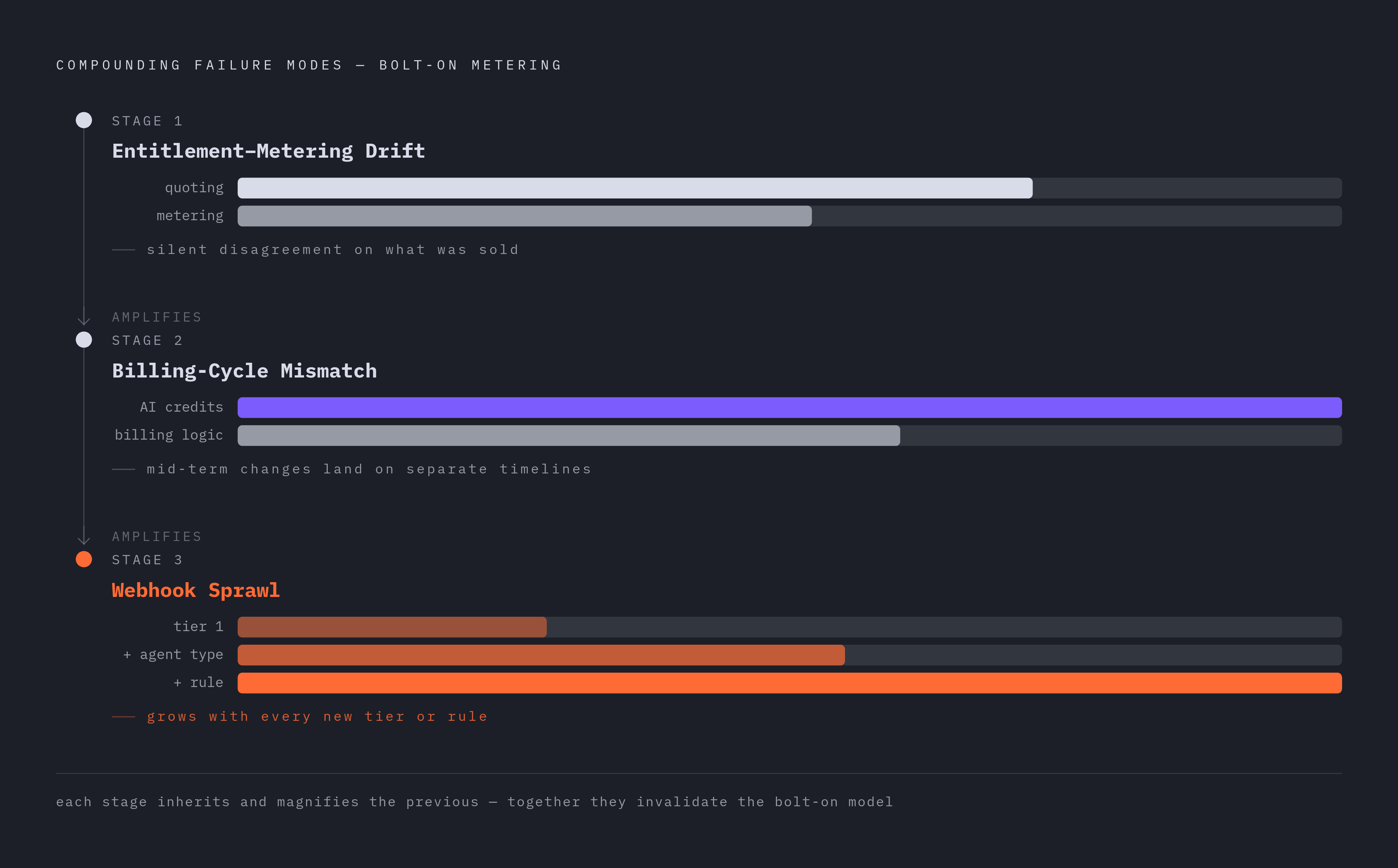
Grafting a metering layer onto subscription plumbing wasn't a bad idea so much as an incomplete one, and it exposed three failure modes that stacked on top of each other instead of canceling out.
The first came from keeping entitlements and metering in separate systems, stitched together through integrations instead of sharing one definition of the deal. A quote sets what a customer is entitled to, but if that entitlement lives in one tool while metering runs in another, the two can quietly drift apart, and nothing flags it when they do. Slow, human-paced consumption used to give someone time to spot drift and fix it before it mattered. Continuous agent consumption removes that cushion entirely, so a disagreement between quoting and metering logic turns into a customer being billed against the wrong tier, or against a credit allocation that expired three days ago.
The second failure mode sits in the billing cycle itself. Traditional billing logic assumes a seat count and a fixed term, a predictable invoice date, a renewal you can circle on a calendar. AI credits don't wait for any of that. They burn continuously, around the clock, with no regard for when finance happens to be closing the books. Worse, mid-term changes like a customer buying more credits or jumping to a new tier have to hit entitlement and metering at the same instant. If those two update on separate timelines, even by a few minutes, the pricing a customer is actually being charged starts drifting from the pricing they agreed to.
The third failure mode is the quiet one: webhook sprawl. Keeping billing, auth, and database systems in sync across a disconnected stack requires a growing web of webhooks, each one needing to stay stable while the systems around it keep changing independently. None of that is a one-time setup cost. It compounds every time the product adds a pricing tier, a new agent type, or a new entitlement rule, until engineering teams are spending more time babysitting synchronization logic than building anything customers actually see.
Put those three together: identity, entitlements, and metering were never built as parts of the same system to begin with. They were three separate systems wearing a trench coat and pretending to be one.
Identity as the unsolved foundation underneath every other billing problem
Every entitlement check and every metering decision in an agentic system rests on one question asked first: what entity actually made this request. Most billing stacks can't answer that reliably, and that single gap undermines everything built on top of it.
The common shortcut treats an agent as a kind of shadow of the human who created it, inheriting that person's session token and whatever entitlements come with their plan. It's a reasonable-sounding shortcut, and it breaks almost immediately. Budget caps and access controls scoped to a human account cannot be meaningfully applied to an agent that may fan out into dozens of parallel sub-tasks, each hitting different APIs with different cost profiles. The cap was built for one person doing one thing at a time.
The billing stack has to start, literally, at the identity layer: what human, agent, service account, or key made this request. Without a clear answer, neither metering nor entitlement enforcement has anything solid to anchor to. Traditional auth was built around human sessions, a person logs in, holds a session, and that session expires when they walk away. Machine identity, service accounts, agent tokens, delegated credentials, has mostly been handled through patchwork: custom service tokens here, a separate authorization mechanism there, M2M flows bolted onto infrastructure that was designed for people, not programs.
This gap isn't new. Auth0 built a client-credentials grant and a scoped machine-to-machine application model specifically because service-to-service authorization needed its own primitives long before anyone was talking about autonomous agents. The same logic now applies one level up: an agent needs a scoped token to call an API, the same way one backend service has always needed a scoped token to call another. It gets more pointed once agents start paying each other. The Nevermined billing architecture guide points out that agent-to-agent payments need infrastructure built for the job, because traditional payment processors were never built to handle autonomous transactions. An agent paying another agent for a sub-task is a real transaction. There's no human session anywhere nearby to anchor it to.
The architecture has to treat agent identity as its own first-class thing, with its own scoped entitlements, its own budget caps, and its own audit trail, as a property of the agent itself rather than whichever human happened to spin it up. Solve that, and entitlements stop being a guessing game.
What a correctly designed entitlement layer looks like with agents as first-class actors
Once identity is solid, the entitlement layer can do its actual job: deciding what an agent is allowed to do, how much of it, and under what conditions, and enforcing that decision the moment the agent tries to act, not in a report generated the next morning.
A well-built entitlement layer needs to support three distinct permission types:
- Boolean permissions: this agent can access this capability, or it can't, full stop.
- Metered permissions: this agent can consume up to N units of a resource before it hits a rate limit or starts accruing overage charges.
- Trait-based permissions: access conditioned on properties of the agent, the customer's plan, or the request itself, so a higher-tier customer's agent might get routed to a more capable model while a lower-tier one doesn't.
Every one of those entitlements should map to something billable. Do that, and pricing stops being a renegotiation of the entire backend every time someone wants to test a new package or tier. Per-customer and per-agent overrides matter for the same reason: a single plan-level entitlement definition falls apart the moment an enterprise customer negotiates a custom cap or a custom credit allocation, which happens constantly.
DealHub's analysis of disconnected quoting and billing argues for the fix running in the opposite direction from "just integrate the two systems better." The real fix is tighter: run metering, entitlements, and invoicing on the same governed logic that produced the original quote, so there is exactly one definition of what was sold, enforced the same way across every single unit consumed. A plan change that updates entitlements a full day after billing already metered usage at the old tier isn't some rare edge case worth shrugging off. In a continuous-consumption model, that's the default behavior unless the system is built to prevent it.
Metering for high-frequency, sub-cent, probabilistic agent actions
Metering agentic workloads requires catching every event individually, keeping all of it, and enforcing limits in real time. Pre-aggregating events or reconciling usage in batches both introduce errors, and at agent scale those errors stop being rounding noise and start being structural.
Every billable action, an LLM call, a tool invocation, a database query, an API hit, needs to emit its own usage event. At minimum that event needs an idempotency key to prevent double-counting, a customer identifier, and a timestamp, with the event name, quantity consumed, and agent ID recommended as additional properties for agentic workloads specifically. That sounds like plumbing detail, and it is, but it's the plumbing that lets an invoice survive a dispute six weeks later.
A single agent session can trigger hundreds of tiny actions, each one costing a fraction of a cent. Traditional invoicing was never built for that kind of volume or granularity, and pre-aggregating those events before storing them destroys the audit trail a customer dispute or billing correction would need later. Keeping usage events at full individual granularity instead of collapsing them early means invoices can be corrected after the fact, backdated when something was wrong, and pricing changes can be tested against real historical usage before anyone commits to them.
Traffic also needs to be tagged at the moment it's captured, with feature, tenant, plan, region, and model attached right then, not stitched on later through some enrichment job. Reconstructing cost attribution after the fact is slower and riskier than capturing it correctly the first time. Real-time enforcement matters for a related reason: a metering system that only checks usage after the fact can't stop an autonomous agent from running up thousands of actions before anyone reviews anything. By the time a human looks at a dashboard, the damage (or the bill) is already done. Tamper-proof, append-only logging on top of all this is what lets an enterprise buyer actually trust the number on their invoice wasn't quietly rewritten after the fact.
What you choose to meter and how you choose to price it turn out to be the same decision. The Salesforce AWU framing, which defines one Agentic Work Unit as "one discrete task accomplished by an AI agent," shifts metering away from raw token counts, how much an AI talked, toward a measure of business execution, what work actually got done. That's a decision about what the metering layer needs to capture in the first place, because you cannot bill for completed work if your system was only ever built to count tokens.
Intercom's Fin, priced at $0.99 per successfully resolved ticket, illustrates outcome-based billing: the metering layer must determine not just that a conversation occurred but that a defined success condition was met. Counting conversations is easy. Judging whether one actually resolved something is the harder, more valuable thing the metering layer has to do.
Why the credit and prepay layer exists
Credits exist to solve a communication problem, not an engineering one. Sub-cent charges for every individual agent action are meaningless to a customer and a nightmare to itemize on an invoice. Credits take that mess and turn it into a number a finance team can actually read, with a visible burn rate and something resembling predictable spend.
Credits also do something seat licenses structurally can't: they let a customer move spend around. Credits can shift across users, departments, or different agent types without anyone renegotiating a license, which matters a lot once an organization is running more than one kind of agent at a time. But none of that works unless the credit ledger reflects consumption in real time. A ledger that only updates once a billing cycle is a deferred invoice wearing a credit costume for continuous agent workloads. It's a deferred invoice wearing a credit costume.
The failure mode here is the same one from the bolt-on experiment earlier, just wearing a different outfit. If the credit ledger lives apart from the metering system, balance and actual usage drift apart. The customer sees a number that's stale. Their agent keeps consuming against an entitlement that's already been used up. Invoice reconciliation is where the drift raises a number nobody can explain.
A mid-term credit purchase has to update the entitlement record and the metering cap at the same moment. If those two updates happen on different timelines, even briefly, the credit system enforces the wrong thing. Capacity packs, prepay credits, and overage billing are variants of one entitlement primitive. Separate those, even slightly, and the credit layer reproduces the same governance gap that sank the original bolt-on experiment, just with a friendlier number on the invoice.
What a unified backend looks like
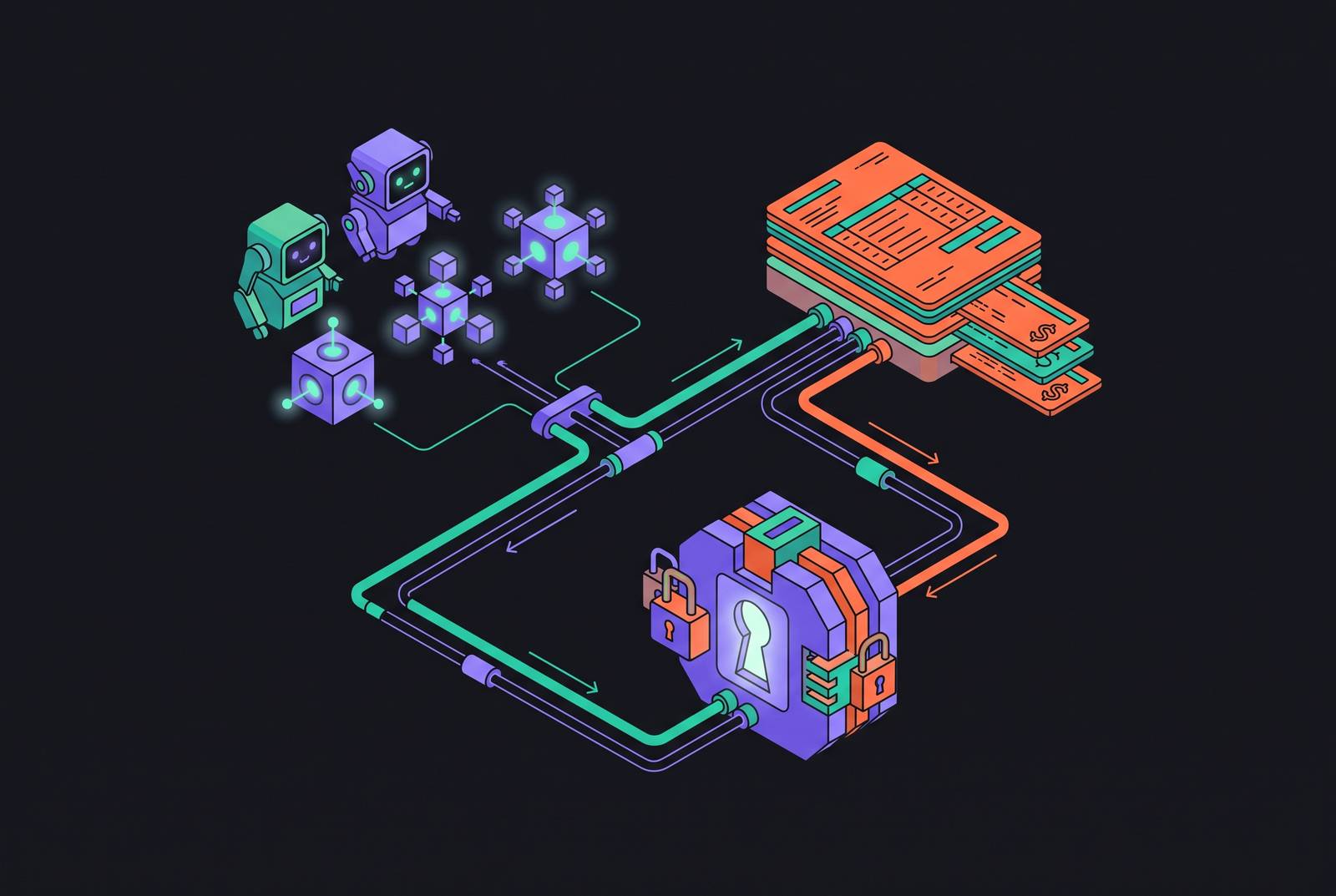
Every argument in this piece points toward the same structural answer: identity, entitlements, metering, and credits can't be separate systems introduced to each other through webhooks and good intentions. They need to be one system, built around a single governed definition of what was sold, who (or what) is consuming it, and how much of it remains.
That means an agent's identity carries its own scoped entitlements from the moment it's created, not inherited secondhand from a human account. It means entitlement changes and metering caps update together, in the same transaction, not on two separate schedules that happen to usually line up. It means every billable action lands as an individual, fully attributed event the instant it happens, kept at full granularity rather than smoothed over for convenience. And it means the credit balance a customer sees on their screen is the same number the metering layer is enforcing against.
None of that is exotic. It's what billing infrastructure has always needed to do, applied to a workload that moves faster, splits into more pieces, and costs fractions of a cent per action instead of one predictable charge per month. The industry already ran the experiment of bolting usage metering onto subscription infrastructure and watched it produce drift, sprawl, and engineering overhead instead of revenue. The unified backend is simply the version of the system where identity, entitlements, metering, and credits were never separate systems to begin with.