Microservices Patterns That Break Down at SaaS Scale
Keep service boundaries aligned with stable product boundaries, not premature scaling hunches.
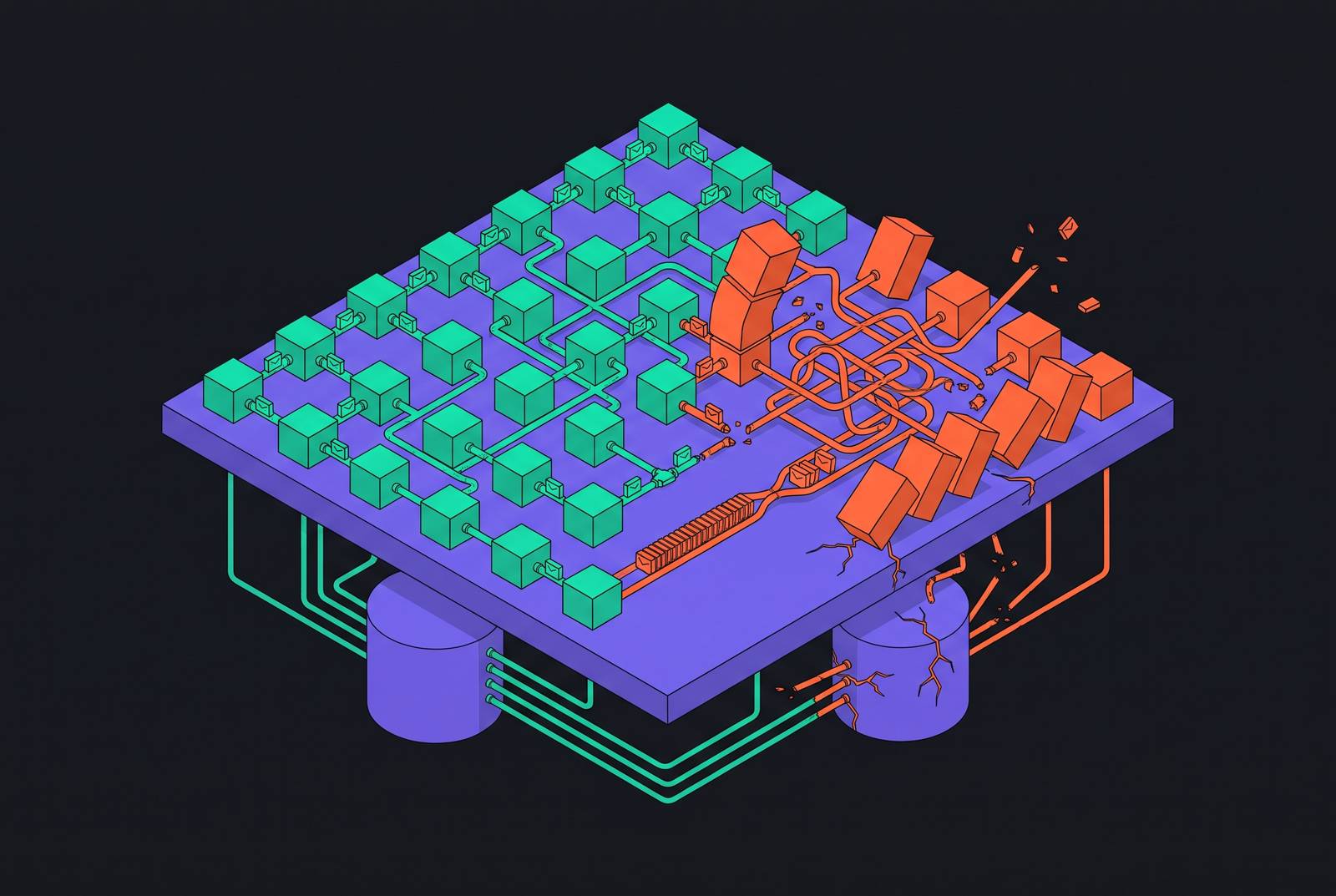
Microservices can break a growing SaaS product when teams set service boundaries before the product boundaries are stable. Three patterns feed into each other and cause the trouble: premature decomposition, fragmented data ownership, and synchronous calls between services. Keep the backend coherent until a specific scaling, reliability, compliance, or team need earns the split.
Why microservices fail SaaS products specifically, not software in general
Advice leaves out the large teams, stable domain models, and workloads with truly different scaling needs that it came from, so only the diagram is left. Patterns derived from Netflix, Uber, and Amazon then reach SaaS teams that have none of those conditions. The diagram looks reassuringly grown-up. The operational bill arrives before the reasons for paying it.
The first misunderstanding is that decomposition itself delivers scalability. Network hops are slower than in-memory function calls, so splitting a request across services can make it slower. SaaS adds multi-tenancy, billing events, auth state, and compliance scope to that calculation, all of which become harder to follow across independent systems. What needs to scale, whether compute throughput, database writes, background tasks, or team headcount? Without an answer, a team is choosing the machinery before identifying the job.
Premature service decomposition: splitting before domain boundaries are stable
A SaaS product’s domain model changes as its pricing, user roles, and features evolve. Those changes can happen within weeks, long before an early architecture has settled. A boundary that looked sensible under the original pricing model may cut straight through the next one. The service split has frozen an early guess. When that guess changes, refactoring moves from work within a single modular codebase to work across deployment boundaries.
That distinction turns ordinary product iteration into coordination work. Refactoring across eight microservices can be an order of magnitude more expensive than making the change within one modular codebase. Local development gets harder, the number of CI/CD pipelines grows, and the team needs dedicated DevOps capacity before the product has earned it. None of this waits for heavy traffic. The team pays the complexity tax while it is still finding out what customers will buy.
For founders and engineering leads without paying customers, product-market fit, or a team larger than five people, this is a poor form of insurance. It buys immediate operational complexity, slower feature work, fragile distributed failure modes, and higher cloud bills against a future need that remains speculative. The strongest objection is reasonable, though. What if keeping the product together makes a later migration painful? A well-enforced modular monolith answers that concern by preserving boundaries in code, so that modules can become services when a genuine reason appears.
Distributed data ownership: what happens when every service controls its own database
Once each service owns its own database, the choice of where to put the boundaries also decides who owns the data. User state is in one store, subscription state is in another, and usage events are somewhere else. The basic question of which customers are approaching their usage limit now requires a distributed query that is slow, brittle, and expensive to maintain. The customer is still one customer. The backend has turned them into a group project.
This fragmentation reaches well beyond inconvenient analytics. Billing events, usage metering, chargeback handling, and subscription state belong to the revenue-critical work of a SaaS business. When different owners hold the records, it is harder both to do that work correctly and to report on it afterward. Usage-based pricing exposes the problem particularly clearly because usage and subscription state must form a coherent customer picture. Otherwise, the data layer works against the business model it is supposed to support.
Tenant isolation introduces another obligation across that fragmented surface. Tenant context must propagate through every cache key, queue message, and service boundary, so each added service creates another place for it to be missing or inconsistent. More boundaries mean more opportunities for tenant context to go astray. A unified customer database instead co-locates user records, transactions, sessions, and usage events, providing the consistent view that billing, retention work, and product-led growth depend on.
Uber’s “Death Star” illustrates how tangled these dependencies can become. Its graph of over a thousand microservices earned the comparison to the Star Wars superweapon because of its tangled, star-shaped visualization. Traffic volume, data ownership and service boundaries all contributed to the tangle, with physical separation failing to make data ownership and service boundaries independent.
Synchronous inter-service communication: the failure mode that scales with traffic
Premature decomposition and distributed data ownership embed problems at design time. Synchronous communication adds a failure mode that becomes more dangerous as traffic grows because each request depends on other services finishing their work. If Service A calls Service B, which calls Service C, each waits on the next. A service boundary gives the waiting a network connection.
When a request needs every service to succeed, the chain’s reliability is the product of those individual reliabilities, rather than the reliability of its strongest component. A slow database query in an auth check can time out a billing confirmation and fail a checkout flow. The customer sees a failed checkout even when three services are mostly healthy. As more traffic passes through that dependency chain, more requests are exposed to latency or failure elsewhere in it.
This is why the pattern cannot be judged solely by how it behaves at launch. A chain that appears tolerable under light use still requires every synchronous dependency to respond when traffic grows. AI-native SaaS makes that constraint especially visible because inference already has high latency. Extra synchronous hops compound the delay structurally. Tuning the surrounding services cannot remove the need to wait for each required step.
The event-driven approach changes how services depend on each other, though it still has complexity. A service that publishes an event and moves on does not block on the downstream consumer’s availability. Failure can therefore remain bounded instead of propagating upstream through a waiting chain. That is the distinction that counts here. Separate deployment units offer little protection if every request still needs them all to be available.
How the three patterns interact and compound as a SaaS product grows
The three patterns reinforce one another as new features arrive. Unstable domain boundaries force changes across services, separate data ownership makes those changes harder to reconcile, and synchronous calls turn the resulting dependencies into shared request failures. Each feature can add services, stores, and calls at the same time. Growth expands all three surfaces at once. The failure exposure grows faster than the load on any single component would suggest.
At launch, the product may have enough traffic and few enough features to hide the cost of its boundaries. A growth inflection then makes the accumulated dependencies visible through fragile checkout flows, difficult usage-based pricing, and unreliable customer analytics. These operational and commercial problems come from a backend whose auth, payments, usage events, and customer data were designed as separate systems without a coherent customer view.
Making one service faster does not reunify customer records, while improving a query does not remove a synchronous dependency elsewhere in the request. The parts may each look healthy on their own. The product still depends on a set of boundaries that its business operations repeatedly need to cross.
The conditions under which microservices genuinely earn their place in a SaaS stack
Microservices make sense when a boundary answers an observable need. A CPU-heavy workload may require different resource allocation from the rest of the product. Background jobs may need a different reliability profile so that they do not share a failure domain with the request-handling API. A data processing layer may also need isolation for regulatory reasons.
When multiple autonomous squads need to deploy independently without coordinating, service boundaries reflect the organisation that exists. Conway’s Law becomes a practical design consideration. Radically different technology stacks also justify a boundary, such as a Python ML service within a Node.js product, because microservices genuinely support polyglot deployment.
The discipline is to distinguish these triggers from ambition. A product’s expected growth is not itself a compute boundary, and a hiring plan is not yet a need for independent deployment. A modular monolith is a useful place to start. Its enforced module boundaries provide places to split when a named requirement appears, rather than forcing the team to discover through expensive rewrites where the boundaries should have been.
What the recovery path looks like when a SaaS product is already over-decomposed
For a team already living with these problems, recovery means incremental consolidation. The Strangler Fig pattern replaces service boundaries with module boundaries while the system keeps running. Two conditions decide whether the team can move ahead with the work or leaves it on the roadmap for good.
The first condition is automated test coverage sufficient to detect regressions across the boundary being consolidated. Without that coverage, each step introduces unknown risk, and the migration stalls because the team cannot judge what it has broken. The second condition is clear ownership of that boundary and its consolidation. Someone must be accountable for finishing the work. Otherwise, the migration can drift indefinitely even when everyone agrees that it is necessary.
A team in that position should treat those conditions as prerequisites. Neither substitutes for the other.
Data consolidation is the hardest part of the recovery. Bringing distributed stores into a single relational database, with tenant scoping enforced at the repository layer, is where the unified customer record becomes recoverable. That restores the basis for accurate billing, usage metering, and analytics.
What a backend architecture designed to avoid these failure modes actually looks like
A backend built around these failure modes keeps its platform surface deliberately small. It has one API gateway, one auth flow, one event backbone, and one shared relational database with tenant scoping enforced at the repository layer. This is not simplicity for its own sake. Each additional surface is another place where tenant isolation can break, billing events can be lost, or compliance scope can expand unexpectedly.
Within that smaller surface, auth, payments, usage events, and customer data form a coherent system. The product can connect who is signing up, who is paying, how they use it, and who is approaching a usage limit. That view helps product-led growth because it brings together what customers do and where they stand with the business. The business needs the whole picture to act. A unified backend makes that picture part of the architecture.
For AI-native products, the same principle extends to agent-driven workflows. An agent that handles billing state, subscription changes, or usage alerts needs a consistent source of truth, with no conflict over which service owns the data. Unified backend platforms can embody this approach by providing a common interface instead of leaving builders to maintain synchronisation between disparate tools. Keep revenue-critical state coherent, isolate failure where separation has a purpose, and let real requirements earn each new service boundary.