Event-Driven Microservices Architecture for Backend State Sync
Asynchronous events let services stay decoupled while keeping state in sync across databases.
Backend state sync between microservices is a real, recurring engineering problem, and event-driven architecture is what most teams land on once the synchronous version falls over. Instead of services calling each other directly and sitting around waiting for a response, each service just says what happened and moves on. The rest of this piece walks through why that shift matters and where it actually shows up once you're building the thing.
Start with the database-per-service rule, because it's the root of everything else. Each microservice owns its own data. No shared database, no shared schema, no sneaking a query into someone else's table. That's good for decoupling, good for independent deploys, good for letting teams move without stepping on each other's code. But it creates a real headache: business transactions routinely span multiple services, and you can't wrap an ACID transaction around data that lives in two different databases owned by two different teams.
The classic illustration, borrowed from microservices.io, involves an Order Service and a Customer Service. A new order can't exceed the customer's credit limit. Simple rule, except the Order Service has no access to the customer's credit data, and the Customer Service knows nothing about the order. Neither one can check the rule atomically, because atomicity needs one transaction, and there are two separate databases sitting in the way.
Two-phase commit looks like the obvious fix, and that's exactly the trap most teams fall into. It re-couples services that were supposed to be independent, adds availability risk (one participant hangs, the whole commit stalls out), and falls apart under real conditions like network partitions or a slow node somewhere in the chain. Nobody running production microservices at scale reaches for 2PC anymore, and for good reason: it solves the consistency problem by recreating the exact coupling microservices exist to remove.
The other tempting shortcut is synchronous HTTP calls between services, basically rebuilding the monolith's function-call chain over the network instead of inside one process. That drags back the exact dependency problem microservices were supposed to fix. Akamai's 2024 research on this makes the point directly: in a synchronous chain, a break or delay anywhere along it can cascade into a full failure of the ordering process. So a distributed system ends up failing the same way a monolith fails, just with extra network hops and more places for things to break along the way.
This isn't some edge case, either. Gartner reported in 2023 that 74% of organizations already run microservices architecture, with another 23% planning to adopt it. That's nearly the whole industry either living with this problem or about to inherit it. Teams that solve state sync properly get the scalability microservices were supposed to deliver in the first place. Teams that don't just trade one flavor of outage for another, dressed up in newer infrastructure.
What event-driven architecture actually means in this context
Worth getting precise here, because the terminology gets sloppy fast. An event is a state change, full stop, something that already happened. What actually travels across the network is an event notification: an async message triggered by that change, not the change itself. Small distinction, but it matters the first time you're debugging at 2am and conflating the two.
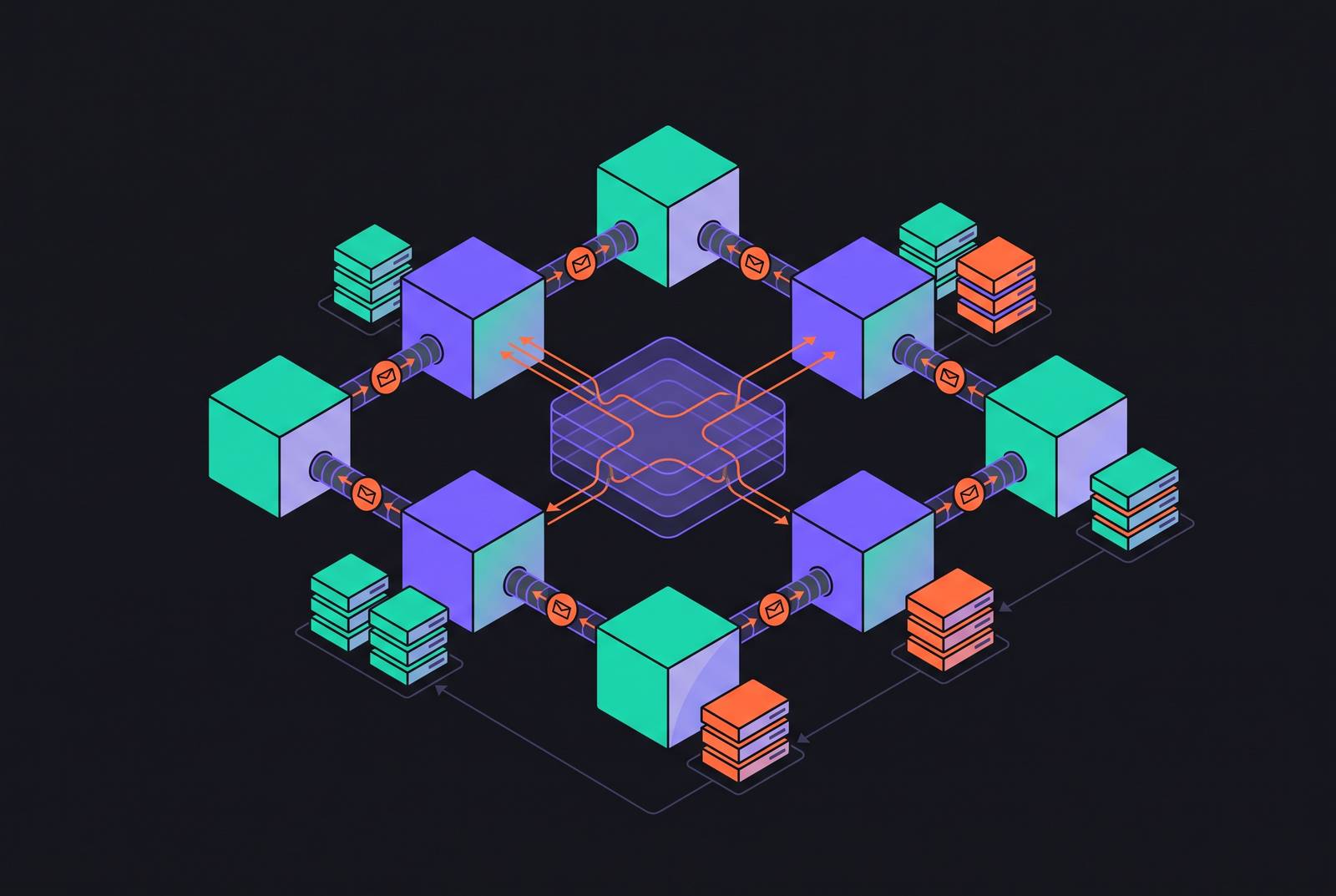
Every event-driven system runs on three roles. Producers emit a notification the moment their state changes. Event brokers catch that notification, hold onto it, and route it to whoever's listening. Consumers subscribe to the events they care about and process them on their own schedule, running their own logic, at their own pace.
The payoff: producers have zero knowledge of who's consuming their events, how many consumers exist, or what those consumers do with the data. That's baked into the model from the start, not bolted on after. Temporal decoupling (producer and consumer don't need to be online at the same moment) and logical decoupling (producer doesn't know or care what consumer logic looks like) both fall out of that same design.
Akamai's 2024 framing defines event-driven microservices architecture, EDMA for short, as applications built from loosely coupled services that talk through async events instead of direct calls. Compare that to a standard request/response setup: no waiting on a response, no direct dependency chain, no slow downstream service dragging everything else down with it.
None of this comes free, and pretending otherwise sets the wrong expectation. Synchronous systems give immediate consistency: the moment a write finishes, every reader sees it. Event-driven systems trade that for eventual consistency instead. The write happens, the event propagates, and consumers catch up a beat later. That lag is usually small, milliseconds to seconds depending on the broker and the load, but it's real, and pretending it isn't is how teams get surprised in production. Three pattern names worth filing away for later: event sourcing, CQRS, and the saga pattern. All three get a full breakdown further down.
How event propagation replaces synchronous calls for state sync
Back to the credit-limit example, now walked through step by step, because seeing the mechanics is what actually makes this click.
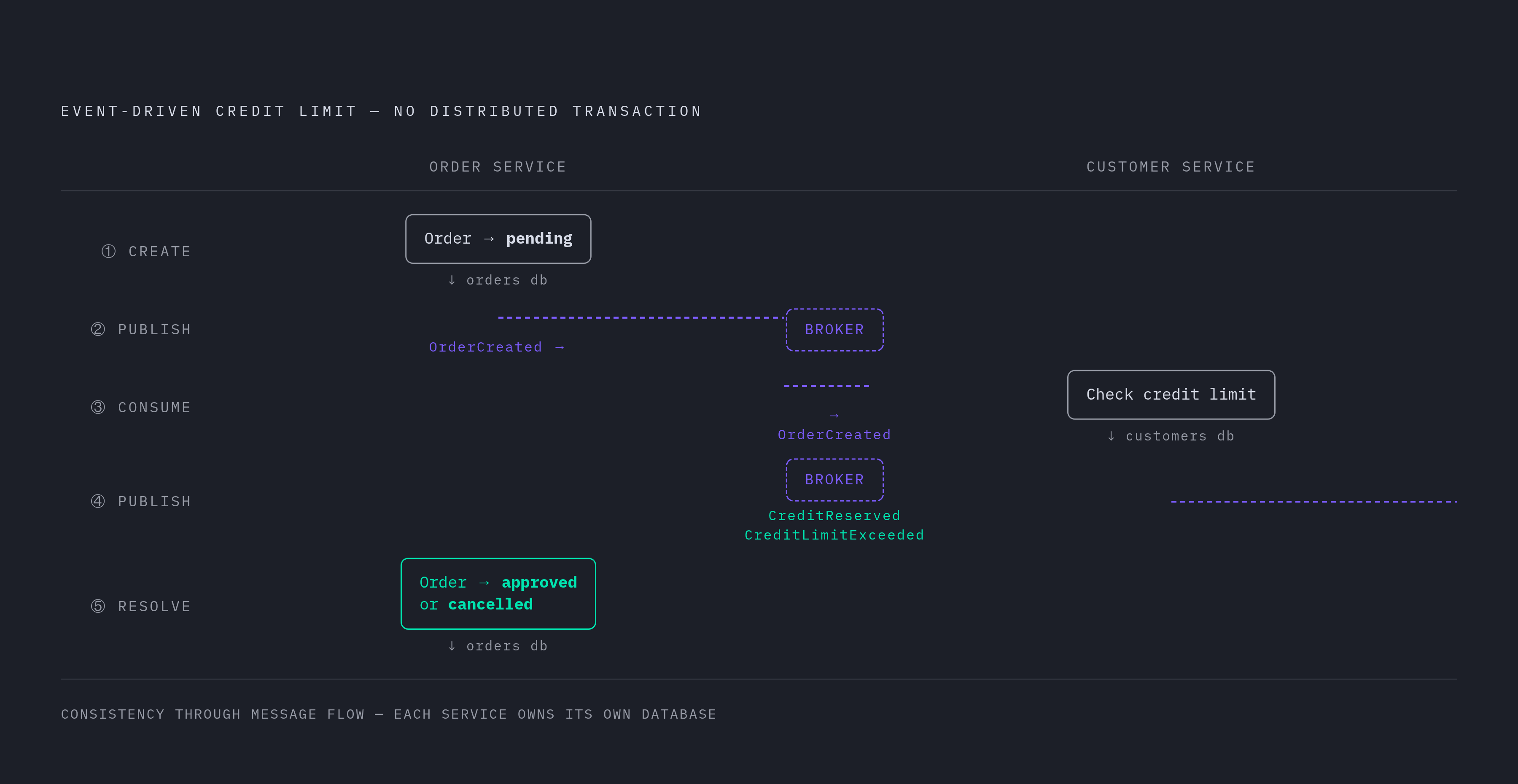
The Order Service creates an order in a pending state and publishes an OrderCreated event. It doesn't wait around for a green light. The Customer Service picks up that event whenever it's ready, checks the customer's credit, and publishes back either CreditReserved or CreditLimitExceeded. The Order Service, listening for that response, flips the order to approved or cancelled depending on what came back.
Notice what didn't happen anywhere in that sequence: no distributed transaction, no service reaching into another service's database, no 2PC coordinator holding a lock across two systems. Each service touches only its own data and tells the world what it did. Consistency shows up as a byproduct of the message flow, not as something a central mechanism has to enforce.
That said, a real problem sneaks in here. A service has to update its own database AND publish the event, and those two things need to happen together, reliably. If the database write succeeds but the event publish fails (server crashes, network drops, pick your poison), the two systems now disagree about what happened. Three patterns exist specifically to close that gap: Transactional Outbox, Event Sourcing, and Transaction Log Tailing. Each solves the atomicity problem differently, and the next section covers event sourcing's approach in detail.
Shopify's production numbers make the strongest case for what this buys at real scale. Apache Kafka sits at the center of their architecture, handling up to 66 million messages per second across domain events, ML inference, search indexing, inventory tracking, and customer notifications. Services scale on their own schedule and stay responsive through Black Friday, which is about as brutal a stress test as e-commerce infrastructure gets. What used to be a fragile chain of synchronous calls turns into a set of independent steps that can each retry, fail, and recover on their own, without freezing everything else in the process.
The three patterns that make event-driven state sync work reliably
A 2025 paper in the World Journal of Advanced Engineering Technology and Sciences (vol. 15, no. 03) names three patterns as the backbone of managing event-driven complexity: event sourcing, CQRS, and saga coordination. Take each on its own.
Event Sourcing flips how state gets stored. Instead of keeping a mutable row that gets overwritten on every update, the system keeps the full ordered log of events, and current state gets derived by replaying that log. This solves the atomicity headache from the last section directly, because writing the event is writing the state. There's no separate "update database, then publish" step to fail halfway through. An event log also doubles as a full audit trail, so recovery, backfill, or debugging can replay history instead of someone guessing at it. The cost lands on the read side: pulling current state means replaying or projecting the log, which adds real complexity to what used to be a simple query.
CQRS, Command Query Responsibility Segregation, splits the write model from the read model. Commands that change state go one way, queries that return state go another, and they don't share infrastructure. This pairs naturally with event sourcing: events update the write side, and separate projections build fast, purpose-built views for reading. Each side scales on its own, so a spike in read traffic doesn't choke writes, and vice versa. The trade-off mirrors event sourcing's: reads can lag writes by a small window, because the projection needs a moment to catch up to the latest event.
The Saga Pattern handles the long-running, multi-service transaction problem by breaking it into a sequence of local transactions, where each step publishes an event that kicks off the next one. Two flavors exist here. Choreography means each service just reacts to whatever event the last one published (the credit-limit example from earlier is a minimal choreography saga). Orchestration means a central coordinator directs every step explicitly. When something fails partway through, sagas roll back using compensating transactions: if step four blows up, the saga fires off events that undo steps one through three.
None of these patterns live in isolation, and picking just one is usually a mistake. Production systems routinely run all three at once, layered together, because each solves a different piece of the same puzzle.
Event broker options and what separates them in practice
Apache Kafka remains the default answer for high-throughput event streaming, built on log-based storage with partitioning for parallelism and replication for resilience. Shopify's 66 million messages per second, cited above, is the clearest proof of what Kafka handles at real scale. SumUp, as of 2025, runs Kafka through Confluent Cloud to process millions of payment events daily across more than 30 countries, staying compliant in regulated markets while still shipping features fast. For teams that want stream processing without standing up a separate cluster, Kafka Streams offers an embedded processing framework that runs inside the consuming microservice itself.
Apache Pulsar distinguishes itself on multi-tenancy, geo-replication, and handling both queues and streams inside one platform rather than forcing a choice between the two. Its tiered storage supports long-term event retention, which matters for systems that need to replay months of history, not just the last few hours. Pulsar shows up more often where multi-region compliance or data residency rules, GDPR being the obvious example, turn geo-replication into a requirement instead of a nice-to-have.
AWS EventBridge is the fully managed option, wired tightly into AWS services and a long list of SaaS providers. No cluster to run, no partitions to tune: it's the fastest route into event-driven architecture for a cloud-native or serverless setup. The catch is the AWS lock-in that comes bundled with it, which makes EventBridge a weak fit for anything multi-cloud or on-prem-adjacent.
Google Cloud Pub/Sub offers global, low-latency messaging and shows up most in analytics pipelines and IoT workloads that already live inside Google Cloud.
Apache Flink sits a layer above the broker, as a stream processing engine rather than a message bus, supporting batch and streaming with genuinely stateful computation. Flink 2.0 shipped in March 2025, a significant release, and ML inference APIs like ML_PREDICT arrived starting with Flink 2.1, a detail that matters a lot for SaaS backends built around heavy machine-learning workloads (more on that below).
On the monitoring side, observability tooling across major platforms has largely caught up to cover Kafka, Pulsar, and EventBridge across the major broker choices.
Picking based on hype instead of workload is the single most common mistake teams make here, and it's an easy one to avoid once you name it. Kafka wins on throughput. Pulsar wins on multi-region compliance. EventBridge wins on speed of setup, but only if the whole stack already lives on AWS. Picking Kafka because it's the name everyone knows, when the actual need is Pulsar's geo-replication, is how teams end up building workarounds for a broker that never fit the job in the first place. Schema governance, managed-versus-self-hosted trade-offs, and GDPR data residency rules should decide this, not brand recognition.
The consistency, ordering, and observability problems that event-driven systems must address
Eventual consistency is a design choice, not a defect. But it demands upfront honesty with whoever's building on top of the system about how long that read-lag window actually runs.
Ordering causes its own headaches. Partitioned brokers guarantee order within a single partition, not across partitions, so out-of-order delivery is a real scenario, not an edge case. Consumer logic has to handle it defensively rather than assuming events always show up in the sequence they were sent.
Delivery semantics add another wrinkle. Most brokers default to at-least-once delivery, meaning a consumer might see the same event twice. So every consumer needs to be idempotent, capable of processing a duplicate event without double-charging a customer or double-counting inventory.
The saga pattern's rollback mechanism, compensating transactions, sounds elegant until you realize every single step in a saga needs its own defined undo operation. That's real design surface, not an afterthought tacked on at the end.
Schema governance is easy to overlook because producers and consumers never talk directly, but they still share an implicit contract: the shape of the event itself. An uncoordinated change to that shape can silently break every downstream consumer, and nobody notices until something's already broken in production. A schema registry exists specifically to catch that before it happens.
Observability gets harder, too. Traditional request tracing follows one synchronous call stack, start to finish. Async event flows fan a single business transaction out across multiple services and broker hops, so distributed tracing, using correlation IDs carried in the event headers, stops being a nice-to-have and becomes load-bearing infrastructure.
The 2025 World Journal of Advanced Engineering Technology and Sciences paper cited earlier lays these challenges out directly: eventual consistency, event ordering guarantees, distributed transaction management, and monitoring across highly distributed environments are the recurring pain points teams run into. Nothing since has overturned that list. Treat it as the bill that comes due before deployment, not the surprise that shows up after.
A DZone migration case study from August 2025 tracked a large e-commerce company moving off a monolith serving roughly 4,000 requests per second onto a Kafka-backed microservices setup. The move decoupled components and lifted throughput, but the gains didn't show up automatically. the gains required deliberate follow-through before the new architecture started paying off, and skipping that investment is exactly how teams end up blaming the architecture for problems the migration itself created.
Where event-driven sync fits SaaS and AI product backends specifically
The SaaS market hit $184 billion in 2024, and is projected to cross $374 billion by 2026. That kind of growth means whatever backend decisions get made now scale up with the business, for better or worse.
AI is no longer a side project bolted onto SaaS products, either. 67% of SaaS companies are already using AI as part of their core value proposition, which means inference workloads sit on the same backend that handles auth, billing, and session state, competing for the same infrastructure right now, today.
AI workloads bring their own event patterns worth naming directly. Inference is slow, seconds rather than milliseconds, so event-driven processing decouples the user-facing layer from the model layer: the user gets an answer when it's ready instead of a request hanging open the whole time. Model output is itself a state change, and publishing that output as an event lets analytics, billing, and feature flags react to it without polling a database every few seconds hoping something changed. Usage-based billing for AI products needs accurate per-request metering, and an event log of every inference call is the natural, already-existing source of truth for that, no separate reconciliation system required. Flink 2.1's streaming ML inference APIs, mentioned earlier, make stream processing a legitimate layer for real-time AI feature pipelines rather than something confined to offline data engineering.
There's a nice bit of overlap here: the same event log driving state sync between services is also the raw material product analytics needs. User actions, subscription changes, feature usage, all of it flows through the same broker, which cuts out the need for a separate analytics instrumentation layer bolted on afterward.
BetterCloud's 2025 State of SaaS report found that 70% of IT teams would rather run on unified platforms than juggle a pile of point solutions. The event bus is what makes that unification actually achievable instead of aspirational, since it's the layer that lets every system see the same stream of truth instead of syncing snapshots between each other.
GDPR raises the stakes on all of this, because an event log is, functionally, a store of personal data. Data residency, retention rules, and the right to erasure all need to get designed into the event schema and broker configuration from day one. Retrofitting compliance onto years of accumulated event history is a miserable project, the kind that eats a quarter of engineering time for something that should've been a config decision from the start. European-hosted infrastructure with GDPR-native defaults built in from day one makes that dramatically simpler.
What a well-integrated backend gives teams that a patchwork of sync'd tools cannot
Picture the alternative concretely. Auth lives in one service, billing in another, analytics in a third, each with its own database. A customer's subscription changes, and now that single event needs to update feature access, log a revenue event, and notify three other systems. In practice that means webhook chains, custom sync logic, and bespoke error handling that some engineer has to babysit forever. That's not hypothetical. It's the default state of most SaaS backends that grew one integration at a time, one internal message and one late-week hotfix after another.
Event-driven architecture resolves that at the infrastructure level. Each state change gets published exactly once, and every system that cares subscribes to it independently. Adding a new consumer (say, a usage-based billing service that didn't exist a year ago) means writing a subscriber, not touching the producer that's already running in production.
The real payoff is a genuinely unified customer database. When every signup, transaction, and session flows through one event log, the full shape of the business, who's signing up, who's paying, how they're actually using the product, becomes visible without cross-system joins or overnight reconciliation jobs trying to force three databases to agree with each other.
AI agents fit naturally into this model, too. In an event-first backend, an agent subscribes to the same event stream as any other consumer, reacts to state changes, takes action, and publishes its own events back into the system, all without custom webhook wiring built specifically for it. That's the native integration model this next stretch of AI engineering actually calls for, not an afterthought bolted onto REST endpoints after the fact.
Platforms that bundle auth, payments, a customer database, and analytics into one cohesive system, Tiun being one example, are really just the infrastructure version of this idea taken seriously. The event log lives inside the platform instead of getting stitched together across five vendors after the fact, one webhook at a time.