Merchant of Record vs Payment Processor
Choosing between them determines who owes taxes, handles chargebacks, and faces compliance risk.
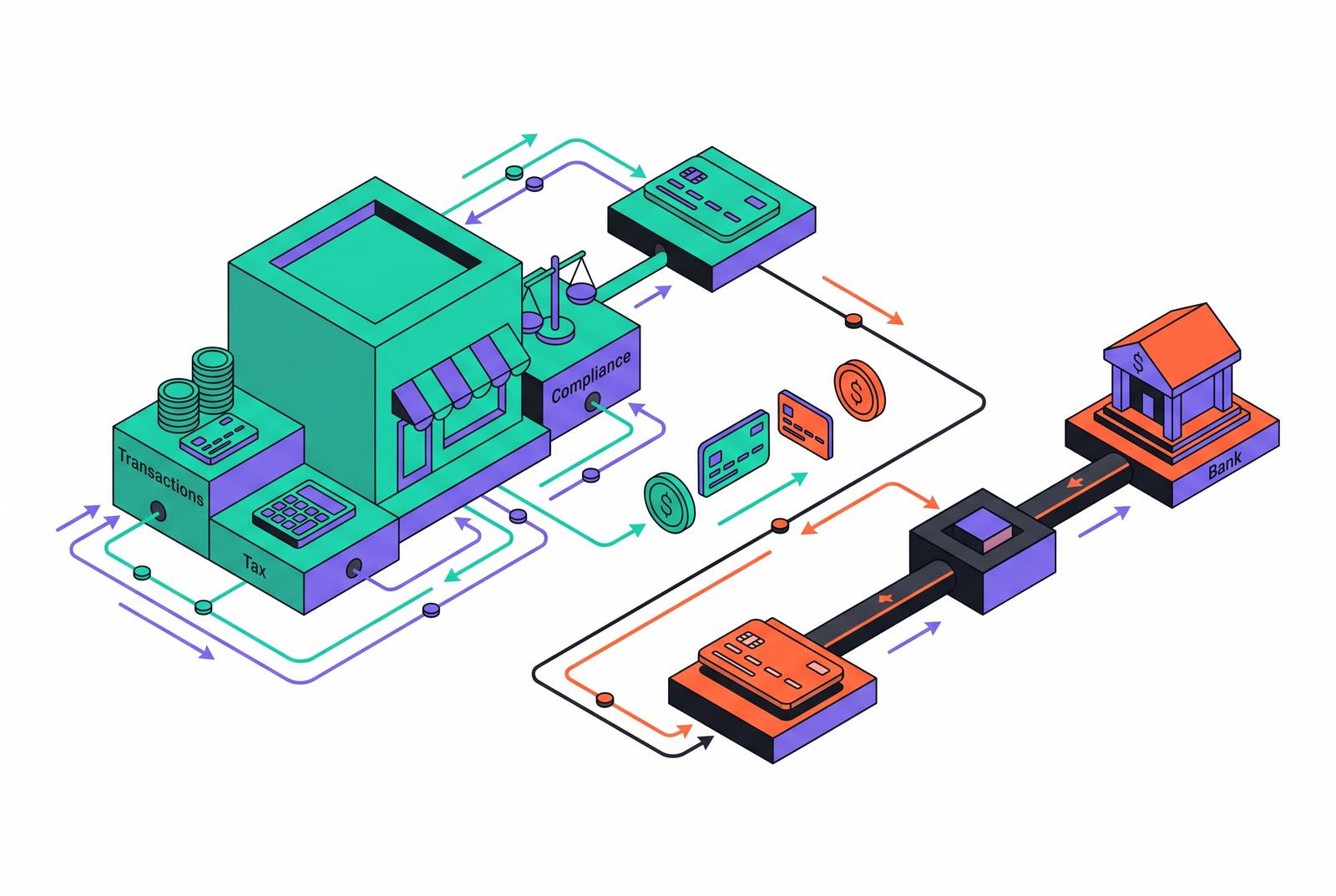
Choosing a merchant of record or a payment processor is a decision about legal liability. It determines who owes the tax, handles the chargeback, and answers for payment compliance. For a SaaS company selling globally, the wrong choice can turn early convenience into years of cleanup. The checkout may look identical. The obligations behind it are not.
What "merchant of record" actually means legally — and why it is not the same as a payment processor
A payment processor authorizes payments and moves money between the buyer’s bank and the merchant’s account. Its role is technical, ending with settlement. A merchant of record, or MoR, occupies a different position. It is the legal seller, holds the merchant account with the card networks, and appears on the cardholder’s statement. One moves the payment. The other stands behind the transaction.
Even when a processor offers a wide range of checkout and risk tools, those features do not make it the seller. The contract and transaction documents determine that role. The legal name on the customer’s receipt is a concrete way to understand the arrangement. If the SaaS company is named as the seller, adding payment features does not shift that position elsewhere.
With an MoR, the SaaS company instead becomes a supplier to a third party that resells the product to the customer. This is a wholesale-retail relationship beneath what may feel like a direct purchase from the software company. The customer experience can remain familiar while the legal structure changes. That is why an MoR is not simply a processor with more features. It takes a different seat at the transaction table.
What the seller-of-record label transfers — and what it does not
The seller-of-record role transfers transaction obligations without changing who builds or delivers the software. An MoR takes responsibility for sales tax, VAT, and GST calculation and remittance, including locally required invoice formats. It also handles consumer protection obligations and refund processing. Chargeback and fraud liability move with the sale. The MoR fights the dispute and absorbs the loss rather than leaving that work and exposure with the software company.
Under the MoR model described here, the application never touches a card number, and the MoR takes on PCI-DSS compliance for payment handling. With a processor, the SaaS company retains responsibility for its PCI scope, chargeback disputes, and refund decisions. Tools can help perform that work. They do not, by themselves, transfer accountability for it.
The boundary is narrower than “someone else handles compliance.” Corporate income tax remains with the SaaS company, as do payroll and contractor payments. Regulated-industry requirements such as KYC, HIPAA, and age verification also remain the product company’s responsibility. Payment-data responsibility changes, but broader customer-data obligations do not disappear.
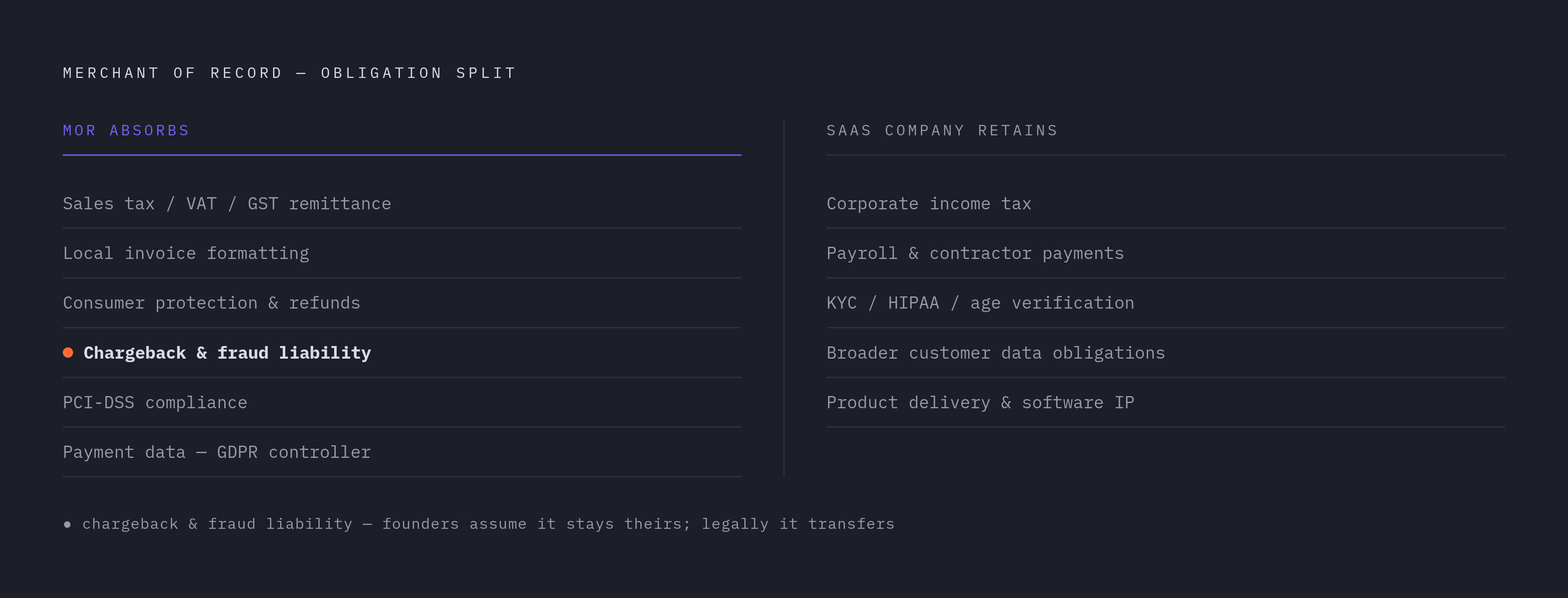
Why the tax burden of selling software globally is the concrete reason this distinction matters
International indirect tax makes the legal distinction tangible because selling software abroad can create obligations beyond the seller’s home jurisdiction. These include EU and UK VAT, Australian and Singapore GST, Indian GST on OIDAR services, and Canadian GST/HST/QST. Different systems require different registrations, filings, and remittances. The work is an ongoing obligation across markets whose rules change.
The EU’s One Stop Shop reduces the need for individual VAT registrations within the EU, but the seller must still manage OSS filings or delegate that role to an MoR. Italy, Mexico, India, and Chile have specific invoice-format or government-clearance requirements. A correct tax amount on the wrong document is not the whole job done.
A processor’s tax-calculation add-on therefore addresses only part of the problem. It calculates the rate without taking on the seller’s registration, filing, or remittance obligations. An MoR assumes those duties as the legal seller and generates the required invoices. That difference persists after the first purchase because subscription renewals trigger tax obligations again.
How the wrong choice compounds as a SaaS company scales internationally
Processor-only can be defensible for a low-volume company selling within one jurisdiction. An early-stage business serving mainly US customers may operate this way before sales-tax nexus is triggered. International subscriptions change the scope of the assessment. The company must now address obligations in the buyer’s market rather than treating successful payment collection as proof that the sale is compliant. Money arriving in the account is not a legal all-clear.
If registration and filing lag behind sales, the cleanup extends beyond submitting late returns. Back taxes, interest, and fines can accumulate wherever nexus was established without compliance. Geographic expansion adds more places to investigate and reconcile. Meanwhile, the business still has current sales to manage.
Delegation introduces a different dependency and its associated risk. Digital River, a long-established MoR provider, shut down its operations, leaving former customers searching for a replacement. That case makes vendor stability and migration terms part of the commercial decision. There is also a cost trade-off. MoR fees are higher per transaction, but the comparison is against processor fees plus tax software, compliance tooling, and internal labor. For large-ticket enterprise deals with thin margins, percentage-based MoR fees can outweigh those separate costs, making a hybrid model worth its added complexity.
The subscription billing model adds a recurring compliance dimension that a processor alone cannot absorb
Each renewal brings the risk of chargebacks and fraud, the work of cross-border settlement, and tax obligations under the rules where the buyer is now. The initial checkout is only the beginning. A model that works for the first payment must also work for every later billing event.
With a base subscription plus consumption charges, invoice amounts change, and the tax must be right each cycle. This matters especially for AI-native SaaS products because they have inference costs and power-user consumption can vary sharply. Revenue events change with both usage and customer headcount.
Plan changes add further financial consequences. Proration, dunning, smart retries, and cancellations all interact with tax or refund handling. An MoR handles these in its subscription platform, while a company using a processor must link its subscription logic, tax tools, and refund policy separately. The processor can take a payment without being responsible for the rules around it. That gap is where integration work collects.
Either model therefore needs a reliable link between billing events and the customer record at the time of each transaction. A unified backend connecting authentication, billing, and customer data makes renewals, plan changes, and usage overages visible together. Fragmented authentication, billing, and analytics tools make that audit trail brittle.
How data ownership and GDPR exposure differ between the two models
Under GDPR, a controller determines the purposes and means of processing personal data. When a SaaS company uses a processor, it retains controller responsibility for payment transaction data. That includes handling Data Subject Access Requests, maintaining Data Processing Agreements, and documenting the lawful basis for cross-border transfers. Outsourced payment execution does not automatically mean outsourced privacy accountability.
An MoR takes responsibility for the payment transaction’s data, reducing the SaaS company’s controller exposure for that slice of customer information. The limit is important. The software company still has obligations for the broader customer data it handles while delivering its product.
Hosting and provider domicile introduce another distinction. The US CLOUD Act allows federal law enforcement to compel US providers to disclose data stored anywhere, including on EU servers. A Europe-domiciled backend with European hosting can remove the transatlantic transfer involved in that data flow, avoiding the need for Standard Contractual Clauses for it. This is a useful trust signal for European enterprise procurement, while the company’s remaining data obligations still require assessment.
Four variables that determine which model fits a given SaaS business
For a team applying these distinctions, the first variable is customer geography. Selling mainly within one jurisdiction, without imminent international expansion, makes a processor defensible. Selling across multiple VAT and GST markets strengthens the case for delegation as volume grows. Countries add work independently of revenue growth. A business with modest sales spread widely can face a different compliance load from one earning more in a single market.
The second variable is the B2B-versus-B2C mix. Enterprise buyers frequently require the software company’s name on the purchase order, contract, and invoice. That can make the company the legal seller by commercial necessity. Self-serve B2C and SMB buyers usually do not require this, so those sales are a better fit for MoR delegation. Customer expectations can settle a question that payment preferences cannot.
The third variable is ARR stage together with compliance capacity. At very early stages, low volume within one jurisdiction can keep processor-only operations simpler and exposure bounded. As recurring revenue spreads internationally, internal tooling and labor costs can begin to exceed MoR fees. The comparison depends on capacity as well as growth.
The fourth variable is the buyer’s contractual requirements. Where enterprise buyers require the software company to contract and bill directly, a hybrid arrangement can use a processor for enterprise and an MoR for self-serve. With that split, the business must store seller identity, documents, refunds, and renewals for each order within each channel. Migration risk matters for all four variables because payment-data lock-in affects whether the business can change models later.
What to look for in an MoR platform if the decision points toward delegation
For teams whose decision points toward an MoR, evaluation should start with contractual scope. The signed agreement must state the provider’s seller-of-record status and spell out who has chargeback liability, refund authority, and data ownership. Tax calculation alone is not enough. The platform should cover the countries where customers are now and will be soon, including the EU VAT, UK VAT, and APAC obligations that apply. India’s OIDAR rules, Canada’s GST/HST/QST, and Brazil’s indirect tax structure deserve specific attention when assessing “global” coverage.
The platform should also support the way the product is priced. Native handling of usage-metered events, plan changes, proration, dunning, and smart retries avoids rebuilding subscription logic outside the platform. Fees should be transparent and all-in for tax, compliance, fraud, and chargebacks. Per-feature charges can reconstruct the fragmentation delegation was supposed to remove.
Data terms deserve equal weight before signing. Teams should check payment-data and billing-history exports, migration paths, vendor stability, and who is responsible for privacy. For European customers, provider domicile and European hosting help clarify the transfer obligations involved.
Finally, the integration architecture should support the operational record the business needs. A unified API for MoR functions, billing, and customer data reduces fragmentation, while CLI or MCP support can help small teams integrate without dedicated infrastructure engineers. A unified backend combining authentication, payments, a customer database, and analytics fits that architectural direction. The contract still has to match the architecture. Evaluate a platform by the obligations it legally accepts when it takes payment.