SSE vs WebSockets for Real-Time SaaS Backend Events
SSE handles one-way server events more efficiently than WebSockets for most real-time SaaS needs.
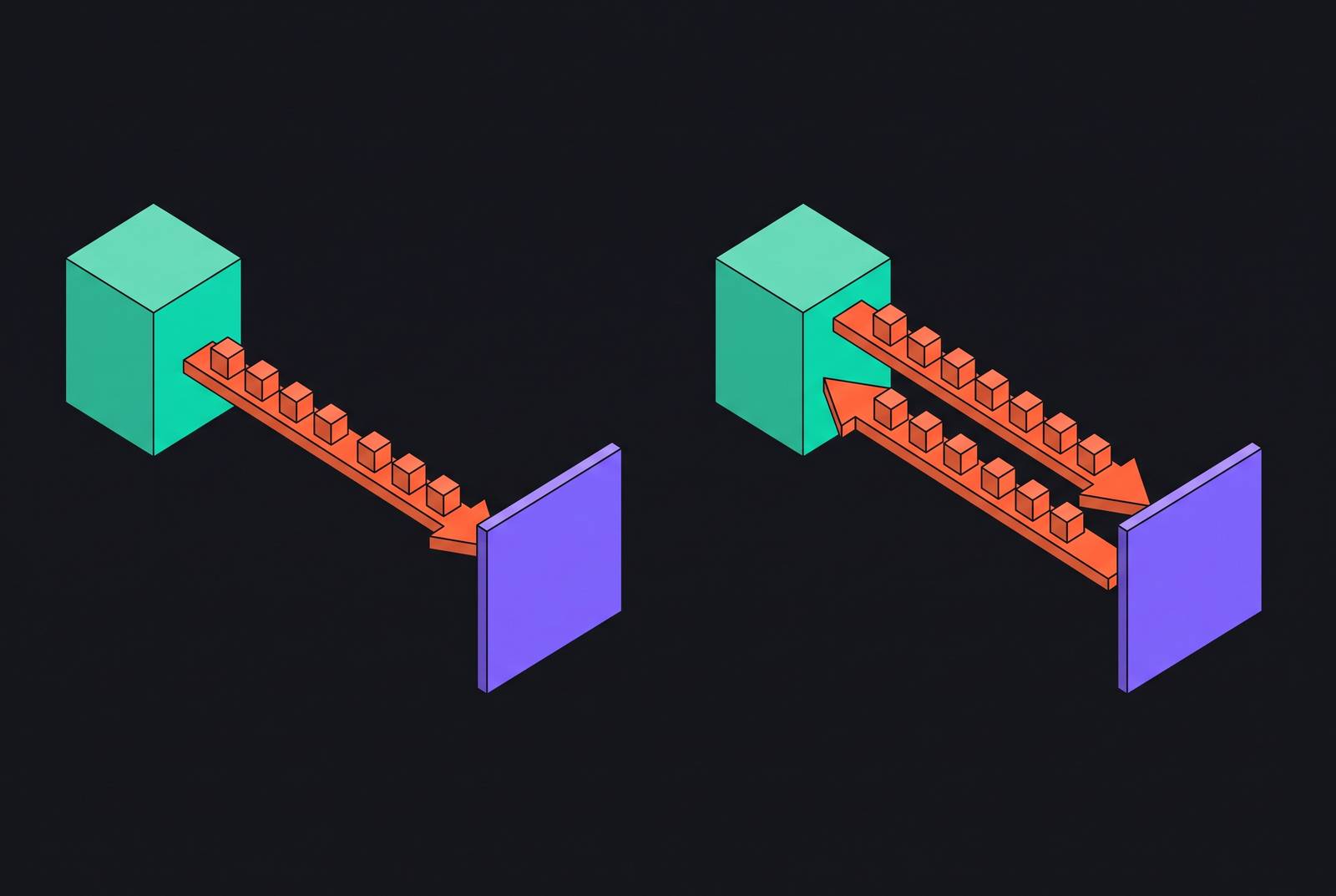
The choice between SSE and WebSockets is about matching the shape of your data flow to the shape of the pipe carrying it." It's about matching the shape of your data flow to the shape of the pipe carrying it. Get this wrong on a greenfield project, and you're not looking at a config tweak later. You're looking at a messaging layer rebuild, with all the QA, downtime risk, and internal team panic that comes with it.
Teams reach for WebSockets out of habit more often than out of need. Something about "real-time" makes engineers default to the full-duplex option, the same way people over-order at a buffet because the sign says "all you can eat." Then six months in, someone notices the client never actually sends anything mid-stream, and the whole bidirectional setup was scaffolding for a conversation that only ever went one way. According to comparison research on the topic, teams have rebuilt entire messaging layers after picking SSE for something that needed two-way traffic, or picking WebSockets for an IoT feed that MQTT would have shrunk by 80% in bandwidth. The rebuild is the actual cost here, not the protocol itself.
So the real question up front is simple: does the server need to push, or does the client need to talk back while the stream is open? Everything downstream, scaling strategy, infrastructure spend, deployment model, follows from the answer.
What SSE is and what it assumes about your event flow
Server-Sent Events work like this: the browser opens an EventSource connection to a URL, and the server responds with a text/event-stream content type. Instead of closing the connection after that response, the server holds it open and trickles events down, line by line, whenever it has something new to say.
After that handshake, the relationship changes. After that handshake, the relationship changes: it's server-talks, client-listens, indefinitely. It's server-talks, client-listens, indefinitely.
A couple of structural facts matter here. SSE is text-only, UTF-8, no binary frames. If you need to send a compressed audio blob or a chunk of protobuf, SSE just isn't built for that job. But it makes up for that limitation with something genuinely convenient: automatic reconnection. If the connection drops, the browser retries on its own, and it tracks a Last-Event-ID header so the server knows exactly where to pick back up. No custom retry logic, no exponential backoff you have to write yourself. That's baked into the browser's implementation of EventSource, for free.
What WebSockets are and what they demand in return
WebSockets start the same way every HTTP request starts: a handshake. But that handshake asks for an upgrade, and once the server agrees, the HTTP connection turns into a persistent TCP tunnel. From that point on, either side can send a frame whenever it wants. No more asking permission, no more request-response cycles.
That's full duplex, and it comes with real numbers attached. The connection requires its own dedicated socket, and each individual frame carries a small overhead on top of the payload. In exchange for that overhead, you get binary framing, ArrayBuffer and Blob support, which matters a lot if you're streaming audio chunks, syncing game state, or moving a compact binary protocol back and forth instead of JSON.
The tradeoff is straightforward: WebSockets buy you two-way, binary-capable communication, and they charge you a more expensive, stateful connection to keep it running.
Where performance differs between the two protocols
For pure one-way delivery, live dashboards, sports scores ticking across a screen, SSE tends to be the leaner option. Server resource use and bandwidth consumption run an estimated 30-50% lower than maintaining a full WebSocket connection for the same one-directional job. Keeping a full-duplex tunnel open for traffic that only ever moves one direction is a bit like renting a two-way radio to listen to the radio. You're paying for a talk feature you never use.
The bigger performance story going into 2026 is multiplexing. Under HTTP/1.1, browsers cap you at 6 connections per origin, which becomes a real problem the moment a page has more than a few streaming widgets fighting for those slots. HTTP/2 changes that math: SSE streams multiplex over a single connection, so that ceiling disappears. WebSockets have a path into HTTP/2 multiplexing too, through RFC 8441's extended CONNECT method, but support across browsers, proxies, and load balancers is inconsistent enough that a lot of WebSocket traffic still falls back to HTTP/1.1 and needs its own dedicated socket.
There's also a quieter overhead cost baked into the WebSocket spec: mandatory client-to-server masking, an XOR operation applied to every outgoing frame. SSE skips this because it never sends client-to-server frames on the stream. Developers who've built both report SSE coming out ahead specifically in broadcast scenarios, where you're pushing the same event to a large number of listeners.
WebSockets do win somewhere, though: at extremely high event rates, thousands of events per second, binary WebSocket frames can run 2 to 4 times smaller than SSE's newline-delimited text format. Worth knowing. But almost no production SaaS system actually lives at that event rate day to day. It's a real regime, just not the one most backends operate in.
The pattern-matching framework: which protocol fits which SaaS event type
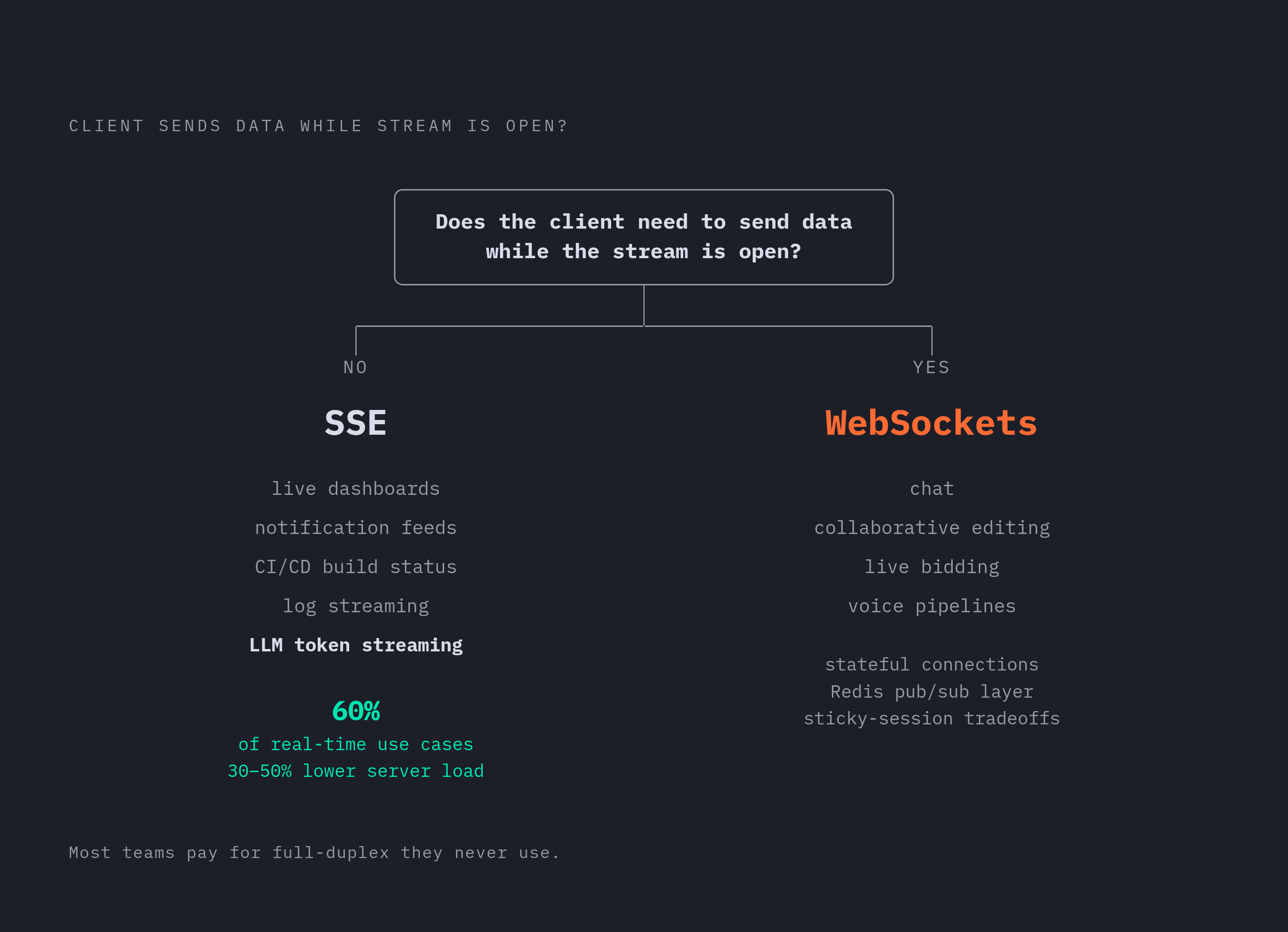
One question decides this, every time: does the client need to send data while the stream stays open?
If the answer is no, SSE is the correct starting point. It's estimated to cover something like 60% of real-time use cases, which is a lot of ground for a protocol that gets overlooked in favor of its flashier cousin.
SSE fits cleanly for:
- Live dashboards and monitoring feeds, server metrics, CI/CD build status ticking across a screen
- Notification delivery, alerts, activity feeds, social timelines
- Progress updates on long-running server-side jobs
- Log streaming and live analytics displays
- LLM token streaming (more on that in a moment)
WebSockets earn their keep when the answer is yes, and the operational cost that comes with them, the stateful connections, the scaling complexity, actually buys something necessary:
- Chat and collaborative editing, CRDT sync, a document-editor style keystroke-by-keystroke broadcast
The research behind this comparison recommends starting with SSE as the default posture, and only moving to WebSockets once there's a confirmed bidirectional need that nothing else can serve. Not a hypothetical future need. A confirmed one.
Why SSE became the standard pipe for LLM token streaming
Every major LLM API works the same way under the hood: you POST a prompt, and you get back an SSE stream of tokens, one after another, until the model's done talking. That pattern has become close to a de facto standard across AI providers.
It fits because the traffic really is one-directional. The model generates tokens moving one way, and the browser has nothing to say back while that generation is happening. There's no negotiation mid-stream. The communication model is structurally unidirectional.
No streaming protocol makes the model generate faster. Total generation time is a function of the model and the compute behind it, full stop. Transport doesn't touch that number. What SSE actually improves is perceived latency, by getting the first token onto the screen sooner, so the user isn't staring at a blank box wondering if anything's happening. That's a psychological win, not a computational one, and it drives user satisfaction independently of how long the full response actually takes to finish.
The metric worth watching is time-to-first-token. It's time-to-first-token, alongside abandonment rate, how many users bail before the response finishes. Actual end-to-end speed matters, but it's secondary to how fast that first token appears in the response.
How the MCP ecosystem moved away from pure SSE
The Model Context Protocol's original transport used HTTP plus SSE: a persistent SSE connection, opened with a GET request, carried server-to-client events, while a separate HTTP POST endpoint handled anything going the other way.
That split created friction the moment people tried to deploy it at scale. Persistent connections don't play nicely with serverless infrastructure or standard load-balanced setups, and running two separate endpoints for one logical conversation added coordination overhead that stacked up fast.
Protocol version 2025-03-26 fixed this by introducing Streamable HTTP. One endpoint. The server responds to any POST with either a plain JSON response or an SSE stream, and it decides which per request. That keeps SSE's push capability alive for the cases that need it, while letting the whole thing run on ordinary stateless HTTP infrastructure, the kind that scales horizontally without anyone thinking twice.
By early 2026, MCP had crossed 97 million monthly SDK downloads, with adoption across every major AI provider. When a protocol at that scale quietly drops its original transport model in favor of something more deployment-friendly, that's not a footnote. If similar architecture decisions are sitting on the roadmap, that's a signal to pay attention to.
Scaling WebSocket connections beyond a single server
HTTP is stateless, which is why it's boring and reliable. Any server can answer any request, load balancers don't have to think hard, and nobody loses sleep over which machine handled the last call. WebSockets are the opposite of boring. The connection is stateful and persistent, tied to one specific server, which means a client connected to Server 1 has no way of receiving a message published on Server 2.
That gap causes a very specific failure. Client A, sitting on Server 1, sends a chat message to a room. Client B is in that same room but happens to be connected to Server 2. Server 2's broadcast logic never sees Client A's message, because it never touched Server 2. The room just silently splits into two rooms that don't know about each other.
The standard fix is Redis pub/sub. Every server publishes events to a shared Redis channel, every server subscribes to it, and each one relays incoming messages to whichever local clients it happens to be holding. That pattern comfortably handles most workloads up to somewhere around 100,000 concurrent connections across a modest server cluster.
Sticky sessions are where things get uncomfortable. Load balancers route a client back to the same server holding its connection, which sounds sensible until that server gets overloaded or falls over. Sticky clients keep hammering the same struggling machine instead of failing over cleanly, which makes load shedding harder and recovery slower. The more a system leans on sticky sessions to keep WebSocket state consistent, the harder it becomes to scale that system dynamically later. It's a dependency that quietly limits your options down the road.
WebTransport: what to watch but not yet ship
WebTransport is the newer option on the horizon, built on QUIC over HTTP/3, offering multiplexed streams plus datagrams. Independent streams mean one slow stream doesn't block the others, no head-of-line blocking. Datagram support opens the door to fire-and-forget, low-latency messaging that neither SSE nor WebSockets handle natively. It's full-duplex like WebSockets, but built without carrying HTTP/1.1's older design constraints along for the ride.
It's not ready for production, though. As of early 2026, browser coverage is around 75%, and there's no confirmed shipping pairing between a major browser and server stack for full production workloads. The practical advice: prototype with it, poke at it, learn its shape. Don't put real users on it in 2026.
That matters for anyone weighing WebSockets today on a brand-new project. Whether WebTransport will eventually be the better long-term home for that workload is a question worth asking. But that's a question for the roadmap, not for this quarter's architecture decision. The near-term answer doesn't change.
Applying the decision to your SaaS backend's actual event catalog
Pull up the actual list of events your backend needs to ship, dashboard metrics, chat messages, build statuses, LLM completions, live bids, whatever's on it, and run each one through the same single filter: does the client need to send data while that stream is open?
Line items like build status, notification feeds, and token streaming answer no, every time. Those go to SSE, and they get the lighter resource footprint, the automatic reconnection, and the HTTP/2 multiplexing benefit as a bonus. Line items like collaborative editing, live bidding, and voice pipelines answer yes. Those earn the WebSocket infrastructure, along with the Redis pub/sub layer and the sticky-session tradeoffs that come bundled with it.
Nobody actually needs to choose one protocol for the entire backend. Most real systems run both, side by side, doing different jobs for different event types. What sinks a project is running the wrong protocol for a given job. It's running the wrong one for a given job, then discovering it eighteen months in when the rebuild ticket lands on someone's desk and the sprint planning meeting gets noticeably quieter.