Webhook vs API for Event-Driven SaaS Integrations
Webhooks push events instantly; APIs pull data on demand.
What APIs do in an integration: the pull model
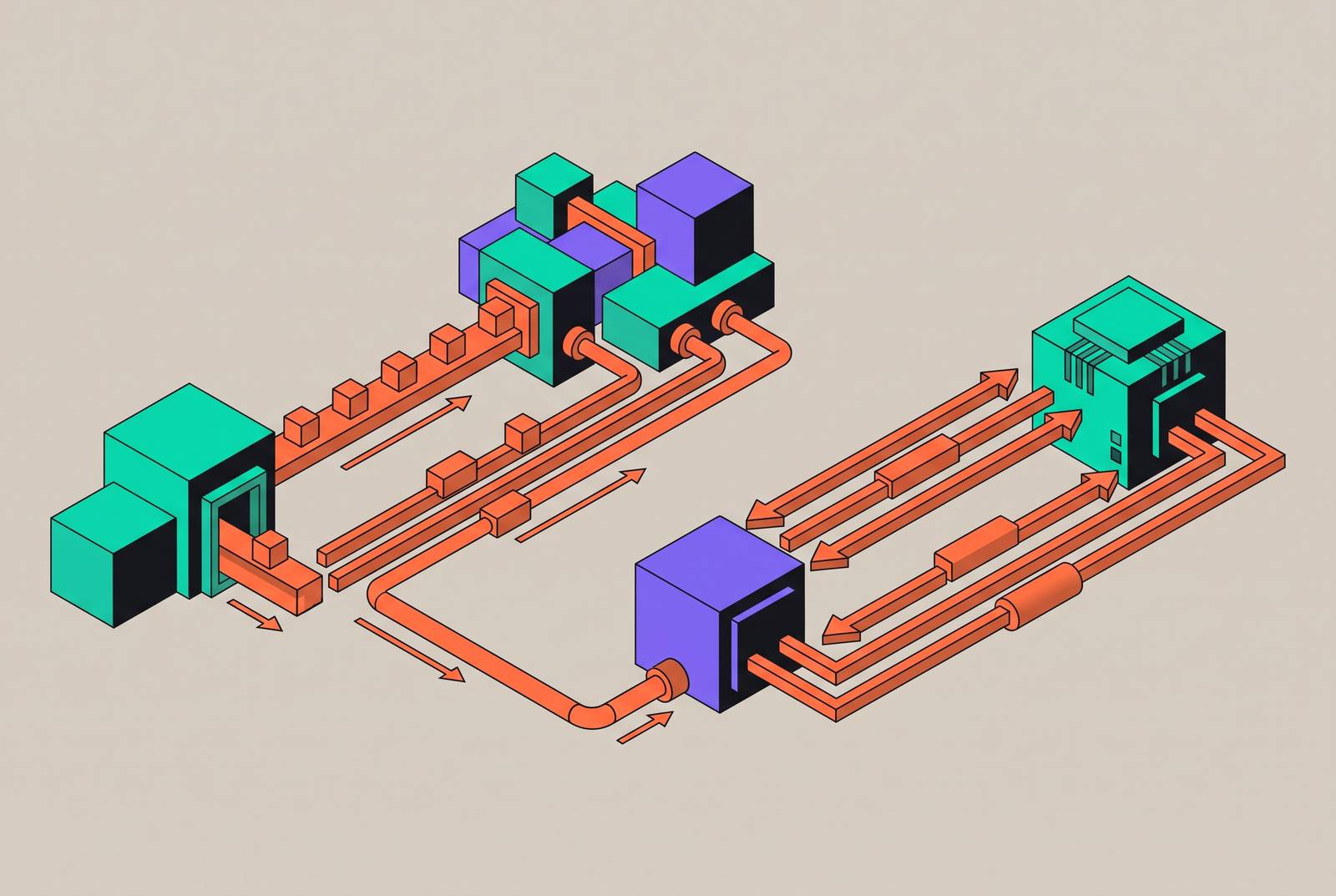
You decide when to ask, what to ask for, and how much to ask for, on your own schedule. You decide when to ask, what to ask for, and how much to ask for. The server just answers: request goes out, response comes back, caller does something with it. That's the entire transaction, and it's why an API is the wrong tool the moment you need to know about something the second it happens.
APIs are genuinely good at a handful of jobs:
- Fetching current state on demand, like checking a customer's account balance right now
- Creating or changing records, like charging a card or updating a shipping address
- Listing or searching, like pulling every order from the last 30 days
- Triggering computation, like generating a PDF invoice
- Running bulk operations across a pile of records at once
What an API cannot do, under any configuration, is tell you the moment something changes on the other end. It sits there. It waits for you to ask. If a payment fails and you want to know the instant it happens, an API alone leaves you guessing, since nothing about its design lets it announce anything unprompted.
So teams poll instead, and polling is where a lot of engineering hours quietly go to die. You ask the same question over and over, hoping to catch the change close to when it actually happened. That means building a scheduler, a checkpoint system to track what you've already seen, retry logic for failed requests, rate-limit coordination so the provider doesn't throttle you, and a reconciliation job to mop up whatever slipped through anyway. Polling isn't a workaround, it's a second system you now have to build, run, and maintain forever. That's the actual reason webhook support is worth celebrating whenever a provider bothers to offer it.
What webhooks do: the push model and the scenarios where it fits
Flipping the direction produces a webhook. The provider initiates. You register a URL, something happens on their end, and they fire an HTTP POST at your endpoint carrying a payload that describes the event. No request, no polling, no waiting around for the next check-in. The moment the event happens on their side, the POST lands on yours.
Calling a webhook a "reverse API" is decent shorthand, though it undersells the shift. With an API, you call the provider. With a webhook, the provider calls you, and that single reversal changes almost everything about how the receiving system has to be built, because now something on your end has to be awake and listening at all hours, including 3am on a Sunday.
Six scenarios make the case for webhooks without much argument needed:
- Payment state changes: a charge succeeds, fails, or a subscription lapses, and you need to know now, not after your next polling cycle
- CRM and lead capture: a form gets submitted, and a webhook creates the lead record in real time instead of waiting for a batch import
- CI/CD pipelines: a code push triggers a build via webhook, and a successful build triggers a deployment via another
- Authentication events: a login, or a suspicious one, fires a webhook straight into a security log or fraud detection system
- Inventory changes: stock updates in a warehouse system, and a webhook tells the storefront before the next page even loads
Every one of those is a state change on one side that something on the other side needs to know about immediately, not eventually. That's the half webhooks own, and no amount of clever polling logic replaces it.
Many SaaS APIs do not support webhooks natively. Everything else either falls back to polling or forces someone to bolt a homemade webhook layer onto an API that was never built to push anything. That gap is where a lot of the infrastructure spending covered later in this piece actually goes.
Side-by-side comparison of properties that determine which to use
Line the two up: the differences aren't cosmetic, they're structural. Treating them as interchangeable is where most integration bugs start, and it's the single most common mistake teams make when they design a new integration.
Initiation. APIs are client-driven: you decide to make the call. Webhooks are event-driven: the provider decides when something's worth telling you about, and you have no say in the timing.
Direction. APIs are two-way, request out, response back. Webhooks are one-way: the payload lands in your lap, and that's the entire interaction.
Timing. With an API, the clock is yours. With a webhook, the clock belongs to whenever the event happens on the provider's side, so your system needs to be ready around the clock, not just during business hours.
Server-side setup. An API needs an endpoint URL and valid credentials. A webhook needs you to host an endpoint yourself and register it with the provider. Your infrastructure now has to stay reachable at all times.
Failure handling. If an API call fails, the client retries on its own terms. If a webhook delivery fails, the provider retries, and how generous that schedule is depends entirely on them, not you.
Authentication. APIs typically lean on bearer tokens or mTLS. Webhooks usually rely on HMAC signing baked into the request header, since there's no login flow happening on an inbound POST.
Resource load. API polling repeatedly hits the same endpoint just to check for changes, and that cost compounds fast at scale. Webhooks skip all of it: nothing fires until there's actually something worth reporting.
Picking a favorite between the two misses the point. Need data, or need to take an action? Use an API. Need to react the instant something changes on someone else's system? Use a webhook. Need both in the same workflow, which is most of the time in production? Wire them together, because that's what every serious system already does, and any team still arguing over "which one is better" hasn't shipped anything real yet.
How production systems wire APIs and webhooks together
Real systems don't pick a side. Any team that tries to run on webhooks alone, or APIs alone, is signing up for a rebuild later. Webhooks carry the change-driven events. APIs handle the reads, the mutations, and the backfills. The two mechanisms exist specifically to cover each other's blind spots.
Take usage-based billing. A metering layer tracks how much of the API a customer is burning through. Once usage crosses a billing threshold, the metering platform fires a webhook at the billing platform with the usage data attached. The billing platform creates the invoice line item, either through an API call or its own internal logic, and the customer sees the charge on the next bill. Three components, two mechanisms, and dropping either one leaves the workflow unfinished. The webhook carries the news. The API does the work.
CRM-to-product sync runs on the same logic, though the failure mode looks different. A deal closes in a tool like HubSpot, a webhook fires, and the product reflects the change in near real time. But webhooks get missed sometimes, or arrive late, so a low-frequency API poll runs quietly in the background to catch whatever slipped through the cracks. Webhook for speed, polling for the safety net, both running at once rather than one standing in for the other.
Authentication events follow the same split inside a single user session. Someone logs in, a webhook fires off to a security log and to the product's own customer record, and later, when the session needs current-state data, an API call goes and fetches the enriched user record. The webhook captures that something happened. The API goes and gets the details.
Keeping customer data, auth events, and billing data in one unified backend, instead of scattered across three disconnected services, makes all of this wiring dramatically simpler. Fewer systems means fewer synchronization gaps somebody has to patch at 2am.
What webhook delivery requires to work reliably in production
Delivery isn't guaranteed, full stop. Nobody promises the payload arrives, arrives exactly once, or arrives on time. Reliability has to be engineered in on purpose. It does not happen by default, and any team that assumes otherwise finds out the hard way, usually during a billing run.
Respond fast, then do the real work later. Acknowledge the webhook with a 2xx response within a few seconds. Running heavy processing inline before responding causes the provider's request to time out, retry, and process the same event twice. Acknowledge first, chew on the payload after.
Build handlers that can survive being called twice. Providers retry on failure, which causes the same event to appear more than once at your endpoint no matter how careful anyone is. Check the event's unique ID against previously handled events before doing anything else. Skipping that check turns a routine network hiccup into a duplicate charge or a corrupted record nobody notices until a customer complains.
Respect the retry signal instead of fighting it. Return a clear 5xx when processing fails, since that's what tells the provider to try again. Retry schedules vary provider to provider but generally follow exponential backoff spread across hours or days. Some of the more mature platforms now ship built-in exponential backoff and retry handling as standard features. Idempotency on the receiving end is still non-negotiable regardless of how good the provider's retry logic is.
Plan for failure like it's already scheduled to happen, because eventually it will. Servers go down. Queue event logs asynchronously so nothing gets lost while the system is unreachable, and pair high-frequency webhooks with a low-frequency polling job as a reconciliation backstop. One common pattern swaps 30-second polling for webhooks to get the speed, then runs hourly reconciliation to catch what falls through. That combination cuts compute costs while actually improving freshness, a rare trade where both sides win.
If a product is the one sending webhooks out, show the work. Give customers a dashboard that shows what got delivered, what failed, and why it failed. Skipping this causes support tickets to pile up fast, since nothing frustrates an integration partner more than a webhook that vanished into the void with zero explanation attached.
The CNCF's CloudEvents spec has become something close to a standard envelope for webhook payloads, with required fields like id, source, and type, plus an optional time field. Adopting it doesn't fix reliability by itself, but it makes payloads interoperable with the broader event-processing tooling that already expects that exact shape.
Webhook security: the attack surface most SaaS teams overlook
Security teams tend to treat the job as finished once SSO and MFA are in place. That assumption is wrong, and it's an expensive one. Webhooks quietly build an entire automated data pipeline that runs completely outside those controls (per Obsidian Security), and most teams have no idea the pipeline even exists.
Webhooks are a different animal from the rest of the identity stack, and treating them the same way is the mistake. They run as non-human identities, so there's no user login attached to any of it. The bearer tokens and API keys that authenticate them function like master keys: whoever holds one gets the full run of whatever that webhook can touch. Worse, they're usually set up once by an admin and then forgotten completely, running silently for months while carrying customer data, financial records, and login events without anyone checking back in.
The visibility numbers make the blind spot concrete. Obsidian's network data shows the average enterprise runs 47 active webhook endpoints across its SaaS stack, and security teams can only account for 23% of them in their own integration inventories. The other three quarters sit in the dark, and dark corners are exactly where an attacker prefers to set up shop.
Traditional security tooling wasn't built to catch any of this, and pretending otherwise is how breaches happen. Firewalls generally can't see inside encrypted HTTPS traffic headed to a domain that looks legitimate. CASBs running in inline or forward-proxy mode can inspect webhook payloads, but only after decrypting the TLS traffic first, and API-mode CASBs inspect payloads after the fact without ever touching the encrypted channel. Both approaches depend on configuration steps a lot of enterprises never finish turning on. SIEM tools have no baseline for what "normal" webhook behavior even looks like. SSPMs capture webhook setup as a static snapshot frozen at one moment, missing the behavioral drift that happens as integrations evolve over months.
The scarier part is lateral movement. A compromised webhook endpoint can let an attacker hop from one breached vendor straight into multiple customer environments at once, riding the same connected pipeline that was supposed to be moving legitimate data.
None of this is unfixable, but fixing it takes deliberate work, not a checkbox exercise:
- Verify the HMAC signature on every payload before touching it. Providers sign payloads with a shared secret, and skipping verification means anyone who can reach the endpoint can forge an event.
- Reject anything with a timestamp more than a few minutes old, which shuts down replay attacks where someone resends a request they captured earlier.
- Rotate signing keys on a schedule, so ephemeral keys shrink the blast radius the moment one leaks.
- Monitor behavior continuously, since webhooks are living connections that shift as integrations change, not something anyone audits once and walks away from.
The infrastructure tools that handle webhook complexity in 2026
Webhook infrastructure splits into two jobs that don't resemble each other. One is receiving events from other people's APIs. The other is sending your own events out to your customers. Different problem, different tool; conflating the two is how teams end up building the wrong thing.
Your product has to accept events from a pile of external providers, and every one of them has its own rules for subscribing, verifying, and delivering. HubSpot configures webhook subscriptions at the app level. Google Calendar's push-notification channels expire after seven days and need renewal on a schedule, or they just stop firing without telling anyone. Salesforce's core REST API doesn't even expose a generic record-change webhook, so teams lean on Change Data Capture, Platform Events, or outbound messaging instead. Every incoming event also has to get mapped to the right customer connection, and in most homemade setups, that routing logic gets dumped on whichever engineering team happens to own the integration that week.
Sending runs the other direction. A product generates an event and has to deliver it to endpoints customers registered themselves. That delivery layer needs to fan out events, sign the requests, retry the failures, and log every attempt without exception. Customers generally expect a portal where they can register endpoints, manage signing secrets, check delivery attempts, and replay anything that failed.
Building either side from scratch in 2026 is the wrong call, and tools already exist to prove it. For inbound webhook management, Nango positions itself around receiving third-party API webhooks, with provider-specific subscription handling, verification, connection attribution, and a polling fallback across a catalog reported at 900+ APIs (per a dev.to source) or 1,000+ APIs (per nango.dev), depending on the source. The structural problem underneath it is that a rules engine also manages OAuth flows, token refresh, rate-limit handling, and tenant isolation; that management is what frees developers to write the actual integration logic in TypeScript instead of babysitting the plumbing. Hookdeck, on the other end, focuses on outbound, high-throughput delivery, fanning events out reliably at scale.
The subscription quirks, the expiring channels, the missing native support, the retry logic, the signature verification: none of it is exotic anymore. That work has already been solved by tools built for exactly this job. Rebuilding it from scratch doesn't earn anyone a medal, it earns them a maintenance burden they didn't need to take on.